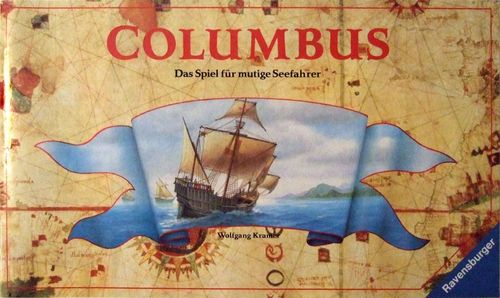
Columbus
Columbus Rulebook
Table of Contents
Table of Contents
Components
- 1 Gameboard (a large reproduction of the sea chart by Juan of Cosa is printed on the back of the game board)
- 54 Water tiles
- 5 Whale tiles
- 12 Route of Columbus tiles
- 11 Letter tiles
- 8 Port tiles
- 7 Ships in Full Sail tiles
- 7 Ships in Calm Seas tiles
- 4 Shipwreck tiles
- 4 Joker tiles (with C. Columbus)
- 12 Hurricane tiles
- 6 Tile stands
- 6 Sailing ships (Caravels)
- 3 Rules summary cards
The Goal of the Game
The goal of the game is to sail the Atlantic with a Caravel, then, after landing in the Americas, be the first to return to your home port.
The red line on the board shows the route followed by Christopher Columbus. The numbers indicate his daily progress.
Caravel: small trading vessel approximately 16 meters long, displacing 60 tons of water, and manned by a crew of approximately 30 men.
Preparation
- Detach all the tiles from the frames and place them face down in the box lid. Mix the tiles well.
- Each player takes 10 tiles and places them on his tile stand. Be careful not to let the other captains see your tiles!
- Each player chooses a ship and places it on a port space on the right edge of the board. Each port space may hold only one ship. The prow of the ship is turned towards America.
- The three rules summaries are placed within reach of all players.
The Game Turn
The game board shows the sea between Europe on the right and America on the left. The captains try to create a path by placing tiles on the map. The ships can move only on the tiles. It is not important which player placed the tile.
The youngest player starts, and play continues clockwise.
In his turn, a player carries out the following actions in order:
- Place tiles
- Sail
- Draw new tiles until he has 10 on his tile stand. (If the player forgets to draw his tiles immediately, he may draw them later.)
As captains are curious by nature, you should arrange your tiles as shown in the illustration, and conceal them from unfriendly eyes.
Example of a Game Turn (The red player starts)
- Place tiles: 1. Water tile; 2. Water tile; 3. Shipwreck tile, to block the other Captain's ship (the other Captain must, in his next turn, move to the next free port along the coast).
- Sail: Since he starts at a port, the red player may advance up to 3 spaces. In this case, however, he can only move 2 spaces.
- Draw new tiles: The red player draws 3 face down tiles from the box lid.
Placing Tiles
When placing tiles on the board, the following rules must be observed: Each player must place 3 tiles in his turn, or 2 tiles if there are 5 or 6 players. It does not matter where the tiles are placed. The tiles can be placed for future navigation, in an area far away from all the ships, or to create obstacles for the other captains by placing tiles in front of their ships. The tiles must be placed.
Where each tile type may be placed:
- Ship in full sail: On all spaces with the same illustration, and on spaces without illustrations (water spaces).
- Letter, islands, coastal area, whales, Columbus's route tiles: Only on spaces with the same illustration on the board.
- Water: On all spaces without an illustration.
- Joker (Christopher Columbus): On all spaces EXCEPT the sinking ship. The joker replaces the illustration in the space.
- Ship in calm seas: On all spaces with the same illustration, and on all spaces without illustrations (water spaces).
- Sinking ship: Only on water spaces.
Note: the placement list above names this tile "sinking ship"; the component list and the rules on sailing call it "shipwreck". It is the same tile.
The Hurricane
When a hurricane is played, it is placed next to the game board. The player playing the hurricane may then move an unoccupied tile to another space on the board. He may move unfavorable tiles (shipwreck, ship in calm seas) farther from his ship, or he may move favorable tiles (ship with full sails, water, whale, joker) closer to his ship. A hurricane tile may be played only once, after which it is placed in the box, out of play.
Example: A shipwreck is in front of a player's ship. He places a hurricane from his tile stand next to the board and moves the shipwreck in front of the boat of the player in the lead.
The Joker (Christopher Columbus)
The joker may replace any tile (including a port on the American coast), EXCEPT the shipwreck.
A joker already placed may be exchanged for the tile which it replaces. It may then be immediately re-used, in which case it counts as a played tile.
It may also be exchanged and retained on the player's tile stand, in which case it does not count as a played tile.
A joker may also be used as a hurricane tile. In this case it is placed beside the board, like a hurricane tile, and the player may move a tile on the board. A joker used as a hurricane is placed back in the box, out of play.
Sailing
The distance which a ship can move depends on the space it occupies at the beginning of its move:
| Starting tile | Distance |
|---|---|
| Ship with Full Sails | 4 spaces |
| Route of Columbus, Islands, Letter, Whale, Start and Goal Ports | 3 spaces |
| Water | 2 spaces |
| Joker (Christopher Columbus) | 2 spaces |
| Ship in Calm Seas | 1 space |
| Shipwreck | 0 spaces |
Ship in Calm Seas
A boat which reaches a space containing a "ship in calm seas" must stop, and loses all remaining unused movement. The boat will be able to move out of the space on the player's next turn. A boat which starts in a space containing a "ship in calm seas" may move only one space on its turn.
Shipwreck
An absolute obstacle! You may neither enter nor pass over a space containing a "shipwreck." A "shipwreck" is thus particularly useful when you wish to block the advance of another captain's ship.
Rules on Sailing
- Each space may be occupied by only one ship. You may, however, move through spaces containing other ships (the spaces count normally). Each player may sail in the direction he chooses.
- Each player may use all, some or none of the movement he is allowed, as he chooses. A player may remain in place and only place tiles. A ship may even sail backwards.
- At the beginning of the game, a ship may sail from starting port to starting port, counting each port as a space. The ship's initial port remains the port in which it started the game, however.
- The ship in last position may move one space more than usually allowed by the tile at that ship's starting location. If several ships are tied for last place, no one gets the extra movement.
Total Blocked Ships
A captain whose ship is completely blocked, announces "blocked" and passes his turn. He must still, however, continue to place tiles and to draw replacements. He may thus be able to break the blockade. If not, the unfortunate captain may, after having missed three turns, move the tile of his choice, just as if he had played a hurricane. He then takes his turn normally.
To indicate the number of turns he has passed, the captain places one of the tiles in his tile stand face down on the table for every turn he passes.
Important note: Captains who don't have coastal tiles may always arrive in the New World at the port in Florida.
Deals
Arrangements and alliances between the players are permitted, as long as they are not contrary to the spirit of play. For example, you should not block a player arbitrarily, but rather the player in the lead.
Landing in America
On Friday October 12, 1492, Christopher Columbus, after 34 days at sea (from the Canaries) landed in what is now The Bahamas. He was convinced that he had found and traveled a sea route towards China and Asia.
If a player reaches one of the ports on the American coast (any remaining movement is lost), he turns his ship around and, on his next turn, may start sailing back to his home port.
The following rules modifications now take effect immediately, and for all players:
- Players may place between 1 and 3 tiles in their turn (even if there are more than 4 players).
- The tiles showing a ship ("ship with full sails", "ship in calm seas" and "shipwreck") may be placed on an already placed tile. There can be, at most, two tiles in a single space, however. You may not place a tile in a space containing another ship or a joker.
- The turn order "place tiles, sail" need not be followed. A captain may now sail before he places tiles, if desired. He may even sail between placing tiles (i.e. place tiles, sail, place again).
End of the Game
On March 14, 1493, after approximately 8 months, Christopher Columbus returned to Palos, his port of departure.
If all the tiles are used, players no longer draw tiles to fill up their tile stands.
If a player runs out of tiles, he may only sail.
The player who (to the applause of the assembled crowd) first returns to his home port wins the race and the game. The other captains continue the race to establish a finishing order.
Only one ship can enter each home port, so there may still be fierce competition on the seas…