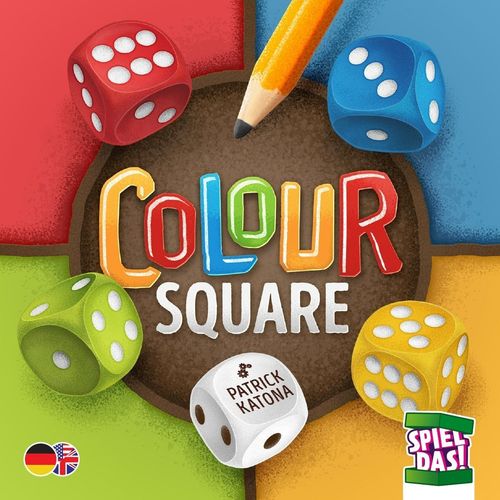
Colour Square
Colour Square Rulebook
Table of Contents
Table of Contents
Game Rule "Standard" (Side A)
Aim
Occupy as many SQUARES as you can - these are the square number fields with the number of points in the middle! To do this enter the dice roll results in the four coloured corners of the SQUARES after each round.
The sum of all four dice roll results must be equal to the number in the center of the SQUARES - you will receive this value as plus points.
In addition, the Scoring provides further bonus points and minus points.
Note: Only the player who fills in a SQUARE correctly first secures the points! After that, the SQUARE is blocked for everyone. Our tip: Focus on just a few SQUARES at a time.
Visit www.spiel-das.de for more variants and demanding tasks.
Preparation
All players get a game sheet from the pad and take a pencil. Pay attention that everyone uses the same side A of the game sheet! Then roll the dice. Whoever has the highest number gets to decide who starts the game.
Playing the Game
During the game as described in these rules, there are active and passive players. When you start the game, you are the first active player and roll all five dice exactly once. Now you have to choose two of the four coloured dice and write the numbers in two coloured corners. The colours of the dice and the corner must be the same colour.
You can write the results of the dice rolls in two corners of one SQUARE or divide them between different SQUARES. Active players ignore the white dice.
At the same time, all passive players must enter the number of the white dice in any corner of a SQUARE. The colour does not matter.
Corrections, i.e. the replacement of numbers that have already been written down are allowed until the next dice roll.
NOTE: The results of the dice rolls may only be entered in empty corners.
Then you continue playing clockwise and the next person becomes "active". Several rounds are played until the End of the game.
Check with the Other Players
Your own game sheet must not be covered! It is expressly allowed and desired to check with the other players in which SQUARES they enter the results of their dice rolls.
Close a SQUARE
A SQUARE is closed when all four coloured corners contain the result of a dice roll. Then call out loud "SQUARE" and name the coordinates (for example B2).
There are now two possibilities: The sum of the dice roll results in the corners corresponds to the number in the center or it does not correspond to the number in the center of the SQUARE.
- If the sum does NOT correspond to the number in the SQUARE, then you shade the white circle in the center with your pencil. For each of these SQUARES 10 points will be deducted in the Scoring. Note: All other players can still fill in numbers in this SQUARE.
- If the total corresponds exactly to the number of the SQUARE, you circle the number. This number counts as plus points in the Scoring.
- All other players mark this SQUARE with an X. They do not get any minus points for this, but they are not allowed to enter any more dice roll results in the corners of this SQUARE.
Exception for the other players: You may still write the result of this dice roll in the corners of the same SQUARE that was closed in this round. If you also reach the exact sum in the middle of the SQUARE, you may also circle the number. If you do not reach a sum yet, mark the SQUARE with an X; otherwise nothing happens. If you reach the wrong sum, shade the white circle in the middle with your pencil.
After "SQUARE" is called - which tells all players what SQUARE has been closed - the game continues normally.
Build a Bridge
If you have closed SQUARES that also have the correct sums and they are next to or on top of each other? Then colour the small bridge between the two SQUARES with your pencil.
In the Scoring you get 5 bonus points for each bridge.
Exception purple SQUARES 4, 5 and 6: Each of these SQUARES gives a one-time extra bonus of 5 points. They must be closed with the correct sum and connected with at least one other SQUARE by at least one coloured bridge.
Exception orange SQUARES 20, 22 and 24 (only on side A): These three SQUARES cannot be connected to other SQUARES by bridges and no bonus points are awarded for them.
Using Jokers
The active player must use two coloured dice. The passive players must use the white dice.
If you do not want to use the dice, you may enter the dice roll result in one of the two Joker fields at the very bottom in the middle of the scoreboard. The active player can choose one or two coloured dice, the passive players can enter the white dice.
Note: These points count as minus points in the Scoring. If both Joker fields are filled in, all future dice roll results must be entered again in the corners of the SQUARES.
End of the Game
If, towards the end of the game, the person actively playing can use only one of the coloured dice, only this number must be entered in a corner - all other coloured dice do not count. The first player that closes all SQUARES on the game sheet, calls out "COLOUR SQUARE".
Now all the other players roll all the dice once more - if they still have free corners. As before, coloured and white dice roll results must be entered. Jokers can be used, but this is not obligatory. If there are completed SQUARES, then proceed as described in Close a SQUARE.
After this final round check your game sheet. Are there still missing dice roll results in SQUARES that have not yet been closed? Then you shade the white circle in the middle with your pencil. Also check your bridges (Build a Bridge).
Covered variant: If you want, you can also play with a covered game sheet. Then call out "SQUARE" loudly, when all players have finished entering all their dice roll results. Corrections are then no longer allowed.
Scoring
Then the points are added up as follows:
Plus points
- Each circled number of a SQUARE are plus points. Add all numbers of a row together and enter the result on the far right in the box with the green check mark. Repeat this for each row. Then add up these four fields and enter the total in the first field (1) of the scoreboard.
- Count the coloured bridges and multiply them by 5. Enter the result in the second field (2).
- Have you circled the numbers 4, 5 and/or 6 and are they situated next to a coloured bridge? Then you get 5 extra points for each SQUARE, to which this applies. Enter them in the third box (3).
Minus points
- Count the SQUARES that are shaded and multiply them by 10. Write the result in box 4.
- Add the numbers you wrote in the two Joker fields. Enter the result in field 5.
If you now add the plus points and subtract the minus points, you will get your final result. The player with the most points wins COLOUR SQUARE.
Game Rule "Advanced" (Side B)
All players get a game sheet from the pad. Make sure that everyone uses the same side B! The rules are identical to "Standard" - with the following exceptions.
Predefined Dice Roll Results
Some coloured corner fields show dice roll results in white letters. In these the exact result of the dice in this color (for example, a red or white 6 in A1) has to be entered. The respective SQUARE cannot be closed otherwise.
Number Ranges
There are new SQUARES with gray number areas in their center. Here the sum of the dice roll results in the coloured corners does not have to provide an exact result, but the sum has to be within the given number range (e.g. greater than or equal to 16 on A1, between 10 and 14 on D1).
- If the sum of the dice roll results in the corners is NOT in the given number range, then you shade the white circle in the middle with your pencil. For each of these SQUARES 10 points will be deducted in the Scoring. The SQUARE may be filled in by everyone else.
- If the sum is within the given range, enter the sum in the middle of the SQUARE. You circle the number and tell the other players the coordinates (for example A3 or C4). The sum in the middle counts as plus points in the Scoring. Otherwise all rules of Close a SQUARE apply.
Game Rule "Task (Solo)" (Sides A + B)
Choose any task and try to solve it! Either alone in solo mode - or together with other players. In this case everyone plays for himself/herself and you roll the dice alternately. The dice rolls of the others are counted as your own dice rolls. You never have to enter an X in a SQUARE, the decisions of the other players have no influence on your game sheet.
Everyone must complete the task - the best result wins.
You may freely choose side A or B of the game sheet. All rules of "Standard" and "Advanced" apply; exceptions are listed directly in the rule of the respective task.
SCORING: The graphic next to the task shows you how well you did (levels: "You nearly made it", "Passed", "Very good!", and "Best possible result" / "That's it!"). The point or square thresholds printed under each task's graphic are listed below as printed, for side A and side B.
Scoring: By Points
Score as many points as possible in the final score. Roll all five dice in each round, and you must use exactly two of them.
Task 1: Snake (Easy)
Close as many SQUARES as possible in the drawn shape with the correct sum. You may enter dice roll results only in these SQUARES in any order. You can enter an X already in the SQUARES that you do not have to fill in.
Count your points at the end. Shaded SQUARES are not minus points.
- Side A, points: 115 / 140 / 166
- Side B, points: 140 / 170 / 196
Task 2: Progression (Medium)
Start in line 1 and close exactly any SQUARE with the correct sum. You may enter your dice roll results only in this line, but in all SQUARES. If you have closed a SQUARE correctly or if you have shaded all SQUARES you proceed to line 2, where you have to close any two SQUARES with the correct sum. If you succeeded or if there are no more corners free for dice roll results, you proceed to line 3. Here you have to close three and in line 4 all SQUARES must be closed correctly (the graphic is just an example).
If the change of a line takes place after you have entered the first result of the dice roll you may use the second dice for the next line.
Count your points at the end. Shaded SQUARES are minus points.
- Side A, points: 100 / 140 / 202
- Side B, points: 120 / 170 / 230
Task 3: Row by Row (Hard)
Start in row A and close exactly any SQUARE. If you have closed a SQUARE correctly or shaded one, proceed to row B. If you have also closed a SQUARE correctly or shaded one, go to row C and finally to row D. Then you start again in row A (the graphic is just an example). Follow the sequence from left to right, until all SQUARES are correctly closed or shaded.
You may always enter your dice roll results only in the row in which you are currently in; but here in all SQUARES. If the change of a row takes place after you have entered the first dice roll result, you may use the second dice for the next row. In this task you are not allowed to build bridges.
Count your points at the end. Shaded SQUARES are not minus points.
- Side A, points: 150 / 175 / 215
- Side B, points: 185 / 210 / 247
Scoring: By SQUARES
The more SQUARES you close with the correct sum, the better the result. In these tasks the Jokers work differently: Instead of a number, enter an X in one of the Joker fields to change the colour of any dice. The number of dice remains the same. This does not give any minus points.
Task 4: Connection (Easy)
Close as many SQUARES as possible in any two rows and any line; with the correct sum and in any order (the graphic is just an example). Dice roll results may only be entered in the SQUARES of the rows and the line you have chosen!
You have 10 dice rounds for this. One round consists of once rolling all 5 dice, of which you may use as many as you like. Before each roll of the dice, you have to draw a line in the result field at the bottom right to count the rounds.
At the end count the correctly closed SQUARES. Shaded SQUARES are not minus points.
- Side A, SQUARES: 7 / 9 / 10
- Side B, SQUARES: 8 / 9 / 10
Task 5: Sequence (Hard)
Try to close as many SQUARES as possible in the shown order from A1 to A4 with the correct sum. In each round, roll all five dice, of which you must use exactly two. Dice roll results can be entered at any time into any SQUARE.
If you close a SQUARE - either with the correct or incorrect sum - check the path between this and A1. All SQUARES in between, which are not yet closed, must be shaded.
At the end count the correctly closed SQUARES. Shaded SQUARES are not minus points.
- Side A, SQUARES: 10 / 13 / 16
- Side B, SQUARES: 12 / 14 / 16