Colorium
Colorium Rulebook
Table of Contents
Table of Contents
Game Overview
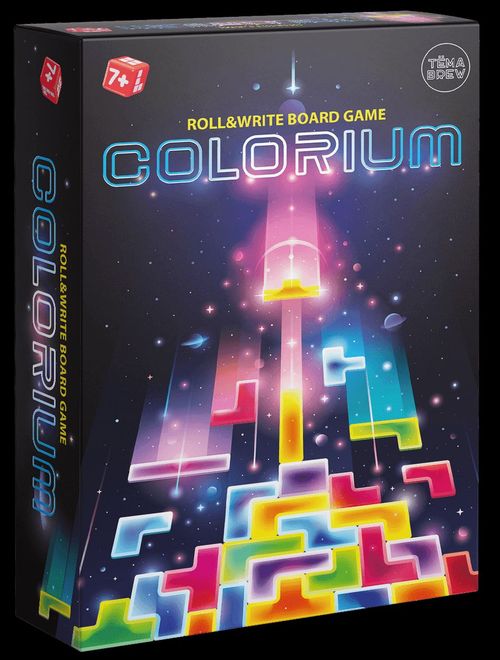
Each round during a game of Colorium, different shapes and colors will be emerging from the abyss, and the players will be trying to combine them and build them into their systems. You will draw colored pieces of polyomino on your board to gain the most victory points and become the guardian of the galactic balance.
Components
- 4 player boards
- 4 shape dice
- 4 color dice
- 6 dry erase markers (red, yellow, green, blue, purple, and orange)
- 16 mission cards (4 types, 4 cards each)
The Goal of the Game
Score the most victory points for drawing different colored shapes on your player board.
Setup
- Each player receives a player board.
- Place as many shape dice and as many color dice as there are players and all 6 markers in the middle of the table.
- Sort the mission cards into 4 piles by their types (shapes, areas, colors, and rows & columns).
- Draw a random mission card from each pile and place them in a row in the middle of the table. Those are the current missions for the game.
- Put all of the remaining mission cards back in the box, you won't need them.
How to Play
The youngest player becomes the first Active player and this role is passed clockwise at the beginning of each round.
Each round, the Active player rolls all dice that are in game (at the beginning, it's the number of players multiplied by 2). Then all players, starting from the Active one, take turns drafting 1 die from the common pool. It can be either a color die or a shape die — whichever they need most at the moment.
When the last player has made their choice, the round is continued in the counterclockwise direction starting with the last player (they take two dice in a row). At the end of the round, each player must have two dice.
Important! Each player must have a color die and a shape die by the end of the round. They may not have 2 dice of the same type.
As soon as each player has their 2 dice, they must proceed with drawing the corresponding shape on their player board.
Drawing Shapes
- Shapes cannot float in the air: each shape must stand with at least one of its spaces either on the bottom of the grid or on another shape drawn during the previous rounds.
- Imagine that shapes drop from the top. They may not get through other shapes or squeeze through the areas that are smaller than the shape itself.
- All shapes from the dice may be rotated 90 or 180 degrees and may be mirrored horizontally or vertically.
- Each player must draw their shape, even if they don't want to.
If a player is not able to draw their shape on their board, that is an immediate endgame for them and they should wait for all other players to finish. In this case, remove 1 shape die and 1 color die from the game. During all subsequent rounds, there will be 2 less dice to roll.
Thus, the players can end the game in different rounds. Try filling your boards as fully as possible.
Player Board
There are slots for marking all used shapes and colors at the top side of the boards. For an easier scoring, each player should mark the colors (in the square areas) and the shapes (in the rectangular areas above the corresponding shape icons) they used in the game.
When all players are done drawing and marking everything on their boards, the round is over and the next Active player begins the next round.
Bonuses
There are bonus icons above each player's grid. If you manage to fill any of the columns with any of the colors completely, you may resolve the bonus effect above that column starting from your next turn.
All bonus effects are single-use. If you have several active bonuses, you may use all of them during one round. For your convenience, we recommend circling all effects that become active and crossing those that have been used.
Bonus Types
- Color die – you may change the color of your drafted die to any other color after drafting both dice. Mark the color that was actually used.
- Shape die – you may change the shape of your drafted die to any other shape after drafting both dice. Mark the shape that was actually used.
- Scissors – you may draw any part of the shape from the die you drafted after "cutting" it once. For instance, the square shape can only be cut into two equal parts consisting of 2 spaces each.
- Wild Space – you may fill any one space on the board with any color.
Game End
The game ends when no one can draw a shape, with or without bonuses.
Scoring
Different Shapes and Colors
- If you managed to draw all 6 shapes on your board, gain 10 victory points. If there are 5 out of 6, gain 5 victory points.
- Gain 10 victory points for using all 6 colors. If there are 5 out of 6, gain 5 victory points.
Rows
To the right of the grid, there are victory points scored for the completed rows. If you are the first or the second to fill the first, third, fifth, or seventh row, you gain the corresponding number of victory points. The left (higher) number is for 1st place; the right (lower) number is for 2nd place. For the first row, there is only one reward — for the first player who completes it.
However, if several players complete the same row during the same round, all of them score the indicated number of victory points. All other players cross the victory points they cannot gain anymore.
Mission Cards
The 4 mission cards, revealed at the beginning of the game, score for everyone who completes them by the end of the game.
Tally up your points for all 4 missions, for shapes and colors at the top of your board, and for all completed rows you have. The player with the highest sum wins!
If there is a tie, the one who has less empty spaces in their grid wins. If there is still a tie, the player with the most points for the completed rows wins. Otherwise, the tied players share victory.
Missions
Rows & Columns
The players score points for each row and column that meets certain requirements.
- Each row and column completed with 2 different colors scores 2 victory points. There must be no empty spaces in that row or column, otherwise it is not scored. There are similar missions for rows and columns completed with 1, 3, or more colors.
- The player scores 5 victory points for each single-colored diagonal line consisting of more than 3 spaces. The same space may be a part of several diagonal lines. Example: the player has 2 green diagonal lines in the top right corner of their grid and they score 10 victory points.
Colors
The players score victory points for the colors they used in their grid.
- Each player scores 1 victory point for each set of 3 spaces of the same color (red, yellow or blue) in their grid. Each color is counted separately, the sum is divided by 3 (rounding down) and then all victory points are added up. Thus, the player with 4 red, 5 yellow, and 6 blue spaces scores 4 victory points.
- Count all blue spaces in your grid. Whoever has the most, scores 4 victory points, second place scores 1 victory point. If there is a tie, all tied players score the indicated number of victory points. All other players score nothing. The same happens with yellow and green then.
Shapes
The players score for the shapes they used in their grid.
- See who has the most shapes of the indicated types. Whoever has the most, scores 4 victory points for their type, while second places gain 1 victory point each. If there is a tie, all tied players score the indicated number of victory points. All other players score nothing.
- Gain 1 victory point for each shape from the mission that you used in your grid.
Areas
The players score for a single-colored area according to the mission.
- Find the largest continuous single-colored rectangle or square. Gain 1 victory point for each space in it. (Example: the player scores 6 victory points.)
- Find the largest continuous single-colored area in your grid. All spaces within it must have at least one common side. Add up its spaces and divide the sum by 2 (rounding down) — these are your victory points. Thus, for an area consisting of 13 purple spaces, you will score 6 victory points.