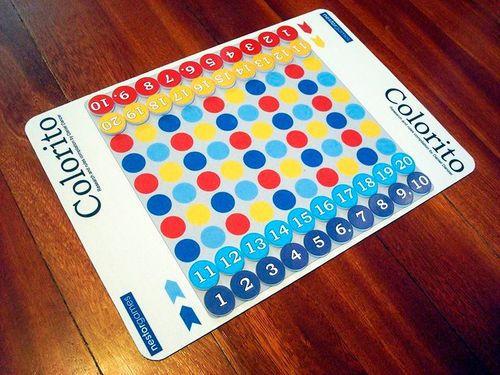
Colorito
Colorito Rulebook
Table of Contents
Table of Contents
Components
A "Colorito" set includes:
- A Colorito board (2 pads).
- 10 red pieces numbered 1 to 10.
- 10 yellow pieces numbered 11 to 20.
- 10 dark blue pieces numbered 1 to 10.
- 10 light blue pieces numbered 11 to 20.
Preparation
One player gets the dark blue 1 - 10 and the light blue 11 - 20 pieces, the other one the red 1 - 10 and the yellow 11 - 20 pieces.
The board is placed between the players, so that each player has the arrows of his colours on his side. The pieces are placed on the players first two rows according to the numbers: Thus red pieces start on blue numbers, and so on.
Object of the Game
Getting your pieces on the opposite side on the board (an overall diagonal move through the centre) onto the spaces with the same number as the piece. Who gets this done in less moves, wins. Same number of moves is considered a tie.
Gameplay
Players agree who starts the game. Turns are taken alternately. There are no captures.
On each turn, a player MUST move ONE of his pieces in one of the following ways:
-
STEP: The piece steps onto an adjacent space of the same colour as the piece or white (numbered). This can be done orthogonally or diagonally in any direction.
Note: Obviously, you cannot do a STEP solely on coloured spaces.
-
JUMP: The piece jumps over one adjacent piece of your own or your opponent's in a straight line, landing on a free space directly behind this piece. This can be repeated as often as possible, orthogonally or diagonally, as long as the last space landed upon is of the same colour as the piece or white (numbered).
-
STEP - JUMP: A combination of first a step and afterwards a jump.
Note: Here it is not mandatory to land on the according colour after the STEP, since the move has not yet ended.
The sample position shows a beginning midgame situation, blue's turn, with sample moves: Black: step. Purple: Jump. Green: Step-jump.
End of the Game
The game ends as soon as one player has got all his pieces on the target spaces with the same number and colour. If the starting player manages to do this first, the opponent has one more move to achieve a tie. The remaining moves needed by the loser to reach the objective of the game are his negative score.
Special situation: If the only target spaces of one player not yet occupied by his correct pieces, are occupied by pieces of his opponent, he also is declared winner
Variants
"Just Colours" (more easy and suitable for beginners to get into the game): Play the game according to the standard rules but totally ignore the numbers on the spaces or the pieces. Just get the pieces onto the row with the matching colour to win the game.
"Strict game" (heavier): Even in a "STEP - JUMP", pieces can do their STEP only, if they land on a space with their own colour or white - and start their JUMP from there.