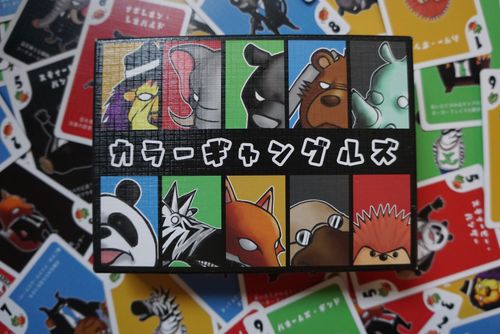
カラーギャングルズ (Color Gangsters)
カラーギャングルズ (Color Gangsters) Rulebook
Table of Contents
Table of Contents
Components
- 50 number cards: 5 colors (Blue, Red, Yellow, Green, Black), with one card each of the numbers 1 to 10 in every color. Each card shows its number and a diet icon in the corner: a meat icon (meat eater), a leaf icon (plant eater), or an icon showing both meat and leaves (omnivore). The color of each number card can be seen from its back.
- 6 color trump cards: one for each of the 5 colors, plus 1 "no trump" card. The background of the color trump card's front is light blue ("水色" sky). The back shows a "?".
- 11 number trump cards: one for each number from 1 to 10, plus 1 "no trump" card. The background of the number trump card's front is orange ("オレンジ色" sky). The back shows a "?".
- 16 territory tiles. Each tile shows an achievement difficulty (1 to 3 paw prints) and an achievement condition.
- 1 Winner tile: "1. Acquire territory" and "2. Update trump".
- 1 Loser tile: "Becomes the next lead player".
- 25 markers: 5 in each of the 5 colors.
Setup
Players, Markers and Number Cards
- Each player chooses a color and takes the 5 markers of that color.
- Use only the number cards of the colors chosen by the players. Return the number cards of unused colors to the box.
- Likewise, use only the color trump cards of the colors chosen by the players. Return the color trump cards of unused colors to the box.
Trump Cards
- Shuffle the color trump cards and place them face down as a draw pile.
- Shuffle the number trump cards separately from the color trump cards and place them face down as a draw pile.
- Turn over the top card of each pile, one color trump card and one number trump card. These are the trumps for the first round.
Territory Tiles
- Randomly choose 9 territory tiles. Return the rest to the box.
- Place them face up in a 3x3 grid, at random.
- If a difficulty 3 tile (three paw prints) is among the 9 tiles, swap it with the tile in the center of the grid.
- The full list of territory tiles is in the appendix, "Territory Tile List".
Dealing Number Cards
- Shuffle the number cards and deal 10 to each player.
- Hold your hand so that other players cannot see the number side of your cards. The color of each card is printed on its back, so other players can always see the color of your cards. Hold your hand spread out so that the colors are visible to the other players.
Draft (Card Exchange)
Before the draft, the trump cards must already be set up face up (one number trump card and one color trump card).
- Each player chooses 2 cards from their hand that they do not need, and places them face down in front of the player to their left.
- From the 2 cards passed to them by the player on their right, each player looks only at the color on the back of the cards, without looking at the number side. Each player adds one of the 2 cards to their hand.
- The card that is not taken is not used for the rest of the game. Gather these discarded cards together in one place, face down.
Tip: The first time you play, you may skip the draft. In that case, deal 9 number cards to each player instead of 10. Gather the leftover number cards (one per player) into a discard pile in one place.
Choosing the Lead Player
- The player who most recently spoke the most "gangster-like" words becomes the lead player, and plays the first card.
- If you cannot decide this way, use rock-paper-scissors or any other method to choose the lead player.
- The game now begins.
Game Flow
The game is played over up to 9 rounds. Each round consists of the following four steps:
- Card play
- Winner and loser determination
- Acquisition of territory tiles and trump update
- Check for end of game
1. Card Play
- Starting with the lead player and continuing clockwise, each player plays one card face up in front of them.
- Must follow (the rule is nicknamed "must follow" in the rulebook):
- The lead player may play any card.
- Every other player must play a card of the color the lead player played, if they have one in hand.
- Only if a player has no card of the lead player's color in hand may they play a card of any color they choose.
2. Winner and Loser Determination
- Once every player has played a card, compare the cards played by their color and number to determine one winner and one loser.
- Card strength is determined by number and color as follows. A is the strongest and the strength decreases alphabetically (A is strongest, F is weakest):
| Number / Color | Color shown on the color trump card | Color the lead player played | Any other color |
|---|---|---|---|
| Number shown on the number trump card | A (strongest) | B | C |
| Any other number | D | E | F (weakest) |
- Among cards with other numbers (D, E, F), the higher the number, the stronger the card.
- If the strength still cannot be decided (for example, two cards with the same number in different colors, both C or both F), the card played earlier is stronger.
- The strongest card's player is the winner, and the weakest card's player is the loser. The winner receives the Winner tile, and the loser receives the Loser tile.
Examples of Winner Determination
In these examples, the number trump card shows 7 and the color trump card shows Blue. Player 1 is the lead player.
Case 1: Player 1 plays Red 10, Player 2 plays Red 2, Player 3 plays Red 1, and Player 4 plays Red 6.
- Player 1 played Red 10. It is not a trump, so its strength is E.
- Player 2 played Red 2. It has the same color as the lead, so its strength is E.
- Player 3 played Red 1. It has the same color as the lead, so its strength is E.
- Player 4 played Red 6. It has the same color as the lead, so its strength is E.
- Since all cards have the same strength E, the number decides the strength. Player 1 is the winner and Player 4 is the loser.
Note (translator): The printed example text says "Player 1 is the winner and Player 4 is the loser." The Loser tile is shown under Player 3, and Red 1 is the lowest card in this trick, so the printed text is evidently a typo for Player 3. This transcription follows the card layout: Player 1 is the winner and Player 3 is the loser.
Case 2: Player 1 plays Red 10, Player 2 plays Red 2, Player 3 plays Yellow 2, and Player 4 plays Green 2.
- Players 1 and 2 are both strength E, as in Case 1. Player 1's number is higher, so Player 1 is stronger.
- Player 3 does not have Red and played Yellow 2. It is not the trump color, and not the lead color, so its strength is F.
- Player 4 does not have Red and played Green 2. Similarly, its strength is F.
- Players 3 and 4 are both strength F. Player 3 played first, so Player 3 is stronger.
- Player 1 is the winner and Player 4 is the loser.
Case 3: Player 1 plays Red 10, Player 2 plays Red 2, Player 3 plays Blue 2, and Player 4 plays Green 7.
- Players 1 and 2 are strength E, as in Case 1.
- Player 3 does not have Red and played Blue 2. Blue is the trump color, so its strength is D.
- Player 4 does not have Red and played Green 7. The number 7 is the trump number, so its strength is C.
- Player 4 is the winner, because a trump number is always stronger than a card that is not a trump number. Player 2 is the loser, because 2 is lower than 10 among the strength E cards.
3. Acquisition of Territory Tiles and Trump Update
[1] Acquiring a territory tile
- The winner looks at the cards played in the trick and places one marker on one of the territory tiles whose condition is met by this trick.
- If the trick meets the conditions of several tiles, the winner may place a marker on only one of them.
- A marker may be placed on a territory tile that already has markers of other players. Leave those markers where they are; they are not removed.
- A marker may not be placed on a territory tile that already has a marker of your own color.
- When a marker is placed, it must go on a territory tile whose condition is met. A marker cannot be placed if you have no markers left in hand, or if no territory tile's condition is met by the trick.
[2] Updating a trump card
-
The winner may update either one number trump card or one color trump card. This is optional.
-
To update a trump card, turn over the top card of that trump card's draw pile and place it face up on top of the current trump card.
-
If a draw pile is already empty, that trump card can no longer be updated.
-
Once this is done, gather the cards played in this round together into one discard pile.
4. Check for End of Game
- If the end-of-game condition below is not met, the game continues to the next round.
- The loser becomes the lead player for the next round.
End of Game and Winner
The game ends immediately when either of the following conditions is met:
- Three in a row: A player acquires three territory tiles in a line (horizontal, vertical or diagonal). That player wins immediately.
- After 9 rounds: When all rounds have been played and no cards remain in hand, the player whose acquired territory tiles show the greatest total number of paw prints wins.
- If players are tied on total paw prints, the player with the most markers on territory tiles wins.
- If players are still tied, the game is a draw.
Territory Tile List
The set contains 16 territory tiles. Each tile shows an achievement difficulty and an achievement condition. The conditions are listed below, grouped by difficulty.
Difficulty 1 (1 paw print)
| Condition | Details |
|---|---|
| My card is odd | The number on the card I played is odd. |
| My card is even | The number on the card I played is even. |
| My card is 1-5 | The number on the card I played is 1 to 5. |
| My card is 7-9 | The number on the card I played is 7 to 9. |
| My card is a meat eater | The card I played has the meat icon or the omnivore icon. |
| My card is a plant eater | The card I played has the leaf icon or the omnivore icon. |
| My card's color matches my markers | The color of the card I played is the same as the color of my markers. |
| My card is not a trump | The card I played is not a trump card (neither its color nor its number is a trump). |
Difficulty 2 (2 paw prints)
| Condition | Details |
|---|---|
| All cards are meat eaters | Every player's card in the trick has the meat icon or the omnivore icon. |
| All cards are plant eaters | Every player's card in the trick has the leaf icon or the omnivore icon. |
| All cards are the same color | All cards played in the trick are the same color. |
| The total of all cards is odd | The total of the numbers on all cards played in the trick is odd. |
| The total of all cards is even | The total of the numbers on all cards played in the trick is even. |
| Won 2 rounds in a row | A player who won the Winner tile in the previous round wins again. |
Difficulty 3 (3 paw prints)
| Condition | Details |
|---|---|
| The difference between the largest and smallest card is exactly 5 | The difference between the largest and smallest numbers among the cards played by all players is exactly 5. |
Blank Tile
- Blank tile: Write your own victory condition and play with it.