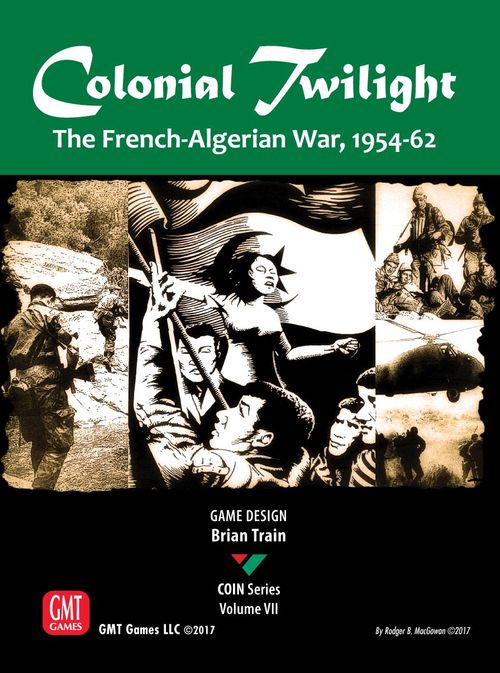
Colonial Twilight: The French-Algerian War, 1954-62
Colonial Twilight Rulebook
Table of Contents
Table of Contents
1.0 Introduction
Colonial Twilight: Algeria 1954-62 is a 2-player board game depicting the conflict in Algeria in its last eight years as a department of France before it became an independent nation. Each player takes the role of an agency seeking to set the fate of Algeria: the French government and the insurgent anti-government forces (mainly these consist of the armed elements of the Front de Liberation Nationale, (FLN) but also including other movements). Using military, political, and economic actions and exploiting various events, players build and maneuver forces to influence or control the population or otherwise achieve their aims. A deck of cards regulates events, victory checks, and other processes. The rules can run a FLN non-player faction, enabling a solitaire game (or one player can take both factions). This game is Volume 7 in the COIN Series of games that use similar rules to cover modern insurgencies. The Designer's Notes in the Playbook lists major rules differences from earlier volumes.
1.1 General Course of Play
Unlike many card-assisted war games, this game does not use hands of cards. Instead, cards are played from the deck one at time. Each Event card contains text that may alter or suspend certain rules of the game, or demand execution of a particular task. Propaganda cards mixed in with the Event cards provide periodic opportunities for instant wins and for activities such as collecting resources and influencing popular sympathies.
1.2 Components
A complete set of game components includes:
- A 22"x34" mounted game board (1.3).
- A deck of 71 cards (5.0).
- 91 blue, black, and green wooden playing pieces, some embossed (1.4; see "Forces Pool" on the Spaces List sheet for a complete listing). Some extra blocks have been added to replace any defective blocks.
- Six black, six white pawns (3.1.1).
- Four embossed cylinders (1.8, 2.3). Edge Track
City
Sector Border
International Border
Support and Opposition marker holding box
Control marker holding box
Population Value
- One sheet of markers.
- One Sequence of Play and Spaces List sheet (1.4.1, 2.0, 6.0).
- Two Player Aid foldouts (3.0, 4.0, 7.0).
- One non-player faction play aid card (8.0).
- Two six-sided dice.
- One background playbook.
- This rule book.
1.3 The Map
The map shows Algeria and nearby areas divided into various types of spaces.
1.3.1 Map Spaces. Map spaces include Sectors, Cities and Countries. All spaces can hold forces.
1.3.2 Wilayas and Sectors. The map is divided into named and numbered areas that correspond roughly with the Wilaya or zone system used by the FLN command structure, with each Wilaya (Roman numeral) divided into a number of mintaka or Sectors (Arabic numerals, so V-1 is the first Sector in Wilaya 5). If you find the numbering system cumbersome, each Sector is also marked with the name of a major town located inside it. Each Sector shows a Population Value (Pop) of 0, 1, or 2 that affects victory via Support for or Opposition to the French government (1.6) or Control (1.7) and some FLN actions. Sectors are further distinguished as Mountain or Plain, affecting player operations and certain Events (5.0). During play, the Government player gains the ability to change the Population Value of some spaces through Resettlement, turning them from Population 1 to Population 0 (place a "Pop 0" marker to denote this). (4.2.1)
1.3.3 Cities. Cities show Population Values of 2 or 3. Cities are spaces in their own right, and are also considered to be part of the Wilaya they are located in, for purposes of FLN March (3.3.2) or Redeploy (6.4.2). Note that Oran and Algiers are Cities contained entirely within a Sector, but Constantine is a City that is adjacent to two Sectors. During play, Cities may increase by up to 1 Population Value (place a "Pop +1" marker to denote this).
Sector Name
Wilaya Border Sector Border
Mountain Sector
Plains Sector
DESIGN NOTE: Each Population Value point represents about 300,000 human beings.
1.3.4 Countries: Morocco and Tunisia. These two Countries were part of the French empire at the beginning of the Algerian conflict but became independent. During the game, on play of a Pivotal Event card (5.1.8), both of these Countries will become sanctuaries for the FLN player's pieces, and the Government player may begin to fortify the borders of Algeria to prevent infiltration from them. Only FLN pieces may be in these Countries, but FLN may not enter these Countries until they become independent. These Countries are treated as Mountain Sectors with a Population Value of 1: the FLN may Rally, March and Extort in these Countries, but their Population is never counted in the total Opposition (1.6.2). During play, these Countries may acquire the ability to contain three Bases (1.4.2), shown by "Base" markers placed in their spaces.
1.3.5 Adjacency. Adjacency affects the movement of forces and implementation of certain Events. Any two spaces that share a land border are considered adjacent.
EXAMPLES: The sector of Philippeville (II-2) is adjacent to Constantine, Setif (II-1), Barika (I-1), Oum el Bouaghi (1-4) and Souk Ahras (II-3). Constantine is adjacent only to Setif (II-1) and Philippeville (II-2).
1.3.6 Coasts. Any spaces adjacent to blue water are "coastal". Algiers and Oran are coastal spaces, as are Morocco and Tunisia. Water is not land, so coastal spaces that do not share a land border are not adjacent.
1.3.7 Border Sectors. There are seven Sectors that are partly bounded by an international border (three border on Morocco, and four border on Tunisia). In the Full Scenario, they are not considered Border Sectors until Morocco and Tunisia have become independent and the Border Zone activated, by play of a Pivotal Event Card (5.1.8). As the international border is progressively fortified, the Border Zone Status rises (3.2.1, 5.1.8). FLN Guerrillas will find it more difficult to March into Border Sectors undetected (3.3.2) and will lose some Resources in the Resources and Commitment Adjustment Phase of Propaganda Rounds (6.2.2). Also, Police in Border Sectors count as Troops in Assaults (3.2.4).
1.3.8 Other Map Features. There are tracks and boxes on the map that record various game parameters or store game pieces: Edge Track. This track runs along the top of the game board, from 0 to 50. It records the amount of Resources the players have (1.8), their current Victory Levels (1.9), the Government Commitment Level (1.8) and the number of Resettled Sectors (4.2.1). France Track. Technically France is where the Government player's Available Forces box is located, and legally Algeria is a department of France, but for game purposes this track is an abstract representation of the ability of the FLN to obtain material from sympathetic organizations and expatriate Algerians, and to affect French public opinion on the war (and therefore the government's commitment to continuing the war). Border Zone Track. When Morocco and Tunisia gain their independence from France (5.1.8), this track is activated to show a status of "0" (zero). During the game the Government player may expend Resources to improve the Border Zone Status so as to inhibit infiltration from these two FLN safe havens (3.3.2). Initiative Track. This diagram is divided into boxes to guide the players' choices during the Sequence of Play (2.3) and keep track of player eligibility. Available Forces boxes. Both players have one of these, to store pieces that may be entered into the map spaces. Note that the Government player's box is divided into two sections, one for French pieces, and one for Algerian. Out of Play box. This is a common box for pieces that are neither Available nor able to be placed into the map spaces. Pieces enter and leave this box through different game functions. Casualties box. This is a common box for pieces that have been eliminated during play. During Propaganda Rounds the pieces here will move either to Out of Play or Available. Capabilities box. This is a common box for players to store markers that denote Capabilities of one side or the other (5.3).
TYPES OF FORCES
Cubes:
Algerian Algerian French French Troops Police Troops Police
FLN Guerrillas: Underground Active
Bases: FLN Government
1.4 Forces
The wooden pieces represent the Factions' various forces: French Troops and Police (dark blue and light blue cubes, respectively), Algerian Troops and Police (dark green and light green cubes), FLN Guerrillas (black cylinders) and all Factions' Bases (light blue or black disks). DESIGN NOTE: Police represent a combination of French Army "sector troops" deployed for static defense, urban police, and rural constabulary and militias. Bases represent command, training, and supply facilities as well as centres of civilian government and administration.
1.4.1 Availability, Removal, and Out of Play. A "Force Pool" inventory on the Spaces List sheet shows the number of pieces in the game. Keep forces Available for placement in that player's Available Forces box. Place FLN Bases in the highest-numbered empty spaces to show the number of on-map Bases to help track earnings (6.2) and victory (7.0). Both players may have forces in the Out of Play box—neither Available nor on the map—and forces can become Casualties (3.3.3, 4.3.3, 5.0, 6.5). Otherwise, forces removed from the map go to Available or Casualties. Unless otherwise instructed (by Event, 5.1.1), forces may only be placed from or replaced with those in the Available boxes. A piece to be replaced by a piece that is unavailable is simply removed. Important: Players while executing an Operation, Special Activity, or Event to place their own forces may take them from spaces elsewhere on the map if and only if the desired force type is not Available. Exception to the above: the FLN cannot take pieces from Morocco or Tunisia to do this (though the player can take pieces from other spaces in Algeria to place them in these countries). EXAMPLES: During a Rally (3.3.1), an FLN player without Available Guerrillas could remove its own from a space (not in Morocco or Tunisia) to place them Underground in a different space. Government Train could take Algerian cubes from another space if none were in Available.
1.4.2 Stacking. No more than two Bases may occupy a single map space. Only FLN pieces may occupy Morocco or Tunisia (1.3.4) (and there is an Event Card that allows the FLN player to place up to three Bases in each of these countries). Placing (such as Bases via Train 3.2.1, Rally 3.3.1, Event 5.1.1, or Deploy, 4.2.1) or moving forces may never violate stacking.
1.4.3 Underground/Active. Guerrillas are either Underground—symbol end down—or Active— symbol end up. Actions and Events flip them from one to the other state. Bases, Troops, and Police are always Active. Always set up and place new Guerrillas Underground (including if replacing a piece). NOTE: Unless instructions specify "Underground" Guerrilla, it is sufficient to "Activate" already Active Guerrillas (they stay Active). Also, "moving" or "relocating" Guerrillas does not affect Underground status unless specified.
1.5 Players & Factions
The game has two factions, the Government and the FLN. See 8.0 for rules to be used for an "automated" FLN player, if there is only one human player and they do not want to play both factions.
1.5.1 Friends and Enemies. The government player has forces recruited or drafted from both metropolitan France (dark blue Troops, and light blue Police and Bases) and Algeria (dark and light green Troops and Police). They are on the same side, though Algerian forces may be built as a result of Train Operations and are vulnerable to Subvert Operations by the FLN player. Occasionally a game rule or event will apply to French or Algerian Troops, or Police only, and will be denoted as such: otherwise, the term "Government" applies equally to both nationalities.
1.5.2 Negotiation. Players may make any mutual arrangements within the rules. The rules do not bind players to agreements.
1.6 Support and Opposition
Support and Opposition affect victory and some operations and activities.
1.6.1 Cities and Sectors with at least 1 Population (1.3.2-3) always show one of three levels of its populace's Support for or Opposition to the Government regime that can shift during play:
Support Neutral Opposition (marker) (no marker) (other side of marker)
1.6.2 Support or Opposition affects player victory (7.2-.3). Show Support or Opposition with markers placed in each City or Sector. Show Neutral spaces by the absence of such markers. Total Support = total Pop Value of Cities and Sectors in Support Total Opposition = total Pop Value of Cities and Sectors in Opposition in Algeria NOTE: Pop 0 Sectors are always Neutral, never at Support or Opposition.
1.6.3 Morocco and Tunisia are Pop 1, but this is only so as to allow the FLN to Rally and Extort there. Their Population Values are never included in Total Opposition.
1.7 Control
A player Controls a Sector or City if the number of their pieces there exceeds that of the other player. Control affects certain activities. Adjust Control markers immediately as Control changes due to placement, removal, or movement of pieces.
1.8 Resources and Commitment
At any moment, a player will have between 0 and 50 Resources that are used to pay for Operations (3.0). During Propaganda Rounds (6.0), players will also gain or expend Resources for other purposes. The Government player also has a Commitment Level, also recorded on the Edge Track. This level is important during Propaganda Rounds and is affected by Events, the player's operational choices, and the FLN player's actions. Mark Resources on the Edge Track with an appropriate cylinder, and Commitment with a marker.
If a player does not have sufficient Resources or Commitment to pay for a given action or choice, they may not perform it. However, if required to lose Resources or Commitment beyond 0 (zero) because of the other player's actions, a player may not have a "deficit" inflicted on them—the index is lowered to 0 and the excess is ignored. NOTES: Compared to the FLN, the Government player has a far greater military capacity in terms of logistics, numbers of troops and firepower. However, there will be problems not only of keeping within budget, but also the practical issues of command and control, the challenges of leadership and motivation in a largely conscript military, and developing a workable counterinsurgency doctrine - which includes improved coordination with law enforcement and civilian agencies. This imposes a practical limit on what the Government player can accomplish during a campaign - therefore a finite amount of Resources. For the FLN, Resources are a more straightforward measure of organization, training, and (especially initially) obtaining actual weapons and equipment. The Government player also has the complication of a Commitment Level, addressing the willingness of the Metropolitan French civilian population and its government to continue to maintain Algeria as a colony (technically and legally, Algeria was the 10th Department of France, but the main effect of this measure was to allow military conscripts to serve their term in Algeria, unlike the just-concluded war in Indochina which permitted deployment only of professional military and volunteers). He may deliberately raise or lower the Commitment Level by sending or withdrawing forces to or from Algeria in Propaganda Rounds. Certain in-game Events will also change Commitment: for example, destroying FLN Bases, sustaining French casualties, using Torture, Event cards, and so forth.
1.9 Victory Markers
Similarly track with markers on the Edge Track the following totals that affect victory (7.0).
- Government: Total Support (1.6.2) plus Commitment (1.8).
- FLN: Total Opposition (1.6.2) plus the number of FLN Bases on the map.
2.0 Sequence of Play
2.1 Set Up
Follow the instructions on the Scenario Guide (10.0) to choose a scenario and various play options, prepare the draw deck, and set up markers and forces.
2.2 Start
Begin play by revealing the top card of the draw deck and placing it onto a played cards pile. NOTE: All played cards and the number of cards in the draw deck are open to inspection.
2.3 Event Card
When playing an Event card, the two Factions will execute Operations or the Event described on the card. At all times one player will be First Eligible, and the other will be Second Eligible. In each Event card round, the First Eligible player is first to choose what they will do, followed by the Second Eligible—whose choices are limited by what the First Eligible player did.
2.3.1 Eligibility. Which player is First or Second Eligible is shown on the Initiative Track by the placement of that player's cylinder on the diagram.
2.3.2 Options for Eligible Factions. First Eligible: The First Eligible player may play the Event, conduct an Operation with or without a special activity, or pass. Once the player has completed the actions, place their eligibility cylinder in the appropriate box on the Initiative Track as described below:
-
If they executed the Event card, place it in the "Event" box.
-
If they conducted an Operation in only one location without a special activity, place it in the "Limited Op" box.
-
If they conducted an Operation in more than one location without a special activity, place it in the "Op Only" box.
-
If they conducted an Operation (in any number of spaces) with a special activity, place it in the "Op + Special Activity" box.
-
If they passed, they receive one or two Resources (see 2.3.3) and place it in the "Pass" box. Second Eligible: The Second Eligible player may then choose one of the boxes adjacent to the First Eligible player's cylinder and conduct actions as described below:
-
If they chose the "Event" box, they may execute the Event card.
-
If they chose the "Limited Op" box, they may conduct an Operation in one space without a special activity.
-
If they chose the "Op Only" box, they may conduct an Operation in any number of spaces without a special activity.
-
If they chose the "Op+Special Activity" box they may conduct an Operation in any number of spaces with or without a special activity.
-
If they chose the "Pass" box, they gain the appropriate amount of resources. 2.3.3 Passing. A player who Passes will take no further action that round. They receive +1 Resource if FLN or +2 Resources if Government. As an exception to 2.3.2 above, both players may Pass, in which case both receive Resources and the order of eligibility does not change.
2.3.4 Limited Operation. A Limited Operation is an Operation in just one location, with no Special Activity. If the Limited Operation is a Garrison (3.2.2), Sweep (3.2.3), or March (3.3.2), it can involve pieces from multiple spaces but only one destination space.
2.3.5 Adjust Eligibility. After the players have completed all execution of Operations, Special Activities, and Events (or after both players have Passed), adjust cylinders on the Initiative Track as follows:
- If the First Eligible player chose to execute an Operation with a Special Activity, or an Operation in multiple locations, the Second Eligible player becomes the new First Eligible player, and places the eligibility cylinder appropriately. (Note that these two boxes on the Initiative Track are shaded differently to remind players of this change of eligibility.)
- If the First Eligible player did anything else (Limited Operation, Event or Pass), they remain First Eligible. Clarifications:
- "Location" in the above rules also refers to the France Track and Border Zone Track, which are not map spaces but which can be chosen for Train and Rally Operations (3.2.1, 3.3.1). For example, if the FLN player selected both the France Track and one map space to conduct a Rally, they would be considered to have chosen an Op Only (that is, an Operation in multiple spaces).
- The Second Eligible player may select only one location to conduct an Operation or Operation with a Special Activity when permitted by the First Eligible player's choice. They must select only one location when required to do a Limited Operation by the First Eligible player's choice. 2.3.6 Next Card. After both players have chosen and executed an option, reveal the draw deck's next card. Play the newly revealed card, proceeding with the appropriate sequence.
2.3.7 Pivotal Events. Each player begins the scenario with one or more unique Pivotal Event cards. Pivotal Events are a type of Event (5.0) that can be played deliberately. Either player may play a Pivotal Event to replace the currently played Event card if:
- Any pre-conditions listed on the card are met, AND
- The First Eligible player has not yet chosen an option (2.3.2). If both players want to play a Pivotal Event at the same time, the Second Eligible player gets priority and plays their card. The First Eligible player keeps their card to play later. Procedure: Playing a Pivotal Event card changes the normal sequence of play. The player playing the Pivotal Event card places it on the played Event card and executes the Pivotal Event instead. The Pivotal Event card stays in the played card pile (exception: the Government Pivotal Event card Coup d'Etat is retained by the player after the Event is executed. The card may be played up to once per Campaign (5.1.7). The player who played the Pivotal Event card becomes or remains First Eligible: adjust the cylinders if necessary, and place the player's cylinder in the "Event" box of the Initiative Track. The other player may choose either an Operation with a Special Activity or Pass, and becomes or remains Second Eligible.
2.4 Propaganda Card
If playing a Propaganda card, conduct a Propaganda Round (6.0), following each phase on the Propaganda Card Sequence of Play (6.1 to 6.5).
2.4.1 Final Propaganda. If the last Propaganda card's Round is completed without a victory (6.1), the game ends: determine victory by 7.3. NOTE: Each series of Event cards ending with a Propaganda Round is a "Campaign", representing one to two years of conflict. In games where all Propaganda Rounds are played, the player with the highest victory margin is the one in the dominant position in the just-concluded peace negotiations. The game analogue to the real-world historical outcome would be a situation like this: neither player wins outright, but the FLN player has the higher victory margin.
3.0 Operations
3.1 Operations in General
A player executing an Operation (Op) chooses one of the four Operations listed on their sheet and selects the map spaces (typically several) to be involved. Select a given space only once for a given Operation. Operations usually cost Resources, often per space selected; the player must have enough Resources to pay for the Operation, including in each selected space. The executing player chooses the order of the spaces in which the Operation is resolved, the enemy pieces to be affected (targeted), and the friendly pieces to be placed, replaced, or moved. Once targeted, enemy pieces are affected to the maximum extent possible.
3.1.1 Pawns. If desired, mark spaces selected for Operations (3.0), Special Activities (4.0), or other actions with white and black pawns. The pawns are for convenience, not a limit on play.
3.1.2 Free Operations. Certain Events (5.5) grant free Operations or Special Activities: they cost no Resources. EXCEPTIONS: Pacification and Agitation still cost Resources even if part of a free Operation (3.2.1, 3.3.1). Other requirements and procedures still apply unless modified by Event text (5.1.1, 5.5.).
3.2 Government Operations
The Government player chooses from Train, Garrison, Sweep, and Assault Operations.
3.2.1 Train. Training adds Algerian forces and can also build Support (1.6) and/or affect certain Tracks. The Government player may select Cities, Sectors that have a Government Base, or the Border Zone or France Tracks (each Track counts as one location). The Government player may not select the Border Zone Track until Morocco and Tunisia have become independent (5.1.8). NOTE: French pieces move in and out of Algeria via the Deploy Special Activity (4.2.1) and Events (5.0), not Train. Procedure: First, pay two Resources per selected location. Then, in those selected locations:
- If a Sector with a Government Base or City, place up to four Algerian cubes (any combination of Troops and Police). If none of the desired pieces are Available (1.4.1), they may be taken from spaces elsewhere in Algeria. Then, in one selected space (even if a Limited Operation, 2.3.4), if desired: ◊ Pacify to remove any Terror marker or markers, and then to shift the space one level toward Support. The space must have Government Control. The Pacification costs two Resources per Terror marker removed or level shifted, even if the Training Operation was free (3.1.2, 5.5). ◊ Note that when the Recall de Gaulle Pivotal Event card is in effect (5.1.7), the Government player may now select Populated Sectors that have Government Control and Troops and Police, in addition to Cities and Sectors with a Government Base. The player may still Pacify in only one space.
- If a Track, do not place any cubes but shift the Track's status marker one box. The marker may be moved at most one box on the track. 3.2.2 Garrison. Garrisoning moves Police among populated and Resettled (4.2.1) spaces, to find enemy pieces there. Pay two Resources total (not per space). If a Limited Operation (2.3.4), all moving cubes must end on a single destination space. Procedure: Move up to six Police cubes between any number of selected spaces. Then, in one of the selected spaces (whether or not a Police cube just moved in or out), Activate one Underground Guerrilla for each Police cube there; in Mountain spaces, Activate one enemy Guerrilla for every two Police cubes (round odd totals down).
3.2.3 Sweep. Sweeps may move Troops and can locate Guerrillas. Pay two Resources per space selected. Procedure: First, move any adjacent Troops (not Police) desired into selected spaces. Then, in each selected space, Activate one Underground Guerrilla for each cube (Police and Troops) there. In Mountain spaces, Activate only one Guerrilla for every two cubes (round odd totals down). EXAMPLE: In Mostaganem (V-4), there are: one Police cube, one Troop cube, two Underground Guerrillas, and one FLN Base. The Government player pays two Resources for a Sweep, naming Mostaganem as the destination space, and moves three Troop cubes from adjacent Sidi Bel Abbes (V-3) into the space. Because there are now five Government cubes in Mostaganem, and because it is a Mountain space, up to two Underground Guerrillas could be Activated there - so both Guerrillas are Activated.
3.2.4 Assault. Assaults remove enemy pieces. Select any spaces with Government cubes and FLN pieces. Pay two Resources per space.
Procedure: In each selected space, remove enemy pieces per the number of cubes there, as follows:
- Remove one enemy piece for each Troop cube, or one for every two Troop cubes in Mountain spaces (round odd totals down);
- In Cities and Border Sectors, count Police as well as Troops; in other Sectors, Troops only.
- Removed Guerrillas go to the Available and Casualties boxes alternately, Available first.
- Removed Bases go to Available. For each Base removed, add one Commitment. Guerrillas first, Bases last: Remove any Active Guerrillas first, then any FLN Bases only once no Guerrillas remain. Remove no Underground Guerrillas (1.4.3). NOTE: Underground Guerrillas in a space prevent further removal via Assault of Bases until the Guerrillas are Activated. DESIGN NOTE: Guerrillas are less hard hitting than Troops but enjoy an information advantage in that counterinsurgents must Activate (locate) them before Assaulting them. ASSAULT EXAMPLE: Continuing on from the above Sweep example, the FLN player was unable or unwilling to change any of the circumstances in Mostaganem during that turn. So now, the Government player declares an Assault there, with the four Troop cubes; because the space is Mountain, up to two FLN pieces will be removed. Government pays two Resources, and removes both Activated Guerrillas. The first Guerrilla is removed to Available, the second to Casualties.
3.3 FLN Operations
The FLN player chooses from Rally, March, Attack, or Terror Operations.
3.3.1 Rally. Rally adds FLN forces and can also build Opposition (1.6) and/or affect the France Track. The FLN player may select any Algerian Sectors, Cities at Neutral or Opposition, Morocco or Tunisia (if these countries are independent, (5.1.8), or the France Track (the Track counts as one location). Procedure: First, pay one Resource per selected location. Then, in those selected locations:
- If a Sector, City or Country, place one Available Guerrilla OR replace two Guerrillas with a Base (within stacking limits, 1.4.2). If the space already has at least one Base, the FLN may instead place Guerrillas up to the sum of the space's Population Value (1.3.2-.4) plus the number of Bases there, or flip all its Guerrillas there Underground (1.4.3). Then, in one selected space (even if a Limited Operation, 2.3.4), if desired: ◊ Agitate (6.3.2) to remove any Terror marker or markers, and then to shift the space one level toward Opposition. The space must have an FLN Base or FLN Control. The Agitation costs one Resource per Terror marker removed or level shifted, even if the Rally Operation was free (3.1.2, 5.5).
- If the France Track, do not place any Guerrillas but shift the Track's status marker one box. The marker may be moved at most one box on the track. 3.3.2 March. March Operations move Guerrillas. Moving pieces may begin in any spaces. Pay one Resource per space that Guerrillas move into. A Limited Operation (2.3.4) March may select only a single, adjacent destination space.
Procedure: The FLN moves any Guerrillas desired into adjacent spaces (1.3.5). Guerrillas moving from one space to another move as a single group. Unless a Limited Operation (2.3.4), Guerrillas may make any number of March moves, until a Wilaya or International Border is crossed. At that point, no further March moves may be taken by that group of Guerrillas. Set all Guerrillas of a moving group to Active (1.4.3) if:
- The space moved into is at Support (1.6) or the moving group is crossing an International Border, and
- The moving group's number of pieces plus the number of Government cubes at the destination exceeds three. (If the group is crossing an International Border, add the current Border Zone Status to the number of Government cubes.) EXAMPLE: Two Underground Guerrillas March from Saida (V-5) into Sidi Bel Abbes (V-3), where there are two Police cubes and Support. The total of four relevant pieces at the destination exceeds three, so the Guerrillas flip to Active. The Guerrillas may continue Marching into Oran or Mostaganem (V-4) by paying one more Resource, since either is in the same Wilaya. EXAMPLE: The FLN player Marches two Guerrillas from Morocco into Mecheria (V-1), where there is one Police cube. The Border Zone Status is "1". Because the total involved is four (2 Guerrillas + 1 Police + 1 Border Zone Status), the Guerrillas are set to Active. If the FLN had Marched only one Guerrilla, it would have stayed Underground. In either case, the FLN cannot continue Marching because the piece(s) crossed an International Border. 3.3.3 Attack. Attack Operations seek to eliminate enemy forces. Select any spaces where there are Guerrillas and enemy pieces; pay one Resource per space. Procedure: In each selected space, Activate (1.4.3) all the Guerrillas there and then roll a die. If the roll is less than or equal to the number of Guerrillas there (whether or not they began Active), remove up to two enemy pieces (Police first, then Troops, then Bases: FLN player's choice whether French or Algerian within each type). For each Base removed, subtract one Commitment. Casualties: Place any pieces removed by Attack into the Casualties box. Attrition: For each French piece removed, the FLN must also remove one Guerrilla from the space (exception: not when combined with Ambush, 4.3.3). Removed Guerrillas go to the Available and Casualties boxes alternately, Available first. Captured goods: If the die roll was a "1", place one Underground FLN Guerrilla in the space. DESIGN NOTE: Selecting Police first represents the FLN's prudent reluctance to engage the Government elite troops head-on, and to defeat their security forces in detail through many small ambushes and raids on isolated outposts held by police and sector troops. "Attrition" represents heavy return fire and the disproportionate casualty ratios that nevertheless occurred in engagements with the French Army, who had access to artillery and airpower.
3.3.4 Terror. Terror Operations in Cities or Sectors affect Support and Opposition (1.6) and place Terror markers that hinder future efforts to influence it. Select any spaces where the FLN has at least one Underground Guerrilla; pay one Resource per space.
Procedure: Activate one Underground Guerrilla in each selected space.
- If the space has no Terror marker, place a Terror marker. Set the space to Neutral.
- Do not place a Terror marker if all are already on the map. (There are 12.) NOTE: Terror Operations will not add Terror markers to spaces that already have them.
4.0 Special Activities
4.1 Special Activities in General
When a player executes an Operation (3.0), they may also execute one of its Special Activities (exception: Limited Operations, 2.3.4). There is no added Resource cost for the Special Activity unless specified. As with Operations, the executing player selects spaces or pieces affected and the order of actions. Select a given space only once as a location for a given Special Activity. Events may grant free Special Activities. Important: A player may execute a Special Activity at any one time immediately before, during, or immediately after its accompanying Operation. EXAMPLE: The FLN Rallies until at 0 Resources, then pauses to Extort and gain Resources, then continues to Rally in added spaces.
4.1.1 Accompanying Operations. Some Special Activities specify that they may only accompany certain types of Operations (3.0). Certain Special Activities either must occur or may not occur where their Accompanying Operations occurred. If not otherwise specified, Special Activities may accompany any Operations and take place in any otherwise valid spaces.
4.2 Government Special Activities
The Government player may choose from Deploy, Troop Lift, or Neutralize Special Activities.
4.2.1 Deploy. This may accompany Train. Procedure: The Government player may move up to six French pieces among the Available box and up to three selected spaces. Spaces must be Cities, or Sectors with Government Bases or Government Control. or The Government player may Resettle one Sector that has Pop 1, and a Government Base or Government Control. The Government player places a "Pop 0" marker on top of the Sector's Population Value on the map, adjusts the Resettled Sectors marker on the Edge Track, and removes any Support/Opposition marker that was there. A Resettled Sector is now treated as a Pop 0 Sector in all respects but one: the Government player may still Garrison there. The FLN player may not Extort or conduct Terror there, and the Sector is permanently neutral (1.6). In future Propaganda Rounds, the Government player will subtract Resources equal to the number of Resettled Sectors (6.2.1). NOTE: In the Full Scenario, the Government player may not Resettle Sectors until after they have played the Mobilization Pivotal
Event. Also, note that some Sectors have already been Resettled at the beginning of the Medium and Short scenarios. DESIGN NOTE: Forced resettlement of indigenous populations is a common method to deal with insurgencies: if you conceive of the guerrillas as fish, you can catch them by draining the ocean. In the Algerian War over 2 million Algerians (over 25% of the Muslim population) were forced to leave their homes. Most were placed in internment camps in primitive conditions, others were placed in villages in areas firmly controlled by French forces. In game terms, this physically prevents large numbers of people from actively helping the FLN; on the other hand, these people are now antagonized against the authorities that forcibly removed them from their traditional villages and farms, and these same authorities must use soldiers and resources to keep them confined. And no, there is no method for the Government player to "put them back."
4.2.2 Troop Lift. This may accompany any Operation. Troop Lift moves Troops, especially to mass them quickly for an Operation. Procedure: Move any French Troops (only) among any three Algerian spaces (certain Events may increase or decrease the number of selected spaces).
4.2.3 Neutralize. This may accompany Garrison or Sweep. Neutralize destroys exposed FLN pieces. It may take place in up to two spaces, in any space that has both Government Troops and Police in it (Control is not necessary). Procedure: Remove a total of up to two Active enemy pieces from among all selected spaces. Remove Bases only from spaces where no other FLN pieces remain. Remove no Underground Guerrillas. Removed Guerrillas go to the Available and Casualties boxes alternately, Available first. Shift each space selected one level toward Opposition; if the space is already at Oppose, it stays at Oppose but place a Terror marker (if one is not already there). For each Base removed, add one Commitment.
4.3 FLN Special Activities
The FLN may choose from Extort, Subvert, or Ambush Special Activities.
4.3.1 Extort. This may accompany any Operation. Extort enables the FLN to gain Resources from areas they inhabit. They may Extort in any spaces with Pop 1 or more that have both at least one Underground Guerrilla and FLN Control (1.7, includes Morocco and Tunisia when these countries become independent, 5.1.8). Procedure: For each selected space, Activate one Underground Guerrilla there (1.4.3). Add 1 to FLN Resources (1.8).
4.3.2 Subvert. This may accompany Rally, March, or Terror (3.3.1, -.2, -.4). Subversion removes Algerian cubes, or replaces them with Guerrillas. It may take place in up to two spaces, with at least one Underground Guerrilla and any Algerian cubes. Procedure: Remove a total of up to two Algerian cubes (Troops or Police) from among the selected spaces, or in one space replace one Algerian Police cube with an Underground Guerrilla. Removed or replaced pieces go to Available. Note that the Guerrilla is not Activated.
4.3.3 Ambush. This may accompany Attack (3.3.3). Ambush enables the FLN to ensure the success of an Attack. It may take place in up to two spaces that have both been selected for an Attack not yet resolved, and have at least one Underground Guerrilla.
Procedure: Instead of the usual Attack procedure (3.3.3), the Attack in that space Activates one Underground Guerrilla only. It automatically succeeds (do not roll) but removes only one enemy piece (using the same order of precedence as in Attack: Police first, then Troops, then Bases). For each Base removed, subtract one Commitment. Attrition (3.3.3) does not apply in Ambushes: if a French piece was removed, do not also remove the Guerrilla.
5.0 Events
Each Event card bears a title, italicized flavor text, and Event text. Flavor text provides historical interest and has no effect on play.
Card Number
Italicized Title Flavor Text
Event Lasting Text Effects Indicator Shaded Text (5.3) (see Dual Use 5.2) Marked for FLN play (see 8.3)
5.1 Executing Events
When a player executes an Event, they carry out the Event text literally (sometimes involving actions or decisions by the other player). Unless otherwise specified, the executing player makes all selections involved in implementing the text, such as which pieces are affected or which player will execute a Free Operation (5.5). If another player is specified or selected to take an action, that player decides the details of the action. Some Events with lasting effects (Capabilities) have markers as aids to play.
5.1.1 Where Event text contradicts rules, the Event takes precedence. EXAMPLE: The shaded text on Card #37, Integration allows the FLN player to carry out a free Subvert, without the normal requirement to do an Operation or have an underground Guerrilla in the space. However:
- Events may not violate stacking (e.g. do not place Bases where there are already two, nor Government forces outside of Algeria, 1.4.2 - though there is an Event card that permits placing up to three Bases in Morocco and Tunisia).
- Events place only available pieces (1.4.1) and markers unless specifying from Out of Play or Casualties; they remove rather than replace if the replacement is not Available or if stacking (1.4.2) would be violated.
- Events may not raise Resources beyond 50 (1.8). 5.1.2 If two Events contradict, the currently played Event takes precedence.
5.1.3 An executed Event's text that can be implemented must be implemented. If not all of its text can be carried out, implement that part which can.
5.1.4 Pivotal Events are Events that have preconditions for play and pre-empt other Event cards. Either player may play a Pivotal Event card at the beginning of the turn, before the First Eligible player has chosen an action. The player who plays a Pivotal Event card executes that Event instead of the ordinary Event card, and becomes or remains First Eligible. See 2.3.7.
Sample Pivotal Event card Government: Coup d'etat, Mobilization, Recall De Gaulle FLN: Morocco and Tunisia Independent, OAS, Suez Crisis
5.1.5 COUP D'ETAT Pivotal Event Unlike other Pivotal Events, this card is kept by the Government player after playing it. It may be used multiple times but no more than once per Campaign (2.3.7). To execute the card, each player rolls 1d6.
- If the Government player rolls higher: both the Recall de Gaulle and/or OAS cards are cancelled if in play. Remove these cards from the game. Add Commitment equal to the lower of the two die rolls, and add Resources equal to the sum of the two rolls.
- If the FLN player rolls higher, they may choose to remove Troops or subtract Commitment. In either case remove cubes or subtract Commitment equal to the lower of the two die rolls. Troops removed may be taken from the map or Available, and are placed in Out of Play (FLN may choose which Troop cubes to remove, but if FLN removes Troops there is no change in Commitment).
- If the rolls are tied, there is no change (but the card is considered to have been played). The Recall de Gaulle Pivotal Event may not be played until Coup d'Etat has been played at least once during the game. It is considered to have been played already at the beginning of the Short Scenario. EXAMPLE 1: The Government player plays Coup d'Etat. Both players roll 1d6: Government gets a"3", and FLN gets a "4". FLN decides to remove Troops, chooses three Troop cubes from the map and places them in Out of Play. EXAMPLE 2: The Government player plays Coup d'Etat while Recall de Gaulle is in play. Both players roll 1d6: Government gets a"4", and FLN gets a "2". Recall de Gaulle is removed from play; OAS is also removed even though it was not in play, because it is now impossible to play it. Government adds two Commitment and six Resources.
5.1.6 MOBILIZATION Pivotal Event This card is used only in the Full Scenario. It may not be played unless the total of Opposition plus FLN Bases is equal to or greater than 15.
-
When executed, the Government player may immediately move any number of pieces from Out of Play to Available, up to onehalf the current Commitment Level (round up), at no cost in Commitment.
-
Also, from this point on, the Government player may Resettle Sectors (4.2.1) and the FLN player may play the Morocco and Tunisia Independent Pivotal Event (5.1.8). 5.1.7 RECALL DE GAULLE Pivotal Event This card may not be played unless the Coup d'Etat Pivotal Event card has been played at least once. When it is played, it stays in effect for the rest of the game unless cancelled by a subsequent play of Coup d'Etat. The card has three effects while in play:
-
In addition to being able to select any City or Sector with a Government Base for Train, Government may now also select any Populated Sector with Government control and Troops and Police (but may still Pacify only one selected space per card and one shift per Pacify).
-
In the Resources and Commitment Adjustment Phase of the Propaganda Round (6.2.1), the number of French pieces in the Available Box no longer adds to Government Resources, and French Casualties no longer affect the Commitment Level. However, Government now does receive Resources equal to Total Support.
-
It permits the FLN player to play the OAS Pivotal Event (5.3.1). 5.1.8 MOROCCO AND TUNISIA INDEPENDENT Pivotal Event This card may not be played unless Mobilization (5.1.6) has been played. When it is played:
-
Morocco and Tunisia become FLN sanctuaries. These two Country spaces are treated as Mountain Sectors that are always at Oppose and under FLN Control. FLN pieces may not enter these spaces until after the card is played, and Government pieces may never enter these spaces. The FLN player may now execute Rally or March in these spaces, and may also Extort in them since they have a Population Value of 1 (though these Population Values are never added to the Total Opposition, 1.6.3). Also, the FLN player may not take pieces from Morocco or Tunisia if placing forces that are not available elsewhere (1.4.1).
-
The Government player places the Status marker in the "0" box of the Border Zone Track. They may improve (move towards "4") the Border Zone Status through Train Operations. The Border Zone Status will move towards "0" in the Reset Phase of each Propaganda Round.
-
From now on, Police in Border Sectors count as Troops in Assaults (3.2.4). DESIGN NOTE: The Border Zone represents the construction of the Morice Line, a barrier built to prevent infiltration to and from Morocco and Tunisia. In most places this consisted of an eight-foot tall electrified fence protected by continuous barbed wire entanglements and minefields on either side of it. The line was constantly patrolled by large numbers of soldiers, who were guided to infiltration attempts by systems of alarms, radars,
searchlights and air surveillance. The Morice Line was effective but took a long time to complete and consumed a large amount of resources. Years later the United States contemplated building a similar "McNamara Line" to prevent infiltration of South Vietnam. To a lesser extent, the Border Zone also represents the presence of the French Navy, which patrolled the Mediterranean to prevent insurgent movement and supplies into or out of Algeria by sea.
5.1.9 SUEZ CRISIS Pivotal Event This card has no preconditions (except that, per 1.8, the FLN player must have at least six Resources to satisfy its execution). When the FLN player plays the card, the Government player removes 1d6 French Troops from map spaces and/or Available (his choice which) and sets them aside. Both players subtract six Resources. In the next Propaganda Round, the FLN player (only) will receive six Resources in the Resource Phase. The French Troops removed will return in the Redeploy Phase. The Government player may place them in any Cities or spaces with friendly Bases, at no cost in Commitment.
5.2 Dual-Use
Many Events have both an unshaded and shaded Event text. The executing player may select either the unshaded or shaded text to carry out (not both). While the unshaded text often favors the Government, a player may select either text option. DESIGN NOTE: Dual-Use events represent opposed effects of the same cause, forks in the historical road, or instances subject to alternative historical interpretation.
5.3 Capabilities
Dual-Use Events marked "GOVERNMENT CAPABILITY" or "FLN CAPABILITY", have lasting effects mainly relating to that player. When executing such an Event, place the corresponding marker on the appropriate side (unshaded or shaded) in the Capabilities box. The Event's effects last for the rest of the game (exception: there is one Event that removes a Capability). There are two Dual-Use capabilities, OAS and TORTURE. When either of these cards is executed it is in effect for the rest of the game (unless cancelled by executing the "Change in Tactics" Event card). PLAY NOTE: Set out executed Capabilities Event cards near the affected player(s) as added reminders. There are small markers supplied to remind players of the effects of certain Capabilities in certain spaces. The "Taleb/Amateur Bomber" markers are placed in the three City spaces, while the "Napalm/Commandos de Chasse" markers are placed in Mountain Sectors.
5.3.1 OAS The card may be played only if the Recall de Gaulle Pivotal Event card is already in effect. It is automatically cancelled if Recall de Gaulle is cancelled, and it may also be cancelled by executing the Change in Tactics card. When the card is executed its provisions come into effect and may be used by either player in place of any Special Activity they perform (the player must perform an Op & Special Activity; they may not do an Op-only or LimOp and use the capability).
- Select one non-Terrorized Populated space in Algeria. Place a Terror marker there and set the space to Neutral.
- Subtract Commitment equal to the Population Value of the space. Subtract FLN Resources equal to twice the Population Value of the space. Reminder: refer to 1.8. If a player does not have sufficient Resources or Commitment to pay for a given action or choice, they may not perform it. However, if a player is required to lose Resources or Commitment beyond zero because of the other player's actions, they may not have a "deficit" inflicted on them - the index is lowered to zero and the excess is ignored. 5.3.2 TORTURE Either player may execute this Event card to bring the card's two provisions into play.
DESIGN NOTE: This does give the Government player a shortterm military advantage but acts against him politically, so it could be to either player's advantage to execute the Event.
5.4 Momentum
Event text (unshaded, shaded, or both) marked "GOVERNMENT MOMENTUM" or "FLN MOMENTUM" also includes lasting effects for that player (there are also Event cards marked only "MOMENTUM", because they have effects on both players). When executing such text, place the card in view near the draw pile. It has effects specified to last until the next Propaganda Round's Reset Phase (6.5), when the card is discarded. NOTE: Any number of Momentum Events can be in play simultaneously.
5.5 Free Operations
Some Events allow a player an immediate Operation or Special Activity that interrupts the usual sequence of play and typically is free: it bears no Resource cost and does not affect Eligibility (3.1.2, 2.3.1), though other procedures and restrictions remain unless modified by Event text (5.1.1). NOTE: Pacification and Agitation cost Resources even if part of free Operations (3.2.1, 3.3.1). A free Ambush Special Activity occurs as if an Attack were occurring in the space (4.3.3).
6.0 Propaganda Rounds
Conduct a Propaganda Round in the sequence of phases below. Exceptions: Never conduct more than one Propaganda Round in a row (without at least one Event card in between). Instead, additional Propaganda cards are played without a Propaganda Round. Do not conduct a Victory Phase on the first Propaganda Round. If this is the final Propaganda Round (2.4.1), end the game after the Support Phase and determine victory (7.3).
6.1 Victory Phase
Do not conduct a Victory Phase on the first Propaganda Round. If any player has met their victory condition, the game ends. See Victory (7.0). Otherwise, continue with the Propaganda Round. After conducting the final Propaganda card's Round (2.4.1), determine victory per 7.3.
6.2 Resources and Commitment Adjustment
Phase Follow these steps to add to the relevant player's Resources or Commitment, to a minimum of 0 or a maximum of 50 (1.8).
6.2.1 Government Resource Adjustment. Add to Government Resources:
-
The current Commitment Level.
-
For each Sector (not City) with Government Control and at least one Government Base in it, Resources equal to the Population Value of the Sector.
-
The number of French pieces in the Available box (but not if the Recall de Gaulle Pivotal Event is in effect (5.1.7).
-
Total Support (but only if the Recall de Gaulle Pivotal Event is in effect (5.1.7). Subtract from Government Resources:
-
The number of Resettled Sectors. 6.2.2 FLN Resource Adjustment. Add to FLN Resources:
-
The number of FLN Bases on the map.
-
The indicated "+Resource" number of the current box on the France Track. Subtract from FLN Resources:
-
The Border Zone Status number (if Morocco and Tunisia are independent). NOTE: This represents interference of the French Navy and the border interdiction zones in preventing supplies and trainees arriving for the FLN. 6.2.3 Commitment Adjustment.
-
Move any number of French pieces from Out of Play to Available, and subtract Commitment equal to one-third of total French pieces moved (round up).
-
Move any number of French pieces from Available to Out of Play, and add Commitment equal to one-third of total French pieces moved (round down).
-
Subtract Commitment equal to one-third of total French pieces in the Casualties box (round down) (do not do this if Recall de Gaulle Pivotal Event is in effect (5.1.7).
-
Subtract the "-Commit" number from the current box on the France Track.
6.3 Support Phase
Players may spend Resources to affect popular Support and Opposition (1.6).
6.3.1 Pacification. The Government player may expend Resources to build Support in any space with Government Control and Troops and Police. Every two Resources spent removes a Terror marker or—once no Terror is in a space—shifts the space one level toward Support, to a maximum of two levels per space. The Government may not spend more Resources in this Phase than the current Commitment Level (1.8, 6.2.3). (See also Train, 3.2.1) DESIGN NOTE: Troops and Police or local militias together provide the security needed to gain popular support.
6.3.2 Agitation. The FLN player may spend Resources to build Opposition in any spaces with FLN pieces and no Government Control (1.7). Every one Resource expended removes a Terror marker or—once no Terror is in a space—shifts the space one level toward Opposition, to a maximum of two levels per space.
6.3.3 Game End? If and only if this is the final Round (2.4.1), end the game and determine victory (7.3). Otherwise, carry on with the Redeploy and Reset Phases.
6.4 Redeploy Phase
Redeploy forces as follows. Government player goes first. Do not adjust Control until finished.
6.4.1 Government Redeploy. The Government player may move any Troops on the map to any Cities or spaces with friendly Bases. Any Police on the map may move to any Government Controlled spaces.
6.4.2 FLN Redeploy. The FLN player may now move any Guerrillas from any space or spaces within a given Wilaya, to any other space or spaces within the same Wilaya with a friendly Base or Bases. DESIGN NOTE: The FLN leaders for each Wilaya were mistrustful of one another, jealous of their resources and not well coordinated or commanded by the FLN headquarters, which was outside of Algeria. Players may still March their Guerrillas into different Wilayas during campaigns, and there is an FLN Capability which allows them to Redeploy from any spaces in Algeria to any other spaces in Algeria with a friendly Base.
6.4.3 Control. Now adjust Control (1.7) to reflect the above moves.
6.5 Reset Phase
Take one in three French pieces and one in three Guerrillas (round down, player's choice exactly which) in the Casualties box and put them in the Out of Play box. Put all other Casualties into their respective Available boxes. Then prepare for the next card as follows:
- Move the France Track marker one box toward "A". Move the Border Zone Status marker one box towards "0" (5.1.8).
- Remove a Terror marker from each space where there is at least one (3.3.4).
- Flip all Guerrillas Underground (1.4.3).
- Place any Momentum cards that were in effect onto the played cards—their Events' effects no longer apply (5.4).
- Set the cylinders on the Sequence of Play chart diagram to show the FLN is First Eligible.
- Play the next card from the draw deck (2.3.6).
7.0 Victory
Each player has unique victory conditions, covered below and on the Player Aid sheets.
7.1 Ranking Wins and Breaking Ties
If no player reaches their victory condition by game end, or both players have reached their victory conditions, the player that reached the highest victory margin (7.3) wins. Ties go to the FLN.
7.2 During Propaganda Rounds
Check victory at the start of each Propaganda Round except the first (6.1). Compare the positions of the two Victory markers (1.9) to the thresholds marked on the Edge Track. Victory conditions are: Government: Total Support (1.6.2) plus Commitment (1.8) exceeds 35. FLN: Total Opposition (1.6.2) plus number of FLN Bases on the map exceeds 30.
7.3 After Final Propaganda
If the final Propaganda Round (2.4.1) is completed without a victory check win (7.2), the player with the highest victory margin wins. The victory margin is the amount a Faction is beyond or short of its condition set forth in 7.2. NOTE: The victory margin will be positive if the Faction has reached or surpassed its goal, negative or zero if it has not. Government: Total Support + Commitment - 35. FLN: Total Opposition + Bases - 30. Victory Deception Option: For a bit more "fog of war", each player at start blindly draws two Deception markers. Set aside the rest; they may not be inspected. Players may reveal their Deception markers only as they use them:
- Empty Threat: No effect (reveal at game end).
- Hidden Agenda: Permanently add +1 to the holding player's victory margin (7.3).
- Hidden Asset: Convert any one Limited Op option (2.3.4) into a full Op & Special Activity option instead. The player may choose to use this marker if they are able to choose a Limited Op due to their eligibility (2.3.2); if the player was First Eligible, they remain First Eligible (that is, the player's cylinder remains in the Limited Op space on the Initiative Track). Discard the marker after use. Stop! You have read all rules needed for a two-player game, or a game with one human playing both factions.
8.0 Non-Player Faction Rules
This section governs actions in games where there is a single human player who does not wish to play both factions. The player will play the Government faction and the Non-Player Sequence of Play aid sheet will direct the player on what to do when the FLN acts. See also the Playbook's 1-Player Examples of Play. Important: For the one-player game of Colonial Twilight, it is strongly recommended that the Player sets up the Short Scenario as the rules have been optimized for this scenario. NOTE: the Non-Player Sequence of Play aid sheet is presented in the form of a flowchart meant to assist the single human player in determining the FLN's actions. While great care has been taken to cover a great deal of possible cases, it cannot realistically be expected for the guidelines to anticipate, cover or otherwise prescribe for every circumstance possible during a game. Players are respectfully encouraged to use their imagination or, in extreme cases, common sense to resolve these situations.
8.1 Non-Player Sequence of Play
To use the flowchart, begin at "Start", and follow the arrows per the answers to "diamond" questions until an action is found.
- To the extent permitted by the Sequence of Play and per the priorities detailed in the sequential steps (1, 2, etc.) within the flowchart boxes, conduct each action to the fullest extent until eligible spaces or Resources run out.
- Many actions contain tie breaker clauses in bold [green]. The tie breakers are used if and as needed, one by one in the order given (a, b, etc.), to narrow the number of spaces already selected down to the number needed.
- Text in italics [red] is not a priority but a reminder of relevant rules of play.
- Operations Possibly Limited. Unlike other games in the COIN Series, the Non-Player options are subject to the rules of the Sequence of Play as detailed in 2.0: the Non-Player only gets those options that are available to it per the Sequence of Play. Remember that the First Eligible player's cylinder on the Initiative Track is placed in accordance with what the player actually did; so if, after all was said and done, a First Eligible Non-Player conducted an Operation in only one space and conditions did not permit any Special Activity, the cylinder would be placed in "Limited Operation". Correspondingly, if the Non-Player is Second Eligible, its choice of available options will be limited by what the Player did.
- Special Activities. If the Non-Player is First Eligible, and it is to execute an Operation, it will also perform a Special Activity if (and only if) the relevant Non-Player priorities lead it to do so (and so become Second Eligible next card) and that option is available per the Sequence of Play.
- Low Resources. When the Non-Player begins the turn with zero Resources, and will not or cannot execute the Event or Extort, it Passes instead (earning Resources, 2.3.3). 8.1.1 Operations, Special Activities, and Events. To execute FLN Operations and Special Activities or a specific Event, see the Non-Player Sequence of Play flowcharts and the relevant rules below. Guidelines: Unless otherwise specified, carry out whatever actions apply to the maximum extent (such as with the most pieces allowed and only as long as needed pieces and Resources are available).
Normal Resource costs, requirements, and procedures still apply. EXAMPLE: Non-Player Terror requires Activating an Underground Guerrilla and costs one Resource per space, per 3.3.4.
8.1.2 Procedure Guidelines. When conducting Events or Operations and Special Activities, unless otherwise specified by the Event text or the Non-Player priorities, the Non-Player FLN will follow these general guidelines (still always within the dictates of the rules of play):
- Place friendly pieces from Out of Play first, then from Available (if choice); place Bases before Guerrillas
- Place Underground Guerrillas before Active ones unless if placing from the map in which case place Active Guerrillas only (flipping them Underground in the process).
- March with Underground Guerrillas before Active, unless the March is certain to Activate the Guerrilla in which case March with Active before Underground Guerrillas.
- Place Guerrillas in spaces at Support, otherwise where there are other friendly pieces already; if unable, then place in random spaces (see 8.2).
- When placing from the map (e.g. during a Rally), place Active Guerrilla pieces (and Active only) from the map to other spaces on the map (as per 1.4.1). Thereby ◊ never remove either of the last two Guerrillas from any FLN Base nor from a Support space. ◊ remove first from where there are the most Guerrillas.
- Remove and replace Guerrillas before Bases, Active Guerrillas before Underground.
- If there is a choice, remove enemy pieces from the map then from Available; remove enemy Bases, then French before Algerians, then or within that, Troops before Police.
- If there is a choice, reduce Commitment first, then Support, then the France Track (toward box "F" only), then Government Resources.
- Shift Support/Opposition where achieving the greatest shift in Support and Opposition combined first (removing Terror markers only if also able to achieve a shift), otherwise affect shifts of Support first, then Opposition.
- Otherwise make space and other selections randomly (see 8.2). 8.1.3 Abbreviations and Terminology Used. The flowcharts and/ or the priorities below make use of the following abbreviations and terminology (in the alphabetical order). 1+, 2+, etc. = One or more, two or more, etc. 1d6 ÷ 2$ = The roll value of one six-sided die divided by two, rounding down. AND: The use of the capitalized "and" indicates that both sides of the conjunction must be realizable and/or true, for the conjunction as a whole to be evaluated (as true or as executable). Max = Maximum. Op (+SA) = Operation (and Special Activity, if and as instructed by the Non-Player priorities). OR: The use of the capitalized "OR" indicates that at least one side (or both) of the disjunction must be realizable and/or true, for the disjunction as a whole to be evaluated (as true or as executable). Res = Resources.
Will/ Would: The "will" and "would", as used in some of the "diamond" questions, refer to what will or would definitively happen were an action executed according to the relevant Non-Player action instructions.
8.2 Random Spaces
If several candidate spaces have equal priority for a Non-player Operation, Special Activity, or Event, select a space using the Random Spaces Map:
- Roll the two dice in succession and refer to the Random Spaces Map: the first die thrown indicates the "tens", the second die the "ones" (Example: "2" followed by "6" is 26, Laghouat). If the first die is a "6", roll again.
- If the resulting space is not a candidate, follow the arrows on the Random Spaces Map until a candidate space is reached. Loop back to Morocco from Tunisia (or vice versa).
- Carry out as much of the action as possible in the candidate space reached, then roll again to select another, if needed. PLAY NOTE: More simply, choose among a few candidate spaces by die roll instead.
8.3 Executing Events
NOTE: Events will not always benefit the FLN directly.
- FLN executing a Dual-Use Event (5.2) will always use the shaded text except when otherwise specified in the Event Instructions printed on the of the flowchart (see card #51. Stripey Hole).
- FLN executes the text of all Non-Dual-Use Events (e.g. #52. Cabinet Shuffle) as if it were shaded, unless the Event Instructions specify otherwise.
- Some Event cards have a symbol printed on them to indicate that the FLN will always play them (if able per the Sequence of Play, 2.0) and/or that there are instructions for the card printed in the "Events Marked for FLN" section of the Player Aid.
- For free Operations or Special Activities afforded by Events, use the FLN priorities for that Operation or Special Activity (8.4).
- Capabilities (5.3) and Momentum (5.4). The FLN will always opt for Capability Events (regardless of which Faction's Capability it is). They only opt for Momentum Events if instructed to do so by the "Events Marked for FLN" section of the Player Aid.
- Ineffective Events. The FLN will opt only for Events the playing of which by the FLN would have an effect (something happens, including Capabilities and certain Momentum Events).
- When there is a choice of who gets Event benefits the FLN always selects itself for a benefit first, then to inflict disadvantage on the Government.
- Pivotal Events. The Non-Player FLN will play the Morocco and Tunisia Independent Pivotal Event after the Government player plays the Mobilization Pivotal Event, at the first opportunity where the just revealed Event is marked for FLN AND FLN are second Eligible. The Non-Player FLN will never play the Suez Crisis or OAS Pivotal Events. If the Government player plays the Coup d'Etat Pivotal Event and the FLN wins the die roll, choose to reduce Commitment by the lower die roll. INEFFECTIVE EVENT EXAMPLE: The FLN is First Eligible and the Event card is Change in Tactics. No Capabilities markers are yet in play. The Event would have no effect, so the FLN moves on to consider an Attack, possibly with Ambush.
8.4 Non-Player FLN Actions
Select the FLN actions as follows.
8.4.1 Pass. If the FLN has 0 Resources AND only a Limited Operation is available to it, then Pass (for an additional Resource, 2.3.3).
8.4.2 Terror. If the Pass conditions are not met, and either all Algerian FLN Bases in spaces with a Population of 1 or more have two or more Underground Guerrillas in them AND all Algerian FLN Bases in 0 Population spaces have one or more Underground Guerrillas in them, OR if the Government has already selected an action that puts it Second Eligible on the next card, then attempt to execute Terror as follows. Otherwise, skip straight to Rally (8.4.5) now. When conducting the actions below, execute them such that FLN will not Activate the last Underground Guerrilla in a space with an FLN Base (so exposing the Base). FLN will pause to Extort if at 0 Resources and Extort is possible.
- First, if the current Event is playable by FLN per the Eligibility order AND the playing of the Event by FLN would reduce the Government victory margin more or as much as Terror per the next bullet below would, do not conduct Terror but skip straight to 8.4.3 Event below now.
- Otherwise, FLN will execute Terror whereever it can remove Support (if short on Resources, select the spaces with highest Population Value first).
- Then, if the Terror Operation is taking place in the final Campaign (that is, the next Propaganda Card will be the last one of the game), FLN will also execute Terror in any spaces that are currently Neutral and Pacifiable (that is, in a City or Sector with Government Base, or, if Recall de Gaulle is in effect, also in a Sector with Troops and Police and Government Control). Select spaces with the highest Population Value first if Resources are insufficient to execute Terror everywhere. NOTE: Terror does not place more Terror markers to spaces that already have at least one (3.3.4). When finished, and if a Special Activity is permitted, conduct Subvert, or failing that, Extort, as below. If none: If no Terror is possible, consider playing the current Event per 8.4.3 below. Subvert: Subvert (4.3.2) as follows, acting in up to two spaces with an Underground Guerrilla and an Algerian cube: first, in up to two spaces, to remove a space's last cube or cubes choosing spaces to remove Police first, then Troops; otherwise, in one space, replace one Algerian Police with a Guerrilla. Finally, only if Subvert above has already removed pieces OR the Government was active on the current card already, and Subvert has not yet occurred in the maximum number of allowed spaces, then Subvert choosing targets randomly. If there are no spaces possible for Subvert as detailed above, Extort as below. If Subvert was not possible, conduct no Special Activity. Extort: FLN will never Extort if its Resources are at 5 or more (in which case it considers Subvert, or if already did so, conducts no Special Activity). FLN may Extort in any populated spaces with an Underground Guerrilla and FLN Control (4.3.2), but FLN will never Extort to Activate the last Underground Guerrilla in a space with an FLN Base (so exposing the Base). Within the above conditions, FLN will Extort first at spaces with two or more Guerrillas (3 or more Guerrillas if Government cubes and an FLN Base are in the space), then in Morocco and Tunisia; finally, only if FLN is still at 0 Resources, FLN Extort everywhere possible. If there are no spaces possible for Extort as detailed above, Subvert as above, or if an Attack without Ambush was conducted, conduct no Special Activity. If Extort was not possible, also conduct no Special Activity.
8.4.3 Event. If no Terror occurred, the FLN will consider playing the current Event (provided the Event is Effective AND per the Eligibility order FLN may play the Event) as follows:
- If the Event is marked for FLN play (8.3), or it is a Capability Event (of either Faction), FLN will play the current Event (per Event Instructions as detailed on the Player Aid, if any).
- Otherwise, FLN will play the current Event if they roll 1, 2, 3, or 4 on a 1d6 AND the FLN's play of the Event will either: ◊ reduce the Government's victory margin, or their Resources, or shift the France Track toward box "F". ◊ place FLN Bases or add to FLN Resources. If none: If the Event is not played, check to see if the Attack conditions are met.
8.4.4 Attack. If the Event was not played and an Attack (with or without Ambush) would remove two or more French pieces, then Attack as follows. When conducting the actions below, execute them such that FLN will not Activate the last Underground Guerrilla in a space with an FLN Base (so exposing the Base).
- First, Attack everywhere, with Ambush if and as needed, where FLN will certainly (that is, with groups of six or more Guerrillas, or with Ambush) remove a Government piece or pieces. Select spaces so as to remove pieces in this order of priority: Bases (for -1 Commitment, 3.3.3); French Troops; French Police; the most pieces. NOTE: The normal rules of play still apply: in individual spaces, Attacks must remove Police first, then Troops, then Bases (3.3.3).
- Then, Attack in one space with at least four Guerrillas and a Government piece. Select the Attack spaces per the priority order given in the bullet above. When finished, and if a Special Activity is permitted and no Ambush occurred yet, conduct Ambush, or failing that, Extort per 8.4.2 above. If none: If no such Attack is possible, check to see if the Rally conditions in 8.4.5 below are met. Ambush: Ambush (4.3.3) in the first two spaces selected above per the Attack priorities. If no Ambush occurred, Extort per 8.4.2 above, otherwise conduct no Special Activity. 8.4.5 Rally. If the conditions for Terror, Event play, or Attack were not met, and either a Rally (in the first or second bullet below) would place at least one Base OR the number of FLN Bases on the map (both in Algeria and abroad) multiplied by two is greater than the number of all Guerrillas in spaces with FLN Bases (Underground or Activated, in Algeria and abroad) plus 1d6 divided by two (round down), then Rally as follows. Stopping when whichever limit is reached first, FLN will Rally in up to six spaces, or expend up to two-thirds (round down) of its Resources in doing so (unless FLN begins the Operation with 8
or fewer Resources, in which case it observes no limit). FLN will pause to Extort if at 0 Resources (whether at the start or during the Operation) and Extort is possible. Finally, at the end of the Rally, FLN will Agitate, if able (per the bullets 6 or 9 below). Important: In the course of executing the priorities below, FLN will never Rally to place a second FLN Base in any space in Algeria. Important: When conducting the Rallies below, place Guerrillas until none are left in Available, then from the map (as detailed in the fifth bullet of 8.1.2 above), and finally, during Rallies thereafter, flip Active Guerrillas at FLN Bases Underground. Within that, place or flip Guerrillas such that at most the Population Value of the space plus 1 Guerrillas, at least one of them Underground, will exist in each Base space. (See Playbook's 1-Player Example of Play.)
- First, in all spaces with three or more Guerrillas, no Government cubes (ignoring this condition if conducting a Limited Operation per the Sequence of Play) and room for a Base: replace two Guerrillas with a Base, replacing Active Guerrillas if possible (as per 8.1.2).
- Then, in all spaces with four or more Guerrillas and room for a Base: replace two Guerrillas with a Base, replacing Active Guerrillas if possible.
- Then, at all spaces with FLN Bases with no or one Underground Guerrillas, but in Morocco or Tunisia and in spaces with 0 Population only if no Guerrilla is Underground there: place Guerrillas (first selecting spaces in Algeria, then or within that, in spaces with cubes, then or within the above, where there is one or more Population, then or within the above, where there are least Guerrillas Underground).
- Then, shift the France Track marker (3.3.1) toward box "F", if able.
- Then, at all non-City spaces at Support that have no Underground Guerrilla: place Guerrillas (in highest Population Value spaces first).
- Then, if able (at FLN Control or Base), select and reserve Resources to Agitate at the conclusion of this Rally Operation, in a space with 2+ Population (conducting also a Rally there if none yet).
- Then, in up to two spaces with the highest Population Value: place Guerrillas (first in a Neutral space where able to gain FLN Control in, then or within that, where able to remove Government Control, that is, to make the space Uncontrolled or FLN Controlled, then or within the above, in a Wilaya with a City and, then or within the above, prioritize spaces with the least Terror markers).
- Then, in up to two spaces where Guerrillas and no FLN Base already exist: place Guerrillas (first selecting spaces in Algeria, then or within that, in spaces where there are the largest number of Guerrillas, and then or within both of the above, where there are no Government Cubes).
- Finally, if no Agitation space was selected in the 6th bullet above, Agitate for the greatest possible shift in one space with FLN Control or a Base (conducting also a Rally there if none yet). When finished, if a Special Activity is permitted, conduct Subvert, or failing that, Extort per 8.4.2 above. If none: If no such Rally is possible, then March. If a March was not possible either, Pass (8.4.1). 8.4.6 March. If the conditions for Rally were not met, then March as follows.
FLN will expend up to two-thirds (round down) of its Resources in doing a March (unless FLN begins the Operation with 8 or fewer Resources, in which case it observes no limit) pausing to Extort if at 0 Resources (whether at the start or during the Operation) and Extort is possible. When conducting the actions below, execute them such that FLN will not March the last Underground Guerrilla, or either of the last two Guerrillas, from any FLN Base space, nor will it March the last Guerrilla from any space at Support. FLN will not March so as to trigger Government Control of any populated space. Important: Unless Dead Zones is in effect (5.4), if and as helpful to fulfilling any of the priorities below, FLN will use the ability of Guerrillas to March again even if they just Marched but are still in the same Wilaya (3.3.2). Also, if and as helpful, FLN will March out of Morocco and/or Tunisia (even if becoming Active due to the Border Zone Track, 1.3.4, 1.3.7) as well as combine Marching Guerrillas from multiple source spaces to enter single destinations. Also keep in mind the third bullet of 8.1.2 for instructions on the March order of Active versus Underground Guerrillas.
- First, March to get one Underground Guerrilla to each FLN Base in Algeria that does not have one (prioritize spaces to which the March costs the least).
- Then, March one Guerrilla to each space at Support (or two Guerrillas to up to one City space if the Amateur Bombers Capability is in effect) if no Guerrillas are there already. (If multiple candidates, March first to where the marching pieces will stay Underground, then or within that, prioritize spaces to which the March costs the least.) Important: Except in the final Campaign (that is, the next Propaganda Card will be the last one of the game), FLN will March into spaces at Support even if this sets the Guerrilla to Active due to the number of cubes there.
- Then, March to remove Government Control (that is, with enough Guerrillas to make the space Uncontrolled) in one populated Sector not at Oppose (if there is a choice, March first to a Mountain space, then or within that, take the one with the highest Population Value and, then or within the above, the space to which the March costs the least).
- Then, March exactly three Guerrillas (possibly from multiple sources) to a non-Resettled Population 0 space with room for a Base (first where there are the fewest Government Cubes, then or within that, to a Mountain space, then or within the above, to the space to which the March costs the least, then or within the above, prioritize the March during which at least one Guerrilla stays Underground). When finished, if a Special Activity is permitted, conduct Subvert, or failing that, Extort, as detailed in 8.4.2 above. If none: If no such March is possible, then Rally. If a Rally was not possible either, Pass (8.4.1).
8.5 Propaganda Round Procedures for the Non-Player Faction
8.5.1 Resources and Commitment Phase. If this is the final Propaganda Round, the 1-Player game ends at the end of this phase. Judge Victory as in 8.6. Optional rule: For a different kind of challenge and lesser difficulty, conduct the full final Propaganda Round as normal.
8.5.2 Support Phase. If this is the final Propaganda Round, Non-Player FLN will conduct all Agitation (6.3.2) they can. Otherwise, FLN will expend up to two-thirds (round down) of its Resources. If Resources are insufficient for Agitation everywhere it is possible, Agitate first for the greatest shift, then where Support, then where fewest Terror markers, then randomly. Remove Terror only if a shift would be achieved.
8.5.3 Redeploy Phase. FLN will Redeploy to get at least the Population Value plus 1 Guerrillas in each Base space, but having no more than three Guerrillas per space with a Base. Otherwise, spread Guerrillas as evenly as possible between Base spaces, within the pieces' current Wilaya. If the CROSS-WILAYA REDEPLOYMENT Capability is in effect, FLN will Redeploy to get the Population Value plus one Guerrillas, but not more than three in each Base space across Algeria. IMPORTANT: FLN will never Redeploy the last Guerrilla of a Support or City space.
8.6 One-Player Victory
A one-player game ends during a Propaganda Round Victory Phase (7.2) only if the Non-Player Faction has a positive victory margin. To win, the player must avoid that situation through each Propaganda Round and have the higher margin after the final Round. If not, the FLN wins the game. Non-player victory: An armistice is concluded with total independence for a new Algeria, which becomes a symbol of Western humiliation and a source of inspiration for continued anti-colonial revolt across Africa. Player victory: If the player does survive to the final Round with the higher victory margin, subtract the FLN Victory Margin from the player's to find the degree of success: 5 or less - Negotiated Future. Algeria does win a form of independence from France, but neither the stability nor good governance of the new country is guaranteed. 6 or more - Vive la France! Diplomacy and strong-arm methods have extinguished the virus of armed revolt. Algeria continues as an integral part of France, now and forever. EXAMPLE: A solo Government player keeps the FLN from reaching a positive victory margin through all Propaganda Rounds. At game end, with Support + Commitment at 30, Government has a -5 Victory Margin. Oppose + Bases is 24, for an FLN Victory Margin of -6. This is a difference of 1, for a Negotiated Future. A very closely negotiated future...
9.0 Key Terms Index
Accompanying—Operation required for Special Activity. (4.1.1)
Activate—Flip or leave Guerrilla Active. (1.4.3)
Active—Status of Guerrilla with symbol end up, and of all Bases and cubes (1.4.3).
Adjacent—Spaces next to each other for actions or Events. (1.3.5)
Agitate, Agitation—FLN spending to remove Terror and increase Opposition. (3.3.1, 6.3.2)
Ambush—FLN Special Activity ensuring Attack success. (4.3.3)
Attack—FLN Operation that removes enemy pieces. (3.3.3)
Assault—Government Operation that removes enemy pieces. (3.2.4)
Available—Forces in holding boxes, waiting to be placed. (1.4.1)
Base—Immobile force pieces that affect Rally, Train, Resources, and Victory, among other functions. (1.4)
Bases Last—Frequent requirement that no protecting cubes or Guerrillas be in a space before removing a Base. (3.2.4, 3.3.3, 4.2.3, 4.3.3)
Border Sector—Sector partly bounded by a segment of the border with Morocco or Tunisia, e.g. Tlemcen, Biskra (1.3.7). Police in Border Sectors count as Troops in Assaults (3.2.4), but only if Morocco and Tunisia have become independent (5.1.8).
Border Zone—Track whose status shows the state of defences (sensors, surveillance, fortifications, troops) of the border facing Morocco or Tunisia. (3.2.1, 3.2.4, 3.3.2, 5.1.8)
Campaign—Event card series leading up to a Propaganda Round. (2.4.1)
Capabilities—Lasting Events that help or hurt a certain Faction's actions. (5.3)
Casualties—Pieces removed by Operations, Special Activities and certain Events. (3.2.4, 3.3.3, 4.3.3, 6.5)
City—Type of space: urban area. (1.3.3) Commitment - Measure of French government and people's willingness to continue prosecuting the war (1.8). Affected by in-game contingencies and events (4.2.1, 5.3.1, 6.2.1, 6.2.3)
Control—More pieces of one player in a Sector or City than other player. (1.7)
Cost—Resources spent on an Operation, Pacification, or Agitation. (3.1, 4.1, 6.3) Country - Type of space: specifically, Morocco or Tunisia (1.3.4, 5.1.8).
Cube—Troop or Police piece. (1.4)
Cylinder—Token to mark a Faction's Resources (1.8, 2.1) and Eligibility (2.3).
Deploy—Special Activity to send French forces from Available to the map, or vice versa, or to Resettle Sectors. (4.2.1)
Dual-Use—Event with two alternative effects. (5.2)
Earnings—Resources that Factions receive each Propaganda Round. (6.2).
Eligible—Able to execute Event or Operation. (2.3)
Enemy—Relationship between Government and FLN players. (1.5)
Event—Card with text a Faction may execute. (2.3, 5.0)
Execute—Implement Event or conduct Operation or Special Activity. (2.3)
Extort—FLN Special Activity that adds Resources. (4.3.1)
Faction—Player role: Government or FLN. (1.5)
Final—Last Event or Propaganda card. (2.4.1, 7.3)
Flip—Switch Guerrilla between Underground and Active (1.4.3)
Forces—Troops, Police, Guerrillas, or Bases. (1.4)
France Track—Display that shows the state of public opinion with respect to the war, and the amount of support the FLN gains from organized expatriate workers. (3.2.1, 3.3.1, 6.2, 6.2.3)
Free—Operation or Special Activity via Event that does not cost Resources. (3.1.2, 5.5)
Friendly—The relationship of a player's pieces among themselves. French (blue) and Algerian (green) pieces are Friendly toward each other. (1.5) Garrison - Government Operation to deploy Police into Populated spaces, and to detect FLN pieces. (3.2.2)
Government—Representing the military, political and administrative people and resources of the Government of France.
Guerrilla—FLN piece difficult to strike when Underground. (1.4)
FLN—Representing the armed and politically active elements of mostly the Front de Liberation Nationale insurgent organization, though other anti-French movements were active at the same time. (1.0, 1.5)
Level—Support/Opposition status of a space. (1.6.1)
Limited Operation (LimOp)—Operation in only one space with no Special Activity. (2.3.4)
Map—Board spaces: Sectors, Cities, Countries (1.3, 1.3.1).
March—FLN Operation to move Guerrillas and Troops. (3.3.2)
Momentum—Events whose effects relate to one player or the other, and which remain through next Propaganda Round. (5.4)
Mountain—Sector type that hinders Assault and detection of Guerrillas in Garrison and Sweep operations. (1.3.2, 3.2.2, 3.2.3, 3.2.4)
Neutral—Space not in Support nor Opposition. (1.6.1)
Neutralize—Government Special Activity that removes enemy pieces (4.2.3)
Operation (Op)—Core action Faction takes with its forces. (3.0)
Opposition—A space's population opposing the French government. (1.6)
Opposition + Bases—Total Opposition plus number of Bases on the map: the measure of FLN victory. (1.9, 7.2-.3)
Out of Play—Box for pieces that are neither Available nor on the map.
Pacify, Pacification—Government activity to increase Support. (3.2.1, 6.3.1)
Pass—Decline to execute an Event or Op when Eligible. (2.3.3)
Pawn—Token to designate spaces selected for Operation or Special Activity. (2.3.4, 3.1.1)
Phase—Part of a Propaganda Round. (6.0)
Piece—Force unit: Base, Troop, Police, Guerrilla. (1.4)
Pivotal Event—Special Event card that can be played voluntarily to replace other Events (2.3.7).
Place—Move a piece from Available to map. (1.4.1)
Plain—Sector type that does not hinder Garrison, Sweep or Assault operations (1.3.2, 3.2)
Police—Government forces that maintain control and help pacify locals. (1.4)
Population (Pop)—The inhabitants of a Sector or City, about 300,000 people per point. (1.3.2-.3)
Populated—A space with a Population Value of 1 or more. (3.2.2, 4.3.1)
Propaganda—Cards triggering Rounds that include victory checks, Resource/Commitment acquisition or adjustment, and other periodic functions. (2.4, 6.0)
Rally—FLN Operation to place or regroup pieces, Agitate, or affect the France Track. (3.3.1)
Redeploy—Propaganda phase in which Factions move pieces. (6.4)
Remove—Take from map (forces to Available, Casualties, or Out of Play as specified). (1.4.1, 3.3.3, 6.4.1 for example)
Replace—Remove pieces to place others in their stead. (1.4.1, 3.2.1, 3.3.1, 4.4.1, 4.5.2, 5.1.1)
Reset—Propaganda Round phase to ready for the next card. (6.5)
Resettlement—Government option under "Deploy" Special Activity that converts Pop 1 Sectors into Pop 0 (4.2.1).
Resources—Players' wherewithal for Operations. (1.8)
Sector—Rural space. (1.3.2)
Select—Choose an action's locations or targets. (3.1, 4.1, 5.1)
Selectable—Refers to a space or track that can be chosen for an Operation or activity, within the criteria set for that Operation or activity.
Set—Change a space's Support/Opposition to a prescribed level. (1.6.1)
Shaded—Second choice of Dual-Use Event, often anti-Government. (5.2)
Shift—Change Support/Opposition or location of a marker on a Track. (1.6.1, 6.5)
Space—Area holding pieces on the map: Sector, City or Country. (1.3.1)
Special Activities—Actions accompanying Operations, unique to a Faction. (4.0)
Stacking—Limits on pieces that can occupy a space. (1.4.2)
Subvert—FLN Special Activity to remove or replace Algerian pieces. (4.3.2)
Support—A space's population favoring the French government, or at least the status quo. (1.6)
Support + Commitment—Total Population Support plus Commitment: measure of victory. (1.9, 7.2-.3)
Sweep—Government Operation to move Troops and flip Guerrillas Active. (3.2.3)
Target—Enemy Faction or piece that is the object of an action. (3.1, 4.1)
Terror—FLN Operation that places a Terror marker in a Sector or City and removes Support. Government Neutralize Special Activity (4.2.3) and some Event cards may also place Terror markers, but do not remove Support unless directed. (3.3.4)
Total Support/Opposition—Calculation of popular views of the Government regime for victory purposes. (1.6.2, 7.2-.3)
Train—Government Operation to place Algerian cubes, Pacify or affect a Track (either Border Zone or the France Track). (3.2.1)
Troop Lift—Government Special Activity that moves Troops. (4.2.2)
Troops—Mobile Government forces specializing in Sweep and Assault. (1.4)
Uncontrolled—Space with neither Government nor FLN Control. (1.7)
Underground—Guerrilla piece, symbol end down: not subject to Assault or Neutralize and capable of Terror, Extort, Subvert, or Ambush. (1.4.3, 3.3.4, 4.2.1, 4.3.3, 4.4.3, 4.5.1, 4.5.2, 4.5.3)
Unshaded—First choice of Dual-Use Event, often pro-Government. (5.2)
Victory Margin—Calculation of a Faction's closeness to its victory condition. Usually a negative number (so recall that with negative numbers, -3 is larger or higher than -5). (7.3)
10.0 Scenario Guide
Choose a scenario and decide who will pla which side. Give each player a Faction fold out. Set up the pieces and prepare the car deck per the instructions below for that sce nario. The FLN player starts as First Eligib in all scenarios. In the Short and Medium scenarios, som Event cards will be set aside. They will no be used and may not be inspected. Optiona ly, sort through the unused Event cards an reveal the ones that confer Capabilities - un shaded for the Government and shaded for th FLN (players must agree whether or not t implement #18, Torture, at game start). Plac markers appropriately; these are in effect the beginning of the game. The other cards ar not used and may not be inspected.
Short: 1960-1962: The End Game
Deck: Give the Coup d'Etat and OAS Pivot Event cards to the Government and FLN play er respectively. The Recall de Gaulle Pivot Event starts in play. Shuffle 36 random Even cards and divide into three piles of 12 Event shuffle one Propaganda card into each pil and stack the piles. Set aside the remainin Event cards.
- Commitment: 15
- Resources: FLN 15, Government 20
- Support + Commitment: 7+15= 22
- Opposition + Bases: 11+8 = 19
- Border Zone status: 3
- France Track: box "E"
- Out of Play: Government: none; FLN: Guerrillas
- Available: Government: 2 Bases, 4 Frenc Police; FLN: 7 Bases, 8 Guerrillas
- Resettled Sectors: 3 (Setif, Tlemcen, Bord Bou Arreridj)
Wilaya I
Barika: Oppose
- Govt - 1 Algerian Police
- FLN - 1 Guerrilla
Batna: - empty
Biskra: Govt Control
- Govt - 1 French Police
Oum el Bouaghi: - empty
Tebessa: Oppose
- Govt - 1 Algerian Police
- FLN - 1 Guerrilla
Negrine: Govt Control
- Govt - 1 French Police
Wilaya II
Constantine: Govt Control, Support
- Govt - 1 French Police
Setif: FLN Control, Resettled (Pop 0)
- FLN - 1 Guerrilla
Phillippeville: Govt Control
- Govt - 4 French Troops, 1 Algeria Police, 1 Base
Souk Ahras: Govt Control, Oppose
- Govt - 1 French Troop, 1 Algeria Police, 1 Base
- FLN - 1 Guerrilla, 1 Base
Wilaya III
Tizi Ouzou: FLN Control, Oppose
- Govt - 1 French Police
- FLN - 1 Guerrilla, 1 Base
Bordj Bou Arreridj: Govt Control, Resettle
- (Pop 0)
- Govt - 1 French Police
Bougie: FLN Control, Oppose
- Govt - 1 French Police
- FLN - 1 Guerrilla, 1 Base
Wilaya IV
Algiers: Govt Control, Support
- Govt - 5 Troops (4 French, 1 Algerian), French Police
Medea: Govt Control
- Govt - 1 Algerian Troop, 1 Base
Orleansville: Oppose
- Govt - 2 Police (1 French, 1 Algerian
- FLN - 1 Guerrilla, 1 Base
Wilaya V
Oran: Govt Control, Support
- Govt - 1 Algerian Troop, 2 Police French, 1 Algerian)
Mecheria: Govt Control
- Govt - 2 Police (1 French, 1 Algerian
Tlemcen: Govt Control, Resettled (Pop 0)
- Govt - 2 French Police
- FLN - 1 Guerrilla
Sidi Bel Abbes: Govt Control
- Govt - 1 French Police, 1 Base
Mostaganem: Govt Control
- Govt - 1 French Police
Saida: - empty
Mascara: Govt Control
- Govt - 1 French Police
Tiaret: Govt Control
- Govt - 1 French Police
Ain Sefra: Govt Control
- Govt - 1 French Police
Laghouat: - empty
Wilaya VI
- Sidi Aissa: - empty
- Ain Oussera: Oppose
- Morocco: 4 Guerrillas, 2 Bases
- Tunisia: 5 Guerrillas, 2 Bases
Medium: 1957-1962: Midgame Development
Deck: Give the Coup d'Etat, Recall de Gaulle and OAS Pivotal Event cards to the Government and FLN player respectively (the Coup d'Etat card has not been played yet). Shuffle 48 random Event cards and divide into four piles of 12 Events. Shuffle one Propaganda card into each pile, and stack the piles. Set aside the remaining Event cards.
- Commitment: 20
- Resources: FLN 15, Government 24
- Support + Commitment: 7+20 = 27
- Opposition + Bases: 9+10 = 19
- Border Zone status: 2
- France Track: box "C"
- Out of Play: Government: none; FLN: 2 1 Guerrillas
- Available: Government: 3 Bases, 1 French Police; FLN: 5 Bases, 6 Guerrillas
- Resettled Sectors: 1 (Tlemcen)
Wilaya I
Barika: FLN Control, Oppose
- FLN - 2 Guerrillas, 1 Base
Batna: FLN Control
- FLN - 1 Guerrilla
Biskra: Govt Control
- Govt - 1 French Police
Oum el Bouaghi: FLN Control
- FLN - 1 Guerrilla
Tebessa: Govt Control
- Govt - 1 French Police
Negrine: Govt Control
- Govt - 1 French Police
Wilaya II
- Constantine: Govt Control, Support
- Govt - 2 French Police
- Setif:
- Govt - 1 Algerian Police
- FLN - 1 Guerrilla
- Phillippeville: FLN Control, Oppose
- Govt - 2 Police (1 French, 1 Algerian)
- FLN - 2 Guerrillas, 1 Base
- Souk Ahras: Govt Control
- Govt - 5 Troops (4 French, 1 Algerian), 2 French Police, 1 Base
- FLN - 1 Guerrilla
Wilaya III
Tizi Ouzou: FLN Control, Oppose
- Govt - 1 French Police
- FLN - 2 Guerrillas, 1 Base
Bordj Bou Arreridj: - empty
Bougie: FLN Control, Oppose
- Govt - 2 Police (1 French, 1 Algerian
- FLN - 2 Guerrillas, 1 Base
Wilaya IV
Algiers: Govt Control, Support
- Govt - 6 Troops (5 French, 1 Algerian 3 Police (2 French, 1 Algerian)
Medea: Govt Control
- Govt - 1 Algerian Police, 1 Base
- FLN - 1 Guerrilla
Orleansville: Oppose
- Govt - 2 Police (1 French, 1 Algerian
- FLN - 1 Guerrilla, 1 Base
Wilaya V
Oran: Govt Control, Support
- Govt - 1 Algerian Troop, 2 French Polic
Mecheria: Govt Control
- Govt - 2 Police (1 French, 1 Algerian
Tlemcen: Govt Control, Resettled (Pop 0)
- Govt - 2 French Police
Sidi Bel Abbes: Govt Control
- Govt - 1 French Police, 1 Base
Mostaganem: - empty
Saida: FLN Control
- FLN - 1 Guerrilla, 1 Base
Mascara: - empty
Tiaret: - empty
Ain Sefra: Govt Control
- Govt - 1 French Police
Laghouat: - empty
Wilaya VI
Sidi Aissa: FLN Control
- FLN - 1 Guerrilla, 1 Base
Ain Oussera: - empty
Morocco: 2 Guerrillas, 1 Base
Tunisia: 4 Guerrillas, 2 Bases
Full: 1954-1962 : Algerie Francaise!
Deck: Give each player all three of their Pi otal Event cards. Shuffle all 60 Event card and make five piles of 12 Events. Shuffle on Propaganda card into each pile and stack th piles. Note that the Government player ma not Resettle Sectors until they have playe the Mobilization Pivotal Event.
- Commitment: 25
- Resources: FLN 8, Government 16
- Support + Commitment: 0+25 = 25
- Opposition + Bases: 5+4 = 9
- Border Zone status: Morocco and Tunis not independent yet
- France Track: box "A"
- Out of Play: French: 6 Troops, 15 Polic 3 Bases; FLN: none
- Available: Government: 3 Bases, 1 Frenc Troop, 3 French Police, 5 Algerian Polic
FLN: 11 Bases, 23 Guerrillas
Wilaya I
Barika: - empty
Batna: FLN Control
- FLN - 1 Guerrilla, 1 Base
Biskra: - empty
Oum el Bouaghi: - empty
Tebessa: - empty
Negrine: - empty
Wilaya II
Constantine: Govt Control
- Govt - 1 French Troop, 1 French Polic
- FLN - 1 Guerrilla
Setif: - empty
Phillippeville: FLN Control, Oppose
- Govt - 1 Algerian Troop
- FLN - 1 Guerrilla, 1 Base
Souk Ahras: - empty
Wilaya III
Tizi Ouzou: FLN Control, Oppose
- FLN - 1 Guerrilla, 1 Base
Bordj Bou Arreridj: - empty
Bougie: - empty
Wilaya IV
Algiers: Govt Control
- Govt - 1 Algerian Troop, 2 Police (1 Frenc 1 Algerian)
Medea:
- Govt - 1 Algerian Police
- FLN - 1 Guerrilla
Orleansville: - empty
Wilaya V
Oran: Govt Control
- Govt - 1 Algerian Troop, 1 French Polic
- Mecheria: - empty
- Tlemcen: FLN Control, Oppose
- FLN - 1 Guerrilla, 1 Base - Sidi Bel Abbes: Govt Control s Govt - 1 French Troop e Mostaganem: FLN Control y FLN - 1 Guerrilla d Saida: - empty
- Mascara: - empty
- Tiaret: - empty
- Ain Sefra: - empty
- Laghouat: - empty
Wilaya VI
- Sidi Aissa: - empty
- Ain Oussera: - empty , Morocco, Tunisia: not independent yet ; OPEN DEPLOYMENT
OPTIONS
- As an alternative to the standard deployments, set up markers (Support, Oppose and Pop 0) and place Out of Play and Available forces as specified for the scenario. Then set up player forces on the map, Government first and with- in stacking limits, and finally place Control markers according to the final situation.
Short Scenario 1960-62
- FLN: 8 Bases (2 each in Morocco and Tunisia), 17 Guerrillas (at least 4 each in Morocco and Tunisia)
- Government: 4 Bases, 9 French and 3 Algerian Troops, 17 French and 7 Algerian Police
Medium Scenario 1957-62
- FLN: 10 Bases (at least 1 each in Morocco and Tunisia), 22 Guerrillas (at least 2 each in Morocco and Tunisia)
- Government: 3 Bases, 9 French and 3 Algerian Troops, 20 French and 7 Algerian Police
Full Scenario 1954-62
- FLN: 4 Bases, 7 Guerrillas
- Government: 2 French and 3 Algerian Troops, 3 French and 2 Algerian Police