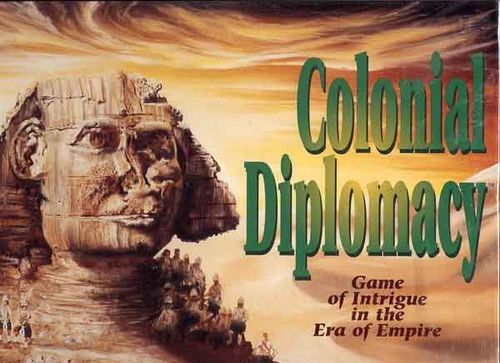
Colonial Diplomacy
Colonial Diplomacy Rulebook
Table of Contents
Table of Contents
Basic Rule
Except as noted below, the standard rules of play for Diplomacy apply. Colonial Diplomacy uses the same order types — hold, move, support and convoy — the same simultaneous adjudication, and the same negotiation between players between each turn. What follows are the ways the colonial map and its seven powers differ from the standard game.
Starting Date
The game begins in 1870.
The Great Powers and Starting Forces
There are seven great powers. The starting units are as follows:
Britain
- Army Madras
- Army Delhi
- Fleet Bombay
- Fleet Hong Kong
- Fleet Singapore
- Fleet Aden
China
- Army Peking
- Army Canton
- Army Sinkiang
- Army Shanghai
- Army Manchuria
France
- Army Tongking
- Fleet Annam
- Army Conchin
Holland
- Fleet Java
- Army Borneo
- Fleet Sumatra
Japan
- Army Kyoto
- Fleet Kyushu
- Fleet Otaru
- Fleet Tokyo
Russia
- Army Moscow
- Army Vladivostok
- Army Omsk
- Fleet Odessa
- Fleet Port Arthur
Turkey
- Army Angora
- Fleet Baghdad
- Fleet Constantinople
There are neutral supply centers marked on the starting map on colored territories, shown with a neutral-colored box drawn around them. Once occupied, a neutral supply center counts as any other supply center.
The Board
Cebu. Cebu looks like a body of water with islands inside of it, which is accurate. It is analogous to Kiel, Constantinople or Denmark in standard Diplomacy: one space containing both land and sea, which can be occupied by either an army or a fleet. An army can use the land bridges to move from Manila to Cebu and from Cebu to Davao (and vice versa). The spaces adjacent to Cebu are Manila, Middle Pacific, Lower Pacific, Davao, Sulu Sea and Luzon Strait.
Impassable spaces. The Caspian Sea, Lake Baykal and any other unnamed space is not passable.
The Moulmein Convention. This version of Colonial is based on the Moulmein Convention, so land bridges have been added between Otaru and Akita, and Sakhalin and Otaru.
Hong Kong. Hong Kong is a British home supply center. It counts as a supply center for any country except China. If China is in possession of Hong Kong, it counts as a non-supply neutral territory.
Province Abbreviations
All land provinces are abbreviated by the first three letters of the province, except the following:
| Abbreviation | Province |
|---|---|
| hk | Hong Kong |
| kag | Kashgar |
| kam | Kashmir |
| mac | Manchuria |
| may | Mandalay |
| mna | Manila |
| gui | New Guinea |
| prs | Persia |
| prm | Perm |
| part | Port Arthur |
| sig | Singapore |
| sik | Sinkiang |
| ubur | Upper Burma |
Sea space abbreviations are less obvious, but there is a pattern:
- All sea spaces which take the form "Sea of Something" or "Gulf of Something" take the abbreviation so# or go#. For example, Gulf of Manaar is "gom" and Sea of Japan is "soj".
- All sea spaces which take the form "Something Sea" or "Something Gulf" take the abbreviation ###s. For example, Persian Gulf is "perg" and Sulu Sea is "suls".
- All sea spaces which end in "Ocean," or carry no water designation at all (such as Lower Pacific), are abbreviated by their initials. For example, Lower Pacific is "lp" and West Indian Ocean is "wio".
- Where there is no conflict, initials may work even where the sea-naming rules above say otherwise. For example, the Okhotsk Sea is "okhs," but "os" will also work.
Victory Conditions
There are 58 supply centers on the board. The victory criterion is possession of 30 supply centers at the end of any Fall retreat.
The Trans-Siberian Railroad
9.2 The Trans-Siberian Railroad (TSR) runs from Moscow to Vladivostok and allows for rapid mobilization of Russian army units across the vast Russian continent (i.e., it allows army units to move more than one province in a turn). The following rules govern its use.
9.21 This is an additional order which may be used by the Russian player and is designated "TSR" on the order sheet. This designation is placed between the names of the starting and finishing provinces. Thus an army in Moscow intending to move to Irkutsk would have orders "A MOS-TSR-IRK." Only the Russian player may use the TSR. The Russian player may not allow another power to use it.
9.22 Only one unit may use the TSR per turn.
9.23 A unit using the TSR may only be transported to an unoccupied province. It may not perform any other function that turn (i.e., it may not attack an occupied province or give support to any other province). For example, an army in Moscow wishing to support a unit in Vladivostok or attack an enemy unit there, would have to move to Irkutsk on one move and then support or attack Vladivostok next move.
A unit using the TSR may attack: (1) a province that is unoccupied at the start of the turn — normal rules of conflict would apply; (2) a province that is occupied at the start of the turn but was made empty during the current turn as a result of that unit moving out — normal rules of conflict would apply; or (3) a province that is occupied at the start of the turn, but if the unit remains in place then the attack will be unsuccessful (even with support) and the unit will have to stop in the nearest empty province along the line of the railroad before the enemy-occupied province.
9.24 A unit may travel as far as it is allowed to go along the TSR according to the normal rules of conflict.
9.241 Thus if any other major power has a military unit in a province along the line of the TSR, a Russian unit would have to stop in the nearest empty province along the line of the railroad before the enemy-occupied province. For example, with a Chinese army in Krasnoyarsk, a Russian army starting in Moscow could travel only as far as Omsk.
The presence of a foreign power in a province along the line of the TSR blocks its use beyond that point. However, if the unit later moves off this province thus unblocking the line, the TSR may again function normally — that is, control of the province reverts to Russia (it is assumed the partisans rebuild the line). Exception: if a supply center on the line of the TSR (Moscow, Omsk, Vladivostok) is captured by an enemy power and later vacated, ownership remains with that power and the TSR is out at that point until Russia is able to recapture the province. Only then is the line "open" again.
9.242 However, if two equal forces attack a province on the TSR resulting in a standoff, the TSR order is not disrupted and the Russian order would go ahead. (The same situation as having to dislodge a fleet in order to stop a convoy order.)
9.25 If a foreign power attacks a province on the TSR, to which or through which a Russian unit had been ordered to move, this would result in a standoff and neither unit would enter that province (unless the attacking unit had support). The Russian unit would stop in the nearest empty province along the line of the railroad. Example: Russia orders A MOS-TSR-VLA, China orders A MON-KRA. This constitutes an equally well-supported attack into Krasnoyarsk, and the Chinese piece would stay in Mongolia while the Russian army would end its turn in Omsk. If there was another unit in Omsk, the unit would have to remain in Perm.
9.26 A unit using the TSR may receive support to enter an empty province along the line of the TSR, to stop a standoff as occurred in the above example. Example: China orders A MAC-IRK, Russia orders A MOS-TSR-IRK and A VLA S A MOS-IRK. The Russian army in Moscow moves to Irkutsk.
9.27 The presence of a Russian army unit on the line of the TSR does not block its path. A unit using the TSR may pass through a province occupied by a Russian unit as long as it doesn't end its movement in that province.
Egypt and the Suez Canal
The Suez Canal allows fleets to move directly from the Mediterranean to the Red Sea, without first passing through Egypt. This is only possible if allowed by a unit standing in Egypt. This unit must start and end the turn in Egypt in order to make the fleet move legal, and the move must be granted permission by the unit standing in Egypt. This is no issue if, for example, Turkey has a unit in Egypt and a fleet in the Mediterranean which it moves to the Red Sea. But if another power wants to use the Suez Canal, the unit in Egypt must specify that it gives its permission — this is done by writing a support order for the move, e.g. "F EGY S ENGLISH F REDS-MEDS."
Egypt has the same function as Kiel, Constantinople or Denmark in standard Diplomacy: it is considered to have a continuous coast towards both the Red Sea and the Mediterranean Sea.
Errata and Clarifications (March 6, 1996)
Map addition. Kyoto is a starting colony for Japan. There should be a white circled dot in Kyoto.
Map change. Constantinople is a province of Turkey. It should be printed in the same white color as the rest of Turkey.
Abbreviation correction. The correct abbreviation for the Andaman Sea is "AND.S," as per Rule 13.0; the abbreviation found on the conference map is incorrect.
Rule change, 9.11. Delete "China may not enter Hong Kong until the turn after another power has occupied it at the end of a counting move (even-numbered turns)."
Rule change, 9.34. Delete "A EGY S SUD."
Rule change, 9.35. Change "Turkey A EGY S British F RS-MED" to "Turkey F EGY S British F RS-MED."
Suggested addition to map. The island of Sakhalin is contained entirely within the Okhotsk Sea, and a unit there cannot be eliminated, so it is suggested that a land-bridge arrow should connect Otaru and Sakhalin, thus allowing a supported attack from Otaru and the Okhotsk Sea to take Sakhalin.
Cebu. Cebu is one space containing both land and sea. It can be occupied by either an army or a fleet. An army can use the land bridges to move from Manila to Cebu and from Cebu to Davao (and vice versa). The spaces adjacent to Cebu are Manila, Middle Pacific, Lower Pacific, Davao, Sulu Sea and Luzon Strait.
Trans-Siberian Railroad, question and answer.
Q. In the following situation, where do A Mos and A Omsk end up? Russian orders: A Mos-TSR-Vla, A Omsk-Kra, A Vla-Seo; Chinese orders: A Mac-Irk.
A. The standoff in Kra means that A Omsk does not move and A Mos stops in Perm.
Q. If Russia orders A Mos-TSR-Vla and China orders A Mac-Irk and A Mon-Kra, what happens?
A. A Mon-Kra fails, A Mac-Irk succeeds, A Mos stops in Omsk.