Colonial 1700-1800: Great Battles
Rulebook PDF: Juegos Mosquete · PDF
Colonial 1700-1800: Great Battles Rulebook
Table of Contents
Table of Contents
Scenario Mode
Scenarios are an alternative mode of play to enjoy Colonial 1700-1800. They have been developed to deepen historical fidelity, so that players are able to recreate the main events of the colonial conflicts that marked the 18th century. All scenarios incorporate extra content in the form of Colonies, Battle cards or Tactic cards, and some of them have a specific Colony layout and special rules.
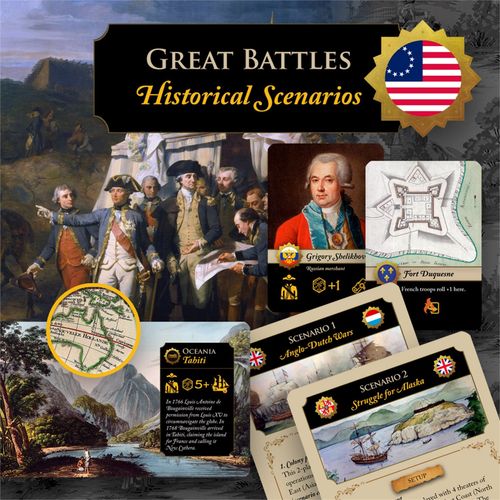
All scenarios have 1 Scenario card for each participating faction, which includes quests, rewards for completing them, and penalties for players if they lose certain colonies or positions.
The Tactic cards that can be used when playing Scenario Mode are marked with the Scenario Mode icon in the lower right corner, next to the card number. During game setup in Scenario Mode, form the Tactic deck only with the cards that show this icon.
Scenario Card Anatomy
The book's diagram of a Scenario card labels the following parts:
- Faction
- No. of scenario
- Scenario name
- Challenges
- Rewards
- Penalties
The challenges, rewards and penalties of each faction's Scenario card are printed on the physical Scenario cards and are not written out in this book.
Rules for the Scenario Mode
- The Secret Objective deck is not used in the Scenario Mode.
- The Political board cannot be customized with Sideshow Bob cards in the Scenario Mode.
Each Scenario card has 5 challenges to be achieved (they are different for each faction, depending on their historical circumstances). If a player achieves all the 5 challenges, the game ends immediately and that player is declared the winner.
If there is no instant victory, each completed challenge at the end of the game grants 1 VP.
Each set of Goods still grants 1 VP, as well as the control of 3 politicians.
There are no VP for regional dominance (majorities) in the Scenario Mode.
Golden rule: if a scenario rule totally or partially contradicts what is indicated in the Colonial 1700-1800 rulebook, the scenario rule takes priority.
Scenario 1. Anglo-Dutch Wars
The Anglo-Dutch Wars were a series of conflicts mainly fought between the Dutch Republic and England (later Great Britain) in the mid-17th and late 18th centuries. This scenario recreates the 4th Anglo-Dutch War (1780-1784) and the British aggression to Dutch colonial territories during the revolutionary period (1795-1815). The decadence of the Dutch India Companies (WIC dissolved in 1792, VOC disappeared in 1799 after bankruptcy), the creation of the Batavian Republic in 1795 and the war in Europe set the Dutch colonial possessions in a situation of extreme weakness. The British exploited it and occupied key Dutch colonies: Kaapstad (Cape Town) in 1795, Ceylon (Sri Lanka) in 1796, Paramaribo (Dutch Guiana) in 1799 and Curaçao in 1800.
Scenario Setup
This 2-player scenario is played with 3 Regions: Caribbean, Africa and Asia. The following Colonies must be placed in this order:
- Caribbean: Sint Eustatius, Curaçao, Barbados.
- Africa: Anamabou, Cape Coast, Kaapstad.
- Asia: Madras, Negapatnam, Trincomalee, Colombo, Malakka, Batavia.
Prepare the setup of the battle of Dogger Bank by placing these ships on the High Seas:
- Admiraal de Ruijter paired with HMS Fortitude.
- Admiraal Generaal paired with HMS Bienfaisant.
- Holland paired with HMS Buffalo.
- Erfprins paired with HMS Preston.
Place the Mysore troops in Negapatnam under the control of the Dutch player.
Initial Control of Colonies
NL begins in Sint Eustatius, Negapatnam and Batavia.
GB begins in Barbados, Cape Coast and Madras.
The rest of setup follows the Colonial 1700-1800 rulebook.
Specific Rules for This Scenario
GB takes the first turn.
In the Battles step of the first turn, the battle of Dogger Bank (1781) that takes place on the High Seas must be resolved normally. After the battle, the winning player will be able to use the ships that have survived and send them to the colonies they want.
Strategy Tips
The battle of Dogger Bank is key, both players must try to win it or destroy as many enemy ships as possible. The Dutch should focus on taking and keeping Kaapstad, as well as fortifying Batavia while expanding in the Region. Kaapstad, Colombo and Batavia are key Colonies for them. The British will have to expand in the Caribbean and pay special attention to Malakka and Colonies in India. Fortifying Madras in the early game could work well.
Historical note: Although both sides claimed victory at Dogger Bank, it proved a British strategic victory: the Dutch fleet withdrew to Texel and did not leave the port again during the war. In the following war of 1795, the Dutch empire was seriously reduced. Kaapstad and Curaçao were returned to The Netherlands by the Treaty of Amiens in 1802. Kaasptad [sic, as printed] was finally occupied by the British in 1806, and Curaçao was invaded in 1807 but recovered in 1816. Ceylon was never returned.
Scenario 2. Struggle for Alaska
This scenario takes place between 1770-1800, when the colonial powers raced to explore and claim Alaska, as well as to discover the South Pacific, with the voyages of Cook, Malaspina and La Pérouse as its main explorations. While the Spanish were consolidating in California and projecting their claims to Alaska, the British were taking advantage in the South Pacific. The French also managed to reach Alaska, although La Pérouse's expedition disappeared north of Australia and was never seen again. The establishment of Fort San Miguel in Nutca (Vancouver) set off the alarms and caused a crisis between Spain and Great Britain in 1789. For their part, the Russians had already established themselves in Kodiak in 1784. In 1788, the arrival of the First Fleet to Australia formally established the British colony of Sydney.
Scenario Setup
This 3-player scenario is played with 4 Regions: Western Pacific (Oceania), Eastern Pacific (Oceania), Alaska (North America) and California (North America). The following Colonies must be placed:
- Western Pacific: Samoa, Tahiti, Hawaii, Isla de Pascua.
- Eastern Pacific: Marianas, Sydney, New Zealand, Tonga.
- Alaska: Nutca, Port des Français, Kenai, Kodiak.
- California: San Francisco, Monterrey.
The layout is printed as follows (p.8). Each arrow marks a group of four Colonies:
- Samoa, Tahiti, Hawaii, Isla de Pascua: "Shuffle these 4 and place them randomly face down."
- Nutca, Port des Français, Kenai, Kodiak: "Shuffle these 4 and place them randomly face down."
- Marianas, Sydney, New Zealand, Tonga: "Shuffle these 4 and place them randomly face down."
- San Francisco and Monterrey are not marked for face-down placement.
Initial Control of Colonies
Players begin with exploration ships in an asymmetrical start, for historical reasons.
ES begins with the corvette Descubierta in Monterrey.
GB begins with the bark HMS Endeavour on the High Seas.
FR begins with the frigate La Boussole on the High Seas.
The rest of setup follows the Colonial 1700-1800 rulebook.
Specific Rules for This Scenario
In this scenario, a large part of the territories explored and claimed were terra incognita at the beginning of the period. Therefore, all Alaska and Oceania Colonies are randomly deployed face down in their Region. The players will not know the position of most Colonies. When a unit reaches a face down Colony, it flips it over and shows what the player has discovered, taking its control.
Strategy Tips
The Spanish should focus their efforts on building the Presidio of San Francisco and establishing themselves in California, while the British should have as their first objective the discovery of Terra Australis, and the French may find a great base on Tahiti and Hawaii. All the powers will converge in Alaska, where each one will want its share of the pie and anything can happen.
Historical note: Alaska was explored by Juan de la Bodega in 1775 and by James Cook in 1778. The Spanish built Fort San Miguel on Nutca Island in 1789, beginning to arrest British ships, which led to a confrontation. Finally, in 1794, Spain agreed to abandon the fort and both powers recognized each other the shared use of the bay.
Scenario 3. American Revolution
The American Revolution started in 1775 when the Thirteen Colonies rejected the British rule under the principle of "No taxation without representation". The patriot victory at Saratoga (1777) was the turning point that led the European powers to realize that the patriots could win, causing France to enter the war in 1778 and Spain in 1779.
Scenario Setup
This 2-player scenario has 4 Regions: New England, Middle Atlantic, Southern Colonies and Northern Area. The following Colonies must be placed in this order:
- Northern Area: Lac Champlain, Montréal, Québec.
- New England: Portsmouth, Boston, Providence.
- Middle Atlantic: New York, Philadelphia, Virginia.
- Southern Colonies: Charleston, Savannah, Pensacola.
Initial Control of Colonies
US begins in Providence, Lac Champlain and Philadelphia.
GB begins in Québec, Boston, Virginia and Pensacola.
The rest of setup follows the Colonial 1700-1800 rulebook.
Specific Rules for This Scenario
The US take the first turn.
The Americans do not have access to Line Infantry at the beginning of the game. The US player gets access to Line Infantry after building the Independence Hall in Philadelphia.
If the US have no control of Philadelphia, they are perceived as weak by the European powers: France and Spain will not join them, even if the American fulfil the conditions. If the US retake control of Philadelphia, they are eligible again for achieving the alliance with the French and the Spanish (they do not need the Independence Hall for this).
Strategy Tips
At the beginning of the game, the American player will be in a difficult situation: their Battle deck has fewer types of units, and without Line Infantry they will have to rely on the poor performance of Colonial militia. The first objective for the American should be to build the Independence Hall in Philadelphia; a Fortress there would be an intelligent choice to protect it. The British player should give priority to the conquest of Philadelphia and eventually to destroy the Independence Hall, trying to cut the European support to the patriots.
Historical note: The arrival of the French "Special Expedition" led by Rochambeau to the East Coast in 1780 and the opening of new war fronts by Spain (siege of Gibraltar in 1779 and invasion of West Florida in 1780) strangled the British military possibilities to send reinforcements to North America and eased the patriot victory at Yorktown (1781). This victory permanently consolidated the new nation.
Scenario 4. French and Indian War
The French and Indian War (1754–1763) was a theatre of the Seven Years' War, which pitted the North American colonies of Great Britain against those of the French, each side being supported by various Native American tribes. The British colonists were supported at various times by the Iroquois, Catawba, and Cherokee tribes, while the French colonists were supported by Wabanaki Confederacy member tribes Abenaki and Mi'kmaq, as well as the Algonquin, Lenape, Ojibwa, Ottawa, Shawnee, and Wyandot (Huron) tribes.
Scenario Setup
This 2-player scenario aims to represent the geographical reality of French and British colonies in North America. Due to that reason, it has only 1 Region where Colonies are connected by a specific adjacency rule (indicated by symbols ═ ╠ ╗).
The adjacency lines printed on p.12 connect the Colonies as follows (═ is a double horizontal line, ║ a double vertical line, and the bracket symbols ╗ ╠ ╝ and ╔ ╣ ╚ join New York to the Colonies around it):
- Québec ═ Louisbourg
- Québec ║ Montréal
- Pays d'en Haut ═ Montréal ═ Lake Champlain
- Pays d'en Haut ║ Ohio Valley
- Lake Champlain ║ Lake George
- Lake George ║ Boston
- Louisbourg ║ Acadie de Terre Ferme ║ Halifax
- Boston ═ Halifax
- Ohio Valley ║ Philadelphia
- New York is joined by the bracket symbols to Ohio Valley, Philadelphia, Lake George and Boston.
Only Colonies in blue (New York, Boston, Halifax, Louisbourg, Acadie de Terre Ferme and Philadelphia) are accessible from and can access the High Seas.
Place the Forts as follows:
- Fort Duquesne and Fort Necessity in Ohio Valley.
- Fort Beauséjour in Acadie de Terre Ferme.
- Fort Carillon in Lac Champlain.
- Fort William Henry in Lake George.
- Fort Niagara (FR side), Fort Frontenac and Fort Oswego in Pays d'en Haut.
Initial Control of Colonies
FR begins in Québec, Lac Champlain and Louisbourg.
GB begins in Boston, Lake George and Halifax.
The rest of setup follows the Colonial 1700-1800 rulebook.
Specific Rules for This Scenario
In this scenario, Forts are buildings that do not roll dice, but rather benefit the units present in the Colony. To reflect the changing hands of various Forts that occurred historically, some of them are double-sided cards: one side with a French name, and one side with a British name. Other Forts, however, must be destroyed by the players (such as Fort William Henry, destroyed by Montcalm in 1757).
Forts may coexist with a Fortress within a Colony.
Strategy Tips
In the French and Indian War, the only ways to access the St. Lawrence Valley (and, consequently, Québec) were control of the Great Lakes, access through Lake Champlain, or access from the estuary of the Saint Lawrence River. For this last access way, controlling Acadia and, especially, Louisbourg was essential. In this scenario, the British player will have to break the front in one of these ways. For their part, the French player must stop the British progress and prevent, in any case, their access to the New France capital: Québec.
Historical note: The British plan in 1758 called for three major offensive actions involving large numbers of regular troops supported by the provincial militias, aimed at capturing the heartlands of New France. Two of the expeditions were successful, with Fort Duquesne and Louisbourg falling to sizable British forces. By 1759 there was a general French withdrawal from the Ohio Valley and the Great Lakes area to defend the valley of the St. Lawrence river. The loss of Louisbourg left the French capital vulnerable: Québec was seized in 1759 with support from the river. James Wolfe and Louis-Joseph de Montcalm died after a battle at the outskirts of the city. The fall of Québec marked the disappearance of New France, and Montréal capitulated in 1760.
Scenario 5. Spanish-Portuguese Wars
The Spanish-Portuguese wars of 1762-1763 and 1776-1777 were fought in the Iberian Peninsula and South America. The South American front was marked by the clash of both powers in Brazil and Uruguay. The objective of the Spanish was to stop the Portuguese expansion and to consolidate their domains north of the Río de la Plata (Banda Oriental). For their part, the Portuguese sought to take the coast and threaten Buenos Aires.
Scenario Setup
This 2-player scenario aims to represent the geographical reality of Spanish and Portuguese Colonies in Southern Brazil and Uruguay. Due to that reason, it has only 1 Region where Colonies are connected by a specific adjacency rule (indicated by symbols ═ ╠ ╗).
The adjacency lines printed on p.14 connect the Colonies as follows (═ is a double horizontal line, ║ a double vertical line, and the bracket symbols join the Colonies on the left and right edges):
- Misiones Orientales ║ Cerro Largo
- Misiones Occidentales ║ Rio Pardo
- Sacramento ═ Cerro Largo ═ Rio Pardo ═ Porto Alegre
- Montevideo ═ Angostura ═ Rio Grande ═ Ilha Santa Catarina
- Sacramento ║ Montevideo; Cerro Largo ║ Angostura; Rio Pardo ║ Rio Grande; Porto Alegre ║ Ilha Santa Catarina
- Buenos Aires is joined by the bracket symbols to Sacramento and Montevideo.
- São Paulo is joined by the bracket symbols to Porto Alegre and Ilha Santa Catarina.
Only Colonies in blue (Buenos Aires, Sacramento, Montevideo, Angostura, Rio Grande, Ilha Santa Catarina, Porto Alegre and São Paulo) are accessible from and can access the High Seas.
Place the Forts as follows:
- Fuerte Santa Tecla in Cerro Largo.
- Forte da Ponta Grossa in Ilha Santa Catarina.
- Forte Santa Tereza and Forte São Miguel in Angostura.
- Forte Jesus, Maria e José in Rio Pardo.
- Forte São José da Barra in Rio Grande.
- Guardia de San Martín in Misiones Orientales.
- Fuerte San Felipe in Montevideo.
Place Sepé Tiarayú and the Guarani rebels in Misiones Orientales.
Initial Control of Colonies
ES begins in Buenos Aires, Montevideo and Cerro Largo.
PT begins in São Paulo, Rio Grande and Sacramento.
The rest of setup follows the Colonial 1700-1800 rulebook.
Specific Rules for This Scenario
In this scenario, Forts are buildings that do not roll dice, but rather benefit the units present in the Colony. To reflect the changing hands of various Forts that occurred historically, some of them are double-sided cards: one side with a Spanish name, and one side with a Portuguese name.
Forts may coexist with a Fortress within a Colony.
Strategy Tips
Suppression of Guarani rebellion: in this scenario both players have as a challenge to crush the Guarani rebellion in Misiones Orientales. This means only one of them may get the reward. Once the rebellion is crushed, the other player will not have the chance to fulfil their quest. Consequently, the first 1 or 2 rounds would be a race between Spain and Portugal to reach Misiones Orientales and complete the challenge.
Historical note: On 24th February 1777, King Joseph I died, and his daughter and successor Maria I dismissed Pombal and signed on 1st October the First Treaty of San Ildefonso with Spain. Spain returned the island of Santa Catarina to Portugal and recognised Rio Grande de São Pedro as Portuguese territory, but kept the strategically important port town of Colonia del Sacramento, which the Portuguese had founded in 1680, with the rest of the Banda Oriental (Uruguay), and also kept the Misiones Orientales. In return, Spain accepted the Portuguese rule of Brazilian territories extended far west of the line that had been set in the Treaty of Tordesillas. In the Treaty of El Pardo, signed on 11th March 1778, Spain gained Equatorial Guinea, which would be administered from Buenos Aires from 1778 to 1810 and was held by Spain until 1968.
Scenario 6. Carnatic Wars
This scenario is printed in this book, but its Indian politicians (Chanda Sahib, Siraj ud-Daulah, Salabat Jung) belong to the Carnatic Wars expansion. A player using this scenario needs that product.
The Carnatic Wars were a series of military conflicts in the middle of the 18th century in India's coastal Carnatic region, a dependency of Hyderabad State, India. Three Carnatic Wars were fought between 1744 and 1763. These conflicts involved numerous nominally independent rulers and their vassals, as well as a struggle for hegemony between the French East India Company and the British East India Company. They were mainly fought within the territories of Mughal India with the assistance of various fragmented polities loyal to the "Great Moghul".
Scenario Setup
This scenario aims to recreate the Second (1749-1754) and Third (1756-1763) Carnatic Wars. This 2-player scenario is played with 3 Regions: Carnatic, Northern Circars and Bengal. The following Colonies must be placed in this order:
- Northern Circars: Masulipatnam, Yanaon, Vizagapatnam.
- Bengal: Calcutta, Chandernagor, Cossimbazar.
- Carnatic: Trichinopoli, Cuddalore, Pondichéry, Wandiwash, Arcot, Madras.
Place the Chanda Sahib card (FR side) covering George III in the Political board and the Carnatic army in Arcot. Place the Siraj ud-Daulah card (FR side) covering Louis XV and the Bengal army in Cossimbazar. Place the Salabat Jung card (FR side) covering Catherine II and the Hyderabad army in Masulipatnam.
Initial Control of Colonies
FR begins in Pondichéry, Arcot (with Carnatic army), Masulipatnam (with Hyderabad army), Chandernagor and Cossimbazar (with Bengali army).
GB begins in Madras, Calcutta and Trichinopoli.
The rest of setup follows the Colonial 1700-1800 rulebook.
Specific Rules for This Scenario
GB takes the first turn.
Players may perform 2 dice rolls instead of 1 each turn during the Political Objective step. They may roll 2 times for the same politician or may split between politicians.
This scenario has 3 new Indian politicians as double-sided cards. Each politician is loyal to a European power and will put the Indian armies at their service. In this regard, any player who controls an Indian politician may use the corresponding native army. Colonies taken by native armies are controlled by the faction (FR, GB) who owns the loyalty of the corresponding Indian ruler.
When an Indian politician changes their loyalty, the card is flipped over, and the new player instantly takes control of that native army (this may cause changes in the control of Colonies and may cause Battles as well).
When native armies are defeated, instead of being destroyed, they are put aside (they are temporarily out of the game). If the corresponding Politician changes their loyalty, the army is put into play again (the Bengali army appears in Cossimbazar, the Hyderabad army in Masulipatnam, the Carnatic army in Arcot).
Strategy Tips
The French begins in an apparently good position (a lot of allies, more Colonies) but this position may be easily threatened by the British. The French player should protect Pondichéry as best they can, keeping control of the Indian politicians and threatening Calcutta and Madras. Remember the benefit of Pondichéry allows the French to move further. In fact, the Native pier may allow the French to travel throughout all Region with just 1 move.
The British should focus on protecting Calcutta and Madras, as well as achieving the loyalty of Indian politicians as soon as possible (the Tactic card William Pitt's Cabinet will help).
Historical note: After the Battle of Wandiwash, the French presence was restricted to Pondichéry, where they surrendered on 22nd January 1761. The collapse of the French position in India was one of the events that compelled France to sign the Treaty of Paris, reducing the French to little more than traders in India, with no options of future territorial expansion.