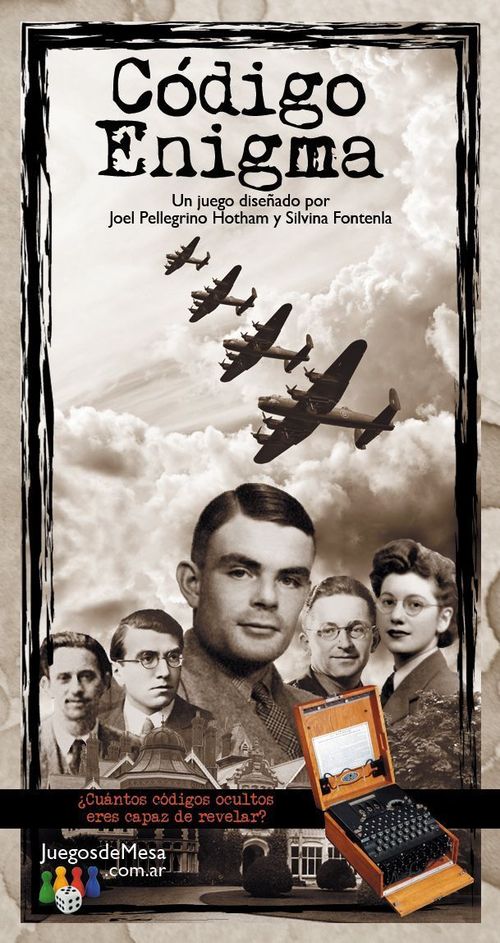
Código Enigma
Código Enigma Rulebook
Table of Contents
Table of Contents
Overview
The goal of the game is to gather the symbols to form the codes that are on the cards and thus win the medal. Each player works with their cards in their play area, and there is a zone common to all players containing a replacement deck of cards, exposed cards, a discard pile and a soldier who stalks the players throughout the game, complicating their task.
Cards have a MEDAL, a SYMBOL and a CODE. A card can be used as a SYMBOL, as a CODE, or as both, when the card's SYMBOL applies to the CODE to be formed within the same card. Each player gathers cards in their play zone, which consists of four areas:
- the SYMBOL/CODE COLLECTION area (RECOLECCIÓN DE SÍMBOLOS/CÓDIGOS);
- the EXPOSED CODE area (CÓDIGO EXPUESTO);
- the HIDDEN CODES area (CÓDIGOS OCULTOS);
- the REVEALED CODES area (CÓDIGOS REVELADOS).
Play areas for each player
The printed diagram shows the common zone for all players at the top, and beneath it each player's own areas: MY EXPOSED CODE AREA, MY HIDDEN CODES AREA and MY REVEALED CODES AREA (left, centre and right), with MY SYMBOL/CODE COLLECTION AREA at the bottom.
Players take turns taking cards, forming codes, or blocking their fellow players with the soldier. The cards a player decides to take are placed in their play zone in the SYMBOL/CODE COLLECTION area. The code the player decides to form is laid down in the EXPOSED CODE area. Each complete code, with its symbols, that a player has formed is moved to the HIDDEN CODES area, where it stays until it is revealed. If a player wants additional points beyond the value of the medal, they should remember the codes they hide. When a REVEAL HIDDEN CODES card appears on a player's turn, that player must reveal their hidden codes to their fellow players out loud. Whoever can recall the SYMBOLS that make up a HIDDEN CODE earns additional points. The MEDALS obtained move to the REVEALED CODES area. When the last REVEAL HIDDEN CODES card appears, the game ends. The value of the medals is added to the additional points, and the player with the highest total is the winner.
Detailed Description of the Cards
(This section describes the printed card-anatomy diagrams on page 3 of the rulebook.)
Common cards: a medal, a symbol and a code of 3 or 4 symbols
Each common card shows:
- a MEDAL (a numbered medal at the top of the card);
- a SYMBOL (an icon in the lower-right area of the card);
- a CODE of 3 or 4 symbols (the row of symbols at the bottom of the card);
- a PHOTO OF AN EVENT (the picture of a historical event);
- the CARD REFERENCE NUMBER (printed at the bottom of the card).
Cards that reveal hidden codes
Each REVEAL HIDDEN CODES card shows:
- the CARD ACTION (the printed text REVEAL HIDDEN CODES, running vertically along the card);
- a PHOTO OF AN ENIGMA MACHINE;
- the CARD REFERENCE NUMBER.
Wild cards
Each wild card shows:
- a PHOTO OF ONE OF THE PROTAGONISTS OF THE ENIGMA MACHINE STORY;
- the NAME OF THE PROTAGONIST (for example, Alan Turing).
Turn-action aids
The rulebook includes two aid cards:
- a card for SETUP, START AND END OF THE GAME (described under Setup below);
- a card with a BRIEF REMINDER OF THE POSSIBLE ACTIONS IN A TURN (described under Turn Actions below).
Setup
(Source: the setup section on page 4 and the setup card on page 3.)
According to the number of players, take the number of wild cards and the number of REVEAL HIDDEN CODES cards that will be used in play. The rulebook specifies: for 2 players use 2 wild cards and 4 REVEAL HIDDEN CODES cards; for 3 players use 3 wild cards and 3 REVEAL HIDDEN CODES cards; for 4 players use 4 or 5 wild cards (to be agreed among the players) and 2 REVEAL HIDDEN CODES cards.
Translator's note: the printed text writes the player-count entries in a shorthand ("para 3-3", "para 4-2" and "4-4 o 5"). The translation reads each entry as "for [N] players use [count]", which matches the setup card on page 3 ("Para partidas de 2/3/4 jugadores se utilizan: 2/3/4 comodines y 4/3/2 cartas 'REVELEN CÓDIGOS OCULTOS'").
To begin forming the REPLACEMENT DECK (MAZO DE REPOSICIÓN), the common cards are shuffled, and 3 are dealt to each player. These are placed face up, one beside the other, in each player's play zone in the SYMBOL/CODE COLLECTION area.
Setup card (page 3)
The setup card reads, translated:
GAME SETUP. For games of 2, 3 or 4 players use 2, 3 or 4 wild cards and 4, 3 or 2 "REVEAL HIDDEN CODES" cards respectively.
START OF THE GAME. Shuffle the cards together with the wild cards. In the centre of the table place 4 cards face up, from left to right:
- a "REVEAL HIDDEN CODES" card;
- a card drawn at random from the deck, with the soldier on top;
- a card drawn at random from the deck;
- another card drawn at random from the deck.
Then deal 3 cards to each player. Add the remaining "REVEAL HIDDEN CODES" cards to the deck and shuffle them in. Place the deck face down on top of the "REVEAL HIDDEN CODES" card located on the left in the centre of the table.
END OF THE GAME. In games of 2 and 3 players, the game ends when the deck runs out. In games of 4 players, when the deck runs out the discard pile is reshuffled to form a new deck, after removing any "REVEAL HIDDEN CODES" cards from it. Only one of these cards is placed at the bottom of this new deck. When this new deck runs out, and that card appears, the game ends.
Common Zone and the Soldier
In the common zone for all players, one REVEAL HIDDEN CODES card is placed face up at the end of what will become the REPLACEMENT DECK (MAZO DE REPOSICIÓN DE CARTAS). It marks the end of the game and is the last opportunity to reveal HIDDEN CODES. Beside it is the ENCARTE zone, which consists of 3 cards face up, one beside the other. The third of these cards also acts as the discard pile (PILA DESCARTE). To begin, the card closest to the replacement deck has the SOLDIER placed on top of it; that card is then blocked.
The replacement deck (to which the REVEAL HIDDEN CODES cards and the wild cards for the player count are added) is shuffled and placed face down, covering the REVEAL HIDDEN CODES card that was already placed face up in the common zone.
What the soldier does
The soldier represents the advance of enemy troops. It lurks over the players for the whole game, blocking any of the 3 exposed cards in the common zone. On its turn a player may not pick up the card that is under the soldier. If the soldier is on the third card, the player may lift the soldier and place on that card the card they wish to discard. The discarded card may not show the same symbol as the one under the soldier, nor may it be the card just picked up.
Beginning the Game
The player who starts is the one whose 3 cards include the highest reference number on the card (the printed text says "referencia de la foto", the reference number shown with the picture). Each player then takes turn by turn from the ENCARTE zone the symbol/code cards they want, placing them in their play area in the SYMBOL/CODE COLLECTION area, taking into account which code they can form from the symbols they have. A player may hold at most 4 cards. When a card is taken from the ENCARTE zone, it is automatically replaced by a card from the REPLACEMENT DECK.
Turn Actions
On their turn a player must perform 2 actions (the same action may be repeated). The available actions are:
Take a card (ENCARTE)
Take one of the 3 cards available in the ENCARTE zone that is not blocked by the SOLDIER.
Lay down one or more cards in your play area to:
- Expose a code. Place in your EXPOSED CODE area a card whose purpose is to build that code. It cannot later be changed to be used as a SYMBOL card. There may be only one incomplete code in that area. This action serves to make room in your SYMBOL/CODE COLLECTION area.
- Complete an exposed code. Lay down the symbol cards needed, one or all at once, to complete an EXPOSED CODE, and then move it to the HIDDEN CODES area.
- Lay down a complete code and hide it. Show the complete code and its symbols to the other players, and move it to the HIDDEN CODES area.
Discard
- Discard a common card. Remove a common card from your SYMBOL/CODE COLLECTION area and place it on the discard pile (PILA DESCARTE), which is the third pile in the ENCARTE zone, even if it has the soldier on top. You may not discard a card that shows the same symbol as the one already on the discard pile, nor the card just picked up.
- Remove an exposed code that you are unable to complete. It must have at least one symbol already exposed in order to be removed. It moves automatically to the REVEALED CODES area and scores negative points.
Soldier
You may move the soldier and place it on top of another card in the ENCARTE zone. If this action is taken, it must always be performed as the second action of the turn.
Play Areas for Each Player
The play-area diagram (page 7) shows the following limits:
- My EXPOSED CODE area: maximum one EXPOSED CODE at a time.
- My HIDDEN CODES area: there is no maximum number of HIDDEN CODES.
- My SYMBOL/CODE COLLECTION area: maximum 4 cards in your play zone.
Exposed Codes
An EXPOSED CODE is formed by one card that acts as the CODE and other cards that act as SYMBOLS. The CODE card may in turn also act as a SYMBOL within the code. The CODE card is placed vertically. The cards that act as SYMBOLS are placed behind it, hiding that card's own code and leaving visible only the symbol being used. Only one WILD card may be used per CODE.
The printed caption for the correct way to place an exposed code reads: the CODE card is placed vertically; the cards that act as SYMBOLS are placed horizontally behind it, hiding their codes and showing only the symbol being used for the EXPOSED CODE.
If you decide not to complete the CODE you have exposed, because the other players prevent you from picking up the cards you need, or because you simply change your mind about forming that CODE, you may discard it. To do so, this CODE must have at least one SYMBOL card. If you take this decision, the value of the CODE's MEDAL will subtract victory points at the end of the game.
Hidden Codes
When you complete an EXPOSED CODE and move it to the HIDDEN CODES area, place the symbol cards in a single pile, face up, with the card that acts as the CODE face down on top, covering the SYMBOL cards. Each HIDDEN CODE formed is placed one beside another in that area.
(Caption on the page: CARTA CÓDIGO = CODE card; CARTAS SÍMBOLOS = SYMBOL cards.)
Revealing Hidden Codes and Scoring
When the card is replenished in the ENCARTE zone and the REVEAL HIDDEN CODES card appears, the game pauses for the reveal. The player whose turn it is must begin exposing immediately, even if they have another action still to perform (they will perform it once all players have finished exposing their HIDDEN CODES).
Before hiding the codes they have formed, a player may remember them in order to reveal them later, when a REVEAL HIDDEN CODES card comes out.
The correct way to reveal a HIDDEN CODE is to say it exactly as it appears on the CODE card being used. For example: "grenade, helmet, tank, grenade" or "tank, grenade, helmet" (the cards are held by a fellow player so that it can be checked that it is exactly so). It is not valid to say it in any other way or to use any other term that is not one of those indicated.
The player who begins exposing chooses their first, or only, HIDDEN CODE and has 4 options:
- If you remember the SYMBOLS of the CODE in the exact order in which they appear on the card, give the cards to your fellow player, expose the code out loud, and if you get it right you win the MEDAL of the CODE card + 2 extra points. Place the card in the REVEALED CODES area vertically.
- If, when exposing the CODE, the symbols are correct but the order in which you name them is incorrect, you win the MEDAL of the CODE card + 1 extra point. Place the card in the REVEALED CODES area horizontally.
- If you do not remember the HIDDEN CODE and do not want to take a risk, turn the cards over to verify that the CODE is correctly formed, and you win the MEDAL of the CODE card (no extra points). Place the card in the REVEALED CODES area vertically but upside down.
- If you expose the CODE incorrectly, you lose the MEDAL of the CODE card and everything goes to the discard pile.
Once a player has finished exposing, that player keeps only the medals won; the rest (the cards that acted as SYMBOLS) go to the DISCARD pile.
If a HIDDEN CODE contains a WILD card, its player may only reveal the symbols correctly and in the exact order in which their CODE is formed. If they make a mistake, everything goes to the discard pile.
Scoring diagram captions (page 9)
The page 9 diagram illustrates the three scoring outcomes: "MEDAL VALUE + 2 POINTS", "MEDAL VALUE + 1 POINT" and "MEDAL VALUE ONLY".
Negative points
If you have decided to discard any EXPOSED CODE, the way to indicate its negative points is to place the cards in the shape of a cross, with the CODE card face up so that the value of the medal, which will score as a negative value, is visible, and one SYMBOL card face down crossing it. (Caption on the page: "PUNTOS NEGATIVOS", negative points.)
The next player then continues exposing. Once all players have exposed their HIDDEN CODES, play continues.
The first REVEAL HIDDEN CODES card to come out
When the first REVEAL HIDDEN CODES card comes out and the players have finished revealing, that card (only the first to appear) is shuffled into the discard pile. This keeps the game going, and it is up to the players whether to use that pile, knowing that a card to reveal is among the discarded cards. When the second REVEAL HIDDEN CODES card comes out, it is placed face up to the right of the discard pile. When the third comes out, it is placed to the left of the REPLACEMENT DECK, to remind all players that if they want to reveal HIDDEN CODES and win more medals, they have only the one shuffled into the discard pile or the one at the end of the REPLACEMENT DECK.
End of the Game
When the deck runs out, the game ends, because the last REVEAL HIDDEN CODES card has appeared. This is the players' last opportunity to reveal their HIDDEN CODES. SYMBOLS can no longer be taken or laid down. The winner is the player whose total, from the value of their medals plus their extra points, is highest.
Exceptions
- A blocked wild card is a lost wild card. It is placed back in the REPLACEMENT DECK, the deck is shuffled, and the card on top is taken to complete the ENCARTE zone. That card is blocked.
- 4 players: at the end of the game the discard pile must be reused without any REVEAL HIDDEN CODES card (only the one that goes at the end of the REPLACEMENT DECK remains).