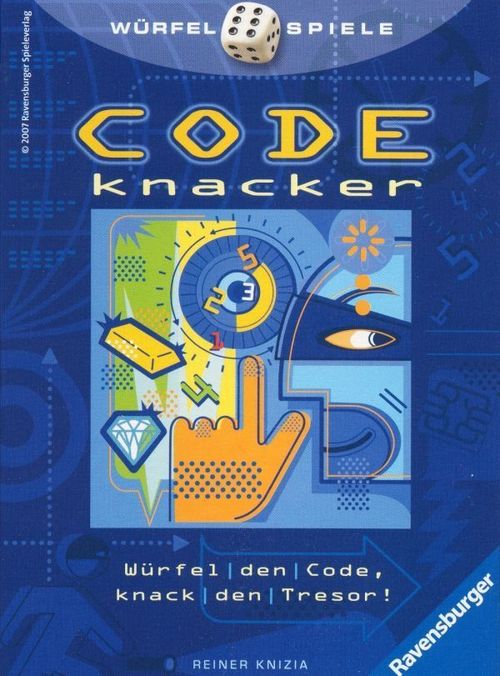
Code Cracker
Code Cracker Rulebook
Table of Contents
Table of Contents
Contents
- 22 safe cards
- 17 red markers
- 5 dice (with numbers from 1 to 5 and 1 x "micro chip")
Game Concept
Taking turns, players try to crack the digital code of the different safes – number by number. But only the player to roll the last free number of a code wins the safe card and pockets the corresponding millions.
The player with the most millions wins the game.
Preparation
Shuffle the safe cards, form a pile, and place it face down in the centre of the table. Turn over the first three cards and place them face up in front of the pile.
The safe cards indicate a three- to six-figure code. In addition, they show a sum between 2 and 5 million that the player who cracks the last number of the code will win.
The red markers are placed next to the pile. The youngest player gets the 5 dice.
How to play
The youngest player starts and then play continues in a clockwise direction. The player whose turn it is first rolls all 5 dice. They must then lay aside one matching die (see following page); however, they may lay aside several matching dice at the same time (but are not forced to do so!). If no matching number was rolled, then that player's turn is over and it's the next player's turn to roll all 5 dice and so on.
If a player lays aside at least one matching die, they decide if they want to re-roll the remaining dice or stop:
- If they continue rolling the dice, the same rules apply again:
- If they can lay aside at least one matching die, they may continue or stop, and so on.
- If they cannot lay aside any die, they're forced to end their turn.
- If they stop, they may take one or several displayed safe cards (see following page).
In other words: A player can re-roll all the remaining dice as long as they can lay aside at least one matching die. After each roll they can choose to stop or continue rolling the dice, and so on. But if they don't roll any matching die, the player is forced to end their turn.
Margin notes: The player whose turn it is rolls all 5 dice and has to lay aside at least one matching die. As long as a player can lay aside at least one die, they may continue rolling the dice or stop their turn. If they do not get a matching die they are forced to finish their turn.
What are matching dice?
Whenever a player rolls one of the free numbers on the three safe cards, i.e. a number that is not yet covered by a red marker, this die matches. In this case, you may lay aside the corresponding die and cover the number with a red marker: The number disappears and an X can be seen, i.e. this part of the digital code is now cracked!
Margin note: A matching die shows any number on one of the three displayed safe cards that is not yet covered.
A die showing a micro chip also counts as a matching die. However, if you lay aside a die with a micro chip symbol, you may not cover any number. The micro chips have the following function: If a player manages to lay aside all five dice during their turn and if at least two of these dice indicate computer chips, they may afterwards re-roll all five dice. So, the prospects of covering up even more numbers are good. If the player manages once more to lay aside all 5 dice including at least two chips, they may again re-roll all 5 dice, and so on.
Margin note: No red marker is placed for each die that indicates a micro chip.
Note: If a player has laid aside all 5 dice and they indicate only one or no chip, their turn is automatically finished; however, this is not considered compulsory, but voluntary.
Example 1
Anne rolls 2, 4 and three chips. She cannot use the 4, but she can cover a number with the 2, so she lays this die aside. In addition, she lays aside two of the three dice indicating the chips. Afterwards, she re-rolls the two remaining dice: 3 + 4. Fortunately, she can cover another number with the 3. But what next? Is it better to re-roll the die or to stop? Anne chooses to reroll the last remaining die: a chip. She may lay aside this die as well. So, she has laid aside all 5 dice and at least two of them show chips: Anne may now re-roll all 5 dice ...
The safe cards
Whenever a player decides to stop their turn (and only in this case!), they may take all the safe cards where the complete code is cracked, i.e. where numbers are all covered with red markers. They put the red markers that are lying on the card(s) back and place the card(s) as "booty" face down in front of them on the table.
Margin note: If a player decides to end their turn they receive all the safe cards where the code is completely cracked. The display is completed so that there are again three cards.
Clarification: A completely cracked safe card is not removed during a turn (and replaced by a new one), but only at the end of a turn.
If a player is forced to end their turn and there are completely cracked safe cards on the table at that moment, they do not receive them. Instead, these cards' red markers are removed and put back; the corresponding cards are put under the card pile. The completely cracked safe cards never remain on the table for the following player.
After each turn, the following rules apply: The safe cards that are not yet completely cracked remain on the table with all their red markers. The display is completed by card(s) from the pile so that there are again three safe cards on the table. Then it's the next player's turn to roll all 5 dice.
End of the game
The game is over when the card display cannot be completed any more so that there are less than three cards on the table. Each player adds up the sums on the safe cards that they've won. The player with the most millions wins the game. If two or more players tie for first place, these players count their cards and the one with the most cards wins.
The game for 1 player
All rules of the basic game apply. But at the end of each turn (that can consist of several rolls with 5 dice because of the chips symbols), the player returns the top card of the pile to the box. After they have put back the last card, they execute their last turn ...
How many millions have they made?