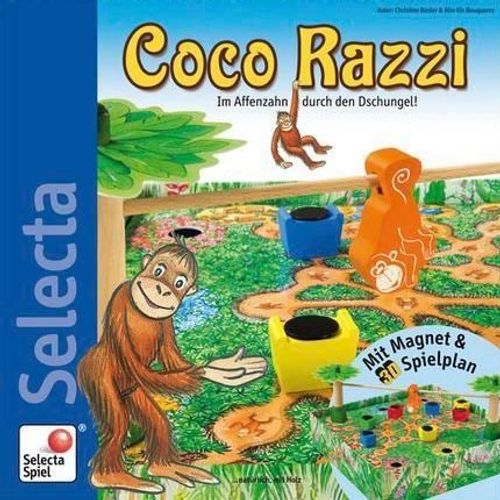
Coco Razzi
Coco Razzi Rulebook
Table of Contents
Table of Contents
Components
- 1 game board (29 x 29 cm)
- 12 baskets
- 1 monkey with magnet
- Palm tree construction
- 32 goods tiles
- 2 palm tops
- 4 market places
- 2 colour dice
- 25 action cards
- These rules
Object of the Game
Each player tries to bring as many fruits as possible with their three baskets to a market on the opposite side. At the same time, with the help of the monkey Pongo, they can steal the goods of their fellow players.
Beware: among the fruit are also coconuts! Other players' coconuts count as negative points at final scoring.
Game Setup
Each player chooses a colour and takes the three baskets and the 8 matching goods tiles. Before the first game, all metal goods tiles are fitted with one of the stickers. The player then places the tiles in front of them with the fruit side facing down. Only that player may know which goods they are transporting. The player places their basket on the village with the coloured roofs in their colour.
With two players, the players may not start from the same village.
Each player also receives one of the market places as a place to store the goods collected during the game. The remaining baskets and goods tiles are set aside. On each long side of the game board, a palm tree is put into the hole in the middle. The two palm tops are each put on top of one of the tree trunks. The monkey Pongo is pushed to any side, close to one of the trees. The action cards are shuffled and placed as a stack, accessible to everyone, next to the game board.
Course of Play
The player who has been in a jungle before begins. Nobody? Then the youngest player begins. They draw the top card from the stack and carry out the action shown on it.
If it is a double card, they choose one of the two actions. If it is a single card, they must carry out that action. After the action is carried out, the card is turned face up and placed beside the stack, and the next player takes their turn. When all cards have been used up, the discard pile is shuffled and used again for drawing.
The Two Card Types
- Single card: You must carry out the action on this card.
- Double card: You may choose one of the two actions shown.
The Action Cards
Village: You must place a new basket on your village and then move it forward by the number of steps shown. If you have no free basket left, you simply move one of your baskets forward by the number of steps shown. If you cannot bring a new basket into play because all the spaces in front of your village are already occupied, you may draw a new action card and carry out the instruction on it.
Footprints: You may move one of your baskets forward by the number of steps shown. Either you move a basket that is already on the game board, or you bring a new one into play.
Monkey: You roll both colour dice. Depending on the colours, the two palm trees are moved, and the monkey Pongo is then pulled along the connecting bar to the opposite side.
Example: You roll blue and red. You may put one palm tree into a hole marked red and the other into the hole marked blue. You usually have two different possibilities for this. Then the monkey Pongo is pulled from one side to the other. If a basket is under the monkey, its goods tile stays hanging on the monkey thanks to a magnet. You may now place this goods tile on your market place. You may look at which goods you have snatched. You should not reveal this to your fellow players.
Goods Swap: You may swap any two goods tiles with each other. You may not look at which goods they are. You may also swap two of your own goods tiles with each other.
Magnifying Glass: You may look under any goods tile. This may also be your own, in case you have forgotten which goods you are transporting.
General Movement Rules
- The starting space is always the village with the roofs in your own colour.
- You may only move forward or sideways, never backwards.
- Baskets (your own and others') may be jumped over. The jumped-over space is counted.
- Only one basket may stand on a space at a time. If a move cannot be carried out for this reason, move another basket instead, or bring a new basket into play.
- When arriving at the market place, points may be lost.
General Monkey Rules
- Moving the palm trees works best by lifting both trees at the same time and moving them.
- The palm trees may stay in place if the dice show exactly the same colours. In this case only the monkey is moved to the other side.
- If several baskets stand in a row, only the first reachable basket is robbed by the monkey.
- The monkey may also steal fruit from your own baskets. These goods go onto the player's market place just like other stolen goods.
- Once the dice have been rolled, the monkey must be played, even if it catches a good the player did not actually want.
- Robbed baskets are set back in front of their player and wait there for their next use.
- The monkey may only rob the baskets standing directly beneath its path. Twisting the monkey sideways to rob baskets on neighbouring path spaces is not allowed!
Tactical Hints
Other players' coconuts give negative points. A player should therefore only steal a foreign goods tile if they are certain it is not a coconut.
Goods already collected should be placed face down on the market place, so that fellow players do not know how many fruits and coconuts are still in the game. It may also be agreed to place them face up, to make the game easier.
End of the Game
The game ends as soon as the first player has collected or stolen five goods tiles. Everyone now turns over their loot and shows it to the other players.
Then scoring takes place:
- Fruit (own and others'): 1 point
- Own coconut: 0 points
- Other player's coconut: -1 point
Goods that are still in play do not count. The player with the highest score wins.
Simpler Variants
Variant 1: The "Goods Swap" cards are sorted out and set aside. This makes it easier to remember where which goods are.
Variant 2: Play is "open": the goods tiles are placed on the baskets with the picture side up. The "Magnifying Glass" cards are sorted out and set aside.
Variant 3: Play is "open": the "Goods Swap" and "Magnifying Glass" cards are sorted out and set aside. All goods tiles (fruit, own coconuts and other players' coconuts) each count as 1 point. The first player to collect 5 goods wins.