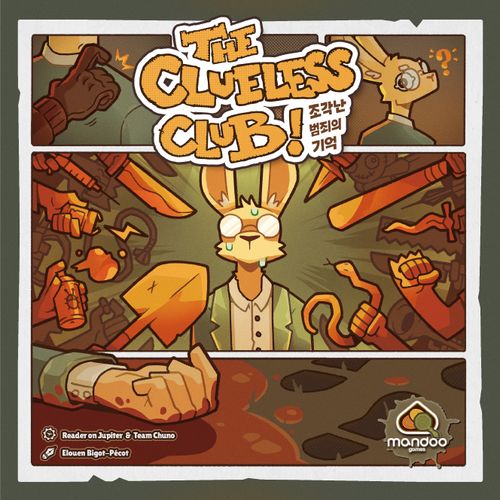
Clueless Club
The Clueless Club Rulebook
Table of Contents
Table of Contents
Key Game Object
All players hold secret information about the crime location, but one player—the culprit—unknowingly holds different information. As crime analysts, you must share your opinions based on the information you have to identify the one player who does not match the group.
If others seem to share your information, you are likely not the culprit; your goal is to identify the culprit and steer suspicion toward them. However, if you find yourself alone, you may be the culprit—conceal this by mirroring the others' opinions. Since the culprit can also escape by uncovering the correct information, share enough to cooperate, but not enough to be exposed.
Components
- 8 Crime Scene Boards
- 18 Opinion Cards (6 cards each for Round 1, 2, 3)
- 12 Confrontation Cards
- 30 Location Cards (5 cards each for numbers 1-6)
- 60 Opinion Tokens (10 tokens each for 6 colors)
- 1 Magnifying Glass Token (First Player Token)
- 20 Weapon Tiles
- 20 Clue Cards
- 6 Circumstance Cards
Personal components (per player): 6 Pencil Tokens, 18 Suspicion Tokens.
Setup
- Select one Crime Scene Board and place it in the center.
- Deal the following personal components to each player: 1 Circumstance Card, 3 Suspicion Tokens, 10 Opinion Tokens, and 1 Pencil Token.
- Separate the Opinion Cards into three piles based on their card backs (Rounds 1, 2, and 3), and shuffle each pile separately. Draw 3 cards from each pile and place them face-down in a 3×3 grid below the Scene Board. Remove all remaining Opinion Cards from the game.
- Shuffle the Confrontation Cards and place them face down in a deck.
- Prepare the Location Cards as follows (for a 3-player game, refer to the "Mr. Rabbit's Scheme" section below):
- The Location Cards should be sorted into six plastic packs. For your first game, you will need to sort the Location Cards into six packs, each containing five cards with the same number. The numbers range from 1 to 6.
- Randomly select one pack and take out [Players minus 1] cards without checking the number.
- Randomly select another pack and take out 1 card without checking the number.
- Shuffle these cards and deal 1 card to each player without revealing the number.
Example: Preparing Location Cards
In a 4-player game, choose one pack and take out 3 cards, leaving 2 cards behind. Then, take 1 card from another pack. Shuffle these 4 cards and deal 1 to each player.
- Shuffle 4 cards.
- Deal to everyone.
Each player's Location Card indicates the location they believe the murder occurred. The location corresponding to the number held by the majority of players is the actual crime scene. The only one player holding a different number is unknowingly the culprit. Avoid focusing too closely on any specific spot on the Scene Board, as doing so may reveal your information to other players.
- The player who most recently held a knife is the first player and takes the Magnifying Glass Token (this token marks the first player and does not move).
- Shuffle Weapon Tiles, then place 1 tile face-up at each location on the Crime Scene Board. Remove the remaining Weapon Tiles from the game.
- Shuffle Clue Cards. Reveal [Players + 1] cards in the center. In turn order (clockwise from the first player), each player takes 1 card and places it face-up in front of them. Remove any remaining Clue Cards.
Each clue card represents a key piece of evidence found at the weapon or scene, left by either the culprit or the victim. When imagining the circumstances of the crime, players focus only on their own clue card and do not consider the clues of others.
Based on your Location Card, the Weapon Tile on the location, and your chosen Clue Card, imagine the circumstances of the crime using the Checklist on your Circumstance Card.
Players take on the role of crime analysts and will present their opinions about the case. It helps to imagine the incident in detail during setup to make the game run smoothly.
Example: Interpreting the Situation
Marco, who chose the glove clue, thinks the culprit prepared gloves to avoid leaving fingerprints. So he imagines it was a planned crime, and that the culprit and the victim may have had a long-standing grudge. Tylor, who has the footprint clue, thinks the traces at the scene were left carelessly. He believes it was an impulsive crime and that the culprit and the victim did not know each other well.
"So these are fingerprint-proof gloves!" — "It was a sudden break-in..."
Gameplay
The game proceeds according to the following flow:
Opinion → Suspicion → Confrontation → Final Vote
(Opinion and Suspicion repeat 3 times before moving on to Confrontation and the Final Vote.)
The Opinion phase is where players express their opinions about the case. After each Opinion phase, players review the opinions for inconsistencies and may use the Suspicion phase to put pressure on one another. After three rounds of Opinion and Suspicion phases, players proceed to the Confrontation phase to identify the suspect. The game then concludes with the Final Vote.
Opinion Phase
- The first player reveals the leftmost Opinion Card from the current round's row by turning it face up.
- All players select a number (1–4) representing how they imagine the crime, adjust their Pencil Token accordingly, and reveal it simultaneously.
- Each player places 1 Opinion Token on the Opinion Card corresponding to their choice.
Opinion Card
Each Opinion Card has four boxes representing degrees or levels.
For example, in the case of injury, 1 means "No Injury," 2 means "Slight Injury," 3 means "Moderate Injury," and 4 means "Severe Injury."
Suspicion Phase
-
After completing the Opinion Phase (by placing the Opinion Token on the third card), each player, starting with the first player and going clockwise, places one Suspicion Token in front of the player they suspect to be the culprit.
You may briefly explain your reason if you wish. Some players may receive multiple tokens, while others may receive none.
-
Players can see who is currently most suspected by the number of Suspicion Tokens in front of them. Once all players have placed their tokens, the player who received the most tokens in this phase has the opportunity to clear their suspicion—they may speak to explain themselves.
Confrontation Phase
-
After the third Suspicion Phase, each player, starting with the first player and going clockwise, has one opportunity to designate a suspect for Confrontation. (Players may be chosen multiple times, or not at all.)
(For a 3-player game, see "Mr. Rabbit's Scheme" below.)
- On your turn, draw two cards from the top of the Confrontation Deck. Designate a player to receive one of these cards, then remove the other card from the game.
- The chosen player reads the question on the received card aloud and provides an answer. They may answer vaguely or even lie depending on their strategy, but they must respond.
If you suspect you are the culprit, you may choose to share opinions based on your guesses about others' information rather than your own. While this helps you avoid suspicion, incorrect assumptions may draw unwanted attention.
Players may agree or disagree with any statement, but they must not ask direct questions or demand answers during this phase.
-
Repeat until all 3 cards for the round are used.
-
Once every player has conducted one Confrontation, proceed to the Final Vote.
Final Vote
-
Take about one minute to discuss, then simultaneously point to the player you believe is the culprit. The player who receives the most votes must reveal their Location Card.
If there is a tie, give the tied players one last chance to plead their innocence. Then, all players vote again, but only the tied players can be chosen. If a tie still remains, all players reveal their Location Cards, and the culprit—the only player holding a different number—immediately wins the game.
-
Any other players who hold a Location Card with the same number as the revealed one must also reveal their cards.
- If all players except one reveal a Location Card with the same number: The culprit—the only player holding a different number—wins the game.
- If no one else reveals a Location Card with the same number: The group has correctly identified the culprit. Without revealing any other Location Cards, the culprit must now guess the real crime scene — the place matching the number held by the other players — and pick up the Weapon Tile from that place. If the culprit chooses correctly, they succeed in destroying the evidence and win the game. If not, the culprit loses, and all other players win together.
-
After the outcome, all non-culprit players describe the version of the case they imagined, based on their Circumstance Cards. The culprit then chooses the player who gave the most convincing explanation of the forgotten truth, naming them the Best Crime Analyst.
Please sort the Location Cards by number and store them in separate plastic packs after the game.
Mr. Rabbit's Scheme (3-Player Variant)
In a 3-player game, you can use this "Mr. Rabbit's Scheme" variant for a more thrilling experience.
Setup
- During setup, when preparing the Location Cards, draw 3 cards from a randomly chosen pack.
- Then, draw 1 additional card from another randomly chosen pack.
- Shuffle these 4 Location Cards well and deal 1 to each player. Remove the remaining 1 card from the game without looking at it. This means there might be no culprit at all in this game!
Final Vote
- When pointing to the player you believe is the culprit, if you think there is no culprit, point to the air instead.
- If all three players point to the air, everyone reveals their Location Cards.
- If all numbers are the same, everyone wins together.
- If the numbers differ, the culprit wins the game.
- If any player doesn't point to the air, resolve the vote normally among the chosen players.