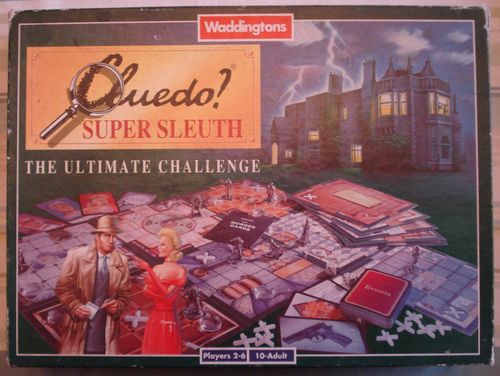
Cluedo?: Super Sleuth
Cluedo?: Super Sleuth Rulebook
Table of Contents
Table of Contents
Contents
- 9 Pewter Character Pieces
- Main Characters (round bases): Colonel Mustard, Professor Plum, Reverend Green, Mrs White, Miss Scarlett, Mrs Peacock
- Incidental Characters (square bases): Inspector Grey, Hogarth the Butler, The Black Dog
- 12 Room Tiles
- 36 Event Cards
- 19 Item Cards (includes 1 spare card)
- 22 Clue Cards (includes 1 spare card)
- 20 Item Cross Tokens (includes 2 spare tokens)
- 20 Clue Magnifying Glass Tokens (includes 2 spare tokens)
- 1 Detective Note Pad
- 1 Murder Envelope
- 2 Dice
- Rules
Object of the Game
To solve, by means of deduction, the mysterious murder of Dr. Black, by being the first player to reach the telephone, in the Main Entrance and make the correct accusation of:-
Who dunnit, where and with what?
Preparations for play
(The rules of an intriguing and interesting game, must inevitably seem to be slightly boring, but these rules have been drawn up as briefly as possible and with a little concentration, should be easily understood).
-
Remove all the components from the box.
-
Place the Main Entrance room tile face up on the surface the game is to be played upon. Shuffle the remaining room tiles and place them face down near the Main Entrance tile.
-
Shuffle the Events card pack and place it face down.
-
Shuffle the Item card pack and place it face down.
-
From the Clue card pack, shuffle the character cards and place them face down. The same is done with the Weapon cards and finally the Room cards. There are now three piles of Clue cards face down. These piles should be moved around so that no one knows which pile is which. One card is taken from each pile and the three cards are placed one by one into the Murder Envelope, which is kept nearby. All the Clue cards can now be shuffled together thoroughly, and placed face down next to the Item and Events cards.
GREAT CARE SHOULD BE TAKEN TO MAKE SURE NO ONE SEES ANY OF THE CLUE CARDS DURING SHUFFLING.
-
Each player chooses one of the six main character pieces and moves this piece throughout the game. The chosen playing pieces are placed on the brown patio of the Main Entrance tile, as are the three incidental characters. Any of the main character pieces which are not chosen by the players will not be used in the game and should be returned to the box. (Note: The fitment inside the box has been designed with nine compartments to house all the character playing pieces after each game).
-
The Clue magnifying glass tokens are placed to one side ready for use as new room tiles are placed on the playing surface.
-
Separate the Item crosses from the plastic sprues by twisting each one until it is released. Place the Item crosses next to the magnifying glass tokens, and dispose of the empty plastic sprues.
-
Each player is given one of the Detective Note sheets, which they may use to mark off the persons, the weapons and the rooms eliminated.
Game Play
- Each player throws a die and the highest number starts first with play continuing in a clockwise direction.
- A player moves by rolling one die. Players' pieces can move the total number of squares on the die, or less if they wish. If the die is rolled they must move at least one square.
- Pieces can only move upon the clear squares indicated on the room tiles. They cannot move on, or through, furniture, walls, Clue squares or Item squares, but they can move over carpets and rugs.
- A player can choose not to move, if they so wish, in which case no die is rolled.
- Pieces must move in straight lines only, i.e. forward, backwards, right or left, but never diagonally. They cannot move through the same square twice in one turn.
- Players may not move their playing pieces onto a square already occupied by another piece. Players must either move to an alternative unoccupied square which does not exceed their die total, or if there are no available unoccupied squares, not move at all.
- Playing pieces are NOT allowed to move over other main character pieces, without permission from the players whose pieces are in the way, and should ask permission before they move.
- If permission is not given, a player must either find a clear alternative route, or stay on the same square for one turn, being allowed to move over the blocking characters on the player's next go. Players pieces cannot move over incidental characters until their next turn.
- A room must be exited via a doorway.
- If a playing piece moves less squares than the number thrown on the die, in order to stop and pick-up a Clue or Item card the player does not move again in that turn unless specifically instructed by the card.
Laying down a new Room Tile
- A new room tile is laid when a player leaves a room whilst moving during the same turn. On reaching an exit (indicated by the room names printed on all four sides) a player turns over a new tile from the top of the pile, places it next to the one they are leaving and continues his turn. The new tile may be placed with any orientation, provided that one of its doorways is lined up with the doorway of the tile that the playing piece is leaving.
- When a playing piece is moving from one tile to another, the doorway of the tile the player is leaving, and the doorway of the tile that the playing piece is moving onto, are not counted as squares.
- When a new room tile is laid, a player must move at least one square in the new room.
- The layout of the tiles should always be on a 4 x 3 grid.
- As soon as the new room tile is laid, Clue magnifying glasses and Item crosses should be placed on the relevant squares. (These are indicated on the tiles by the words "CLUE" and "ITEM").
Searching for Clues and Items
CLUE CARDS
- Clue cards form the basis of deduction through the process of elimination. A player can obtain one of these cards by landing next to a Clue square if it has a magnifying glass on it. On obtaining any of these cards, players should not allow them to be seen, by their opponents.
On receiving a character, room or weapon card players should discreetly record it on their Detective Note sheets, in order for it to be eliminated from their suspicions. Care should be taken to ensure that no other players see their cards or what they have written on their Detective Note Sheets.
Clue cards are retained by the players and are NOT returned to the bottom of the Clue card pile.
ITEM CARDS.
- Item cards function as per the instructions on the cards, and are usually used strategically to gain advantages over other players, particularly later on in the game. A player can obtain an Item card by landing next to an "Item cross" square, provided it has a plastic item cross on it. The instructions on the Item cards are only read aloud when a player wishes to use a card at the beginning of their turn. If an Item card is discarded it is NOT put back into the pack in play.
EVENTS
- An Event card is immediately drawn from the pack when a player throws a red spot on the die. The instructions upon the card are read out aloud and followed by the player, and if the card is discarded it IS returned to the bottom of the card pile.
Making a suggestion
When a player reaches a room, that player can immediately make a "suggestion" to another player, who is already in it, but their turn ends after making the suggestion.
For example, if the player representing Miss Scarlett, entered the lounge, and another player (e.g. Professor Plum) was already in it, she could make a suggestion by saying
"I suggest that the murder was committed in the Study, by Reverend Green with the Spanner".
When making a suggestion, the player does not have to be in the same room, as the room they suspect the murder took place in, or does not have to suspect the person who is in the same room.
NOTE: Spare main character playing pieces fall under equal suspicion as do pieces in play, but are not physically used during the game.
This suggestion having been made, the player who represents Professor Plum's playing piece must examine his cards, and if he has one or more of those cards (the Study, Reverend Green or the Spanner), he must show one only of those cards to the player who is representing Miss Scarlett (unseen by the other players). If the player representing Professor Plum is unable to show one of the cards asked for (the Study, Reverend Green or the Spanner), the player's turn ends.
Note: If a player is in possession of the 'Hypnotist's Crystal Pendant' card or is instructed to make the same suggestion once to each player in a room (dictated by some of the Events cards) the player may be shown more than one player's card if any of the other players are holding any of the cards the player is looking for.
Bluff "suggestions" may be made by including a Person, Weapon or Room from which a player holds the card (or cards) in his own hand. He may thus satisfy himself as to the whereabouts of one card and at the same time mislead other players.
If it is discovered that a player is in possession of a card which he has accidentally or otherwise failed to show to anyone making a "suggestion" to him, thus falsely indicating that he did not hold any of the named cards, he will be penalised by having no further turns in the game, and will remain as a player only to contradict "suggestions". (This does not of course mean that if he holds 2 cards named in a "suggestion" he should show more than one of them).
The Accusation
When a player is satisfied that he knows which are the three Murder Cards, i.e. he has made a "suggestion" to each of the other players and none have shown him any one of the three cards he named, and he does not hold any of them in his hand, he can, make an accusation.
The accusation is done by writing the three names on his Detective Notes, and a player must reach one of the squares adjacent to the telephone on the Main Entrance tile, in order to "check" whether he is correct. This is done by looking at the three cards in the Murder Envelope, taking great care that they are not seen by the other players.
A player can only make one "accusation".
If the "accusation" is correct, the player lays the cards face up on the table showing the three names which he has written on his Detective Notes (ie the Person, the Weapon, and the Room) to the rest of the players, and he is declared the winner.
If the "accusation" is incorrect the player replaces the three Murder Cards unseen by any other player into the envelope. Having made a false "accusation" the player has no further turns in the game, but remains as a player only to contradict "suggestions" made by other players, with the cards he holds in his hand.
In a 2 or 3 player game, after 3 Clue cards have been placed in the Murder Envelope, and the remaining cards shuffled, deal out 2 Clue cards to each player.
Example of an "Item" card
Card: "A Hypnotist's Crystal Pendant". Scene-setter text: "Use this item when you are on a square next to another player and want to make a suggestion to them." Instruction text: "Instead of making the normal one suggestion to that player, you can make two. Your turn is ended." Footer: "Keep this card for future use".
- Type of Item: the card's title.
- "Scene setter": the italic text on the card.
- Instruction to player; e.g. Provided the player moves his piece next to a square occupied by another player, he can ask two different suggestions instead of one. This means that his opponent would have to show him two cards, if he has them in his hand.
- This card is retained by the player during the game, unless another player's card instructs the player to discard it.
Example of an "Events" card
Card: "Hogarth requests the maids to do the dusting". Text: "Remove 2 unclaimed Item crosses from the room Hogarth is in. or If there are no unclaimed items, or Hogarth is not in play, ignore this card." Footer: "Continue your turn, and move up to 6 squares. Discard this card after use".
- Type of Event: the card's title.
- Instruction to player; e.g. If there are any unclaimed Item crosses in the room Hogarth is in, the player removes them but does not take an Item card; or if there are no unclaimed Item crosses or Hogarth is still in the Main Entrance, this card is ignored.
- The card is placed to the bottom of the "Events" card pile.