Clue
Clue Rulebook
Table of Contents
Table of Contents
Object of the Game
Be the first to deduce the three facts of the murder: which suspect did it, with which weapon, and in which room. You do this through suggestions and careful elimination, then win by making a correct accusation.
Equipment
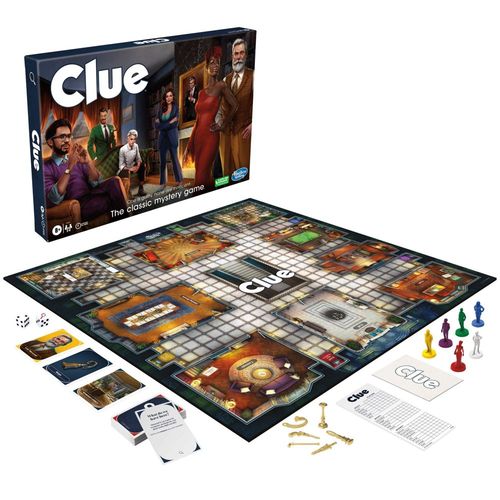
- Gameboard depicting nine rooms of a mansion.
- 6 suspect tokens: Miss Scarlett, Colonel Mustard, Mrs. White, Mr. Green, Mrs. Peacock, Professor Plum.
- 6 weapons: Knife/Dagger, Candlestick, Revolver, Rope, Lead Pipe, Wrench/Spanner.
- Deck of cards: 6 suspect cards, 6 weapon cards, 9 room cards.
- A confidential case file envelope, a detective notepad for each player, and dice.
Setup
- Place the six weapons into rooms (spread them out, one or more per room as they fall).
- Place all six suspect tokens on their named starting squares around the board, regardless of how many people are playing.
- Separate the cards into three stacks: suspects, weapons, rooms. Shuffle each stack, draw one card from each without looking, and place those three into the envelope — this is the solution. Set the envelope in the center.
- Shuffle all remaining cards together and deal them out clockwise; some players may hold one more than others. Look at your own cards secretly and cross them off your pad (they cannot be part of the solution).
- Each player takes the token of their character; unused characters remain on the board as tokens that can still be moved into rooms by suggestions but do not take turns.
Miss Scarlett always goes first; play proceeds clockwise.
Taking a Turn
On your turn:
- Move your token, then
- If you are in a room, you may make a Suggestion, then
- You may make an Accusation (optional).
Moving
Roll the dice and move your token that many squares, horizontally or vertically (not diagonally), through the corridors. You may not enter a square twice on the same turn, and you may not pass through or share a square with another token.
- Enter a room through one of its doorways (a doorway costs one step). You cannot end mid-doorway, and only one token may pass through a doorway at a time.
- Secret passages: rooms in opposite corners are linked by secret passages; if you are in such a room you may, instead of rolling, take the passage to the far room.
- If you were moved into a room by another player's suggestion, on your next turn you may make a suggestion in that room without rolling, or roll and leave as normal.
Making a Suggestion
Once you are inside a room, you may suggest a possible solution naming that room, one suspect, and one weapon — e.g., "I suggest it was Professor Plum, in the Library, with the Candlestick." You must name the room you are currently in.
- The named suspect token and weapon are immediately moved into your room (even if they were elsewhere, and even if that suspect belongs to another player).
- Disproving: starting with the player to your left and going clockwise, each player checks whether they hold any one of the three cards you named. The first player who holds one or more must privately show you one of those cards (they choose which). As soon as one card is shown, the suggestion is disproved and the process stops.
- If no player can disprove the suggestion, that is powerful information — those three cards may all be in the envelope (unless you hold some yourself).
Note the shown card on your pad. Making a suggestion is how you gather evidence; you are not accusing anyone yet.
Making an Accusation
When you believe you know the solution, you may — on your turn — make an Accusation, naming a suspect, weapon, and room. You need not be in the named room, and you may accuse regardless of where your token is.
- Secretly check the envelope: look at the three cards without showing anyone.
- If you are correct, reveal the cards — you win the game.
- If you are wrong, you lose: return the cards to the envelope without revealing them, and you are out of making any further moves or accusations. However, you stay in the game only to disprove other players' suggestions with your cards. Play continues among the rest.
You may make only one accusation per game — get it wrong and you cannot win.
Winning
The first player to make a correct accusation wins. If every player but one has made an incorrect accusation, the last remaining player should verify the solution by checking the envelope and wins.
Strategy Notes
Keep careful track on your detective pad of every card shown to you and every suggestion others fail to disprove. A suggestion you make can also be used to move a rival's token away from a room they want, or to figure out which cards an opponent holds by watching whether they can disprove.