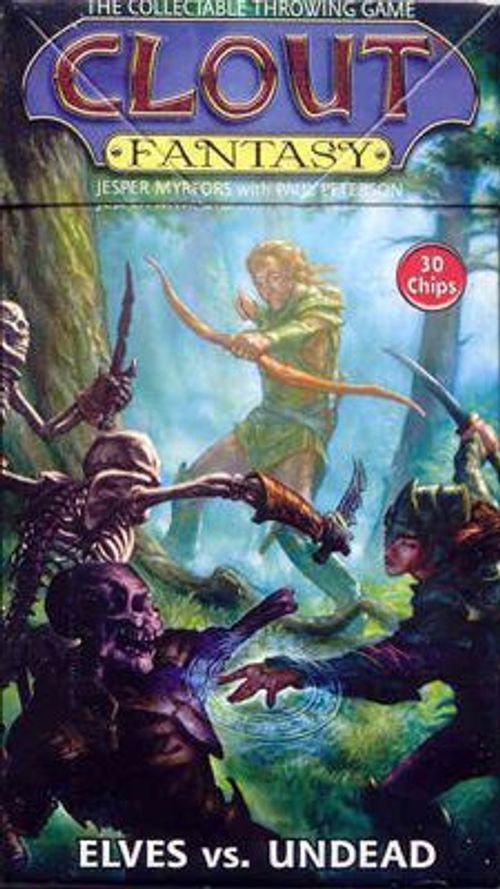
Clout Fantasy
Clout Fantasy Rulebook
Table of Contents
Table of Contents
The Basics
Overview
Players take turns throwing chips from their playing stacks into the playing area. Each chip has a number of clout points, which can be affected by chips near it. Once all of the chips have been thrown, players add up the points on the playing area, and the player with the most clout wins.
Setup
To play Clout Fantasy, you'll need a playing stack of fifteen chips that represent troops, bases, actions, and relics from the same colored faction. The chips in your playing stack are yours alone. You should not reveal any chip to your opponents until you have thrown it onto the playing field. For your first few games, you might want to use one of the ready-to-play stacks included in each Clout Fantasy starter set. After a couple of games, though, you'll probably want to construct your own playing stack (see Creating a Playing Stack in the Advanced Rules section).
You'll also need a playing area to represent the battlefield. A standard playing area for Clout Fantasy is a hard surface that is one square meter in size. However, for more casual play, other playing areas are acceptable (see Playing Areas in the Advanced Rules section).
Before the game starts, you should decide where players will throw their chips. You can either space players evenly around the playing area, or you can designate a specific place for all players to throw from.
You'll also need a measurer such as the one included in a Clout Fantasy starter set. The measurer is different on each side. Use the side with the [all-ability symbol] when playing on a standard playing area, and use the side with the [range symbol] when playing on larger playing areas. The marks indicate range increments. When players of different abilities play together, experienced players should use the black marks, while newer players should use the red marks. (See also Handicapping in the Advanced Rules.)
Parts of a Clout Fantasy Chip
Name. The chip's name appears at the top of the chip.
Clout points. The dots show both the cost to put the chip into your playing stack and the number of points the chip is worth if it is on the playing area at the end of the game.
Range. This number determines the distance from the edge of the chip that it can affect other chips. The distance is measured in range increments, so a chip with a range of 2 when the range increment is five centimeters can affect chips ten centimeters away. (In general, your range increment should be about five centimeters for every meter of diameter. For more on range increments, see Playing Areas in the Advanced Rules section.)
Defense. This number determines the chip's ability to resist attacks from other chips. Action chips have no defense value and have a [action symbol: lightning bolt] printed here instead, to remind you to remove the action chip at the end of the turn.
Rarity symbol. This symbol indicates whether a chip is common [black dot], uncommon [silver ring], or rare [gold diamond].
Text box. The chip's abilities, immunities, and ignorable abilities are listed here.
Expansion symbol. This symbol indicates which set of chips this chip came from. Common chips have a black expansion symbol, uncommon have a silver one, and rare chips have a gold expansion symbol. The chip pictured in the rulebook's diagram does not have an expansion symbol because it comes from the Clout Fantasy base set. Base-set chips don't have expansion symbols.
Faction. The color of the chip, and often its illustration, indicate what themed faction it belongs to. The fifteen chips in your playing stack cannot come from more than one faction. However, your stack may contain a limited number of neutral chips that do not belong to any particular faction.
Chip Types
There are four types of Clout Fantasy chips: troops, bases, actions, and relics.
Troops. Troops are the people and creatures you use to try to control the battlefield. These chips stay in play until an effect removes them. They are worth points at the end of the game. They may also have abilities that activate when they are thrown. Troops do not have any symbols before or after their name.
Bases. Bases represent physical places on the battlefield, such as terrain and fortifications, and are more difficult to destroy than troops. You get an extra point at the end of the game for each of your chips within the range of a friendly base. A standard stack contains exactly two bases. Bases have a [base symbol: tower icon] before and after their name.
Actions. Actions represent events, spells, and other commands that you use to sway the tide of battle. These chips activate when they are thrown but are removed at the end of the turn they are thrown. They cannot be attacked in any way and have no defense value. A [action symbol: lightning bolt] is printed where a defense value would normally appear, to remind you to remove the action chip at the end of the turn.
Relics. Relics represent the powerful magical objects you use to get an edge in battle. They can be small personal objects, such as armor or weapons, or towering monoliths. Relics act like troops in that they stay in play when thrown, but they are unaffected by many of the abilities that affect troops. Relics have a [relic symbol: ornament icon] on either side of their name.
Playing the Game
To decide which player goes first, you can use any random method acceptable to all players. Play order proceeds clockwise and remains the same throughout the entire game. A turn in Clout Fantasy consists of two main steps: throwing a chip and then applying abilities.
Step 1: Throw a Chip
On your turn, select a chip from your stack and throw it onto the playing area. If it's your first turn of the game, you must throw one of your bases, but on later turns you may throw any chip in your stack that you choose.
You may throw your chip any way you wish so long as you obey the following rules: 1) you must throw your chip in an arc (that is, it must go up from your hand before going down to the playing area), 2) your hand may not enter the space above the playing area, and 3) you must throw from at least thirty-five centimeters above the surface of the playing area.
If the thrown chip ends its movement entirely outside of the playing area (by bouncing or rolling, for example) it is removed from play without activating.
It is acceptable for your chip to move a chip that's already on the playing area. However, if it moves the chip outside of the playing area, that chip is moved back into play just inside the nearest edge.
Note that some abilities may modify the way you throw your chip or even allow you to put a chip onto the playing area without throwing it. It is also possible (though unlikely) that you will find yourself unable to play any of the remaining chips in your stack. Should this happen, you must reveal all of your remaining chips to your opponent(s) and then remove a chip of your choice from your playing stack and put it in your discard stack. Repeat these steps on each of your turns until either you are able to play a chip or you run out of chips.
Step 2: Apply Abilities
After you throw a chip onto the playing area, its abilities are usually activated. However, some abilities activate at other times, and some abilities are even optional. Also, abilities activate every time it is appropriate for them to do so. Most standard abilities activate once when the chip is thrown, but other abilities might be activated many times after it is thrown as other chips land or rest within range. Continuous abilities, for example, activate immediately upon landing on the playing area and are always considered to be in effect and applied before other abilities. Refer to the Abilities List: If an ability does not activate once after being thrown, its description will tell you what to do.
Abilities are activated and resolved in several stages. First, movement abilities are activated. Movement abilities affect where a chip ends up on the playing field after it is thrown and may determine what abilities on other chips activate and are applied. After throwing a chip, determine all of the movement abilities that are activating and then resolve them. If two or more abilities indicate conflicting effects that are mutually exclusive and cannot all be resolved (such as moving the same chip to two or more different places), the player whose turn it is decides which effect is applied; the conflicting abilities are ignored.
Next, after all movement abilities have been resolved, other abilities activate. As with movement abilities, you should determine what all of the activating abilities are and which chips they affect before resolving any of them. This is especially important when chips remove each other from play. If you resolve one of the abilities before activating the other, then you might remove a chip before you resolve its abilities. As when resolving movement abilities, if two or more different nonmovement abilities indicate effects that cannot all be resolved, the player whose turn it is decides which effect is applied and ignores the conflicting abilities.
If the order in which two nonconflicting abilities are applied is important, the player whose turn it is decides the order in which they are applied.
Rally abilities can cause new abilities to be activated while you are still resolving other abilities. When this happens, wait until all other abilities have been resolved, and then start the process of applying abilities again for the newly activated abilities, starting with movement abilities and then applying other abilities. If multiple sets of these abilities have activated, resolve each set separately, in the order chosen by the player whose turn it is.
Chips that are removed from play go to the discard stack of the player who owns the chip. Chips in your discard stack do not count for points.
After a chip has been thrown and the effects of all abilities that activated have been resolved, play passes to the next player, clockwise around the playing area.
Examples of Play
Example 1
Homer has one chip on the playing area, Treant Watcher. It has a defense of 2 and two abilities. The first is strike 1. Since there are no chips within range, strike cannot be activated. The second ability is ambush 2, which will remove any of Marge's chips that have a defense of 2 or smaller that end up within range of Treant Watcher. Ambush does not activate when the chip is thrown but instead can be activated with other nonmovement abilities whenever an opponent's chip enters its range.
On Marge's turn, she throws one of her troops: Questing Warrior. It has a range of 1 and a defense of 1. It lands almost two range increments away from the Watcher. However, Questing Warrior has the ability move 1, which means that Marge can move the Warrior one range increment in any direction. Since move is a movement ability, it must be resolved before other types of abilities are applied. Marge moves the Warrior one range increment closer to the Watcher, which is close enough to put the Watcher in range.
Now that all of the movement abilities have been resolved, other abilities can be applied. The Questing Warrior uses its strike ability on the Treant Watcher. Since the Warrior's strike value is higher than the Watcher's defense, the Watcher will be removed. However, remember that in Clout Fantasy you must apply the effects of all activated abilities before removing any chips from play, so before the Watcher is removed it gets to use its ambush ability. Since the Watcher's ambush ability has a greater value than the Warrior's defense value, the Warrior is removed from play as well.
Example 2
Terrance has a Grave Creepers in play. It has a range of 2 and the continuous ability stop. Stop prevents movement abilities from being activated within range of the chip.
Phillip has an Infiltrator in his stack. It has the ability place, which allows him to put the chip on the playing field wherever he would like instead of throwing it. He would like to place it next to the Grave Creepers so that its strike 3 ability can remove the Grave Creepers from play; however, the ability stop prevents movement abilities from activating within its range, so Phillip cannot use place to put it there. However, since place is an optional ability, Phillip could choose to throw the chip normally and try to get it where he wants it.
Winning the Game
When no players have any chips remaining in their playing stacks, the game ends. Players total their points in the playing area, and the player with the most clout wins. Scoring is as follows:
- Each of your chips on the playing area is worth the number of points equal to its point value.
- Each of your chips within the range printed on one or more of your bases is worth an additional 1 point. (Being within the range of multiple bases is not worth additional points; the maximum bonus for a chip is 1 point, regardless of how many bases it is in range of.)
- Certain abilities, such as loyal and disloyal, modify the point value of chips.
- The last chip thrown in the game is treated as though its point value were 0, regardless of its printed point value. It can, however, still earn points normally for being in a base's range and from abilities.
Abilities
Most chips have abilities, which represent what the chip does when in play. Abilities activate when the chip is thrown onto the playing area. Abilities can only affect other chips within range of the chip with the ability. Ranges are measured from the edge of the chip with the ability and can affect any chip that has any part within that range.
Ability Types
All abilities are standard abilities unless they are indicated as continuous in the abilities list below. Standard abilities activate whenever appropriate, when the chip is thrown or when indicated in their ability description. Continuous abilities produce a continuous effect while the chip is in play. Upon landing in the playing area, they activate immediately and affect all chips within range, and they also affect any chip that later lands or rests within range of the chip. The effects of continuous abilities must be resolved before standard abilities are applied.
Ability Classes
Some abilities, but not all, belong to one of several ability classes, such as movement abilities, attack abilities, and rally abilities. Movement abilities (such as exchange, attract, and repulse) affect the final placement of chips, attack abilities (such as ambush, strike, and counterattack) are used to attack your opponents' chips, and rally abilities (such as command, rethrow, and reanimate) cause another chip to activate. All movement abilities must be resolved before any other abilities may be applied.
Abilities List
Ambush. Whenever one of your opponent's troops rests within range of this chip, compare the ambush value to that chip's defense. Remove the opponent's chip from play if its defense is less than or equal to the ambush value. This is an attack ability. You may choose not to activate this ability.
Attract. Move a number of troops in range equal to the attract value directly toward this chip until they reach the edge of this chip. Stack chips if necessary. This is a movement ability.
Aversion. Whenever one of your opponent's troops lands within range of this chip, it must be rethrown once. If it lands within range of any of your chips with aversion on the new throw, it is not rethrown again. This is a continuous ability.
Bomb. If any of your opponents' troops rest within range of this chip, then remove those chips and this one from play.
Boost. Add the boost value to the attack abilities of any of your chips within range of this chip. This is a continuous ability.
Command. Choose a number of your chips within range up to the command value and activate them. Do not rethrow the chips unless an ability allows or requires you to do so. Do not activate any rally abilities on those chips. This is a rally ability. You may choose not to activate this ability.
Counterattack. When one of your opponents' troops uses an attack ability on this chip, compare the counterattack value to the defense value of the attacking chip. Remove that chip if its defense value is lesser than or equal to the counterattack value. This is an attack ability. You may choose not to activate this ability.
Destroy. Remove from play a number of troops and/or relics (yours and/or your opponents') within range equal to the destroy value. Chips that are closer to this chip must be removed before chips that are farther away.
Disloyal. This chip is worth 1 point less at the end of the game for every opponent's chip within range. A chip cannot be worth less than 0 points. This is a continuous ability.
Exchange. After throwing this chip, exchange its position with that of one of your other chips within range. This is a movement ability. You may choose not to activate this ability.
Fly. For the purposes of determining whether this chip is within range of an opponents' chip without fly, the distance between the two chips is increased by 1 range increment. The range is not adjusted when applying the abilities of chips that have fly or when applying this chip's abilities to other chips. This is a continuous ability.
Loyal. This chip is worth 1 additional point at the end of the game if any other chip of yours is within range. This is a continuous ability.
Master. Chips that are within range of a chip with master may use [master symbol: hand icon] abilities. This is a continuous ability.
Move. On the turn this chip is thrown, the owner may move the chip up to the move value in range increments from its landing position. This is a movement ability. You may choose not to activate this ability.
Place. You may place this chip anywhere on the field instead of throwing it. You may choose not to activate this ability and throw the chip normally. The chip activates as though thrown. This is a movement ability.
Poison. Remove any chips without poison belonging to you or your opponents that rest within range of this chip.
Possess. You gain control of an opponent's chip within range of your choice. As long as that chip is in play and in range, apply all rules as though the chip were yours, including scoring points at the end of the game. Control returns to the previous owner if this chip is removed from play or if this ability is removed.
Precision. After you throw this chip, you may choose to rethrow it. You may do so up to a number of times equal to its precision value. This is a movement ability.
Protect. Increase the defense of all of your troops within range by the protect value. This is a continuous ability.
Provoke. When choosing the target of an attack ability, a player must choose a chip with provoke before a chip without provoke. This is a continuous ability.
Push. On the turn this chip is thrown, the owner may move another of their chips within range up to push value in range increments. This is a movement ability. You may choose not to activate this ability.
Raze. Remove from play a number of bases and/or relics (yours and/or your opponents') within range equal to the raze value. Chips that are closer to this chip must be removed before chips that are farther away.
Reanimate. Remove from play one of your troops within range, then select one of the other troops in your discard stack and throw it. You may not throw one of the troops from your discard stack unless you removed one of your troops from play. The chip activates normally when thrown except that none of its rally abilities activate. This is a rally ability.
Replace. Do not throw this chip. Instead, you must remove one of your other chips from play and place this one in its position. This chip activates as though thrown. This is a movement ability.
Repulse. Move a number of your opponent's troops equal to the repulse value directly away from this chip until they are outside of the range of this chip. This is a movement ability.
Rethrow. Pick up another of your chips within range and throw it. That chip activates. Do not activate any rally abilities on the chip. This is a rally ability. You may choose not to activate this ability.
Siege. Choose one of your opponent's relics or bases within range. Compare its defense value to the siege value. Remove that chip from play if its defense value is lesser than or equal to the siege value. This is an attack ability. You may choose not to activate this ability.
Stop. No chips within range of this chip can activate movement abilities. This is a continuous ability.
Strike. Choose one of your opponent's troops within range of this chip and compare its defense to the strike value. Remove that chip from play if its defense is lesser than or equal to the strike value. This is an attack ability. You may choose not to activate this ability.
Support. Increase the range of all of your other chips within range by the support value. This is a continuous ability.
Team. The values of all attack abilities for this chip are increased by 1 for each of your other chips with team within range. This is a continuous ability.
Trap. Choose a number of all opponents' troops within range equal to the trap value. Ignore the point values and all abilities of those chips. Chips regain their abilities and point values if this chip is removed from play or this ability is removed.
Unique. You may not throw this chip if another copy of it is on the playing area. This is a continuous ability. A playing stack can have no more than one copy of any chip with unique.
Weaken. The values of all attack abilities for all opponents' chips within range is lowered by the weaken value. This is a continuous ability.
Immunities to Abilities and Ignoring Abilities
Some chips have immunities to certain abilities, which is indicated by parentheses around the ability's name. A chip that is immune to an ability cannot have that ability applied to it. For example, (Strike) means that the ability strike cannot be applied to the chip. Chips that are immune are not counted when applying abilities that have a set number of targets.
Other chips can ignore certain abilities, which is indicated by brackets around the ability's name. An ability that can ignore a certain ability treats chips within its range as though they do not have that ability. For example, strike 4 [Fly] means that when you apply your strike ability toward another chip, you treat that chip as though it does not have the fly ability. However, that chip still has fly for purposes of other abilities your chip has.
Ability Modifiers
The abilities list describes what each ability does normally. However, abilities can be modified to create slightly different effects. These modifiers are indicated by symbols after the ability. An ability may have more than one modifier.
An all ability ([all symbol]) affects all chips, both yours and opponents', within range of the chip. This modifier is applied to abilities that normally only affect a limited number or type of chip. If this modifier is on an ability that you can choose not to activate, you may still choose not to activate it.
A friendly ability ([friendly symbol]) affects only your chips. This modifier is applied to abilities that normally don't affect your chips or that normally affect all chips. If this modifier is on an ability that you can normally choose not to activate, you do not have that choice any longer and must activate the ability.
An opponents' ability ([opponents' symbol]) affects only opponents' chips. This modifier is applied to abilities that normally don't affect opponents' chips or that normally affect all chips.
A remove ability ([remove symbol]) does not activate automatically. Instead, you may choose whether or not to activate it when you throw the chip. If you choose to activate it, then you must remove the chip from the playing area at the end of the turn.
A master ability ([master symbol]) can only be activated if the chip is within range of a chip with the ability master.
Advanced Rules
Playing Areas
The standard playing area for Clout Fantasy is a square that is one meter on each side, on a hard surface. However, for casual play you can play it almost anywhere: your kitchen floor, your schoolyard, a pool table, a Persian rug, and so on. When choosing a place to play Clout Fantasy, keep two things in mind. First, the size of your playing area determines the range increment you will use during the game. The range increment determines how close chips must be to affect one another. In general, your range increment should be about five centimeters for every one meter of diameter. For example, if your playing area is one meter across, your range increment should be five centimeters, while for a four-meter playing area, your range increment should be twenty centimeters.
The second thing to remember is that the playing area's surface will affect the dynamics of the game. If you play on a hard substance, such as wood or linoleum, chips will bounce and roll more than if you play on carpet or earth. Both are playable areas though.
Handicapping
Physical dexterity is essential in Clout Fantasy and can improve with practice. After just a few games, many players excel at making chips land close to where they want them, giving experts a big advantage over new players. But it's easy to make a game between two players of different skill levels more fun and fair. Just set a different range increment for each player. Giving the inexperienced player a larger range increment will mean that they do not have to be as accurate in their throws, which will make the games more even. The measurer included with the starter set is marked with measurements for handicapping. The more experienced players should use the black markings, while the less experienced players should use the red markings.
Creating a Playing Stack
Each Clout Fantasy player needs their own playing stack of chips. When you first start playing and have limited numbers of chips, it is permissible to play with a stack of any fifteen chips, such as one of the ready-to-play stacks found in a Clout Fantasy starter set. Once players have sufficient chips, however, they should follow the rules for constructing a stack to ensure that players have an even footing:
- A playing stack must have exactly fifteen chips.
- A playing stack can have no more than three copies of any chip.
- A playing stack can have no more than one copy of any chip with the ability unique.
- The chips in your playing stack may not come from more than one faction. In general, this will mean that all the chips are the same color. However, your playing stack may contain up to two neutral chips.
- The total point value of all chips in the playing stack must be 25 or less.
- The stack must contain exactly two bases.
Glossary
The printed glossary entries for the five ability modifiers show only the modifier symbol followed by its definition. The modifier names used as headings below are taken from the Ability Modifiers section above, in the same order.
Ability. A feature of a chip that may affect other chips near it and may also be modified by abilities on chips already in play. Abilities are usually activated when a chip is thrown. Abilities come in two types (standard and continuous) and may belong to an ability class (such as movement or attack).
Ability modifier. A variation of an ability that produces slightly different effects from the normal version. Modifiers are indicated by a symbol following the ability ([all symbol], [friendly symbol], [master symbol], [opponents' symbol], or [remove symbol]).
All ability. An ability modifier that makes an ability affect all chips within range of the chip.
Friendly ability. An ability modifier that makes an ability affect only your own chips.
Master ability. An ability modifier that can only be activated if the chip is within range of a chip with the ability master.
Opponents' ability. An ability modifier that makes an ability affect only opponents' chips.
Remove ability. An ability modifier that makes activation optional, but with a cost. A remove ability does not activate automatically. Instead, the thrower may choose whether or not to activate it. If the thrower chooses to activate it, then the chip is removed from the playing area at the end of the turn.
Action. One of the four types of chips (with troops, bases, and relics). Actions activate when they are thrown but are removed at the end of the turn they are thrown. They cannot be attacked and are printed with a [action symbol] symbol instead of a defense value.
Activate. Begin resolving the effects of a chip's abilities. Chips activate when they are thrown but may also be activated by other abilities. Activate also refers to resolving the effects of a single ability on a chip.
Attack ability. One of several ability classes an ability may belong to. Compare the attack value to the defense value of an opponent's chip, and remove the opponent's chip from play if its defense value is less than or equal to the attack value. Certain abilities (such as weaken and boost) modify all attack abilities.
Base. One of the four types of chips (with troops, actions, and relics). Players receive an additional point for every chip within range of a base at the end of the game. Bases have a [base symbol] before and after their name.
Clout points. The number of white dots between the art and text box on a chip. The clout points indicate both how much it costs to put the chip into your playing stack and how many points the chip is worth if it is in play at the end of the game.
Continuous ability. One of the two ability types (with standard ability). Continuous abilities produce a continuous effect while the chip is in play. Upon landing in the playing area, they affect all chips within range, and they also affect any chip that later lands or rests within range.
Defense. A chip's ability to resist attacks from other chips. Troops, bases, and relics have defense values, but actions do not.
Discard stack. The stack of a player's chips that have been removed from play. Chips in your discard stack do not count for points.
Faction. All of the chips that exist within a particular color theme. Orange chips represent the goblin faction, for example.
Ignorable ability. An ability on all chips within range that you can ignore when applying a particular ability on your chip that has the ability to ignore. An ignorable ability is indicated by brackets around the ability's name. See Ignore, below.
Ignore. Treat chips within range as though they do not have the indicated ability when applying the ability specified on your chip. Ignoring is indicated with brackets on your chip. For example, assault 3 [Fly] means that when applying your assault ability, you treat all chips within range as though they do not have fly. However, those chips still have fly for the purposes of applying other abilities your chip might have.
Immunity. An ability that the chip is immune to. A chip that is immune to a certain ability cannot have that ability applied to it. Chips that are immune are not counted when applying abilities that have a set number of targets. Immunity to an ability is indicated by parentheses around the ability's name.
Land. When a chip is on the playing surface after being thrown but before abilities have activated. For rules purposes land applies only on the turn the chip is thrown or in which its abilities activate. (See also Rest.)
Movement ability. One of several ability classes an ability may belong to. Movement abilities affect the final placement of chips on the playing area. They are resolved before any other abilities, which means that a player may be able to move the chip away from chips that might attack it or toward chips that it might attack.
Neutral chip. Neutral chips have no faction. They may be used in any stack of any faction so long as the rules for creating a stack are followed.
Playing area. The area into which chips are thrown. Chips landing outside of the playing area are removed from play, and only chips within the playing area count for points at the end of the game. Chips moved outside of the play by other chips are placed just inside the playing area at the nearest edge.
Playing stack. The set of chips that a player can choose from on their turn.
Rally ability. One of several ability classes an ability may belong to. Rally abilities allow you to activate additional chips during your turn but may restrict which abilities on those chips you may activate.
Range. The distance at which a chip can affect other chips. This distance is measured in range increments from the edge of the chip.
Range increment. The unit of measure, agreed upon before the game starts, in which all ranges in a given game of Clout Fantasy are measured. For example, if the range increment is five centimeters and a chip has a range of 3, the chip can affect chips within fifteen centimeters of its edge. In general, your range increment should be about five centimeters for every meter of diameter of your play surface. For example, a one-meter playing area has a five-centimeter range increment, while a four-meter playing area has a twenty-centimeter range increment.
Relic. One of the four types of chips (with troops, bases, and actions). Relics stay in play when thrown but are unaffected by many of the abilities that affect troops. Relics have a [relic symbol] on either side of their name.
Remove from play. Place the chip in its owner's discard stack.
Rest. When a chip is on the playing surface and all movement abilities have been resolved. For rules purposes rest applies only on the turn the chip is thrown or in which its abilities activate. (See also Land.)
Standard ability. One of the two ability types (with continuous ability). Most standard abilities activate once when the chip is thrown but have no continuous effect on play. All abilities are standard abilities unless they are indicated as continuous in the abilities list.
Troop. One of the four types of chips (with bases, actions and relics). Troops stay in play and are worth points at the end of the game. They may also have abilities that activate when they are thrown.
Value. The number printed after an ability's name. The abilities list describes what the value of each ability indicates.