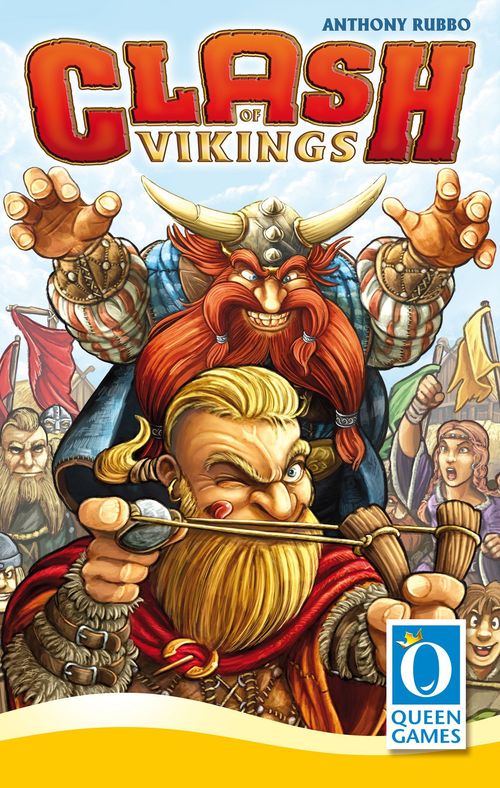
Clash of Vikings
Clash of Vikings Rulebook
Table of Contents
Table of Contents
Components
Shared game components:
- 1 Arena board, assembled from 2 parts
- 1 Overview board, double sided: "A" side (Base Game) and "B" side (Bluff arena variant, see the Bluff Arena Variant section)
- 1 Viking trophy, assembled from 2 parts
- 25 Bracelets: 6x value 1, 8x value 2, 7x value 3, 4x value 4
- 1 Rules booklet
Game materials for each player (in each of the 4 Viking colors: red, yellow, blue, and green):
- 1 Viking and 1 Draw board
- 12 Clash cards: 2x Walk, 1x Sprint, 1x Slam, 1x Club, 2x Punch, 1x Hammer, 2x Slingshot, 2x Shield
Object of the Game
The time has come for the annual Viking brawl, where the best warriors will test their skills and daring in the arena in a challenge to collect the most treasure. Clever bluffing and good timing is needed to triumph in the Clash of the Vikings. On their turn, a player will play a card face-down and announce an action – but did they tell the truth, or are they bluffing? That is for the other players to decide. The actions on the cards will allow you to move around the arena and collect bracelets, or attack the other players to make them drop the treasure they have collected. The game will end when all the loot has been collected, and whichever Viking collects the most is the winner and gains the Viking trophy!
Set-up
-
The arena board is assembled and placed on the table, with players deciding which side they want to play. The overview board is placed next to it with the A side up.
-
Each player takes a set of Clash cards, a Viking, and a Draw board of the same color. Each player also takes 1 bracelet each of value 1, 2, and 3. The bracelets are kept face-down in front of the players and the Viking is placed on one unoccupied Starting space in the arena. All players shuffle their cards and place them face-down as a draw pile next to their Draw board. Then, each player draws the top three cards to form their hand.
Note: Cards discarded during the game are turned 90 degrees and placed on the other side of the Draw board.
-
Shuffle the rest of the bracelets face-down and form a supply next to the arena. Randomly draw from the supply and place one bracelet face-up on each of the Bracelet spaces on the board.
In a 2-player game draw 9 and in a 3-player game draw 6 bracelets from the supply and return them to the box unseen.
-
The Viking trophy is placed next to the arena and a starting player is randomly determined.
Playing the Game
CLASH OF VIKINGS is played in a clockwise direction beginning with the starting player.
On a turn, the active player must play two cards from their hand, one after the other. For each card played, there are three phases:
- Phase 1: Announce action
- Phase 2: Call Bluff
- Phase 3: Perform Action
Note: Phase 3 is sometimes skipped, depending on the outcome of Phase 2.
Once both cards have been played, all players who have fewer than three cards refill their hand back to three cards from their draw pile. If a player's draw pile is ever empty, they should shuffle their discard pile to form a new draw pile. The next player clockwise becomes the new active player.
The game ends at the end of the turn in which there are no more bracelets remaining in the supply. All players count the total of their bracelets, and the player with the highest total is the winner and gains the trophy!
A Player's Turn in Detail
If the active player's Viking is on the Center space, they immediately take two bracelets from the supply, and place them face-down in front of them. If there is only one bracelet left, they should take only one.
Now the active player must play two cards.
- First they choose one of their three cards in hand and follow the 3 phases in order:
Phase 1: Announce Action
The player announces the action, without revealing their card, which may or may not be the action listed on their card. The card is then placed face-down on the column of the overview board that corresponds to the announced action.
Example: The blue player plays one of her cards to the overview board and announces that she has played "SPRINT." Is this the truth or did she bluff?
Phase 2: Call Bluff
Before the player performs the announced action, all other players, with at least one bracelet in front of them, have the opportunity to declare that they think the active player is bluffing (i.e. that the announced action is not the action listed on the player's card). Only one player may call a bluff, so the person who declares they want to call one first will get to.
Note: In rare cases, if it cannot be determined who called first, the next player in player order wins the call.
Example: The green player calls a bluff on the declared "SPRINT." Since the red player does not have any bracelets he cannot call a bluff, even if he wanted to.
-
If nobody calls a bluff, play continues with Phase 3: Perform Action.
-
If a bluff is called, the active player reveals their played card:
Active player did not bluff (told the truth): The active player takes any one bracelet from the player that called a bluff, then proceeds to Phase 3: Perform Action.
Active player did bluff (did not tell the truth): The player who called the bluff takes any one bracelet from the active player. If the active player has no bracelets left, they take a bracelet from the supply, if possible. Phase 3: Perform Action is then skipped.
Phase 3: Perform Action
The active player performs the action they announced, regardless of if the card was revealed or not.
Move: WALK & SPRINT
The player may move their Viking one (WALK) or up to two (SPRINT) spaces in any direction in the arena, following the movement rules:
- 1: A Viking may move to any adjacent space, which counts as one movement.
- 2: Only one Viking can be in any one space. A Viking can move through another Viking with SPRINT (not SLAM) but cannot end its movement on a space with another Viking.
- 3: The water spaces cannot be moved onto or through.
- 4: If the Viking movement ends on a space with one or more bracelets, the player picks up all bracelets and places them face-down in front of them.
Push: SLAM
The player moves their Viking up to two spaces onto a space with another Viking, moving the opponent's piece to an adjacent space of their choice. The piece cannot be moved onto a water space or a space occupied by another Viking. If the Viking is placed on a space with bracelets, that player takes the bracelets.
If a player is not within two spaces of another player, they may not use a SLAM.
Melee Attack: PUNCH, CLUB
The active player's Viking may attack any one Viking adjacent to their own.
-
CLUB: The active player takes any one bracelet of their choice from the attacked player, placing it face-down in front of them.
-
PUNCH: The active player takes any one bracelet of their choice from the attacked player, revealing it and placing it face-up on a space adjacent to the attacked Viking. It cannot be placed on the active player's Viking. If the bracelet is placed on a water space it is immediately removed from the game and placed back in the game box. If the bracelet is placed on a space with another player's Viking that player takes the bracelet.
Example: The yellow player does the "PUNCH" action and takes one bracelet from the green player, placing it face-up on the space already containing a bracelet.
Note: If a player does not have any bracelets, the attacking player does not get any bracelet through CLUB or PUNCH.
Shield
The SHIELD may be used by an attacked player to counter a melee or ranged attack (but not SLAM).
Instead of losing a bracelet to the active player, the player may announce that they have a SHIELD and place a card face-down next to the overview board.
Important: The player can bluff about having a SHIELD. They may place any card face-down next to the overview board.
The active player then has the chance to call a bluff on the declared shield:
-
If the active player does not call a bluff, the attack action is not carried out and play continues.
-
If the active player calls a bluff, the SHIELD card is revealed:
It is a SHIELD: The attack action is not carried out and the attacked player takes any one bracelet, if possible, from the active player, placing it face-up in front of them.
It is not a SHIELD: The active player takes any one bracelet from the attacked player, if possible, placing it in front of them. Then they still carry out their attack action.
Note: The bluff-call outcome above is printed in the rulebook under the Ranged Attack heading, but it applies to any SHIELD played against a melee or ranged attack.
Ranged Attack: SLINGSHOT, HAMMER
The active player's Viking may attack any one Viking standing at least two spaces away.
-
HAMMER: The active player takes any one bracelet of their choice from the attacked player, placing it face-down in front of them.
-
SLINGSHOT: The active player takes any one bracelet of their choice from the attacked player, placing it face-up on a space adjacent to the attacked Viking. If the bracelet is placed on a water space it is immediately taken out of the game and placed back in the game box. If the bracelet is placed on a space with another player's Viking that player takes the bracelet.
Example: The green player performs the "SLINGSHOT" action and takes a bracelet from the yellow player, choosing to place it on the water, which removes it from the game.
Note: If a player does not have any bracelets, the attacking player does not get any bracelet through HAMMER or SLINGSHOT.
Second Card
After this, the active player plays their second card following the same three phases.
Turn End and Drawing Cards
All cards played to the overview board are placed face-down on the respective player's discard pile. All players with fewer than three cards in hand draw up to three cards again. If a draw pile is empty, the discard pile is shuffled and used as the new draw pile.
If a Bracelet space is unoccupied by a Viking and has no bracelet on it, a bracelet is drawn from the supply, if possible, and placed face-up on the Bracelet space.
Note: While the player's bracelets are kept face-down, a player may always look at their own bracelets to check their values.
Play continues with the next player's turn.
Game End
The game ends after the turn in which there are no more bracelets left in the supply.
Players reveal and total up the value of their bracelets. Whichever player has the highest total is the winner and claims the Viking trophy!
In case of a tie, the player with more bracelets wins. If the tie persists, there are multiple winners.
Bluff Arena Variant
Here, players will need to bluff more and calling a bluff will happen more frequently, making the game more challenging.
Changes during set-up: Players remove one SHIELD, PUNCH and SLINGSHOT card which will not be used in the game. The overview board is placed with the B side up. Each player draws two cards instead of three.
Changes during game play: Players still have to play two cards on their turn, but now only having the choice in which order they want to play their two cards. After a player's turn, all players draw up to two instead of three cards.