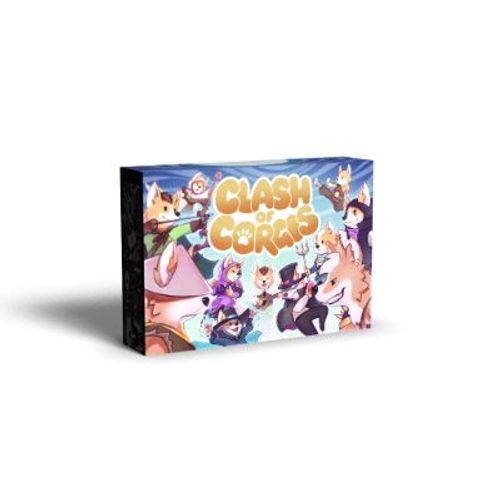
Clash of Corgis
Clash of Corgis Rulebook
Table of Contents
Table of Contents
Original
Overview
Clash of Corgis Original is a card game where players aim to be the first player to get rid of all of their cards in their hand. Players will be challenged to keep a strong hand throughout the game, and must also consider how to best use their cards' special effects wisely in the path to victory.
Objective
Be the first player to get rid of all cards in their hand.
Setup
Shuffle the deck and deal 12 cards to each player's hand. Place aside the remaining cards in the deck face-down at the corner of the table. Randomly pick a player to go first. For consecutive games, the winner of the previous game goes first.
How to Play
Players play the game in rounds. For each round, starting with the first player and going clockwise around the table, each player takes a turn playing a card combination (known as a combo) until all but one player can no longer make a combo, or chooses not to. Then, the player of the unbeaten combo starts a new round. Play continues until one player gets rid of all cards in their hand.
Starting a Round
If you are the first player of a round, play any combo (known as the leading combo) from your hand face-up to the middle of the table. There are 5 types of combos:
- Single: One card of any rank.
- Double: Two cards of the same rank.
- Triple: Three cards of the same rank.
- 4-of-a-Kind: Four cards of the same rank.
- 5-of-a-Kind: Five cards of the same rank.
Card Effect Activation
Once a player has played a combo, that player activates one card effect of the card(s) played, if possible (see Card Effects).
Continuing a Round
If there is a leading combo already on the table, you must Beat or Pass.
Beat
Play a combo from your hand that:
- Matches the same type of combo as the leading combo, and
- Has a higher card rank than the leading combo's card rank
Note: When a player chooses to beat the leading combo, they must play their card(s) on top of the leading combo. By doing so, the card(s) played become the new leading combo. This will create a face-up pile of cards in the middle of the table. (It is okay if the cards shift around on the table as long as all players can see and are aware of the leading combo.)
Pass
Announce 'Pass' and end your turn.
Ending a Round
A round ends when a player plays a leading combo in which afterwards, all other players, on their turn, 'Pass' in succession. The player of this unbeaten leading combo gathers the pile of cards from the middle of the table, sets them aside in a pile at the corner of the table, and starts a new round. Play continues, round after round, until a player gets rid of all cards in their hand. That player is the winner.
4 Player Example Round
The example is shown as a sequence of plays:
- P1 begins the round and plays a 1.
- P2 beats the 1 with a 7.
- P3 passes.
- P4 beats the 7 with a 9.
- P1 beats the 9 with an A.
- P2, P3 & P4 pass. P1 wins the round.
Card Effects
1 Oracle (Chance): Privately view the top card of the deck. If the suit of that card matches a suit from a card in this combo, discard it to win the round. Otherwise, return it to the top of the deck.
2 Bard (Sing): Play your turn again, but if you do, at least 1 card from your next play must match this card's suit.
3 Healer (Heal): Draw 1 card. Then, return 1 card from your hand to the bottom of the deck.
4 Monk (Mix-Up): Target the next player. Declare high or low. If you said low, the next play must be lower ranked to beat this play. If you said high, the next play must be higher ranked (as usual).
5 Fighter (Pierce): Target the next player. Force them to expose a card from their hand. That card can not be played this round. (see Expose in Important Terms)
6 Mage (Burn): Discard 1 card from your hand that matches this card's suit.
7 Archer (Deadeye): Target any player. Randomly select a card from that player's hand and expose it. (see Expose in Important Terms)
8 Berserker (Panic): If a player chooses to pass on their turn while this card is part of a leading combo, that player must expose a card of their choosing. (see Expose in Important Terms)
9 Assassin (K.O.): Target the next player. Skip their turn.
Ace Samurai (Parry): During another player's turn, you may activate this card while in your hand to cancel a card's effect that targets you as a player. If played this way, you must expose this card. (see Expose in Important Terms)
Wild Illusionist (Illusion): This card can beat any rank. Once played, this card copies the rank and the effect of the previous leading combo. If played first in a round, the rank becomes 0 and has no effect. The Wild can not be used in combination with other non-Wild cards.
Important Terms
Rank: The rank is the relative strength of a card and it is found at the top-left of a card. Cards rank from low-to-high: 1 2 3 4 5 6 7 8 9 A
Suit: The suit represents the clan that a card belongs to and is located below the rank of a card. There are 5 different suits. From left-to-right they are: Earth, Water, Fire, Wind, and Void.
Leading Combo: The leading combo is the combo in the middle of the table that players must attempt to beat in order to play cards from their hand. Once a player beats the leading combo, their combo becomes the new leading combo.
Hand: The hand is where players keep their cards private from all other players.
Exposed Hand / Expose: When a card is exposed, it becomes visible to all players. Exposed cards are immediately placed face-up in that player's exposed hand area, which is directly in front of each player. The exposed hand is part of a player's hand. Therefore, players must get rid of all cards in their hand, including their exposed hand, to win. In addition, exposed cards can only be played as a Single combination.
Playing Area: The playing area (also referred to as the middle of the table) is an area where combinations are played to.
Deck: The deck is composed of the leftover cards that remain after the initial setup of the game. It is placed face-down at the corner of the table. Certain card effects will make use of the deck.
Discard Pile: The discard pile is where cards are sent to from the middle of the table after a round ends. Certain card effects will send cards directly to the discard pile. Cards in this pile remain face-up. It is placed to an edge or corner of the table.
Treasure Island
Overview
Clash of Corgis Treasure Island is a card game where players aim to gain points (referred to as loot) by building a party of fighters to defeat foes. You'll need to consider the strength and effects of your fighters, but also how you can achieve bonus effects on your path to victory.
Objective
Be the first player to win 10 points (known as loot).
Setup
Shuffle the deck and deal 3 cards to each player's hand. Place aside the remaining cards in the deck face-down in the middle of the table. Randomly pick a player to go first. For consecutive games, the winner of the previous game goes first.
How to Play
Starting with the first player and going clockwise around the table, each player takes a turn consisting of 3 phases in the following order:
Phase 1: Draw
Draw from the deck until you have 3 cards in your hand. If the deck runs of out cards (at aytime during the game), the current turn's player must immediately shuffle all of the cards in the discard pile and form a new deck.
Phase 2: Build your Party
Play up to one card from your hand face-up to table area directly in front of you. (This area is know as your party.) (You can have a maximum of 2 cards in your party.) If you already have 2 cards in your party, you may replace a card in your party with a card from your hand by discarding the card in your party that you wish to replace and playing the desired card from your hand into your party. After playing a card, activate its effect, if possible (see Card Effects).
Phase 3a: Fight
To fight, you must have at least 1 card in your party. You may declare and take 1, 2, or 3 cards from the top of the deck (keeping the face of the card(s) hidden from all players including yourself) and lay the cards face-down in the middle of the table. (These cards, taken in this manner, are known as foes and the number of cards taken represent how many foes you wish to fight with your party.)
Phase 3b: Determine a Victor
Flip the foes face-up for all players to see. Then, compare the total sum of the rank of your party to the total sum of the rank of the foes. (Note that both the Ace and the Wild are treated as a rank of 10). There are 2 possible outcomes, win or lose.
Win: If the total sum of the rank of your party is greater than the total sum of the rank of the foes, take the foes and place them as loot face-up into your loot pile (as you have defeated the foes and have taken their loot). (Note that the foes turn into loot if you win.)
Lose: If the total sum of the rank of your party is equal to or lower than the total sum of the rank of the foes, discard the foes (as they have escaped with the loot).
Phase 3c: Retire your Party
Discard all cards in your party to the discard pile.
Example of a Fight
You have a 7 and 9 in your party.
You choose to fight this turn. You feel confident and decide you want to fight 2 foes. So, you declare and take 2 cards from the top of the deck and lay the cards face-down in the middle of the table.
Then, you flip the foes face-up. Then, compare the total sum of the rank of your party to the total sum of the rank of the foes.
- Total Rank of Foes: 10 + 1 = 11
- Total Rank of Your Party: 7 + 9 = 16
You win because your rank is higher! Take the foes as loot and retire your party by discarding your party to the discard pile.
Card Effects
1 Oracle (Future Sight): Privately look at the top card of the deck. If it is the same suit as this card, take it as loot. Otherwise, place it back on the top of the deck.
2 Bard (Inspiration): Draw a card. Then, you may retake your 'Build your Party' phase.
3 Healer (Heal): During the 'Retire your Party' phase, you may keep one card on the table (except for another Healer).
4 Monk (Negotiation): Target any player. They must fight 3 foes right now, if possible.
5 Fighter (Piercing Lance): Target any player. Select a card from their hand and look at it privately. If that card is lower than 5, steal one loot from their loot pile, if possible. Otherwise, the selected card gets discarded.
6 Mage (Elemental Stun): Target any player. Select a card from their hand and look at it privately. If that card is the same suit as this card, steal one loot from their loot pile, if possible. Otherwise, the selected card gets discarded.
7 Archer (Piercing Arrow): Target any player. Select a card from their hand and look at it privately. If that card is higher than 7, steal one loot from their loot pile, if possible. Otherwise, the selected card gets discarded.
8 Berserker (Intimidation): Target any player. That player must reveal their hand to all players and discard their highest ranked card. If there is a tie, you can choose which card is discarded instead.
9 Assassin (Elimination): Target any player. Discard any card in their party, if possible.
Ace Samurai (Parry): During another player's turn, you may activate this card while in your hand to cancel a card's effect that targets you as a player. If played this way, you must play this card to your party. If you have a full party, you may replace a card in your party or discard this card instead.
Wild Illusionist (Copycat): Copy a card effect in your party for this turn only.
Bonus Effects
Players can be granted a unique bonus effect during the Fight phase of their turn when two cards in their party both share the same rank (known as a double bonus) or same suit (known as an Earth, Water, Fire, Wind, or Void bonus).
Earth Bonus: If you lose a fight, you may keep your party on the table (instead of discarding them) during the 'Retire your Party' phase.
Water Bonus: Increase the rank of a card in your party to 10.
Fire Bonus: Reduce the rank of a foe to 0.
Wind Bonus: You may choose 1 foe to discard and replace with a new foe from the top of the deck.
Void Bonus: Increase the total rank of your party by 10.
Double Bonus: Multiply the sum of the rank of your party by 2. (A party with an Ace and a Wild do not get a Double Bonus, but a party with 2 Aces or 2 Wild cards will.)
Glossary
Rank: The rank is the relative strength of a card and it is found at the top-left of a card. Cards rank from low-to-high: 1 2 3 4 5 6 7 8 9 10. The Ace and Wild are treated as a rank of 10.
Suit: The suit represents the clan that a card belongs to and is located below the rank of a card. There are 5 different suits. From left-to-right they are: Earth, Water, Fire, Wind, and Void.
Discard Pile: The discard pile is the pile where cards are sent to when discarded. Cards in this pile remain face-up. It is placed next to the deck, in reach of all players.
Loot Pile: The loot pile is an area on the table next to a player where loot is placed. Every player has a loot pile. Cards in this pile are considered loot. The number of cards in this pile should remain known and visible to all players.
Foe: A foe refers to the card(s) taken from the top of the deck at the start of a fight.
Party: The party is an area on the table directly in front of each player. It is the area that players can play cards from their hand so they can build their party. Each player has their own party.
Capture the Illusionist
Overview
Clash of Corgis Capture the Illusionist is a 2-player card game where players take alternative turns in this luck, memory, and deductive game, revealing opponent's cards in attempts to capture the opponent's Illusionist.
Objective
Capture the opponent's Wild (Illusionist) card two times.
Setup
Each player takes 11 cards of the same suit from the deck, places the remaining cards aside, and shuffles their 11 cards face-down. Take 8 cards from the deck and without looking at the face of the cards, re-arrange them on your side of the table so that you have 2 rows of 4 (evenly-spaced) face-down cards each. Then take the remaining 3 cards and add them to your hand. You may look at your hand.
Randomly pick a player to go first. For consecutive games, the loser of the previous game goes first.
Important Things to Note
Players are not allowed to look at face-down cards or re-arrange cards on the table at any time, unless a card effect or ruling says otherwise. Please note the 3 unique card positions: Hidden, Revealed, and Rested.
Hidden: A card that is hidden to a player. A hidden card can refer to both a face-down card on the table and also a card that is in a player's hand. A card in the Exposed Hand Row that changes to Hidden, is moved to the player's hand.
Revealed: A card that is face-up and vertical on the table. When a card from a player's hand is activated or revealed by an opponent's card effect, the card is placed face-up (revealed) to that player's Exposed Hand Row.
Rested: A card that is face-up and horizontal on the table. When you have activated a card, change that card's position to this position. Cards in this position can not be activated unless a ruling says otherwise.
How to Play
Starting with the first player, each player takes a turn. A turn consists of three phases in the following order: Insight, Activate a Card, and Cooldown.
Insight
You may privately look at a hidden card on the table belonging to you. Then, return that card face-down to its original hidden position.
Activate a Card
Select a card (that you wish to activate) from your hand or table that is not rested. If that card is from your hand, place it face-up (revealed) into your Exposed Hand Row. If that card is a hidden card on the table, flip it face-up (revealed) in its same location on the table. Then, activate that card's effect, if possible (see Card Effects), and change the position of that card to rested.
Cooldown
Change the position of all of your rested cards to revealed, except for the card(s) you activated this turn.
Capturing an Illusionist
To capture your opponent's Illusionist, you must reveal your opponent's Illusionist from the ability of one of your card effects, and the opponent does not save their Illusionist (see Saving an Illusionist). Then, your opponent must immediately take all 11 of their original starting cards and follow the same steps in the initial setup of the game. After ending your turn, play continues to your opponent.
Saving an Illusionist
If your opponent reveals your Illusionist from the ability of one of their card effects, you may discard your Ace from your hand or the table (regardless of its position) (and place it somehwere outside of the main playing area) to save your Illusionist from being captured.
If you do not know where your Ace is (in the event that it is hidden), you may make one attempt to select one of your hidden cards, and without peeking at the face of the card, discard it. If the card discarded was your Ace, return your Illusionist back to its original hidden position. Otherwise, you must immediately take all 11 of your original starting cards (including your Ace) and follow the same steps in the initial setup of the game. Afterwards, your opponent continues their turn.
Card Effects
1 Oracle (Future Insight): Privately look at one of your hidden cards in your front row or back row. Then, activate another card.
2 Bard (Divine Music): Select one of your opponent's revealed cards and change it to rested. Then, activate another card.
3 Healer (Graceful Heal): Shuffle one of your face-up cards (except this card) along with up to two of your hidden cards and re-arrange them in a hidden position, so that the placement of cards are the same as before. Then, activate another card.
4 Monk (Furious Fist): Reveal one of your opponent's hidden cards in their front row.
5 Fighter (Piercing Lance): Reveal one of your opponent's hidden cards in their front row or back row in the same column as this card. (See 'Column' in Glossary)
6 Mage (Magic Attack): Reveal one of your opponent's hidden cards in their back row.
7 Archer (Piercing Arrow): Reveal one of your opponent's hidden cards in their hand.
8 Berserker (Shattering Roar): Your opponent must reveal one of their hidden cards in a row that is furthest to you. Then, change all of your opponent's revealed card(s) to rested.
9 Assassin (Targeted Strike): Your opponent must select one of their hidden cards in their front row or back row. Delcare any card rank and reveal the selected card. If the card rank you declared is the revealed card, activate this card's effect again.
Ace Samurai (Honorable Strike): Your opponent must reveal one of their hidden cards of their choice.
Wild Illusionist (Grand Illusion): Reveal one of your opponent's hidden cards in their front row, back row, or in their hand. Then, shuffle this card along with up to two other hidden card(s) and rearrange them in a hidden position, so that the placement of cards are the same as before.
Note: When a card's effect can not be resolved, its position remains Revealed, instead of changing to Rested.
Fair Gameplay Tips
When shuffling and re-arranging your cards, arrange them so that the 'Clash of Corgis' logo is facing the same way for all of your cards. Have your opponent cut the deck after shuffling and return the deck to you. You may not shuffle the deck any further afterwards.
When a player activates a card effect that targets your hand, you may shuffle your hand before the opponent makes their selection.
Glossary
Rank: Cards rank from low-to-high: 1 2 3 4 5 6 7 8 9 A (Ace) and Wild.
Suit: The suit represents the clan that a card belongs to and is located below the rank of a card. There are 5 different suits. From left-to-right they are: Earth, Water, Fire, Wind, and Void.
Discard Pile: The discard pile is the pile where cards are sent to when discarded. It can be anywhere outside of the main playing area. There is only one card, the Ace (Samurai), that utilizes the discard pile.
Front Row: The front row is the row of your cards on the table that is furthest from you.
Back Row: The back row is the row of your cards on the table that is closer to you than your front row.
Exposed Hand Row: The exposed hand row is the row of your cards that is closest to you. When a card is placed into this row, the player that is doing the revealing gets to choose which column to place the card into. (See 'Column')
Column: A column refers to an area on a player's table. (The area is highlighted in the printed rulebook's diagram.)
Hidden: A card that is hidden to a player. A hidden card can refer to both a face-down card on the table and also a card that is in a player's hand.
Revealed: A card that is face-up and vertical on the table. When a card from a player's hand is activated or revealed by an opponent's card effect, the card is placed face-up (revealed) to that player's Exposed Hand Row.
Rested: A card that is face-up and horizontal on the table. When you have activated a card, change that card's position to this position. Cards in this position can not be activated unless a ruling says otherwise.