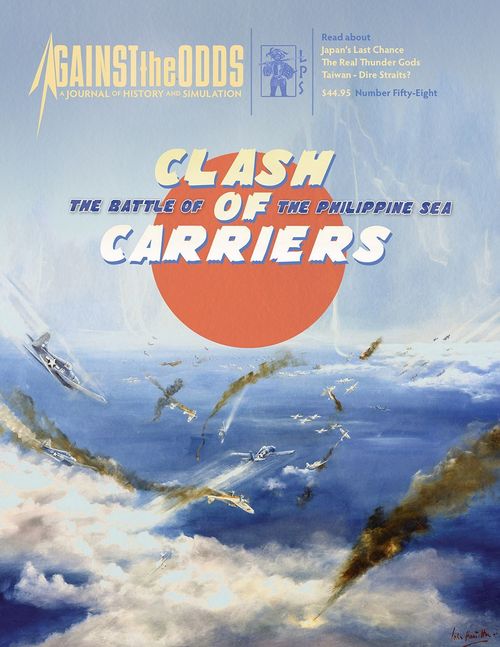
Clash of Carriers: The Battle of the Philippine Sea
Clash of Carriers: The Battle of the Philippine Sea Rulebook
Table of Contents
Table of Contents
- Read This First
- 1.0 Introduction
- 2.0 Game Components and Terms
- 3.0 Task Groups, Task Forces, and Stacking
- 4.0 Sequence of Play
- 5.0 Initial Phase
- 6.0 Activation Subphase: Search
- 7.0 Activation Subphase: Movement
- 8.0 Activation Subphase: Air Combat
- 9.0 Damage
- 10.0 Victory Conditions
- Advanced Rules
- 11.0 Submarines
- 12.0 Surface Combat
- 13.0 USN Air: Radar Intercept CAP
- 14.0 IJN Bombers Deliver the Ordnance
- 15.0 Optional Rules
- 16.0 Scenarios
Read This First
We've organized the overall structure of the rules of this LPS simulation game to follow this game's sequence of play in introducing concepts. The rules themselves are written in a format known as the Case System. This approach divides the rules into Modules (each of which deals with a major important aspect of play). Modules are numbered sequentially as well as possessing a title. Each Module is divided into Sections (that deal with a major sub-topic inside the Module) which are also numbered sequentially. Modules and Sections are introduced by some text that briefly describes the subject covered by that particular Module or Section. Finally, the majority of each Section consists of Cases. These are the specific, detailed rules that govern play. Each Case is also numbered sequentially.
The numbering follows a logical progression based upon the number of the Module of which the Cases are a part. A Case with the number 7.5.1, for example, is the first Case of the fifth Section of the seventh Module of the rules. The numbering system is designed as an organizational aid. Use it to determine where a Case is located in the rules.
The example above is the number of the fourth Case of the first Section of the third Module of the rules.
Learning to Play the Game
Begin by familiarizing yourself with all of the components listed for this game. Then skim through the charts and rules, reading all the titles of the Modules and Sections. Set up a game scenario or portion of a scenario (after reading the applicable Module) and play a trial game against yourself. During this trial game, try referring to the rules only when you have a question and remember the numbering system we employ makes it easy to look up rules when you do. While a trial game may take you an hour or two, it is the quickest and most pleasant way to learn (short of having an experienced friend teach you). We also don't recommend attempting to learn the rules word-for-word. Memorizing all the details is an effort that few can do. We've written these rules to be as comprehensive as possible, but they are not designed to be memorized. Taking in the rules in this way (as you play along) is the best approach to mastering this game.
1.0 Introduction
Clash of the Carriers is a moderately complex simulation of the largest carrier battle in history, the Battle of the Philippine Sea. The battle was fought from 18-20 June 1944 as the US invaded the Mariana Islands, landing on the island of Saipan. The Imperial Japanese Navy (IJN) committed its carrier force in an attempt to decisively defeat the United States Navy's (USN) carrier force known as Task Force (TF) 58. The historical outcome was a decisive defeat of the IJN's carrier force, eliminating it as a viable force for the remainder of the war. For the USN, it was an incomplete victory since most of the Japanese carriers survived the battle while their air crews did not.
1.1 Game Scale
Each game turn is roughly six hours with three day turns and one night turn per calendar day. Each sea hex is approximately 25 nautical miles across. Each naval unit represents one ship (for battleships, cruisers, and carriers) or four ships (destroyers). Aircraft units represent between six and 20 aircraft.
1.2 Rounding Convention
When making any calculation for game purposes, round up all fractions equal to or greater than 0.5 to the next highest number unless otherwise indicated. Round down fractions less than 0.5.
Examples: round 2.5 up to 3; round 2.4 down to 2.
1.3 Die Roll Convention
Clash of the Carriers uses a 10-sided die (D10). A die roll of 0 is treated as ten (not zero).
1.4 Rules Convention
These rules govern game actions. If an action is not specified within the rules, that action cannot be performed. Scenarios (Module 16.0) offer a variety of historical events and possibilities to extend the standard game. That said, players are free to experiment with their own optional "house" rules.
2.0 Game Components and Terms
Each copy of Clash of the Carriers is composed of the following:
- One 22″x34″ map sheet
- 294 counters (146 ⅝″ and 148 ½″)
- 3pp Damage Log sheets, and 3 cardstock Player Aids
- This set of rules, including player aids
Players will need to supply at least one 10-sided die (D10) to play the game, although more D10s may be helpful. Players will also need at least one opaque container from which to randomly select marker units during the course of the game.
2.1 Game Map
The map portrays an area of the central Pacific Ocean that saw combat operations during 1944. A hexagonal ("hex") grid is printed over the map to regulate the placement and movement of units across the area. A unit is considered to be in one hex at any one time. Each hex contains a four-digit identification number to define exact locations and to allow the recording of unit positions if the game needs to be taken down before it can be completed.
Most hexes are water, but some are islands/atolls. Some islands hold airfield icons and can base Japanese aircraft units up to their capacity. Areas without hex numbers are generally out of play, but some Japanese-held islands containing airfield bases are located beyond the hex grid – the number indicates how many hexes beyond the map the aircraft need to travel to reach the map. A portion of the map is dedicated to various tactical displays and marker tracks.
Compass Direction: For play purposes, consider the north edge of the map to consist of hexes from 1001 to xx01.
Dotted Lines VP-16 and VB-101: These lines represent the limit of US land-based reconnaissance aircraft from VP-16 and VB-101. Some overlap occurs.
2.2 Abbreviations
- AF – Air Flotilla
- AG – Air Group
- B – Bombers
- BET – Betty
- BR – Battle Round
- CA – (Heavy) Cruiser
- CAP – Combat Air Patrol
- CL – Light Cruiser
- CV – Carrier
- CVL – Light Carrier
- DB – Dive-bombers
- DD – Destroyer
- DES DIV – Destroyer Division
- DES RN – Destroyer Squadron
- DR – Die Roll
- DRM – Die Roll Modifier
- DTLS – Dauntless
- F – Fighters
- FB – Fighter Bombers
- HD – Helldiver
- HLCT – Hellcat
- IJN – Imperial Japanese Navy
- Lt. – Light
- MOB. – Mobile (Fleet)
- MP – Movement Point
- St. – Saint
- T – Torpedo bomber
- TF – Task Force
- TG – Task Group
- UNDET. – Undetected
2.3 Counters
Counters fall into two types: combat units and markers. Combat units are either naval or air. Yellow units are USN, and white units are Japanese. Marker counters are used to record various game functions and events.
2.3.1 Sample Naval Unit
Some naval units have split Movement Points. Use the MPs to the left of the slash on odd-numbered turns and MPs on the right on even-numbered turns.
The Protection Factor shows how many steps/boxes of damage the unit can sustain on the Damage Log. The Damage Log records actual ship status.
DES DIV and DES RN counters are considered one naval unit, even though they represent up to four individual destroyer ships.
The reverse of most naval units shows a "Fired" notation over its Surface Gunnery factors. Use this to remind players which ships have already fired (Section 12.5).
2.3.2 Sample Air Units
All USN air units (blue stripe) are carrier-based. Japanese air units are either land-based (peach stripe) or carrier-based (green stripe). Airframe designations are included for historical interest only and have no effect on play.
Most IJN Air Units possess two steps. When a full-strength IJN air unit loses a step due to combat, it is turned over to its reduced (weaker) side. When a reduced-strength IJN air unit loses a step due to combat, it is destroyed and removed from play. If a full-strength unit loses a step and it does not have a reduced side, it is destroyed and removed from play.
USN Air Units are never removed from play. When a full-strength USN air unit loses a step, it is turned over to its fatigued (weaker) side. When a reduced-strength USN air unit loses a step due to combat, it remains on its fatigued (weaker) side and remains in play. Design note: The scale of losses to American carrier squadrons was low. On the other hand, combat attrition to Japanese squadrons was extremely heavy and resulted in the annihilation of many units.
2.3.3 Game Markers
Clash of Carriers uses a number of marker counters to indicate non-combat events and status.
- Turn: For use on the Game Turn Track. One side is the sun for Day turns and the other is the moon for Night turns.
- Battle Round: For use on the Battle Rounds Track during a Surface Combat (Section 12.0).
- Task Force (TF): Large naval formation made up of one or more TGs.
- Task Group (TG): Smaller naval formations (Note that Japanese TGs are called "Forces.") Each TG and TF uses two markers: one is placed on the map to indicate location and the other is placed in an opaque container for a random draw for activation during a game turn.
- Special Command Chits: Represents overall USN and IJN command (Section 8.7).
- Detected: Detected indicates a successful search that found enemy ships.
- -1 MP or -2 MP: Reminds players to subtract one or two MPs from their next move (Section 7.2).
- Submarine: The front is an S atop a sonar screen. The reverse is either a conning-tower side that indicates a submarine or "False Contact" which means it is a dummy marker and is not a submarine. Note: Japanese submarines optional.
- Smoke is used on Surface Battle Display (Section 12.4), and Battle Hex is placed on the map to remind players where a battle is being fought.
2.4 Player's Aids
The game uses these tables, displays, and tracks to regulate play:
- Surface Battle Display and Turn Track: located on-map.
- IJN and USN Search Tables (used to locate enemy TGs and TFs): front of the PAC
- Task Force Composition: one separate display for each player.
- Ship Damage Table: back of the PAC
- Torpedo Critical Hit Table: back of the PAC
- Damage Logs: One separate set for each player (2pp for the USN, 1p for the IJN). Players should make copies before play as these will be marked up during play.
- Air-to-Air Combat Table: back of the PAC
- Antiaircraft (AA) Table: back of this rulebook
- USN Submarine Search and Detection Table: Case 11.1.4
- Air-Sea Battle Display: separate display
3.0 Task Groups, Task Forces, and Stacking
Each player controls a number of Task Groups (TGs), of which one or more can be assigned to a Task Force (TF). At the start of the game, all naval units must be assigned to a TG and intact naval units must be assigned to a TG. During the game, damaged ships may voluntarily separate from a TG and move independently. Ships may also change their TG when starting the turn in the same hex as another TG.
Each TG and TF uses two markers: one on the map and one in the Activation Pool. During the Activation Phase, pulling a TG marker activates only that TG, while pulling a TF marker activates all TGs assigned to that TF.
3.1 Task Group (TG)
All intact naval units are assigned to a Task Group (TG), with up to 16 naval units per TG. A DES DIV or DES RN counts as a single naval unit even though the counter represents up to four destroyers. The scenarios assign naval units to TGs on a historical basis. Naval unit counters are placed in the appropriate TGs on the organization chart.
A Japanese TG is called a "Force."
3.1.1 TG Limits. The USN player may have a maximum of 10 TGs. Some of these may be "dummy" TGs, which contain no naval units.
The IJN player may have a maximum of eight TGs. Some of these may be "dummy" TGs, which contain no naval units.
3.1.2 USN TG Restrictions. To reflect doctrine, the USN player may have a maximum of four TGs that contain aircraft carrier naval units. Each TG contains a maximum of four aircraft carrier naval units.
3.1.3 IJN TG Restrictions. The IJN player may have a maximum of eight TGs containing aircraft carrier naval units, with each TG containing a maximum of three aircraft carrier naval units.
3.1.4 Shifting Ships Between TGs. At the start of the Initial Phase of a turn, a player may shift ships among TGs stacked in the same hex as long as each TG contains 16 or fewer naval units and players observe aircraft carrier unit restrictions.
Naval units that start in USN TG 58.1, 58.2, 58.3, 58.4, and 58.7 may not be combined with naval units that start in TG 52.10 – even if new TGs are created. They may exist together in the same hex, but never exist in the same TG.
3.1.5 TG Creation and Disbandment. TGs may be created or disbanded during the Initial Phase. Any ships present in the same hex can be used to form a new TG or shift into an existing TG. If a new TG is created or abandoned, be sure to add or remove its marker from the Activation Pool. Thus, at the start of each Activation Phase, only active TGs (real and dummy) have a marker in the Activation Pool.
3.1.6 Dummy TGs. Both players can create dummy TGs with no naval units assigned to that particular TG. Since they have no ships, they cannot engage in searches or combat. If the opposing player gains any type of detection on a dummy TG, it is immediately removed from the map without a contact report being made. If a marker of a removed Dummy TG is subsequently drawn from the Activation Pool, ignore it and discard it.
Dummy TGs are initially placed in the same hex as an existing TG. Dummy TGs may be voluntarily removed by the owning player during any turn's Initial Phase. They can be reused during the same Initial Phase.
Dummy TGs have a maximum speed of four hexes per turn.
3.2 Task Force (TF)
Each player controls one and only one Task Force (TF). The USN has TF 58 and the IJN has TF Mobile Fleet. No other TFs may be created during the game.
3.2.1 USN TF 58 Limit. The USN player may assign up to five TGs to TF 58.
3.2.2 IJN TF Mobile Fleet Limit. The IJN player may assign up to three TGs to TF Mobile Fleet.
3.2.3 TF and TGs. During the Initial Phase of a turn, TGs in the same hex as a TF may be added to the TF as long as limits are met. Remove the TG marker from the map and place on the TF chart.
Likewise, TGs may be split off of TFs during the Initial Phase – remove the TG marker from the TF chart and place the TG marker on the map.
3.3 Stacking
A maximum of two friendly TGs or one TF (which may contain more than two TGs) may stack in a hex without forming a TF. If three or more TGs occupy the same hex at the conclusion of the End Phase, a TF must be formed during the next Initial Phase. If three or more TGs occupy in the same hex at the conclusion of the Initial Phase, TGs must be moved out of the hex during movement..
Opposing TGs may occupy the same hex to conduct a surface battle.
3.4 Damaged Naval Units
Damaged naval units do not need to be in a TG. If separated from a TG during the Initial Phase, they are placed on the map and may move independently of TGs and TFs during the End Phase of a turn. They have no Activation marker.
4.0 Sequence of Play
Turns are divided into three phases, each with subphases, with each subphase completed before starting the next subphase and each phase completed before starting the next phase.
Once a player has completed a subphase, he may not go back to perform some forgotten action or re-do a poorly-executed action unless his opponent graciously permits it.
4.1 Initial Phase
Both players may create or merge their TGs and TFs as permitted (Sections 3.1 and 3.2), and may adjust the composition of TGs by shifting naval units as permitted. Remember to add or remove markers to the Activation Pool so that all corresponding TF, TG, and AF markers on the map are in the opaque Activation Pool container.
Check the Turn Record Track to see if the IJN player receives air unit reinforcements.
Check the Turn Record Track to see if the USN player recovers air units that had flown Extended Range missions.
During Day turns, both players may allocate CAP missions above their TGs and TFs. CAP missions are voluntary, not mandatory.
The USN player rolls for and places submarine markers.
4.2 Activation Phase
A player randomly draws a marker (which can be either IJN or USN) from the opaque container and the player with the matching TG, TF, or AF performs movement, search, and combat subphases.
The other player now randomly draws a marker (which can be from either IJN or USN) and the player with the matching TG, TF, or AF performs movement, search, and combat subphases.
Keep randomly drawing markers and performing actions until all markers have been drawn.
4.3 End Phase
Both players move damaged units that are not assigned to a TF or TG, with the IJN player moving all his damaged ships first.
Remove all detected markers from TFs and TGs or flip the TF or TG marker to its Undetected side during every Night Terminal Phase.
Remove all submarine markers from the map and return to opaque containers.
5.0 Initial Phase
5.1 TG, TF, and Detached Unit Formations
Both players adjust their TGs and TFs as permitted (Sections 3.1 and 3.2), including any detaching of damaged naval units and creation of dummy TGs.
5.2 Activation Pool
Place TF and TG markers in the Activation Pool so that all Command, TF, TG, and AF markers on the map have a corresponding marker in the opaque Activation Pool container.
A TF may contain one or more TGs, but only the TF marker is placed in the Activation Pool container – the individual TG markers that make up the TF are not placed in the Activation Pool.
Damaged naval units that are not part of a TG or TF do not have any activation markers. These will be moved during the End Phase.
5.3 IJN Air Unit Reinforcements
Check the Turn Record Track to see if the IJN player receives air unit reinforcements for the current turn. If so, add the units to the appropriate TG or island airbase.
5.4 USN Air Unit Availability
Check the Turn Record Track to see if the USN player recovers air units that had flown Extended Range missions. If so, add the units to the Ready Box in the appropriate TG.
5.5 Recovery From Fatigue
During a Day Turn, the USN player flips all air units in the Flown Box on the TG chart to their fatigued (weaker) side and moves them to the Ready Box.
During a Night Turn, the USN player flips all air units in the Flown Box on the TG chart to their full strength side and places them in the Ready Box.
The IJN player does not flip air units to their full strength side – Japanese air losses are permanent in this game. The IJN player does not move air units from the Flown Box to the Ready Box.
5.6 Japanese Island-Based Air Unit Recovery
All Japanese island-based air units roll 1D10 to attempt to move aircraft from the Flown Box to Ready Box. The die roll needed is 1 to 5 on Guam and 1 to 3 for all other airfields. Units that make the roll are now Ready for use. Units that fail remain in the Flown Box and are not ready for use this turn.
5.7 Combat Air Patrol (CAP)
During Day turns, both players may allocate CAP missions above their TGs and TFs. CAP missions are voluntary, not mandatory. There is no CAP during Night turns.
Players move Fighter (F) and/or Fighter-Bomber (FB) air units to the CAP box within the TG or TF. Bombers never perform CAP missions.
The Japanese player may fly CAP over island airbases.
6.0 Activation Subphase: Search
Randomly draw a marker from the Activation Pool. The owning player may perform the following in order: search (Module 6.0), movement (Module 7.0), and combat (Module 8.0) with units belonging to that marker.
Although unlikely, if USN and IJN naval units end movement in the same hex, use the Surface Combat rules (Module 12.0) to resolve surface combat.
Air searches may be performed against all enemy TG/TF within range.
6.1 Secret Search Rolls
To represent the hide-and-seek nature of reconnaissance, the D10 search rolls are made in secret and only the results are told to the enemy. Note that the owning player may legally fudge the results as noted on the Search Table. This fudging applies to both air searches and surface ship searches.
Thus, when the Japanese player searches a hex containing USN TF or TGs, the USN player rolls the die in secret and declares the number and type of units. When the USN player searches a hex containing the IJN TF Mobile Fleet or TGs, the IJN player rolls the die in secret and declares the number and type of units with the following restriction:
If a unit type is in the hex, it must be reported – you never reduce the number to 0 (zero). If a unit type is not in the hex, you never report the type is present.
Example: The IJN picks a hex to search containing a USN TG. The US player rolls 1D10 and rolls a 7: The USN player reports the number of ships per type present in the TG, but can alter the number up or down by up to two ships per type. The US player does not reveal the die roll result, but instead declares the number of each ship type within that +2 or -2 range. If the 12-ship TG contains 2 CV, 2 CVL, 2 BB, 2 CA, and 4 DES DIV, the US player might declare: "1 CV, 3 CVL, 1 BB, 4 CA, and 6 DES DIV." Thus, all the ship types in the hex are declared. Ship types that are not in the hex are not declared. All numbers declared are within 2 of the actual number of naval units in the hex. Design note: Search sightings often had some inaccuracies during their reporting. The ability of players to obscure the real numbers reflects these inaccuracies.
6.2 Friendly Hex Search and Detection Subphase
Whenever an enemy TG or TF is in the same hex as a friendly TG or TF, both players roll 1D10 in secret, add modifiers, and relate the results. If the spotted enemy TG/TF is a dummy counter, the dummy counter is removed as indicated in the Search Tables and the opponent informed.
6.3 Air Search and Detection Subphase
USN/IJN naval unit and Japanese island-based air searches only occur during Day turns and never on Night turns.
6.3.1 Naval Unit Search Ranges. USN TG/TF search range is 13 hexes. IJN TG/TF search range is 22 hexes.
Only successful air searches by IJN carrier-based aircraft detect USN TG/TF with the possibility of launching an air strike attack by carrier aircraft. Japanese island-based aircraft never use IJN carrier-based search results as a basis for detection or attack -- island-based aircraft must perform their own detection in order to attack USN naval units. Design note: This represents the almost complete lack of coordination between Japanese carrier and land-based formations.
6.3.2 Japanese Island-Based Search Range. The 61st Air Flotilla based on Guam has a search range of 25 hexes. The 22nd Air Flotilla never performs searches.
Successful air searches by Japanese island-based aircraft only allow island-based aircraft to detect the USN TG/TF with the possibility of launching an attack. Japanese carrier-based aircraft never use island-based aircraft search results as a basis for detection and an attack.
6.3.3 US Land-Based Search Range. The dotted lines on the map represent the limit of air searches by US land-based aircraft. These air searches may be performed during a Night turn. Note that the search areas are different but do overlap. Both US formations may search in the overlap areas.
Successful air searches by US land-based aircraft only provide information, not detection. USN carrier-based aircraft never use land-based aircraft search results as a basis for detection and an attack. Design note: This restriction reflects the difficulty in getting information passed in a timely manner to afloat commanders.
6.4 Detached and Damaged Naval Units
Damaged naval units and any escorts that are detached from a TG/TF must be searched for just like a TG/TF.
6.5 Dummy TGs
Dummy TGs possess no ships, carry no aircraft, and never conduct searches or perform combat. Dummy TGs that enter an enemy-occupied hex never conduct a search or perform combat.
7.0 Activation Subphase: Movement
7.1 TG/TF Movement
Players may move an individual TG or TF when its associated marker is drawn from the opaque container. A TG/TF moves up to their movement allowance, with the movement rate of the slowest naval unit determining the entire TG's or TF's maximum Movement Points (MPs).
Note: the more damage inflicted on a naval unit, the slower that naval unit may move, which in turn may affect the speed of the TG/TF. Players may detach damaged naval units in the Initial Phase of a turn (Section 5.1).
Some naval units have split Movement Points. Use the MPs to the left of the slash on odd-numbered turns and MPs on the right on even-numbered turns.
Players move their TGs/TFs individually, hex-by-hex until all MPs are expended, the player ends movement before all MPs are expended, or units enter a hex containing enemy units. TGs/TFs move from a hex to one of the adjacent six hexes at a cost of 1 MP. Hexes may not be skipped.
7.2 MP Reductions
Some TGs and TFs may start the turn with -1 or -2 MP markers. Remember to account for those MP reductions during movement. It is possible that some naval units, from damage, may not be able to move.
Any TG or TF that comes under an enemy air attack with four or more enemy air units loses 1 MP on its next move. Place a -1 MP marker on the TG to remind the player. This marker is placed regardless of whether or not damage was inflicted on the TG/TF.
If the TG or TF suffers another enemy air attack with four or more enemy air units, flip over the -1 MP marker to its -2 MP side. A TG or TF never suffers more than a -2 due to enemy air attacks no matter how many enemy air attacks a TG or TF suffers in a turn.
Note that TGs/TFs with damaged ships may face a reduction in MPs due to the damaged ship.
7.3 Damaged Naval Units and Undamaged Escorts
Players may detach damaged ships for independent movement with the goal of leaving the map. Detached USN units must sail either east or south as quickly as they can to exit the east or south map edge. Detached IJN units must sail either west or north as quickly as they can to exit the west or north map edge. Neither can move into surface combat.
Detached and damaged naval units may be assigned undamaged escorts, which must remain with the detached and damaged naval units at all times. When detached and damaged naval units exit the map, these undamaged escorts must also exit the map. Once exited from the map, all the damaged and undamaged naval units never return to the map or play.
8.0 Activation Subphase: Air Combat
Air attacks may be launched against any detected TG, TF, Detached/Escort units, or island-based airfield within range of the aircraft MPs. This subphase is the heart of the game system and consists of numerous steps.
Note: Air attacks are performed against one TG in a hex, even if several TGs are combined in a hex under a TF formation. If more than one TG is in a hex, the attacked TG is selected randomly.
8.1 Air Attack Movement
After movement, count the number of hexes from the aircraft carrier or island hex to the target hex, ignoring the starting hex but counting the target hex. Each hex equals 1 MP. If the target hex is equal to or less than the MP of the aircraft unit, the target may be attacked. If not, the target is out of range and cannot be attacked.
8.1.1 USN Extended Range. Full-strength USN air units can fly an additional 3 MP (total equal 11 MPs) by voluntarily flipping over and attacking using the Fatigued (weaker) side. Fatigued units never extend their range.
8.1.2 USN Extended Range Availability. Each USN air unit that used Extended Range to attack IJN targets rolls 1D10 upon completion of its attack:
- 1-5: Place on the Game Turn Track four turns ahead of the current turn. These air units are unavailable for use until the beginning of that turn. When available, place in the Ready Box of the appropriate TG at full strength.
- 6-10: Place on the Game Turn Track two turns ahead of the current turn. These air units are unavailable for use until the beginning of that turn. When available, place in the Ready Box of the appropriate TG at full strength.
8.2 CAP Air-to-Air Combat
Any F or FB unit assigned to Combat Air Patrol (CAP) during the Initial Phase intercepts incoming enemy air units entering their TG's/TF's hex or an island airbase hex (if Japanese). USN CAP using the Radar Intercept advanced rule (Section 13.0) can intercept up to two hexes away from the TG/TF. Japanese CAP only intercepts enemy air units in the hex containing the TG, TF, or island base.
8.2.1 CAP Against Enemy Without Escorting Fighters. Total the Combat Factors of the CAP, find the appropriate column in the Air-to-Air Combat Table, and then roll 1D10 and add appropriate modifiers. Cross index the Combat Factors with the modified die roll to get the number of steps of damage that the CAP inflicted upon enemy aircraft.
Only the CAP units attack. The bombers do not attack the CAP.
The owning player flips a number of Full-Strength air units to the reverse side equal to the number of steps of damage. No IJN air unit may be eliminated until all IJN air units are on their weaker reverse side.
USN air units are never eliminated. Units that suffer a step loss while on their reverse Fatigue side get a -1 DRM per step loss to their Damage Table roll.
Surviving bombers attack naval units (Section 8.4).
8.2.2 CAP Against Enemy With Escorting Fighters. If an air attack contains F or FB air units as escorts and encounters CAP over enemy naval units, the attacker must peel off at least a number of F or FB counters to equal the number of CAP air unit counters. The escort counters match up with defending CAP counters.
If the attacker has more F/FB air units than the CAP defenders, the attacker may either assign the excess to add to the air battle against the CAP, or, continue to escort the bomber units to the naval unit target to perform AA Suppression (Case 8.5.1).
If the defending CAP has more F/FB air units than the attackers, the excess CAP units may attack the escort fighters or may be assigned to attack a particular enemy bomber unit.
Air combat against fighters is the same as air combat against bombers (Case 8.2.1).
8.2.3 CAP From Many TGs. All CAP air units in a hex are used when the hex is under attack by enemy air units. Even if the CAP fighter units come from different TGs that comprise a TF formation, all fighter units are part of the same defensive CAP.
8.2.4 Post Air Battle CAP. CAP units used in air combat remain in the hex throughout the turn but take no further action against enemy air units returning from an attack. Specifically, CAP units do not fire at surviving enemy air units that have attacked naval units.
If a new raid arrives in a hex, CAP units that survived the initial raid will intercept the new raid.
Surviving escort fighter units that stayed with the bombers to battle the CAP never perform AA suppression (Case 8.5.1).
8.3 Defending Naval Unit Placement
All naval units of a TG under attack are placed as the owning player sees fit on the Air-Sea Battle Display. One and only one naval unit is placed per box.
If a hex contains multiple TGs, the targeted TG is selected at random. If a hex contains a TF, one of its TGs is selected at random to be targeted.
8.4 Attacking Air Unit Placement
The attacking player places all air units in one or more boxes on the Air-Sea Battle Display containing an enemy ship. All air units must be placed, although more than one air unit can be placed in a single box.
8.5 Anti-Aircraft Combat
All Anti-Aircraft (AA) fire from naval units is by individual naval unit. AA factors are never combined.
A naval unit can fire at each enemy air unit within range in a single turn.
IJN AA range is the box the naval unit occupies on the Air-Sea Battle Display. IJN naval units do not fire into adjacent boxes.
USN AA range is the box the naval unit occupies on the Air-Sea Battle Display. In addition, a USN naval unit may fire – individually, never combined – at half strength (round up) into an adjacent box containing a Japanese air unit.
8.5.1 AA Suppression. Escort fighter units that were unengaged by CAP may be placed on an enemy ship to suppress the AA fire. Each fighter unit in a box gives a -1 DRM to a naval unit's AA fire.
8.5.2 AA Fire. The defending player selects one naval unit to fire AA and picks an attacking enemy air unit (usually bombers, but fighters are eligible targets, too) in range. Roll 1D10, add AA Suppression modifiers if any, and cross index the modified die roll result with the number of AA factors firing on the Anti-Aircraft Table. Results are:
- No effect: No effect to air unit.
- D#: If attacking air unit is Japanese, suffers one step loss. US ignores D results.
- #: DRM applied to aircraft attack die roll against target ship.
The defending player selects another naval unit to fire AA at an attacking enemy air unit in range. This can be the same enemy air unit or a different enemy air unit. Do not combine AA fire factors from multiple naval units. Each naval unit fires separately at air units.
Each naval unit resolves AA fire against an enemy air unit until all naval units have fired at air units in range or all enemy air units are eliminated. Surviving air units now attack the ship in the same box.
Note: If using the Advanced Rule Deliver the Ordnance (Module 14.0), IJN bombers shot down by AA continue on to attack US ships. IJN bombers shot down by US CAP never Deliver the Ordnance, even if in the same hex as US ships.
8.6 Air vs. Naval Combat
After AA results, surviving USN and IJN bomber units (if using the Advanced Rule Deliver the Ordnance – Module 14.0, all IJN bombers) resolve attacks against an enemy naval unit. Each air unit resolves its attack individually – never combine combat factors against an enemy naval unit.
Roll 1D10, add DRMs if any, and cross index the modified die roll result with the number of combat factors on the Damage Table. Results are:
- No effect: No effect to naval unit.
- #: Number of hits applied to the naval unit.
If a full-strength naval unit is hit, find the appropriate naval unit entry in the Damage Log and mark off a number of boxes equal to the number of hits.
You will notice that a naval unit's combat capabilities usually decline with hits. Use the reduced factors for future movements, attacks, and actions (Module 9.0).
If the last box has been crossed off, the naval unit is sunk. Remove the counter from the TG display or map.
A hit from a Torpedo air unit is marked as a normal hit but has the possibility of a Critical Hit (Section 9.3).
Return all surviving air units to their appropriate Flown Box on their TG Composition sheet. Surviving air units are not intercepted by CAP on the way back to their carries or bases.
[Printed note: Open staples to separate Player Aids insert.]
8.7 Special Command Chits
When the USN Command Chit is drawn, the USN player can activate his only TF or any TG (but not land-based air units). After doing so, he returns the command chit to the Activation Pool. Thus, the USN command chit can potentially be used to activate several TGs during a single turn.
When the IJN Command Chit is drawn, the Japanese player may also activate his TF or any TG (but not an island-based air formation) that has not already been activated. However, after he has done so, he does not return the IJN Command Chit to the Activation Pool. Thus, the IJN Command Chit activates a single TF or TG during a turn.
For both players, when the marker of the TF, TG, or air formation activated by the players' Command Chit is drawn from the Activation Pool in a later sub-phase, simply ignore it and select another marker.
Command Chits do not allow a TF or TG to move twice in an Activation Phase, but they do permit the players an enhanced degree of control over their forces.
Example: TG Activation during a turn: The US player draws the chit for USN TG 58.7, which activates this TG. The TG has 5 MPs as all its ships are speed rated 4/5 and this is an even-numbered game turn.
However, the TG has a -1 MP marker placed on it from an air attack last turn, so its speed this turn is actually 4 MP.
It conducts an air search and finds an IJN TG within its aircraft strike range. It spends 2 MPs to move toward its intended target. It then spends its last 2 MPs moving to the southeast to launch an air strike against the IJN TG.
9.0 Damage
The Damage Log indicates how many hits a particular naval unit can absorb before it is sunk. As a naval unit takes hits, cross off boxes equal to the number of hits. Note that damage causes its movement and combat capabilities to be reduced.
If the last box has been crossed off, the naval unit is sunk. Remove the counter from the TG display or map.
9.1 First Hit
If a full-strength naval unit is hit, find the appropriate naval unit entry in the Damage Log and mark off one box. Use the reduced factors for future movements, attacks, and actions.
Note that some naval units only contain one box on the Damage Log, so the first hit will sink the naval unit. In this case, remove the counter from the game.
9.2 Additional Hits
On second and additional hits, find the appropriate naval unit entry in the Damage Log and mark off boxes equal to the number of hits. Use the reduced factors for future movements, attacks, and actions.
If the last box gets crossed off, the naval unit is sunk. Remove the counter from the TG display or map.
9.3 Critical Hits
Each hit from a Torpedo air unit or from a naval unit in surface combat with the "T" (Torpedo) characteristic may cause additional damage.
For each Torpedo hit, roll 1D10, add DRMs, and consult the Torpedo Critical Hit Table on the Player Aid Card.
9.4 Aircraft Carrier Hits
Hits on aircraft carriers (CV and CVL) also degrade air operations. When a carrier unit takes 50% damage, as noted on its Damage Log, it may no longer launch CAP, attack, or any other air mission. Move any air units from the Ready Box to the Flown Box.
9.5 Damaged Naval Units and Undamaged Escorts
Damaged naval units and undamaged escort naval units may be split off from a TG during the Initial Phase (Section 7.3).
10.0 Victory Conditions
At the conclusion of the last turn, both players tally their Victory Points (VPs). The IJN VPs are subtracted from the USN VPs to determine the Victory Level.
For the IJN player, "damaged" means putting at least one hit on a carrier.
10.1 Japanese VPs
The IJN player is awarded VPs for sinking or damaging the following USN units (per unit). For purposes of determining VPs, any hit on a non-DD unit is considered to have damaged it.
- CV sunk = 20 VPs
- CV damaged = 4
- CVL sunk = 10
- CVL damaged = 2
- BB sunk = 8
- CA sunk = 4
- CL sunk = 3
- DD sunk = 1
Also, the Japanese player gains VPs for IJN aircraft carriers that survive the game:
- Full-strength CV = 5 VPs
- Damaged CV = 2 VPs
- Full-strength CVL = 3 VPs
- Damaged CVL = 1 VPs
10.2 US VPs
The US player is awarded VPs for sinking or damaging the following IJN naval units (per unit).
- CV sunk = 10
- CVL sunk = 5
- BB Yamato or Musashi sunk = 10
- Other BB sunk = 8
- CA sunk = 5
- CL sunk = 2
- DD sunk = 1
Also, the US player gains VPs for destroying Japanese aircraft carrier (not island-based) air units. Aircraft destroyed if a carrier sinks count also towards the total:
- Each 2 IJN carrier-based air combat factors destroyed = 1 VP
Also, each End Phase, the USN player loses VPs for not having 14 or more naval units in the Saipan hex. Subtract 1 VP per naval unit below 14. For example, if only 13 naval units are in the Saipan hex during an End Phase, -1 VP, if only 12 naval units, then -2 VP, and so on.
10.3 Levels of Victory
Subtract Japanese VPs from US VPs and consult the following list:
- US 30+ VPs: Decisive US Victory (historical result)
- US 20 to 29 VPs: Significant USN Victory
- US 10 to 19 VPs: Draw
- US 0 to 9 VPs: IJN (Pyrrhic) Victory
- US negative VPs: Decisive Japanese Victory
10.4 Historical Victory Level
The USN sank two CVs and one CVL (25 points) and destroyed 64 IJN carrier air factors (divided by 2) for another 32 VPs. The USN player failed to destroy one IJN CV (-5 points) and five CVLs (-15 points). The IJN player scored no VPs.
The US 57 VPs subtracts the IJN 20 to get a final US total of 37 VPs. The difference is 37 VPs, which is a US Decisive Victory.
Advanced Rules
11.0 Submarines
11.1 Submarines
Historically, US submarines sank two IJN carriers.
11.1.1 Submarine Markers. The US player places five submarine markers in a separate opaque container. Do not mix sub markers with TG/TF markers.
In the Initial Phase of a turn, put all five markers in the container. The US player rolls 1D10 and randomly pulls the number of markers indicated and without looking at them:
- 1-3: Pull two sub markers
- 4-6: Pull three sub markers
- 7-8: Pull four sub markers
- 9-10: Pull all five sub markers
DRMs:
- On June 18 turns: No DRM
- On June 19 turns: +1 DRM
- On June 20 turns: -1 DRM
11.1.2 Submarine Marker Deployment. The counters will deploy face down with only the "S" side showing. For each pulled marker, the player rolls 1D10:
- 1-5: Place sub marker on a hex that is two or more hexes away from any enemy TG or TF.
- 6-10: Place sub marker on a hex that is one hex away from any enemy TG or TF.
Thus, neither player knows if a sub marker is real or a false contact.
Submarine markers are never placed in a hex with enemy naval units.
A maximum of one sub marker may be placed per hex. Submarine markers are never moved on the map.
11.1.3 Submarine Contact. If a TG, TF, or detached naval unit enters a hex with an enemy submarine marker, immediately flip over the submarine marker. If the submarine marker is a False Contact, nothing happens. If the marker is a real submarine, roll on the Submarine Detection Table (Case 11.1.4).
If more than one TG enters the submarine hex, randomly roll 1D10 to determine which TG is affected by any results on the Submarine Contact Table.
Surviving TG, TF, or detached naval units may continue movement after enemy submarine attacks.
11.1.4 USN Submarine Search and Detection Table. This table determines the results of naval units entering an enemy submarine hex. Roll 1D10:
| Die Roll | Result |
|---|---|
| 1-2 | No detection and no attack on enemy naval units. |
| 3-4 | Naval units detected* with + or – 3 number of naval units by type. Place a Detection marker on the TG. No attack on enemy naval units. |
| 5-6 | Naval units detected* with + or – 2 number of naval units by type. Place a Detection marker on the TG. Attack one random enemy naval unit. |
| 7-8 | Naval units detected* with + or – 1 number of naval units by type. Place a Detection marker on the TG. Attack one random non-DES DIV or non-DES RN enemy naval unit. |
| 9-10 | Naval units detected and tell enemy player the exact number and type of naval units. Place a Detection marker on the TG. Attack one enemy naval unit of the submarine owner's choice. |
If a unit type is in the hex, it must be reported – you never reduce the number to 0 (zero). If a unit type is not in the hex, you never report the type is present.
11.1.5 Submarine Attacks. If a submarine attack occurs, roll 1D10. If the targeted TG does not contain a DES DIV or DES RN naval unit, add a DRM of +1.
Cross index the modified die roll result with the 6 column of the Damage Table. Results are:
- No effect: No effect to naval unit.
- #: Number of hits applied to the naval unit.
Remember that each Torpedo hit may also cause a Critical Hit (Section 9.3). See also the Torpedo Critical Hit Table on the Player Aid Card.
11.1.6 Submarine Counter Removal. All submarine counters are removed from the map during the End Phase of the turn and returned to their container.
12.0 Surface Combat
Surface combat occurs when a TG or TF enters the hex of a detected enemy TG, TF, or damaged naval units with escorts.
Surface combat also occurs when a TG or TF enters the hex of an undetected enemy TG, TF, or damaged naval units with escorts and performs a search that detects the enemy naval units.
Surface combat never occurs with undetected enemy naval units.
Surface combat consists of randomly deploying naval units on the Surface Battle Display and then performing up to eight Battle Rounds (BRs), with each BR composed of the following five subphases:
- Movement
- Gunnery Attack
- Torpedo Attack
- Air Attack
- Disengagement
12.1 Surface Combat Initiative
Both players roll 1D10 for initiative. High roll wins the initiative. Reroll ties.
12.2 Surface Combat Deployment
Place the Battle Hex marker on the map to remind players that the battle is taking place in a specific map hex. Place the Battle Round marker on the 1 box of the Battle Round Track.
The players roll 1D10 per naval unit, placing the unit on the Surface Battle Display in the appropriate box matching the die roll. Note that the IJN and USN start on opposite sides of the Surface Battle Display and that Day and Night boxes are used depending on the current turn.
When either side has a carrier in a TF or TG involved in a surface attack, the player can "scramble" all aircraft on all carriers in the TF or TG that are in the Ready Box. These aircraft are eligible for action in the surface engagement (Section 12.7). There is no movement penalty for a TF or TG that scrambles aircraft.
If the surface attack occurs during a Night turn, the aircraft do not scramble.
12.3 Surface Combat Movement
The player with initiative moves some, none, or all his naval units a number of boxes equal to or less than the MPs of the unit. Note that damaged units often have reduced MPs.
The units may move into or through boxes containing friendly or enemy naval units without penalty.
Naval units that seek to exit the Surface Battle Display via box 1 (IJN only) and box 25 (USN only) must start the movement subphase in that box and roll 1D10. If the die roll is equal to or less than the BR number, they exit. If not, they remain in the box. Use a -1 DRM if any Smoke is on the Surface Battle Display.
If all of one side's naval units exit the Surface Battle Display, the battle is over.
12.4 Surface Combat Smoke
DES DIV and DES RN naval units can lay smoke in one box that they start in or enter during a BR Movement subphase. Players are not limited by the Smoke counter mix and can create their own Smoke counters if needed.
Firing out of, into, or through a box with Smoke is a -1 DRM.
12.5 Surface Combat Gunnery and Spotting
All surface combat firing is simultaneous, and all damage is applied simultaneously. Rotate the counter to indicate it has fired.
Spotting range within the Surface Battle Display is unlimited during Day turns. During Night turns, IJN spotting range is 6 boxes and USN spotting range is 18 boxes. Naval units never fire at enemy naval units outside spotting range.
For each naval unit, players roll 1D10 and add any applicable DRMs. Cross index the modified die roll result with the Surface Gunnery Combat Factor of the naval unit on the Damage Table. Results are:
- No effect: No effect to the naval unit.
- #: Number of hits applied to the naval unit.
If a naval unit is hit, find the appropriate naval unit entry in the Damage Log and mark off a number of boxes equal to the number of hits.
You will notice that a naval unit's combat capabilities usually decline with hits. Use the reduced factors for future movements, attacks, and actions (Module 9.0).
If the last box has been crossed off, the naval unit is sunk. Remove the counter from the TG display or map.
12.6 Surface Combat Torpedo Attack
Certain naval units possess torpedoes, as noted with a "T" on the counter. If any such units survive gunnery combat, they may make torpedo attacks if within range. Remember to include Surface Gunnery Combat DRMs. Do not count the box the firing unit is in, but do count the box the targeted unit is in.
USN Torpedo Range: up to 3 boxes with no DRM, but with -1 DRM for each additional box up to 7 boxes. Examples: Firing at a target 4 boxes away would generate a -1 DRM. Firing at a target 7 boxes away would generate a -4 DRM.
IJN Torpedo Range: up to 6 boxes with no DRM, but with -1 DRM for each additional box up to 12 boxes. Example: Firing at a target 8 boxes away would generate a -2 DRM.
Remember to include all DRMs listed for the Damage Table.
A hit from a Torpedo is marked as a usual hit but has the possibility of a Critical Hit (Section 9.3).
Intervening units are ignored.
Each naval unit may fire torpedoes once during a surface battle.
12.7 Surface Combat Air Attack
During a Day turn, any carriers on the Surface Battle Display with air units in the Ready Box may fly them off to attack enemy naval units on the Surface Battle Display.
Place the air unit on the targeted naval unit. Only the targeted unit fires AA (Section 8.5) and surviving air units perform an attack on the targeted naval unit (Section 8.6).
12.8 Surface Combat Disengagement
At the end of each Battle Round 1 through 7, both sides decide whether to continue the surface battle or disengage to end the battle (Section 12.9).
- If both agree to disengage, the surface battle ends.
- If both agree to continue the battle, the surface battle continues.
- If one player wants to disengage and the other does not, both players roll 1D10 and use a +1 DRM if Smoke was laid plus +1 DRM per Battle Round completed. If either roll is a modified 11 or more, the surface battle ends (Section 12.9).
Example: After the fifth Battle Round, with Smoke in a Surface Battle Display box, one player seeks to disengage and the other does not. Both players rolled 1D10 and the results were 2 and 5. The 2 die roll is modified +1 for Smoke and +5 for completed Battle Rounds for a modified total of 8. It's not enough. The 5 die roll is modified +1 for Smoke and +5 for completed Battle Rounds for a modified total of 11. The Surface Combat ends.
At the end of Battle Round 8, the Surface Combat automatically ends.
If all of one side's naval units exit the Surface Battle Display from box 1 or box 25 (Section 12.3), the battle is over. Consider this as the equivalent of one side that wanted to disengage, and the other side didn't.
12.9 Surface Combat Ends
After Surface Combat ends, determine where TGs will be located.
If one player wanted to disengage and the other didn't, the player seeking to disengage retreats one hex on the map, obeying all stacking limits, towards a friendly map edge. For the USN player, the friendly map edge direction will be east or south. For the IJN player, the friendly map edge direction will be west or north. The player that didn't want to disengage remains in the map hex.
If both players sought to disengage, both players retreat one hex towards a friendly map edge.
If neither player sought to disengage and the Surface Combat ended due to the completion of Battle Round 8, the player with the most undamaged naval units remains in the hex and the other player retreats one hex (obeying stacking limits).
Place a -1 MP marker on all TGs/TFs that retreated.
13.0 USN Air: Radar Intercept CAP
The USN was equipped with radar that could vector CAP to incoming Japanese air attacks.
Flip full-strength F units on CAP to their Fatigued (weaker) side and place them one or two hexes away from their carrier's hex to engage incoming bombers. CAP air combat (Section 8.2) occurs in that hex, not the targeted hex. If the intercept hex overlaps the targeted hex, the air combat occurs before any other combat.
Japanese bomber units destroyed by CAP never use the Deliver the Ordnance Advanced rule (Module 14.0), even if the CAP intercept was in the same hex as a targeted TG or TF.
After CAP combat, the CAP remains in that hex for the rest of the turn, intercepting any Japanese air units that enter that hex or any adjacent hex on the way to attacking USN targets.
Japanese Fighters do not use radar intercepts.
14.0 IJN Bombers Deliver the Ordnance
If an IJN air unit in the same Air-Sea Battle Display box as an USN naval unit is destroyed by AA, roll the die. On a 1-5, the aircraft is destroyed before it could deliver its ordnance; on a 6-10, it conducts an attack before it is destroyed. In this case, the aircraft delivering the attack keeps all die roll modifiers assessed against it before it was destroyed.
Japanese bomber units destroyed by CAP never use this Deliver the Ordnance rule, even if the CAP intercept was in the same hex as a targeted TG or TF.
Example: A Japanese 3-strength DB takes one hit from AA and becomes flipped to its 1-strength side. Instead of attacking using the 1 column on the Damage Table, use the 3 column instead. After the attack, the air unit flies back to its carrier with its 1-strength side.
15.0 Optional Rules
Players may use some or all optional rules to increase historical accuracy.
15.1 Secret TG and TG Composition
Secret searching (Section 6.1) works better if both players hide their TG compositions. You'll need to juggle the space, but mounted boards from old boardgames placed on edge to hide your sheets will work fine.
15.2 Japanese Submarines
Historically, Japanese submarines did so little, they were a non-factor in the battle. As a what-if nuance, give the IJN player the three submarine counters. The Japanese player places the three submarine markers in a separate opaque container. Do not mix IJN submarine markers with TG/TF markers or with the USN submarine markers.
15.2.1 IJN Submarine Marker Selection. In the Initial Phase of a turn, the IJN player rolls 1D10 and randomly pulls the number of markers indicated and without looking at them:
- 1-3: Pull zero sub markers
- 4-6: Pull one sub marker
- 7-8: Pull two sub markers
- 9-10: Pull all three sub markers
DRMs: None.
15.2.2 IJN Submarine Procedures. IJN submarines follow the same submarine procedures as US submarines (Cases 11.1.2 through 11.1.6).
15.3 Prevailing Wind Effects
When launching aircraft from aircraft carriers, both players must move 1 hex to the southeast before launching CAP and 2 hexes to the southeast when launching bombers. Measure the distance from the launch hex.
15.4 Night Turn MP
Both sides gain one extra MP during a Night turn.
15.5 Extra TG MP Costs
For a more accurate portrayal of time spent reorganizing naval forces, when creating or disbanding TGs (dummy or real), place a -1 MP marker on each TG in a hex that was newly created or an existing TG that had naval units shifted into it from a disbanded TG.
15.6 Aircraft From Different Carriers
The IJN player may operate carrier aircraft from any aircraft carrier. If a carrier is sunk, IJN air units may land on a different IJN carrier – the number of factors operating from any one carrier cannot exceed its starting scenario strength.
The USN player cannot operate carrier air units on different aircraft carriers. If a USN carrier is sunk, its associated air units are removed from the game.
15.7 Secret Movement
This requires extra paperwork. Instead of moving TGs/TF markers (real and dummy) on the map during the turn, the owning players secretly jot down the hex number where each TG/TF ends up after movement. Then, each player tells his opponent how many times to roll for search results.
Roll search results as usual, only placing TG/TF markers if found (modified roll of 5+). If the spotted enemy TG/TF is a dummy counter, the dummy counter is removed as indicated in the Search Tables and the opponent informed. If the found TG/TF contains ships, announce results.
Make sure each player rolls searches for all TG markers – maximum 10 for US and 8 for IJN – plus TF markers (maximum one each) plus any dummy markers whether in range or not and whether on the board or not.
Players should remember to roll for land-based searches.
If using Submarines (Module 11.0), the owning player rolls for the number of markers (Case 11.1.1), selects and records one location hex per marker, and calls out the location hex or hexes to the opponent. Do not roll for placement (Case 11.1.2), just pick a hex per marker.
The enemy player places a submarine marker (sight unseen) in that hex. If the marker lands on a hex containing enemy ships, or enemy ships enter the hex during movement, the enemy player flips over the marker to see if it is a real submarine or a false contact. If real, resolve detection (Case 11.1.4) and announce results. Perform any additional submarine combats as needed.
For additional hide and seek secrecy, with additional paperwork, players plot and write down TG and TF movement before announcing submarine hexes.
16.0 Scenarios
Clash of Carriers contains three scenarios: the Historical Scenario, the TF 58 Unleashed Scenario, and the Japanese Dream Scenario.
[Scenarios 16.2 (TF 58 Unleashed) and 16.3 (The Japanese Dream) are not in the available official PDF and are not transcribed here.]
16.1 Historical Scenario
The scenario covers 12 turns. The historical task forces of each side with their assigned ships are listed below.
16.1.1 IJN Forces
The IJN TF Mobile Fleet is deployed within three hexes of hex 0618. It must have at least one of TGs Force A, B, or C assigned to it but can have a maximum of all three. The IJN player may also deploy up to three other TGs (two of which could be Force A, B, or C or Dummy TGs) west of hexrow 07XX (inclusive). Note: in reality, Force A, B, and C were all with the Mobile Fleet in hex 0618. However, to create uncertainty in the mind of the USN player, the IJN player is allowed a degree of latitude in his at-start deployment.
IJN Initial TG ship assignments:
TG Force A with the following units:
- Carriers: Taiho (with F 4-12, DB 5-12, T 3-12), Shokaku (with two F 3-12, DB 4-12, T 2-12), Zuikaku (with F 4-12, FB 2-12, DB 4-12, T 2-12)
- Cruisers: Myoko, Haguro, Yahagi
- Destroyers: DIV61, DIVS10/17
TG Force B with the following units:
- Carriers: Junyo (with F 3-12, FB 1-12, DB 3-12, T 1-12), Hiyo (with F 3-12, FB 1-12, DB 3-12, T 1-12), Ryuho (with F 3-12, FB 1-12, T 1-12)
- Battleship: Nagato
- Cruiser: Mogami
- Destroyers: DIV4, DIV27
TG Force C with the following units:
- Carriers: Chitose (with F 1-12, FB 2-12, T 1-12), Chiyoda (with F 1-12, FB 2-12, T 1-12), Zuiho (with F 1-12, FB 2-12, T 1-12)
- Battleships: Yamato, Musashi, Kongo, Haruna
- Cruisers: Atago, Takao, Maya, Chokai, Kumano, Suzuya, Tone, Chikuma, Noshiro
- Destroyers: DIV31, DIV32
Land-based Air Force (all units begin at full strength and Ready):
- Guam: 261st Air Group (one F 3-25); 521st Air Group (one B 1-30); 523rd Air Group (one DB 1-25)
- Peleliu: 263rd Air Group (one F 3-25); 343rd Air Group (one F 4-25); 761st Air Group (one T 1-25)
- Yap: 265th Air Group (one F 2-25); 521st Air Group (one B 2-30); 523rd Air Group (one DB 2-25)
- Iwo Jima: 521st Air Group (one B 2-30)
16.1.2 Japanese Reinforcements
Turn 2:
- Truk: 253rd Air Group (one F 2-25); 755th Air Group (one T 1-25)
Roll one 10-sided die: the number rolled is the turn that the units below appear on the island indicated:
- Iwo Jima: 263rd Air Group (one F 1-25)
- Peleliu: 202nd Air Group (one F 3-25); 503rd Air Group (one DB 2-25)
Revived Reinforcements: On every Day turn randomly select one IJN land-based air unit from the dead pile and place it on Guam in the Flown Box. If the unit has a reduced side, place it on its reduced side.
16.1.3 USN Forces
The USN player starts with the following:
Task Force 58: hex 3111 with three assigned TGs: 58.2, 58.3, and 58.7
TG Task Group 58.2:
- Carriers: Bunker Hill (with VF-8 (two F 4-8), VB-8 (one DB 6-8), VT-8 (one T 5-8)), Wasp (with VF-14 (two F 4-8), VB-14 (one DB 6-8), VT-14 (one T 5-8)), Monterey (with VF-28 (one F 4-8) VT-28 (one T 3-8)), Cabot (with VF-31 (one F 4-8) VT-31 (one T 3-8))
- Cruisers: Sante Fe, Mobile, Biloxi
- Destroyers: DES RN 52, DES DIV 104, DES RN 1
TG Task Group 58.3:
- Carriers: Enterprise (with VF-10 (one F 4-8, one F 3-8), VB-10 (one DB 5-8), VT-10 (one T 4-8)), Lexington (with VF-16 (two F 4-8), VB-16 (one DB 6-8), VT-16 (one T 5-8)), San Jacinto (with VF-51 (one F 4-8) VT-51 (one T 3-8)), Princeton (with VF-27 (one F 4-8) VT-27 (one T 3-8))
- Cruisers: Indianapolis, Cleveland, Montpelier, Birmingham, Reno
- Destroyers: DES RN 50/1, DES RN 50/2, DES DIV 100, DES DIV 90
TG Task Group 58.7:
- Battleships: Washington, North Carolina, South Dakota, Indiana, Alabama, Iowa, New Jersey
- Cruisers: New Orleans, Minneapolis, San Francisco, Wichita
- Destroyers: DES DIV 12/1, DES DIV 12/2, DES DIV 89, DES DIV 106
TG Task Group 58.1 in hex 2811 with the following assigned units:
- Carriers: Hornet (with VF-2 (two F 4-8), VB- 2 (one DB 6-8), VT-2 (one T 5-8)), Yorktown (with VF-1 (two F 4-8), VB-1 (one DB 6-8), VT-1 (one T 5-8)), Belleau Wood (with VF-25 (one F 4-8) VT-25 (one T 3-8)), Bataan (with VF-50 (one F 4-8) VT-50 (one T 3 -8))
- Cruisers: Baltimore, Boston, Canberra, San Juan, Oakland
- Destroyers: TG 38.1, DES DIV 42, DES DIV 11/1, DES DIV 11/2
TG Task Group 58.4 in hex 3209 with the following assigned units:
- Carriers: Essex (with VF-15 (two F 4-8), VB-15 (one DB 6-8), VT-15 (one T 5-8)), Langley (with VF-32 (one F 4-8) VT-32 (one T 3-8)), Cowpens (with VF-25 (one F 4-8) VT-25 (one T 3-8))
- Cruisers: Vincennes, Houston, Miami, San Diego
- Destroyers: DES RN 12, DES DIV 24, DES RN 23, DES DIV 46
Task Group 52.10 in hex 3712 with the following assigned units:
- Battleships: New Mexico, Idaho, Maryland, Colorado, Tennessee, California, Pennsylvania
- Cruisers: Louisville, Honolulu, St. Louis
- Destroyers: DES RN 54/1, DES RN 54/2, DES RN 54/3, DES RN 54/4
Remember that ships of 52.10 never combine with TGs 58.1, 58.2, 58.3, 58.4, and 58.7.
16.1.4 Three Scenario Special Rules
Cautious Spruance. The decisions of the commander of the USN's Fifth Fleet, Admiral Raymond Spruance, were the most controversial and critical of the entire battle. TF 58 and its three associated TGs (58.2, 58.3, and 58.7) must stay within nine (9) hexes of Saipan. TF 58 must remain intact and cannot separate or create TGs. Both these restrictions are lifted on turn 9.
IJN Decisive Battle Mentality. The Mobile Fleet sortied to the Marianas with the intent of destroying the USN's carrier fleet in a decisive battle. This means the IJN player must launch air strikes against any USN TG with at least three carriers on either 18 or 19 June. Failure to do so results in an immediate USN decisive victory. These strikes must be conducted with all available IJN carrier-based air units.
The IJN may not move any TG or TF to the west until after he has launched strikes with all available carrier-based units.
Japanese Coordination. Japanese land-based air forces cannot attack any USN carrier TF or TG until it is given the order to do so by the commander of the Mobile Fleet. In the Initial Phase of any turn, the IJN player announces he is giving the order which allows his land-based air forces to attack a USN carrier TF or TG. After giving the order, the IJN player places the TF Mobile Fleet marker in the activation pool. When this chit is drawn, the IJN player must tell the USN player "The flagship of the Mobile Fleet is within 3 hexes of hex ####". The flagship of the Mobile Fleet is carrier Taiho. If Taiho has been sunk, the IJN player designates a new flagship.