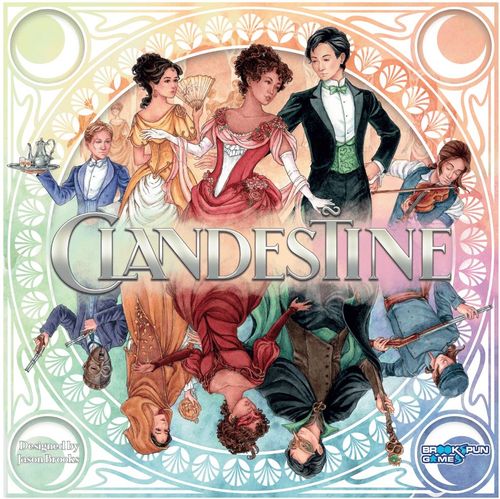
Clandestine
Clandestine Rulebook
Table of Contents
Table of Contents
Overview
Clandestine is an asymmetric resource management game with mancala-style Action selection. Each player controls a unique secret Society, competing to become the dominant force in the city by earning the most Intrigue by the end of the game.
To do this, players use Pawns to take Actions, which yield various resources used to pay costs and enhance their abilities.
Pawns move around the board between the Public path, which any player can use, and their private Society path. Pawns move when Actions are taken, and concentrating Pawns on a space increases that Action's Strength. Choosing the right Actions to gather your forces before unleashing a powerful play is the key to victory.
Along the way, players will discover mystical Relics to attach to their society, reveal clever Secrets to turn the game to their favor, and use Alchemy to convert Energy and Gold into more valuable tools, all the while managing the Chaos their Actions will cause. Eventually, they'll be strong enough to ascend to higher Levels and take big leaps in capability. When a player attains their fifth Level, the game end is triggered, and the winner is the player who scores the most Intrigue from the state of their Society and their Actions during the game.
Box Contents
- 5 Secret Societies, each with: 1 Tableau with Ascension & Strength Dials, 1 Society Path, 6 Society Leader Pawns, 3 Alchemy Tokens, 2 Starting Tiles, and Secret Cards (31 Secret Cards in total)
- 14 Path Connectors
- 5 Public Leader Pawns
- 25 Public Follower Pawns
- 55 Universal Follower Pawns
- 12 Deep Alchemy Tokens
- 50 Ascension Tiles
- 1 Ascension Board
- 24 Conjunction Cards
- 108 Relic Cards
- 1 Relic Map
- 40 Chaos Tokens
- 90 Gold Tokens (1x60, 5x30)
- 35 Energy Tokens (1x25, 5x10)
- 60 Intrigue Tokens (1x40, 5x20)
- 1 Chalice
- 10 Reference Cards
- 1 Score Pad
- 1 Rulebook
- Solo Components: 24 Nemesis Intent Cards, 3 Nemesis Difficulty Cards, 2 Nemesis Paths, 16 Nemesis Agents, 12 Nemesis Society Leaders, 12 Nemesis Tithes, 1 Nemesis Scoring Card
Setup
- Determine First Player. The player who was most recently entrusted with a secret is the First Player. Give that player the Chalice. Turn order starts with that player and proceeds clockwise.
- Choose a Society. Each player chooses a Society to play, in reverse turn order:
- a. Take the Tableau, Path, Secrets, Leaders, Starting Tiles, and Alchemy tokens belonging to your society.
- b. Separate your Secrets by level, face-up. (Level is the Roman numeral in the lower right of the Secret card.) Shuffle the Level I Secrets deck and place it face-down in front of you. Set the rest aside in separate face-up piles by level for now.
- c. Take the resources listed in the "Starts With" panel on your Tableau.
- d. Rotate the Ascension Wheel on the bottom of your Tableau to Level I.
- e. Place four of your Society leaders on the lower left colored side of your Tableau (in the cutouts). Place your remaining Alchemy token(s) just to the right of the four Society Leaders.
- Build the City. Flip the First Player's Path to a random side. Then use the Path Connectors with the dots that correspond to the current player count to connect each other player's Path to the First Player in a ring, flipping Paths and Connectors such that their Fundraise and Discover spaces alternate. (In an odd-player-count game, one space will be duplicated; match the top-right space of the First Player's Path to their right connector.)
- Populate the City. Each player places Pawns on their Path and connector to its right, according to the diagram on the setup page.
- Populate the Ascension Board.
- a. Place the Ascension Board near the City.
Key Concepts
Intrigue
Power isn't found in gold, or guns, or occult books. It's found in people. Make them see the world as you do, and they will make you omnipotent.
Intrigue represents the City's acceptance of your vision for the future. The player with the most Intrigue at the end of the game is the winner!
Levels
Secrecy is safe, but slow. There are advantages to be gained from working under the light of day.
As you build your society, you will gain Levels. Levels represent the public visibility of your society and its impact on life in the City. The game end is triggered when any player reaches Level 5. However, the goal of the game is still to have the most Intrigue; just because your society is the most visible doesn't mean it's the most powerful!
Your Society
There will be those who disagree with you, who have their own plans for the city. Subvert them or destroy them, but whatever you do, don't ignore them.
Each player commands a secret society, working from the shadows to influence the City. Each society is unique, with its own Society Path, Secrets, and special abilities that change how it interacts with the game and with other players.
Paths of the City
Move with grace between the backrooms and the street. Ensure that the flow of the city is always in your favor.
The pieces of the game board that you assembled during setup make the City. The City is made up of spaces, each of which corresponds to an Action that players can use there. The City's spaces are divided into a single Public path, and a Society path for each player. Paths control the direction of Pawns as they move around the board.
The Public path is the inside loop in the City. Each player also has their own Society Path that overlaps with and branches off from the Public path. The spaces where the Public and Society paths intersect are called Sidewalks; the spaces in a Society Path that don't intersect with the Public Path are called Chambers.
Arrows in each City space point in the direction of movement: the Public path moves clockwise, and the Society paths move counterclockwise. When pieces move from a space, they always move in that direction (unless otherwise noted by the effect that moves them).
Pawns and Strength
This work requires many hands. Shepherd your followers and gather your allies, even if they don't know who you really are yet.
The City is populated by Pawns, who travel around the city's paths and help increase the Strength of your Actions on the spaces they occupy.
Pawns come in four varieties:
- Public Leaders are worth 2 Strength. Any player can perform Actions with them. They may only move along the Public path.
- Public Followers are worth 1 Strength. They can't perform Actions. They may only move along the Public path.
- Society Leaders are worth 2 Strength. Only the player who matches their color may move them and perform Actions with them (they still contribute 2 Strength to Actions taken by other players on their space, however). They may only move along that player's Society path.
- Universal Followers are worth 1 Strength. They can't perform Actions. They may move along any path, following the Leader that performed an Action whether that Leader moves along a Public Path or Society Path.
A space can have multiple Pawns on it. The total Strength of all of the Pawns on a space is the total Strength of an Action used there.
Suits
The ends always justify the means, and you have a great many means at your disposal.
Relics and Secrets belong to one or more Suits, indicated by hexagonal icons written on the bottom-left side of their cards. Suits matter for gaining Levels; you'll need to amass ever-larger numbers of cards with matching suits to power your next Ascend Action (how you gain Levels).
Each suit represents the means your society uses to affect change on the City:
- Rod: The path of vigor and ambition. Lead the way and ensure dominance at any cost.
- Sword: The path of focus and calculation. Remove distraction and execute a perfect strategy.
- Disk: The path of need and practicality. Make others desire what you have.
- Chalice: The path of mystery and subtlety. Take what you want with a soft, unseen hand.
Other Resources
Several other resources are gained and spent throughout the game:
- Gold: The end of alchemy, and the means to power. Used to Ascend and make simple trades.
- Energy: Cosmic force for manipulating the unseen. Used for advanced trades and the most powerful Secrets.
- Chaos: Disruption to the status quo that works against your goals. Accumulating too much restricts trades and depletes Intrigue.
The supply of Resources is infinite. If you run out of tokens for a Resource, use some other means to track it.
Turns
One by one, you make your moves, pulling strings overtly and covertly.
On your turn, select either a Public Leader or one of your Society Leaders to perform the Action on their space. Determine the Strength of the Action, move the Pawns on that space, then perform the Action.
In addition to your Action, on your turn, you may also play one Secret while choosing your Public Leader/Society Leader but before taking your Action (see page 13). You may also make Alchemy trades (see page 17).
Lastly, at the end of your turn, gain 1 Energy from the Chalice, then pass the Chalice to the player on your left. If at this point you have more Relic and/or Secret cards in your hand than the maximum printed on the Ascension dial showing through your Tableau, discard cards until you're at your maximum again.
Strength
All pawns that were on the space contribute their Strength to the Action. The more Pawns you move at once, the more Strength your Action will have, and the more effective it will be.
All Leader Pawns (Society Leader and Public Leader) are worth 2 Strength each. All Follower Pawns (Universal Follower and Public Follower) are worth 1 Strength each.
Each Action has a formula describing its effects. For instance, Fundraise instructs you to "Gain Gold = Strength." If you used this Action with 1 Leader and 1 Follower in that space, you would have 3 Strength, and would therefore gain 3 Gold.
Pawns aren't the only way to increase an Action's Strength. Secrets, Relics, and other effects can also make your Actions stronger.
Use the Strength Tracker at the top of your Tableau to help you track the Strength of your Actions.
Example: Mason looks at the Leaders available to him and decides to Fundraise with his Society Leader. First, Mason calculates the Strength of the Action. He is moving two Leaders and two Followers. Leaders are each worth 2 Strength, and Followers are each worth 1 Strength, so this Action has a total Strength of 6 (2 + 2 + 1 + 1). He sets his Strength dial to 6 as a reminder. Next, Mason moves the Pawns. He picks up all of the pawns on that space. He then places a Follower on the next spaces ahead of the Fundraise space. He decides to place the Public Follower first, then place the Universal Follower so that it ends up inside his Society – he can do this because he's acting with a Society Leader that will be moving into his Society shortly! Now that the Followers have been placed, Mason places the Leaders. He places the Society Leader in the space after the Universal Follower. The Public Leader can't be in his Society, so he instead places it in the next space it could go into: the one next on the Public Track after the Public Follower. Finally, it's time to perform the Action. Fundraise says to gain Gold = Strength. Mason's Strength for this Action is 6, so he takes 6 Gold. It's now the end of Mason's turn, so he gains 1 Energy and passes the Chalice to the player on his left. It's now that player's turn.
Moving Pawns
Before performing the Action, the Pawns on that space move forward. Pick up all of the Pawns in that space. Place one Follower on each space ahead of the space you used, until you run out of Followers. Then place one Leader each space after that.
If you have different types of Pawns in the same group, you may choose the order you place them within Leaders and Followers.
Each Leader type moves along specific paths:
Public Leaders follow the Public path. When they move, all Public and Universal followers will follow them along that path.
Society Leaders follow their own Society path. When they move, all Universal followers may follow them along that path. Public followers will follow the leader for as long as they are able along the shared Public path spaces on the Sidewalk. If the Leader continues to move into spaces they can't follow, they move along the Public path instead, as if the Leader had gone that way. They didn't see the Leader slip through the chamber door...
With particularly powerful Actions, you may find yourself moving so many Pawns that you come full circle on your path. Keep placing your Pawns one at a time even if this happens.
Actions
Fundraise
The practical realities of running the society are never far from your mind.
The Fundraise Action helps you acquire more Gold.
When you Fundraise, gain Gold equal to your Strength.
Discover
Your contacts extend far beyond the borders of the City, and they send news of exciting finds in distant lands.
The Discover Action helps you acquire Relic cards.
When you Discover, you may acquire Relics from the Relic Map with total value up to your Strength.
For more information on the Relics and the Relic Map, see page 14.
Reveal
As you peel back the mystery and develop your dogma, new truths are revealed to you.
The Reveal Action helps you acquire Secret cards.
When you Reveal, draw Secret cards from your deck equal to half your Strength, rounded down.
For more information on Secrets and how to use them, see page 16.
Ascend
When you're ready to shed your old skin and step out into the light, we'll be there waiting to greet you.
The Ascend Action increases the Level of your society, increasing your power and helping to end the game.
When you Ascend, choose the Suit you will Ascend with, then pay the cost to gain your next Level, written on the dial of your player mat, then gain a Level. You may reduce EITHER the Gold cost by your Strength, OR the Suit cost (Rod/Sword/Disk/Chalice) by half your Strength, rounded down. You must choose one or the other; you can't reduce both the Gold and the Suit cost.
If you can't pay the cost to gain a Level, this Action does nothing.
For more information on Levels, see page 18.
Purge
You'll inevitably attract enemies and undesirables in your midst. Have a plan in place to rid yourself of your parasites.
The Purge Action helps you remove Chaos from your mat and clear Pawns from your Society's sidewalk.
When you Purge, remove a number of Chaos on your Tableau equal to half your Strength, rounded down. You must remove Chaos on your Alchemy sections first.
After removing Chaos, choose a number of Public/Universal Followers on your Sidewalks up to half your Strength, rounded down. Move them forward until they're no longer in your Society's public spaces.
Normal movement restrictions still apply to the Purge Action. Public Followers may only move along the Public Path, but Universal Followers may move along either path (since your Society Leader initiated the action).
For more information on Chaos, see page 20.
Example: Natalie performs the Purge Action with 6 Strength. She moves the Public Follower forward to the next available public space, and the two Universal Followers forward to the first chamber in her Society.
Regroup
Position your forces to be ready when the time is right.
Societies don't have a Regroup Action among their Society's spaces. However, Secrets and other effects can allow you to take a Regroup Action, usually for free as part of another effect.
The Regroup Action helps move Pawns around your Society path.
When you Regroup, choose EITHER from the spaces on your Society Path:
- One of your Society Leaders
- Public/Universal Followers up to your Strength
Move each of the chosen pieces forward a number of spaces up to your Strength. You may move each Pawn a different number of spaces.
Normal movement restrictions still apply to the Regroup Action. Public Followers may not be moved into your Society's Chambers.
Example: Natalie performs the Regroup Action with 2 Strength. She chooses to move two Universal Followers. She can move each of them up to 2 spaces, so she moves the right one 2 spaces and the left one 1 space, such that they both end up on the same space just inside her Society.
Relics
There are powers outside of the physical realm that cultures ancient and modern have learned to control. By collecting their relics, you too can wield these mystic forces.
Relics are bonuses that can be assigned to your Society spaces. They enhance the Actions in those spaces, and specific combinations of them can trigger a Conjunction for a significant bonus. They can also be used to pay for Ascension; see page 15 for more details.
Acquiring Relics
Relics are acquired via the Discover Action (see page 12).
The Relic Map is a collection of revealed Relic cards, distributed among four vertical Routes that meet in the center. Any Relic on the Map may be acquired; however, Relics further from the City (higher on the Map) cost additional Strength, written on the space above those Relics.
In addition, you gain 1 Chaos for each Route you acquire Relics from in the same Action beyond the first (for instance, if you acquired from three routes, you would gain 2 Chaos).
At the end of each turn, remaining Relics on that Route move down to fill all available spaces, then new Relics are added to that Route's top empty spaces and revealed until that Route is full. The current player chooses the order in which cards are moved down the Map. Add new Relics from the deck to the Map from left to right (and bottom to top within each route).
Example: Joan takes a 6 Strength Discover action. They choose to take the Ruby Toad (1 value), Elaborate Orrery (2+1 value), and Bloodied Scales (1+1 value), for a total of 6. Joan acquired Relics from two Routes, so Joan also gains 1 Chaos.
Your Relics
Relics you acquire go to your hand. The maximum number of Relics your hand can hold is written on the Level Wheel for your current Level. At the end of your turn, if you have more Relics in your hand than your maximum, discard Relics until you're at your maximum again.
The Relic deck is finite. Once discarded, Relics can never be drawn again.
Relic card anatomy: 1. Name; 2. Effect Type; 3. Effect; 4. Flavor Text; 5. Value (Strength needed to acquire); 6. Suit; 7. Alternate Suit.
Assigning Relics
Relics in your hand can be assigned to spaces on your Society Path at any time via an Alchemy trade. To assign a relic, pay the cost for the Alchemy trade on your player mat, then place the Relic you're assigning in any slot next to one of your chambers (some chambers have multiple slots).
Your Society has six slots. Each slot may hold up to one Relic. All slots may hold Bright Relics, but only the two innermost slots may hold Dark Relics.
Relics can have many different effects, but most enhance the Action of the space they're assigned to. When that space's Action is used, also perform any "+" effect written on the Relic.
In addition to their effects, assigning Relics in a specific arrangement around your Society can trigger your Conjunction. See the Conjunction section on page 20 for more details.
Bright and Dark Relics
Relics' card backgrounds can be Bright or Dark. Dark Relics are more powerful and more expensive than Bright Relics, and may only be assigned to specific slots in your Society. Dark relics also have an alternate Suit value that may be used to pay for Ascension, fulfill Conjunction requirements, or count for endgame scoring. When performing an effect that uses Suit, you may choose either of the values (but not both).
Relic Effects
Relics have effects while assigned to your Society's spaces. Relics' effects come in three varieties, depending on the header above their effect:
- Relics with a "+" header add an additional effect each time an Action is used on the space they're assigned to. You may choose to apply a Relic's effect immediately before or immediately after performing your action (unless indicated otherwise). For instance, you gain 2 Gold whenever you use the Ruby Toad's space.
- Relics with a flag header are worth Intrigue at the end of the game. For instance, you gain Intrigue for each Chalice symbol in your assigned Relics at the end of the game with the Wooden Cup.
- Relics with an eye-in-circle header have some other effect that is usually permanent or ongoing. If you replace an assigned Relic that has a permanent or ongoing effect, you no longer have the benefit of that effect. For instance, the Knotted Silk gains you a Deep Alchemy token when this Relic is assigned. If you were to replace the Silk, you would lose its Deep Alchemy token.
Secrets
The defining feature of a secret society is what it keeps hidden. Its goals, its membership, and its understanding of the world must remain mysterious to those outside its circle.
Secrets are cards unique to each Society that help it manipulate the game and gain an advantage.
Secrets are drawn via the Reveal Action (see page 12). Once drawn, Secrets go to your hand. The maximum number of Secrets your hand can hold is written on your current Society Level. At the end of your turn, if you have more Secrets in your hand than your maximum, discard Secrets until you're at your maximum again.
Playing Secrets
You may play one Secret each turn, while choosing a Public Leader/Society Leader but before taking your Action. Each Secret has two possible effects. When you play a Secret, choose which effect to perform. Once the effect has finished resolving, discard the Secret.
Some Secret effects have an Energy Cost as part of their effect. You must pay the amount of Energy written in these effects to use them; otherwise, you can't choose to perform that effect.
Your Secret deck is finite. Once discarded, Secrets can never be drawn again.
Secret card anatomy (example: Soapbox Speech): 1. Name; 2. Effect; 3. Alternate Effect; 4. Flavor Text; 5. Intrigue Value; 6. Society and Level; 7. Suit.
Gaining New Secrets
New Secret cards are added to your deck each time you gain a Level. You begin the game with only Level 1 Secrets in your deck. When you gain a new Level, shuffle the Secret cards for that level into your deck, then draw two Secrets. Skip this step for Level 5; there are no level 5 Secrets.
Each society also has a powerful Conjunction Secret. Your Conjunction Secret is added directly to your hand when your Conjunction is achieved.
Secrets and Moving Pawns
Many Secrets allow you to move Pawns. Your Secrets may never move pawns belonging to other players, nor pawns in other players' Chambers.
Alchemy
Alchemy allows you to exchange one resource for another. Each Society has different Alchemy trades available. Most Alchemy trades can be performed at any time, including on other players' turns.
Using Alchemy
Alchemy trades are performed by assigning Alchemy tokens. To make a trade, place an unassigned Alchemy token in the slot for that trade, pay the resources to the left of the arrow, and gain the benefits on the right side of the arrow. Each set of trades may only have one Alchemy token assigned to it.
Example (a standard "Any Time" trade panel): By placing an Alchemy token on this trade, you can exchange: 3 Gold for 1 Energy, 5 Gold for 2 Energy, or 6 Gold for 3 Energy.
Retrieve all of your Alchemy tokens at the beginning of each of your turns.
Deep Alchemy
Deep Alchemy tokens are a special kind of Alchemy token that you can acquire through some Relics, Secrets, and Conjunctions.
Deep Alchemy tokens are used to repeat trades. To use one, assign it to any previously assigned Alchemy or Deep Alchemy token by placing it on top of that token. Then perform the trade as if you'd just placed a regular Alchemy token on it. Deep Alchemy tokens can't be used to perform your first trade of that type.
Like regular Alchemy tokens, retrieve your Deep Alchemy tokens at the beginning of each of your turns.
Alchemy Effects
Most Alchemy trades use common icons, but some effects are unique to Alchemy. These effects are described below:
- 2 Energy -> Assign a Relic (to an empty slot): Assign a Relic from your hand to one of your empty slots.
- 3 Energy -> Assign a Relic (to a filled slot): Assign a Relic from your hand to one of your filled slots, and return the Relic that filled it to your hand.
- 3 Energy -> Regroup (Strength = 1): Take the Regroup Action with Strength = 1. (This does not count as your Action for this turn.)
- Universal Follower + 4 Energy -> New Society Leader: Initiate a new Society Leader. Remove a Universal Follower on your society path and replace it with the Society Leader in the slot to the right of this trade. This trade can only be made at or above a specific Level (Level II in this example). Additionally, if the Universal Follower you replaced was on one of your sidewalk spaces, gain 1 Chaos for holding this ceremony in an indiscrete location. After all of your Leaders have been removed from your tableau, the last trade gives you 4 Intrigue instead of a new Leader.
- Unlock icon: When you remove a Society Leader from your Tableau and reveal this unlock icon, remove the Alchemy token it points to from your Tableau as well. You may now use that Alchemy token on this and future turns.
Levels
As your society gains influence, its members become more powerful and their effects on the City become more difficult to ignore.
Levels represent your society's overt power. Gaining a Level is a significant boost to your abilities and your Intrigue, and if you reach Level 5, you will begin the end of the game.
Ascending
Levels are gained via the Ascend Action (see page 12). The cost to gain a level is written on the Ascension wheel of your Tableau under "Next," and consists of both Gold and Rod/Sword/Disk/Chalice Suits. To pay the Suit cost, discard Relics and Secrets from your hand until their number of matching Suit icons is greater than or equal to the Suit cost. Any Suit may be used to pay this cost, as long as all of them match. You may not discard more cards than necessary to Ascend.
Tuck any Relics you discarded beneath your player mat; they are worth Intrigue at the end of the game. Secrets you discarded are not worth Intrigue at the end of the game.
Example: To Ascend from Level 1 to Level 2, Tam needs to spend 8 Gold and four matching Suits. They can pay this cost with the three cards shown (Relic/Secret cards worth 2, 1 and 1 Sword icons, per the example illustration). If Tam Ascended with Strength = 3, Tam could reduce that cost by either 3 Gold or 1 Sword (but not both).
Gaining a Level
When you gain a Level, take the following steps:
- Grow in power and influence. Rotate the Ascension wheel on your Tableau to your new level.
- Develop new Secrets. Shuffle the Secret cards for your new Level into your Secret deck. Then draw 2 Secrets. Skip this step for Level 5; there are no level 5 Secrets.
- Seize an opportunity. If you just reached Level 2, take one of the available Conjunction Cards in the row next to the Ascension board.
- The first to rise is powerful, but vulnerable. If you're the first player to reach that Level, do the following:
- a. Take the First-to-Level Ascension tile for that Level.
- b. More followers flock to each society. Add a Universal Follower to each Sidewalk space (for all players). (Skip this step for Level 5.)
- c. Your rise destabilizes the City, and your enemies take advantage. Each other player in clockwise order performs the suit effect at the top of the Ascension board that matches the Suit you paid. (Skip this step for Level 5.) If the effect references a 'Level', it's referring to the level of the player that just ascended.
- Bring new skills into your fold. Choose any Ascension slot (either empty or full) less than or equal to your new Level in the column that matches the Suit you paid. Take the Ascension tile that fills that slot, or gain the resources written on that empty slot.
The Suit effects at the top of the Ascension board are: Military - Move all Public/Universal Followers on a public space without a Public Leader/Follower to the next Public Leader/Follower space (move all pawns on a public space w/o leaders to the next leader). Economic - Gain Gold = Ascender's Level, OR draw 1 Relic. Political - Regroup with Strength = Ascender's Level, OR lose 1 Chaos. Occult - Draw 1 Relic. Draw 1 Secret. Gain 1 Chaos.
Using Ascension Tiles
The tiles you gain when Ascending have a variety of effects:
- Tiles with an eye-in-circle header will add an additional effect to your Society. The effect to the left increases your Secret hand size by 1.
- Tiles with a flag header are worth Intrigue at the end of the game. The effect to the left is worth 5 Intrigue.
- Tiles with a hooded-figure header provide a one-time benefit. You may flip the tile during your turn to perform its effect. Flipping the tile to the left will take a Regroup action with Strength = 3.
Examples of Ascension tile effects:
- Flip this to take the Regroup action with Strength = 2.
- Flip this to play an additional Secret this turn.
- While you have this, your Secret hand size is increased by 1.
- While you have this, your Relic hand size is increased by 1.
- While you have this, you don't pay Energy costs when playing Secrets.
- While you have this, gain 2 Gold whenever you Fundraise.
- Flip this to gain 3 Energy.
- Flip this to remove 2 Chaos.
- This is worth 2 Intrigue at the end of the game.
Starting Tiles
Each Society begins the game with a pair of Starting Tiles. These tiles are used exactly like any other Ascension Tile.
Conjunctions
The city is awash in new people, technology, and ideas, searching for a home. It's up to you to make these drifting stars align in your favor.
Conjunctions represent unique opportunities in the City that your Society can use to its advantage. Each conjunction has an effect that gives you power now, and a goal that lets you unlock your Conjunction Secret later.
You claim a Conjunction when you reach Level 2.
Goals
Each Conjunction card has an arrangement of Suits around a track. If ever the six suits of Relics assigned to your Society match the type and order of your Conjunction, immediately put your Conjunction Secret into your hand. Note that Relics in Chambers with two slots can match the goal for their Chamber in either order.
Each Relic you match to your goal is also worth 2 Intrigue at the end of the game.
Conjunction card anatomy: 1. Goal; 2. Name; 3. Effect; 4. Flavor Text.
Conjunction Alchemy
Some Conjunctions give you additional Alchemy trades. From now on, you may place your Alchemy tokens on the Alchemy slot on the card to perform these trades.
Chaos
Your existence is a threat to the established order. If you move too much, and too quickly, you risk causing chaos in the city and turning the people against you.
Chaos represents disorder created in the city from the players' Actions. Chaos makes it harder for the player to perform Alchemy, and other types of Actions.
At the end of the game, you lose Intrigue equal to your highest filled Chaos slot's Intrigue value.
When an Action instructs you to gain Chaos, take Chaos tokens from the supply to fill the bottom-most empty slots on the Chaos meter on the left of your Tableau. When you lose Chaos, remove Chaos tokens from the top filled slots of the meter. You can have more Chaos tokens than the meter can hold.
Accumulating Chaos also prevents the use of Alchemy. If any of your top black Chaos slots are filled, you can't perform any Alchemy trades.
The End
We want to see change, yes, but most of all we want to see that change endure. You should not be content with being a mere chapter in the city's history... you should strive to write the entire book.
The end of the game begins when either of the following conditions is met:
- A player reaches Level 5.
- The Relic Deck is empty.
When the end of the game begins, note which player's turn caused it to begin. The game ends immediately before their next turn (such that each other player has one final turn). Remember you can still perform "Any Time" Alchemy trades on other players' turns!
When the game ends, calculate your final Intrigue by adding the following together:
- Intrigue = The square of your current Level (e.g. Level 4 = 16 Intrigue).
- 2 Intrigue for each assigned Relic that matches your Conjunction goal (up to 12 Intrigue).
- Intrigue for assigned Relics in your Chambers that score at the end of the game (flag header).
- Intrigue value for Relics you used to Ascend.
- Intrigue value of the Secrets in your hand.
- 3 Intrigue for each of your Society Leaders in the City.
- 1 Intrigue for each Universal Follower on your Society path.
- Any Intrigue tokens and tiles you've gained.
- Subtract Intrigue equal to the Intrigue value of your highest filled Chaos slot.
- The Twilight Masks gain 3 Intrigue for every 2 Chaos they purged throughout the game.
The player with the highest total Intrigue wins! If there is a tie, it's broken in favor of the player with the highest First-to-Level Ascension tile. If no tied player has a First-to-Level Ascension tile, break the tie in favor of the first player with the highest Intrigue in the bulleted categories above, starting from the top.
Example: It's the end of the game, and Victor gets: 16 from his Level (4x4); 4 from relics matching his Conjunction; 5 from his flag-header Relic; 13 from Relics used to Ascend; 9 from Secrets in his hand; 12 from his Society Leaders (4x3); 6 from his Universal Followers (6x1); 3 from his Ascension token; 8 from his Intrigue tokens; -4 from his Chaos. All together, he has 72 Intrigue.
Societies
The Mariners' Union
Originally established as a tradespeople's union, this society has grown into a tight-knit array of shipping moguls and trading companies. Their members are technical and practical, and their hierarchy is draped in the nautical trappings of their craft. They seek to document the metaphysical mysteries of the world, and have created a web of explorers and pirates who funnel magical Relics into their laboratories.
Trading Company
The Mariner's Union dominates the Relic Map. They're able to acquire Relics more easily than other players, and can even extend the Map with new cards that are cheaper for them and more expensive for their opponents. Meanwhile, they benefit when other players access the Map, gaining resources whenever anybody uses the Discover Action.
The Garden Club
The Garden Club is a collection of businesspeople who look out for their mutual interests. While most of its members are law-abiding, the upper echelons of its hierarchy secretly control the city's black markets, and couch their criminal secrecy in layers of metaphor and superstition that has confounded even the most dogged investigators.
Community Investments
The Garden Club focuses on gaining large amounts of Gold to fund their activities. They can Invest their Gold on spaces and other game components, and then gain Gold proportional to that investment whenever any player uses that object. Once they've sufficiently enriched themselves, they can use their fortune to power Alchemy trades.
Many of the Garden Club's Secrets instruct you to Invest. To Invest, add the specified number of your Gold to the object you're investing on. If you don't have enough Gold, you can't Invest.
Whenever a space you've Invested on is used to take an Action (by any player), gain Gold from the supply equal to the amount Invested on it.
Whenever a Relic is purchased from a Route (by any player), gain Gold from the supply equal to the amount invested on that Route. (The bottom-most space on the Relic Map does not generate payouts for any investments.)
The Twilight Masks
The Twilight Masks take matters into their own hands. This secretive gang of vigilantes is unafraid to terrify, hurt, or even kill those it considers threats to the public.
Its members don masks to carry out their horrific work, each of which represents a predator. These fearsome visages are meant to channel the ferocity of the beasts they depict, and to remind their victims that they aren't at the top of the food chain.
Capitalize on Chaos
The Twilight Masks capitalize on the growing Chaos in the city to keep other players in line. They're able to place Chaos tokens on spaces and other game components, reducing their effective Strength or otherwise punishing other players for using them.
Chaos has additional functions for the Twilight Masks. Many Secrets will instruct you to place Chaos on an object.
When a space with Chaos is used to take an Action, reduce its Strength by the amount of Chaos on it if an opponent used that Action, or increase its Strength by that amount if you used that Action. Then move all Chaos from that space to the acting player's Chaos slots.
A Relic with Chaos on it costs additional Strength equal to the amount of Chaos on it if an opponent attempts to acquire it, or costs less by that amount of Strength if you attempt to acquire it. Then move all Chaos from the Relic to the acting player's Chaos slots.
The Serpent Keepers
The Serpent Keepers are an ancient and well-connected group dedicated to the preservation of social order, counting politicians, diplomats, and even kings among their number. They use their influence to fight what they perceive as the universe's natural decay into chaos, symbolized by the eponymous "serpent," ensuring that peace reigns supreme. That this peace is maintained by keeping themselves in power is just a happy accident.
We Are Everywhere
The Serpent Keepers quietly build their influence over the city and regulate the other societies with hidden traps. They can Initiate spaces to claim them, and then Prime their Secrets on them, which trigger when that space is used. These cards will always help the Keepers, but may hurt other users, so beware entering their territory!
To Initiate, place an Intrigue from the supply on the space you're Initiating.
To Prime, place the primed Secret face down next to an Initiated space.
Keep these cards face down; don't show other players what they do. When that space is used to take an Action, flip the card face up and follow its instructions. Its effects will be different depending on whether the Keepers or another player triggered them.
The number of face-down secrets that can exist on an individual space can never exceed the Keeper's current Level.
The Blue Army
Empires have risen and fallen, and tyrants have come and gone, but the people will always remain. So says the Blue Army, a shadow regiment of soldiers from conscripts to generals, who are working to secure the city's independence as its own sovereign state.
Revolt
The Blue Army controls the movements of Pawns, gathering them together to generate lots of Strength for their Actions. Later in the game, they can use their gathered Pawns to score large amounts of Intrigue.
The Blue Army has a special Revolt Action in their Chambers that no other Society has. When you Revolt, choose EITHER from the spaces on the Public Path:
- One Public Leader
- Public/Universal Followers up to your Strength
Move each of the chosen pieces forward a number of spaces up to your Strength. You may move each Pawn a different number of spaces. Then gain 1 Chaos and perform another Action with a Public Leader.
Solo Play
Fundamentally, you are an agent of change: the architect of a more perfect world, founded on more enlightened ideals. It makes sense, then, that your greatest nemeses would be the most regressive factions of church and state, grown fat from feeding on the stagnation of their crumbling institutions. Even without competition from other upstart societies, breaking their resistance will be a superhuman task... will you be equal to it?
Clandestine can also be played solo. In solo play, you face a more powerful society that is operated entirely by the game. You can choose to compete against the Most Holy or the Silver Guard. You can face the Nemesis by yourself, or add it as an additional player to a multiplayer game.
Your Nemesis
Your game-operated opponent in solo play is called your Nemesis. Treat the Nemesis like another player: it has a seat at the table, takes a turn, and uses Actions just like a human player would.
To set up a Nemesis game, set up the game as normal, adding the Nemesis' Path to the City at the last available seat (such that it takes its turn last). Instead of the usual placement of Pawns on their Society Path, follow the Nemesis setup diagram (Pawns placed on the Nemesis Path as shown in the solo setup illustration). Then do the following:
- Choose the Difficulty you'd like to use for this game. Each Difficulty card has two Difficulties printed on it.
- Separate the Intent cards into Sun, Moon, and Star piles, then randomly add cards from each pile to the Intent deck according to the numbers on the Difficulty card. Return the rest of the Intent cards to the box.
- Shuffle the Intent deck and place it face down in the top Intent slot to the right of the Difficulty card.
- Flip the top card of the Intent deck face-up on the bottom Intent slot.
- Perform the setup steps unique to the Nemesis (see their Setup sections).
- Flip the Difficulty card over.
Nemesis Turns
The Nemesis uses Intent cards in two slots to decide what to do on its turn. The two center rows pointed at by the Difficulty card combine to form the directives the Nemesis will follow.
On the Nemesis's Turn, do the following:
- Flip the top Intent card of the deck face up. You now have two face-up Intent cards showing, one in the top slot and the other in the bottom.
- Does the Nemesis attempt to Ascend? If the top Intent has an Ascend symbol, the Nemesis will attempt to Ascend using the Target Suit. If so, follow the steps on page 28.
- Which Action does the Nemesis use? Do the following:
- a. Starting from the space in Leader Selection and proceeding in the direction of its arrow, search for the Leader(s) that match the Leader Properties. If multiple Leaders match, break ties in favor of leaders found earlier in the search.
- b. The Nemesis uses the found Leader to perform the Action on that Leader's space. Move Pawns as normal (Followers then Leaders). The Nemesis will always place Public Followers before Universal Followers, and Public Leaders before Society Leaders.
- Does the Nemesis perform Alchemy? Do the following:
- a. Follow the instructions in Alchemy Result.
- b. If the Nemesis Assigns a Relic, assign the oldest Relic in their hand of the Target Suit to an available slot in the chamber shown in Assign Relic.
- Move the face-up Intent card from the top slot to the top of the pile in the bottom slot. If the Intent deck is empty, shuffle all intent cards below the card just moved and place them face down to make a new Intent deck.
The Target Routes (12) on the Intent card show which routes of the Relic Map the Nemesis takes Relics from. Example: the combination of Target Routes shown (left route, right route, and bottom of the map) with the Chalice Target Suit has the Nemesis acquire each Chalice Relic from the left route, right route, and bottom of the map.
Fundraise Action
The Nemesis uses the Fundraise action normally.
Discover Action
When Discovering, the Nemesis will acquire Relics from the Relic Map. The Nemesis will acquire all Relics that match the Target Suit in the Target Routes (12) of the Relic Map. (The Nemesis ignores Strength and doesn't gain Chaos from taking relics from multiple routes.)
Other Actions
Each Nemesis has unique actions in its Chambers. See their section on the following pages for what these Actions do.
Nemesis Ascension
How can one possibly ascend when one is already at the height of power? Slowly, carefully, but inevitably. We must be more nimble than our foes to prevail.
The Nemesis will attempt to ascend using the Ascension Tokens on the Ascension Board. Ascension works differently for the Nemesis than it does for the player: instead of ascending right away, the Nemesis gathers Ascension Tokens over several turns.
The Nemesis' Difficulty card has four Level Slots, each of which holds Ascension Tiles as it works to ascend to the corresponding level.
When the Nemesis ascends, find the target tile on the Ascension board. The target tile is in the row of its target level, the Target Suit's column, and on the side indicated by the Intent Card.
- If the target tile is on the board, the Nemesis takes it.
- If that tile has already been taken, the Nemesis takes the other tile in that level and suit.
- If both tiles in that level and suit have already been taken, the Nemesis has Ascended to the next level:
- If available, it takes the First-to-Level Tile of that level and places it face-down on the current slot (otherwise, flip the top tile on the current slot so it's face-down).
- Then, it takes the target tile from its new target level and places it face-up on that slot. If its target was Level V when it ascended, the end of the game is triggered instead, if it wasn't already triggered by another player.
Note: When the Nemesis ascends to Level II, it does NOT take a Conjunction card. Additionally, if the Nemesis is the first to ascend to a new level, the bonus at the top of the Ascension Board IS triggered for all other players.
Example: The Nemesis is Ascending. Its target suit is Sword and its target Level is III. The target tile is at the yellow circle. However, this tile has already been taken, and so has the one next to it in the Sword column. The Nemesis therefore takes the yellow highlighted First-to-Level Tile at Level III, puts it on its III slot, and flips the tiles on that slot. Then it picks a new target tile. Its target Level is IV now, so its new target tile is the blue highlighted one, which it puts on its IV slot.
The Most Holy
Watching from the spires of the city's great cathedral are the eyes of the Most Holy. This ancient and secret brotherhood of elders has twisted church policy from the shadows for generations, quashing reforms and enriching themselves with the tithes of the laiety.
The Most Holy seeks to defeat you by siphoning off your Gold via Tithes, and capturing Universal Followers via the Choir and converting them to their own Society Leaders.
Most Holy Setup
To finish setting up the Most Holy:
- Place the remaining Most Holy Society Leaders on the four Lower Choir slots.
- Place a number of Universal Followers from the supply on the leftmost Upper Choir slots, according to the Difficulty card.
- Add a number of Tithe tokens according to the Difficulty card, following the procedure in Unique Actions below.
Most Holy's Unique Actions
The Most Holy's Chamber spaces have Actions unique to them.
- This symbol means "Add a Tithe token to a public Fundraise space." To determine which space gets the Tithe token, break ties in the following order:
- The space with the least Tithe tokens.
- The space(s) closest to the Most Holy's Society Path.
- This symbol means "Gain Gold for each Tithe token in play."
- This symbol means "Convert Pawns." To convert pawns, check if the Most Holy has the Gold in the leftmost open slot of the upper Choir. If so, they pay that Gold, move the rightmost Universal Follower from the upper Choir to the lower Choir, then move a Society Leader from the lower Choir (if available) to the bottom space in the Most Holy's Chambers. Universal Followers in the Lower Choir remain there for the rest of the game.
Example: The Nemesis is Converting Pawns. The leftmost open slot in the upper Choir is 5 Gold, so the Nemesis pays that to move their rightmost Universal Follower to the lower Choir, then moves one of their Society Leaders out of the lower Choir to the bottom space of their Chambers.
Tithes
Less of a tithe and more like a protection racket. Abstaining is not an option.
The Most Holy can add Tithe tokens to Fundraise spaces.
When you use a Fundraise Action with Tithe tokens on it, you must give one of the Gold you gained to the Most Holy for every Tithe token on that space. If the Tithes demand more Gold than you gained, you must give all of the Gold you gained.
The Choir
The elders have no shortage of wild-eyed young converts waiting in the wings.
The Most Holy capture and convert Universal Followers into their own Society Leaders.
The first time a Universal Follower would leave the Most Holy's Chambers each turn, that Universal Follower is placed on the leftmost available upper Choir slot in the center of the Most Holy's Path board.
The Silver Guard
Magic has existed since time immemorial, of course, from ancient witchfolk carving servants from wood to the elaborate electrothurgy of the modern age. For those with the knowledge to recognize them, like yourself, these occult artifacts are the gateway to power beyond the mere real.
That power has attracted the attention of a covert detachment of the secret police – the Silver Guard. For years, it has been quietly gathering up relics and disposing of their users in an attempt to consolidate all mystic force into the hands of the state.
The Silver Guard seeks to defeat you by denying you access to Relics and interfering with your Chambers' operations by deploying Agents.
Silver Guard Setup
To finish setting up the Silver Guard:
- Place the remaining Silver Guard Society Leaders lying down on the four Cell slots.
- For each human Society, place a number of Agents in that Society according to the Difficulty card, following the procedure in Unique Actions below.
- Reveal a number of Relics from the deck according to the Difficulty card. For each card, place an Agent on each Relic on the Map that matches that card's suit.
- Reveal Relics from the deck until you've revealed a Bright Relic from the number of unique Suits according to the Difficulty card (for instance, the pictured example needs 1 card from each of 3 unique Suits). Put those Relics in the vault, following the procedure in The Vaults on page 31. Put all other Relics revealed this way on the bottom of the Relic deck in a random order.
Silver Guard's Unique Actions
The Silver Guard's Chamber spaces have Actions unique to them.
- This symbol means "Place an Agent on each Relic on the Map matching this suit."
- This symbol means "Place an Agent on the next open space." The next open space is a human player's leftmost Chamber space without an Agent. To determine whose space gets the Agent, break ties in the following order:
- The player with the fewest Agents in their Society.
- The player with the highest Level.
- The player(s) with the highest First-to-Level Ascension tile (including none).
Agents are double-sided. Use the side that matches the object the Agent is placed on to remind yourself of its function.
Agents on Chamber Spaces
They go where they please, wielding the might of the state like a cudgel to get that they want. This fearsome power requires a human wielder, though, and if gold or violence were to dissuade the fragile user...
When you use an Action with an Agent on it, reduce that Action's Strength by 2. Then move that Agent to the next space along your Society Path. When multiple Agents occupy the same space, their penalties stack. If an Agent leaves your Chambers, return it to the supply.
You may remove all Agents on any one space at any time during your turn by paying either of the costs below:
- Bribe them. Pay Gold to the Silver Guard equal to twice the Silver Guard's Level.
- Kill them. Gain Chaos equal to the Silver Guard's Level.
At the end of the game, if an Agent is on one of your chambers, discard all Pawns on and Relics assigned to that space before scoring.
Agents on Relics
Even fleeing the city won't escape their reach. They'll find you anywhere in the empire. In all likelihood they're already shaking down your foreign contacts.
Acquiring a Relic with an Agent on it costs an extra 1 Strength. After acquiring that Relic, return its Agents to the supply.
When a Relic would receive a 2nd Agent on it, the Agents on the Relic are returned to the supply and the Silver Guard places it in the Vault. See below for what happens when Relics enter the Vault.
The Vaults
The looming gray building that houses the Silver Guard's collection overlooks the main street of the governance district. It's the perfect place to spy on bystanders and drag them in for interrogation... or is it experimentation?
Relics claimed by the Silver Guard's Agents are placed in its Vault. Expanding the Vault helps the Silver Guard gain Leaders and hold Followers.
When a Relic is placed in the Vault, the Silver Guard move the Society Leader on that suit down a number of spaces equal to the Intrigue on that Relic. If the Leader moves off the bottom slot, place it on the bottom space of the Silver Guard's Path.
After the Leader is moved from the top slot, that slot becomes a Cell that traps Followers that enter it. When placing pawns during an Action, after you place the first Follower (Universal or Public) on a space, each unlocked Cell connected to that space traps one of the next Followers that would leave it.
Followers trapped on Cells are used and moved when any player takes an Action on the space connected to them.
Example: The Nemesis Fundraises with the Society Leader and 3 Universal Followers on their Fundraise space. The first Follower is placed on the Discover space, then the next two are trapped in the unlocked Cells connected to it. Later, the Nemesis Discovers. The Followers trapped on the Cells connected to the Discover space count for that Action, so the Nemesis once again has a Leader and 3 Followers to use and move.
Nemesis Scoring
The Nemesis gains Intrigue based on which Society it's playing and which Difficulty you've chosen to play against. At the end of the game, place the scoring card below the Difficulty card, then follow the star column that corresponds to your Difficulty to see how to score the Nemesis' Intrigue.
Glossary
- Action (12) – A game effect that uses Strength to determine how powerful it is. Each space has an Action on it, and some effects can cause you to take Actions that aren't on your paths.
- Acquire (14) – To take a Relic from the Relic Map and put it in your hand.
- Add – To increase the Strength of a player's next Action.
- Alchemy (17) – The trading of one resource for another. Each society has a unique set of alchemy trades on its tableau.
- Alchemy Token (17) – A token that represents your ability to transmute matter and energy. The first time you make a Trade, you must place an Alchemy token in that trade's Alchemy slot.
- Ascend (12, 18) – A type of Action that represents your society becoming more overt in its effects on the City. You must spend a combination of Secrets, Relics, and Gold to Ascend to a new level. The game end is triggered when a player ascends to level V.
- Assign (15) – To place a Relic in a Relic slot on your Society. Once assigned, Relics' effects may be activated.
- Backward – When moving a pawn backward, move it counter to the direction of the path.
- Bright Relic (15) – A type of Relic with safe and stable powers. Bright Relics are less expensive to acquire and generally less powerful than Dark Relics.
- Chalice (9) – A type of Suit representing occult connections.
- Chambers (8) – The four private spaces on your Society Path. Only your Society Leaders and Universal Followers may move into your chambers.