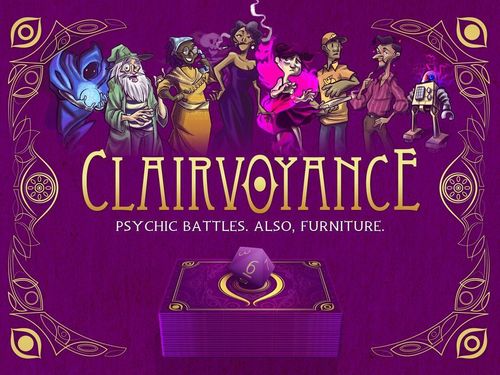
Clairvoyance
Clairvoyance Rulebook
Table of Contents
Table of Contents
Game Components
One 8-sided die
8 Character cards
5 Health counters
80 Playing cards
One Rulebook
Set Up
Pick a character and place it in front of you. Put a health counter on the 10.
Shuffle the deck and deal 5 cards to each player.
Each player says a number from 1 to 8. Roll the die. Whoever guessed the face the die lands on goes first. If no one guessed correctly, roll again.
Place the die in front of the first player, with that face up.
Turn order goes clockwise. Pass the die to the next player to indicate whose turn it is.
Objective
You win when all other players have 0 (or less) health.
When a player loses all their health, they discard their hand and possessed items (see possession) and are now out of the game.
The Turn
On your turn you can take up to 2 actions. If there are more than 2 players currently in the game, or if you started the game with just 2 players, then only 1 of these actions may be throwing an item.
Actions that involve turning the die:
Possess an item or put an item into another player's possession.
Throw an item from your hand.
Actions that do not involve turning the die:
Throw a possessed item.
Discard up to 2 cards.
After you finish taking actions, draw up to your max hand size of 5 cards. If at any time the deck run out of cards, replenish it with the shuffled discard pile.
At any point in the game, you may use character abilities, utilize single-use item's effects, or play instant cards from your hand for no action cost.
Turning the die
Whenever you play an item card from your hand, reveal the card and declare your intention to throw the item or to put it into your or another player's possession. Other players now have a chance to interfere by playing instant cards, activating single-use abilities, or using character abilities. Once everyone who wants to interfere has done so, you must then turn the die along 1 of the 3 edges to an adjacent face. (You will only ever turn the die more or less than 1 face if directed to do so by a card or character ability).
Die Example
Gertrude takes an Armchair from her hand to throw at RX-97. To activate the card, she must get the die to show a 6 or a 1. The die currently displays a 3 face-up.
Gertrude looks at the 3 faces adjacent to the 3 and see 2, 6, and 4. She turns the die so the 6 faces up. This activates the Armchair and it hits RX-97, dealing it damage.
If the number on the displayed face matches one of the card's activation faces, the card succeeds in being played. If the number does not match, discard the card. You must still turn the die, even if you cannot make it show the needed activation face. This unsuccessful attempt to throw or possess the card still counts as using an action.
Possession
An item becomes possessed when you take it from your hand and place it in front of yourself or another player. The possessed item stays on the table. Whomever the card is placed in front of (regardless of who placed it) owns the card, and can use its ability or throw it.
You may have up to 3 possessed items. If at any time you would gain a 4th, you must first discard one of your existing 3 possessed items.
Throwing Items
To attempt to throw an item, select one of your items (possessed or in your hand), and choose a player as your target. Once you have declared your intention to throw a possessed item, it is no longer considered possessed.
Players (including the current player) have a chance to interfere with your throw by activating their possessed items' single-use effects or by playing instant cards.
If you throw an item from your hand, then after players have had a chance to interfere with the throw, you must turn the die. If this fails to reveal one of the item's activation faces, then the throw fails and no damage is dealt. If your throw successfully lands, the targeted player is dealt the amount of damage indicated on the item card.
If you thrown an item from your collection of possessed items, do not turn the die; the throw automatically succeeds. However, players may still interfere to reduce how much damage is dealt. After anyone who would like to interferes does so, the targeted player takes the remaining damage.
Normally, you may only throw 1 item during your turn. However, the moment the number of players in the game is reduced to 2, even if this happens mid-turn, any number of your actions may be throws. (Note that if you started with 2 players this does not apply).
Card Types
Items
Items are cards you can possess or throw from your hand. Some items have effects that are either single-use or continuous.
Single-Use Items
You may either utilize a single-use item's effect or throw the item. After either, discard the card.
To use the effect, first possess the card. You may then use the single-use effect at any time, without using an action or turning the die.
Single-Use Example
Claire already possesses Music Box.
Claire: "Get used to dancing the blues!"
Harold: "Not anymore — an idea's sprung to mind."
Harold uses the effect from Jack-in-the-Box, a single-use item he has possessed, to destroy Music Box. Harold then discards Jack-in-the-Box.
Continuous Items
An item marked with a continuous symbol is not discarded after its effect is used (unless the card says otherwise). The effect can occur more than once. Continuous effects are not optional.
Note
It is possible that 2 or more players will try to play an item or instant, activate a single use ability, or activate a character ability at the same time that another player is trying to do one of these things. Should this happen, the person closest to the left of the turn-holder gets to have their move take place first.
Once that player's move is resolved, the next player (going in turn order) chooses to either follow through with their originally intended move or withdraw it. If a player withdraws their intended move, the card that would have been activated is returned to its original location and/or the ability is considered not to have been used.
Instants
Instant cards may be played at any time (including others' turns) and their effects are resolved immediately. Discard an instant card after use. Playing an instant does not use up an action.
Instant Example
Sebastian announces he's throwing a Lamp at Mama Rita, which will do 2 damage.
"Not so fast!" says Mama Rita, "I'm feeling a little Pyrokinesis coming on."
Mama Rita plays Pyrokinesis, an instant, to destroy the Lamp. Sebastian still turns the die 1 face.
Characters
Character Abilities
Each character has a unique ability that can be used once per game at any time. When a player declares they are using the ability, it immediately takes effect, and the current player must pause their turn to allow anyone to respond to it.
Character Biographies
Mama Rita
Charges Apply: Take 1 possessed item from any player and put it into a different player's possession.
Gertrude
Pyromania: Destroy 1 item.
Harold
Ding-Dong!
Guaranteed Delivery: Only character abilities can affect your next thrown item.
Ed
Scrounge: Take 1 card from the discard pile and put it into your hand.
RX-97
Circuit Breaker: Change the target of the current thrown item.
Myr
Eminent Domain: Search through the deck and put 1 item into your hand. Then shuffle the deck.
Sebastian
Charm: Until the start of your next turn, no one can throw items at you. (Charm may only be initiated during your turn.)
Claire
Prognosticate: Set the die on any face.
Play Variants
Two Player
In a 2 player game, you can only throw 1 item each turn. When determining first player, each player picks 2 numbers instead of 1.
Team Play
Players can form teams. Make sure each team has an equal amount of players, and sit across from your teammate. The only difference in play is that your team wins when all other teams' players have 0 health.