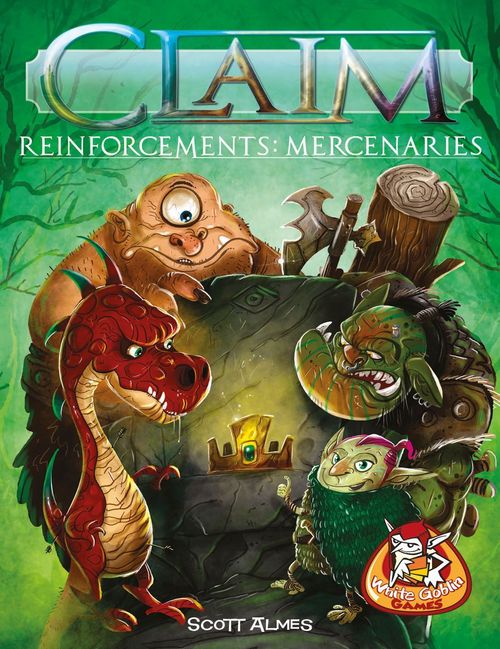
Claim: Reinforcements – Mercenaries
Claim: Reinforcements – Mercenaries Rulebook
Table of Contents
Table of Contents
Components
58 cards
- 18 Heroes
- 7 Elves, numbered 1-7
- 7 Orcs, numbered 1-7
- 8 Elf/Orc, numbered 1-8
- 10 Cyclops, numbered 0-9
- 8 bonus cards
- 2 overview cards
To support the game we added 8 "+1 bonus cards" that can be used for the Unicorn faction (from Claim Reinforcements: Maps) and any other faction that need modifiers.
Set Up
The Elf/Orc factions replace either the Goblin/Knights or the Gnome/Giants combination. The Cyclops faction can be used to replace normal 10 card factions.
Hero Rules
At the beginning of the game, shuffle the deck of Hero cards and deal 5 of them out face-down. Then, shuffle your normal faction deck and remove 5 cards from the top. Add the 5 hero cards to the faction deck and then shuffle the deck thoroughly. This will be your faction deck that you use during the course of the game. Place the face-down deck in the middle of the table. Deal each player 13 cards. Each player takes their cards into their hand without showing these to the other player.
Now, in addition to your normal factions, you will have a few hero cards in the deck. They will be played and used as normal cards, but each has their own unique ability. When played, the following rules will take effect:
- If the Hero is the first card played, then the opponent may follow with any faction. There is no 'lead' faction for that hand. The values (and any special abilities) will determine the winner.
- If the Hero is the second card played, it is considered to be of another faction. So, the opponent's lead card will still have an advantage.
When Heroes are collected in Phase II, they do not count as any specific faction and do not count towards end game scoring (unless otherwise stated). The Heroes trump any faction or location power, if there is a conflict, but artifacts trump everything.
Game Overview
The game is played in two distinct phases. In Phase One, each player gets a hand of cards that they will use to recruit followers. In Phase Two, they will use the followers they gained in Phase One to compete and win over the five factions of the realms. At the end of the game the player who has the majority of followers of a faction wins that faction's vote. The player who wins the vote of at least three factions wins the game!
Phase One: Recruit Followers
This phase consists of thirteen tricks, one for each card in each player's hand. The Leader for each trick is the player who won the last trick (exception: Dragons). The first Leader of the game is the youngest player. Each trick is played by following these three steps:
Reveal one card
Flip the top card from the deck in the middle of the table and place it between both players. The players will be competing for this card.
Play cards
- The Leader plays any single card from his hand.
- Note: He can choose a card of any faction, this doesn't have to be a card of the faction the players are competing for.
- Then the other player plays any single card from their hand.
- Important: If able, the other player must follow faction. Which means, if this player has a card in their hand of the faction of the card just played then it must be played. In other words, a player can only play a card of a different faction if no card in their hand matches the faction of the one played by the Leader.
Collect cards
- The player that played the highest valued card (0 is the lowest, 9 the highest) of the faction played by the Leader wins the card in the middle. In case of a tie, the Leader wins the trick.
- Note: If the second player played a card of another faction than the Leader automatically wins the trick.
- The winner places their won card face-down in their Follower deck (exception: Seer). The loser takes a card from the top of the deck in the middle and places it face-down in their Follower deck. This player may look at the card, but is not allowed to show it to the other player.
- Note: Cards in your Follower deck will be your hand for Phase Two.
- Discard all (remaining) cards played.
- Important: Be sure to keep your Score pile face-up and your Follower deck face-down to keep them separated.
Continue until the deck is depleted and the players are out of cards in their hand. Now the game moves onto Phase Two.
Phase Two: Gather Supporters
Both players take the 13 Follower cards they gained during Phase One into their hand. Now, players will play another 13 tricks. However, instead of competing for particular cards in the middle, this time players compete for both cards played each trick. Each trick is played by following these two steps:
Play cards
- The leader plays any single card from their hand.
- Then the other player plays any single card from their hand.
- Important: The rules regarding following faction are still in effect!
Collect cards
- Determine the winner like in Phase One.
- The winner of the trick places both played cards face-up in their Score pile, unless a faction power (Trolls, Gnomes) is in effect.
- If either player has played a Giant card, the player winning the trick may discard one opponent's won Gnome card for each Giant in this trick with the same value.
After all players have played all cards from their hand, all factions are scored.
End of the Game & Scoring
The players count how many cards of each faction they have in their Score pile. Whoever has the most cards of a faction wins that faction's vote. If there is a tie, whoever has the highest numbered card of that faction wins the vote. If a tie still exists check who has the second highest numbered card of that faction, and so on. The player who wins the vote of the most factions wins the game. In case of a tie for the most factions the player with the most cards of factions which voted for him, wins the game.
Faction's Special Powers
Each faction has a special power that effects play. They are as follows:
- Cyclops: At the end of the game, the player with the least amount of Cyclops wins the favor of the faction. You must have at least one Cyclops to win. If there is a tie for the number, the player with the lowest valued Cyclops is the winner.
- Elves: No special ability
- Orcs: No special ability
- Elves and Orcs: This replaces the base factions (Knights/Goblins or Giants/Gnomes). These are special because they have dual suited cards: In Phase 1 or 2, when you play a dual suited card, you must announce whether it's played as either an Elf or an Orc. It may be played as either, but you must choose. In Phase 2, if this card is won, it stays the suit that it was declared to be when played. You can orient the card to show what suit it is.
Heroes
- Singing Bard: On the next hand, you play the lead card.
- Centaur Archer: If played to follow another card, beats any 5 or 6.
- Bug Lord: If you play this card in Phase 2, add 1 to it for each faction card that you've acquired.
- Jester: If played second, this card switches places with the card your opponent played. The hand resolves as if they played this card and you played the other card.
- Siren: If you lead a hand with this card and lose, then you take a card from your opponent's score pile.
- Witch: If this card is lead, it can only be beaten by even numbers greater than 5.
- Minotaur: If this is the last card you play in Phase 1 or 2, then you automatically win that hand.
- Stone Golem: If following a card that is valued between 1-4, the Stone Golem crushes it and the other card is discarded. The Golem wins the hand.
- Necromancer: You may swap this card from your hand with a card that is about to be discarded. (Phase 1)
- Life Stealer: If played to follow another faction, then this card takes on all the abilities of that faction as if it was that faction. It does not count as another faction during scoring.
- Gargoyle: If you collect this card in Phase 2, you count it as two of any other faction card.