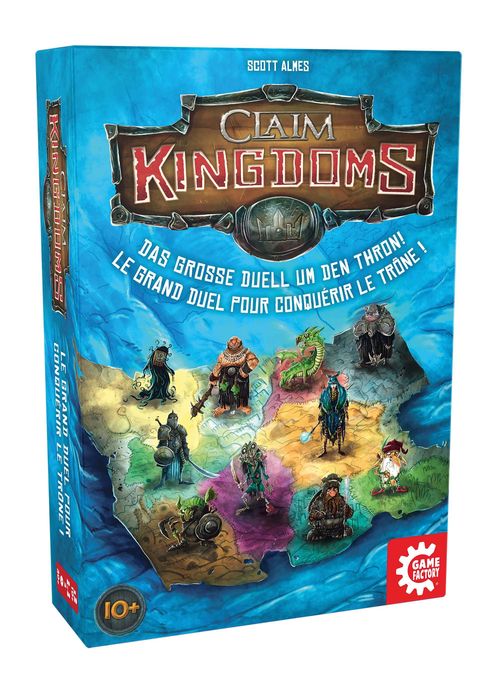
Claim Kingdoms: Das grosse Duell um den Thron!
Claim Kingdoms: Das grosse Duell um den Thron! Rulebook
Table of Contents
Table of Contents
Contents
- 70 faction cards (7 cards per faction)
- 2 tiles "50+/100+"
- 32 playing pieces (16 each in red and blue)
- 1 scoring track
- 2 faction overviews
Goal of the Game
Collect as many points as possible during the game and in the faction scoring. The player with more points at the end wins and conquers the throne.
Game Setup
Only 7 of the 10 factions are needed per game. Decide which factions you want to play with. Put the 3 unneeded factions back in the box.
Now shuffle all cards of the 7 factions together and place them as a face-down draw pile (for easier handling it can also be several piles) on the table, preferably somewhat off to the side.
For the display, reveal 3 cards and lay them out next to the draw pile. Reveal the top card of the draw pile and place it face up in the middle of the table as the starting card. The kingdom gradually grows around this card. Place the scoring track somewhat off to the side.
Each player receives:
- 2 cards from the draw pile, which he keeps secret from his opponent,
- a faction overview,
- the playing pieces of one color, of which he places one on space 0 of the scoring track,
- the matching "50+/100+" tile.
Now the fight for the kingdom can begin. The younger player may decide whether he starts himself or lets the older player go first.
Course of Play
Players take turns. When it is your turn, you carry out the following actions in the given order:
- Place a card and set a piece
- Use the card's ability
- Draw a card
After that it is your opponent's turn.
1) Place a Card and Set a Piece
Place one of your two hand cards so that it borders at least one side of one or more cards already lying face up. It is not allowed to place a card only corner to corner.
Then place one of your playing pieces on the card you have just placed.
Example: At the spaces marked green you can place a card. (The diagram shows a 2x2 block of cards in the middle; the orthogonally adjacent spaces are marked as allowed, the corner-only spaces as not allowed.)
2) Use the Card's Ability
If you wish, you can now carry out the ability of the card you have just placed.
Note: Some abilities bring you victory points (SP). For this you advance your playing piece on the scoring track accordingly.
If your piece moves past the 50 or 100, you take your "50+/100+" tile and lay it in front of you with the corresponding side up.
An overview of the individual abilities can be found on pages 4-6 and on the faction overview.
3) Draw a Card
Draw a new card. You can take either one of the face-up cards of the display or a face-down card from the draw pile. If you choose a card from the display, it is immediately replaced by a card from the draw pile, so that, as long as possible, 3 cards are always face up.
Should 3 identical cards ever lie in the display, 2 of them are shuffled under the draw pile and replaced by 2 new cards.
Game End and Scoring
The game ends either when
- a player, after both have had the same number of turns, has no playing pieces left in his supply
or
- all cards have been placed, that is, there are no more cards in the draw pile, in the open display and in the players' hands.
Then the scoring of the 7 factions takes place (best in the order of the faction overview). Whoever controls a faction, that is, has more playing pieces on the respective faction cards, receives its value (e.g. 4 SP for the Goblins) and advances his piece on the scoring track accordingly. If the players are tied, no SP are awarded.
Tip: For a better overview, take all pieces of the faction being scored off the respective faction cards.
The player with the most points wins. Should both players have the same number of SP, the one who has more playing pieces in his supply wins. If there is still a tie, both players share the victory.
Overview of Victory Points per Faction
- Goblins (Kobolde): 4
- Dwarves (Zwerge): 5
- Gnomes (Gnome): 5
- Trolls (Trolle): 6
- Undead (Untote): 6
- Dragons (Drachen): 7
- Seers (Seher): 7
- Doppelgangers (Doppelgänger): 7
- Giants (Riesen): 8
- Knights (Ritter): 9
Overview of the Factions
The abilities are activated when you place the respective card and set your playing piece on it. As already mentioned, you do not have to use the ability if you do not want to.
Goblins (Kobolde)
You immediately receive 1 victory point (SP) for each Goblin on which a piece of your color stands. The Goblin just placed also counts.
Example: The red player places a Goblin and immediately receives 2 SP.
Dwarves (Zwerge)
You immediately receive 1 SP for each Dwarf in this continuous row and column. The Dwarf just placed also counts.
Note: Gaps and turned-over cards (caused by the Giant, see page 5) interrupt rows and columns.
Example: The red player places a Dwarf and receives 4 SP.
Trolls (Trolle)
You immediately receive 1 SP for each different faction in this row or column. However, there may be no other Troll in this row or column for you to score. Placing a Troll without scoring is allowed, though.
Note: Gaps and turned-over cards (caused by the Giant, see page 5) interrupt rows and columns.
Example: The red player places a Troll and scores the row. He receives 3 SP. Had he scored the column, he would get 1 SP.
Dragons (Drachen)
You immediately receive 1 SP for each horizontally, vertically and diagonally adjacent card.
Note: You receive no SP for turned-over cards.
Example: The red player places a Dragon and immediately receives 3 SP.
Gnomes (Gnome)
You immediately receive 1 SP. Then you place another piece of your own on a horizontally or vertically adjacent card. Should an opposing piece already stand on this card, you may place your piece alongside it.
Note: You may not place one of your own pieces onto a piece of your color or onto a turned-over card.
Example: The red player places a Gnome. He receives 1 SP and then places another piece on the Undead (alongside Blue).
Knights (Ritter)
You may remove up to 2 opposing playing pieces from horizontally or vertically adjacent cards.
Example: The red player places a Knight and removes both blue playing pieces.
Undead (Untote)
You swap the playing piece you have just set with an opposing playing piece, but without activating the ability of this card again (it was already activated by your opponent during his turn).
Example: The red player places an Undead. He uses its ability and swaps his piece just set with Blue, so that his piece now stands on the Knight and the blue piece on the Undead.
Giants (Riesen)
You may turn over one open, horizontally or vertically adjacent card. Any playing pieces standing on this card go back to their owners. The turned-over card is neither considered in the scoring, nor can playing pieces or a new card be placed on it in the course of the game. The turned-over card also interrupts rows and columns and accordingly affects the abilities of other factions.
Example: The red player places a Giant. Then he turns over the adjacent Undead. The blue playing piece goes back to its owner.
Seers (Seher)
Instead of taking a card from the display or from the draw pile, you draw 3 cards from the draw pile. From these and your hand card, choose 2 cards and shuffle the remaining cards back into the draw pile.
Doppelgangers (Doppelgänger)
With the Doppelganger you may copy the ability of a horizontally or vertically adjacent card. Depending on the card, the following happens:
- Goblins: You receive 1 SP for each Goblin on which a piece of your color stands. Note: The Doppelganger does not count as a Goblin.
- Dwarves: You receive 1 SP for each Dwarf in this continuous row and column. The Doppelganger does not count as a Dwarf.
- Trolls: You receive 1 SP for each different faction in the row or column in which the Doppelganger is located. You receive no SP if several Trolls lie in a row or column. The Doppelganger does not count as a Troll.
- Dragons: You receive 1 SP for each card horizontally, vertically and diagonally adjacent to the Doppelganger.
- Gnomes: You receive 1 SP. Afterwards, following the rules, you place a piece on a card adjacent to the Doppelganger.
- Undead: You swap the playing piece on the Doppelganger with an opposing playing piece.
- Knights: You remove up to 2 opposing playing pieces that stand adjacent to the Doppelganger.
- Giants: You turn over a card adjacent to the Doppelganger.
- Seers: Carry out the ability of the adjacent Seer (see above).
- Doppelgangers: no effect.