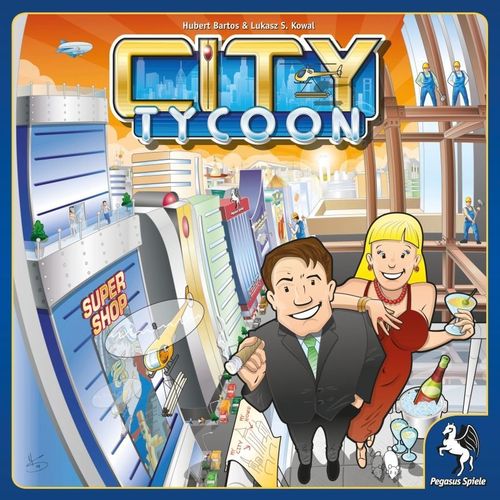
City Tycoon
City Tycoon Rulebook
Table of Contents
Table of Contents
Game Components
City Tycoon includes the following components:
168 tiles
- 4 starting city tiles - distinguished by the letter "S" on the back side. At the beginning of the game they form the city center.
- 6 electric plant tiles & 6 water plant tiles - double-sided tiles with red and blue backgrounds, which supply the city with electricity and water.
- 32 terrain tiles - tiles with grassland on one side and water on the other side.
- 120 district tiles - all the other tiles. Their back sides indicate in which round (I-IV) they are used. Districts are used to expand the city.
85 resource cubes
30 red cubes, 25 blue cubes, 25 yellow cubes, 5 large yellow cubes (equivalent to 5 small cubes).
Each of the three resources in the game (electricity, water and goods) has its own color of cubes. They are used to mark the flow of resources and their usage in individual districts.
130 player markers
There are 5 sets of player markers in five different colors (26 for each color), with which players will mark the district they have built, the number of victory points earned, and the player turn order.
Score board
Players mark their earned victory points on the score board. The player who earns the most victory points wins. Next to score track is the player order track, which determines the order in which players build and supply districts.
Money
30 coins with value "1", 30 coins with value "5", 10 coins with value "10", 10 coins with value of "25".
Money comes in coins of 4 denominations: 1, 5, 10, 25. Players pay money to buy new districts and pay to transfer resources.
Instructions
This rulebook explains how to play.
Game Preparation
The 4 starting tiles are arranged in the center of the table (they are distinguished by the letter "S" on their back). Put a number of resource cubes equal to the number of players onto the starting water plant and electric plant tiles. (E.g. with 4 players, put 4 blue cubes on the water plant and 4 red cubes on the electric plant).
When playing with 2 or 3 players you should arrange starting tiles in a different way (see "Starting Tiles Set Up in 2 and 3 Player Games" below).
District tiles are divided into 4 piles according to the numbers on their backs (I, II, III, and IV). Lay the 4 piles face down near the score board.
Put the resource cubes (blue, red, yellow) and money beside the score board.
Place the water plant and electric plant tiles in 2 piles next to the score board. Stack these tiles in order so that the tile with number 1 is on top and number 6 is on the bottom. Place the terrain tiles nearby.
Each player chooses a set of 25 player markers. Each player places one marker on the "0" space of the score track to indicate victory points.
The second one will be used to indicate the player order during the game.
In the first round the player markers are placed in random order on the player order track. The first player receives $20, and each successive player gets $2 more than the previous player (second player gets $22, the third gets $24, etc.) All players' money is publicly visible.
The game is ready to begin.
Starting Tiles Set Up in 2 and 3 Player Games
In a 2-player game, 2 sides of the city center (all spaces south or east of the city center) are inactive. In a 3-player game, 1 side of the city center is inactive (all spaces south of the city center). Put water tiles next to these sides to remember that those sides are unplayable. Arrows on the board indicate the directions of possible expansion.
Sequence of Play
The game lasts for 4 rounds, and during each round players will go through 5 phases.
Here's the plan. You have money. I'm supervising the construction of a city which will be as good as possible for the residents. Your goal is to satisfy its residents as much as possible. At stake is a substantial cash award. But you are not the only investor competing for the reward. The residents themselves will decide who deserves the prize.
Round Sequence
- Player Order - Determine the player order of players for this round. (This Phase is skipped in the first round because the initial starting player order is random.)
- New Tiles - Dealing and selection of 6 district tiles.
- Building - Players in turn place district tiles.
- Supply - Players in turn supply resources to their own districts.
- Cleanup - Remove used resource cubes and renew them on the water plants and electric plants which can recycle.
1. Player Order
Rearrange the player markers on the player order track, from poorest to richest. The player with the least money will be first, and the player with the most money will be last. In the case of a tie between players, their relative order from the previous round remains unchanged.
It's good to be first! Building first and supplying resources first is very advantageous. On the other hand, being later in the player order means additional money, which can be useful... A difficult choice ...
2. New Tiles
Each player receives 6 random district tiles from the current round's stack (I, II, III or IV). Players only see their own tiles.
Each player then selects 1 of their tiles and puts it face down in front of them. Each player then passes their remaining 5 tiles to the player on the left and receives 5 tiles from the player on the right. This placing and passing continues until each player has placed 6 district tiles in front of them. A player's tiles remain hidden from other players until used.
District plans! Your choices determine your possibilities! Choose districts most suitable for your strategy. Sometimes it is worth taking a tile that doesn't help you but would help your opponent - you can always sell it later. The important thing is to stay ahead - no matter how!
3. Building
Players take turns building according to the player order, starting with the first player.
During their turn, a player must reveal one of their district tiles to do 1 of 3 possible actions:
- Build a district
- Build a water plant or electric plant
- Sell a district tile
After one player's turn, the next player on the player order track takes a turn. (After the last player's turn, the first player gets another turn.) The building phase ends when no player has any district tiles left, i.e. each player has done 6 actions.
I can't stand laziness! Work! Work! Keep working! What!? You want to wait and see what the others are doing? No way! Either you invest, or you're fired! A lot of people are eager for this opportunity. So stop wasting time and get back to work!
Build a District
To build a district, the player must choose a location for the tile - it must touch at least one side of any previously placed tile. (It does not have to touch another of that player's tiles; any tile is sufficient, including terrain tiles.) The player pays the tile's cost and places one of his markers onto the tile. This means that only this player will be able to supply this district.
Some advice about building districts: be sure to have easy access to resources. Without them, most of your districts will not be profitable, and instead of being a promising entrepreneur, you'll end up bankrupt.
You wonder which tiles you should choose? Oh, I think they're all useful, so I leave the decision to you. I admit that some are a little less ... profitable. A city park will not increase your money, but don't think only about your portfolio - think about satisfied residents also!
Description of Tiles and Icons
- District type - this icon lets you easily distinguish district types adjacent to a tile with a cooperation icon.
- Building cost - the player pays this amount to build the district.
- Special ability - this icon shows an additional ability of the district.
- District ability - indicates profits gained from the district.
- Victory Point - the player moves his marker ahead the indicated number of spaces on the score track. Whoever has the most victory points will win.
- Electricity, Water - resource cubes produced by electric plants and water plants. Delivering resources to a district with that type of requirement icon gives the benefit indicated under the icon.
- Goods - resource cubes produced as a benefit from supplying a good-producing district. Delivering goods to a district with a goods requirement icon gives the benefit indicated under the icon. A good received as a benefit from supplying is stored in front of the player and is publicly visible. A player can deliver a stored good during a supply turn by placing it directly onto the target district, with no transport cost.
- Construction - immediately after placing the tile, the player receives the benefit indicated under this icon.
- Cooperation - the benefit under this icon is added to every adjacent district with the same color as the cooperation icon when that adjacent district is supplied. Example: A green icon giving a victory point gives it to all adjacent green districts when they are supplied. Note: This also affects opponents' buildings!
There are various kinds of districts indicated by colored icons: Residential District, Shopping District, Downtown District, Industrial District, Special District, Electric Plant, Water Plant.
Some 4th round tiles have an icon that means you earn victory points for every district you already own of a particular type when you place this tile. The icon indicates the type of district and the points gained per already owned district of that type.
Build a Water or Electric Plant
A player may reveal and discard one of their district tiles to build a water or electric plant. The player takes the top tile from the water or electric plant stack, pays its cost, and adds it to the city so that at least one of its sides touches an already placed tile. Water and electric plant tiles have 2 sides - the player chooses which side to build.
Place the indicated amount of resources and one of the player's markers onto the newly built tile.
Sell a District Tile
A player may reveal and discard a district tile to receive $5 from the bank.
4. Supplying Districts
Players take turns supplying districts according to the player order, starting with the first player.
On their turn, a player chooses one of their districts to supply with resources to get its benefit. When supplying electricity or water, the cubes must be transported from 1 or more plants to the destination district. If they are transported through tiles not belonging to the player, then transportation costs must be paid. (Transportation through a player's own districts is free.)
If a player can not or chooses not to supply a district, the player passes and takes no further turns in this supply phase. (So players might not all take the same number of turns in the supply phase.) A player can not supply opponents' districts. After one player's turn, the next player on the player order track takes a turn. (After the last player's turn, the first player gets another turn.)
The supply phase continues in player order until all players have passed.
During each of the four rounds players take turns (according to the player order) supplying their districts with resources.
Supplying means delivering the required combination of resources to one of your districts. Districts need specific resources - supplying them gives the indicated benefit.
Water and electricity can be taken from any water plant or electric plant, even from more than one (your own, the city's or another player's) and transported through a path of orthogonally adjacent tiles to a district. Goods (previously collected in front of a player) are directly supplied to a district with no transportation needed.
For each electric or water cube taken from another player's plant, the player must pay $2 to the plant owner. For each cube, a transportation cost of $2 must also be paid to the tile owner for each tile owned by another player along the chosen path between the plant and the destination. The player must also pay $2 to the city for each cube taken from city plants or moved through city tiles, but treat the 4 city tiles as if they were one large tile so that a given cube will never cost more than $2 to the city. Transportation through a player's own districts is free. Remember that forest tiles are owned and can be used during transport, but water tiles are unowned and cannot be used during transport.
Perhaps this sounds confusing. Here's how it works:
You choose one of your districts which doesn't yet have cubes, you decide from where you'll get the required resources, you pay for transport and you get the benefit.
If resources are transported through opponents' districts or a city district, they charge you a fee. Ideally you will have your own water plants and electric plants in your own connected network of districts. Then your transportation is free. Then the next player does the same, and when the turn comes back to you, you can supply another of your districts. If you pass, you drop out and don't get to act again during this phase.
Goods cubes are not subject to transportation costs. They are simply placed directly on the target district as a supply action.
Sometimes a player will transport different types of resources from various locations and also deliver goods in a single supply turn. To supply a given district, all required cubes must be delivered and all transportation costs must be paid during one single supply turn. If that's not possible, a different district must be supplied, or the player must pass.
Transportation Cost Example
Take a look at this example. Let's say you are the red player:
- You transport 2 cubes: electricity and water from a city electric plant and city water plant. You avoid going through the blue player's district, so you avoid paying him transportation fees, but you still pay the city $2 for the electricity and $2 for the water.
- You transport 1 electric cube from the blue player's electric plant and it goes through 2 of the blue player's districts. You pay 3 x $2 = $6 to the blue player.
- You transport 2 electric cubes from your own electric plant through a city district. You pay 2 x $2 = $4 to the city.
Delivered cubes are placed onto the tile (to remember that it has been supplied this round), and the player immediately receives the corresponding benefit.
A district can be supplied only once per round, even if you have enough resources to supply it again.
Each district may be supplied only once per round! The player may choose which of a district's requirements to supply, and which transportation path to use.
When you supply the district you have to choose one of the available options! Remember, only one!
5. Cleanup
The cleanup phase prepares the next round or the end of the game.
After the first 3 rounds, remove all cubes from all districts which were supplied, and put them back into the resource bank. Leave cubes on electric and water plants.
Plants with a recycling symbol refill their cubes to their initial value.
After the 4th round, the game is ended.
Game End
After the 4th round, points are calculated to determine the winner.
Players receive 1 victory point for every $10 they have at the end of the game. (Money used to buy victory points is returned to the bank.)
Collected goods (yellow cubes) and resources remaining on electric plants and water plants do not give points.
The player with the most victory points wins. The most final money is a tie-breaker for players with the same scores. There is no additional tie-breaker.
This is the end - a handshake from the mayor and the gratitude of the citizens is the best reward. And if you happen to make a little profit on the side, well, no one could fault you for that... Thank you!
Example Game
Magda, Tom and Peter set up the game as described in "Game Preparation" and are ready to start playing.
First they deal themselves 6 tiles each from the round I stack. Each of them chooses 1 of their tiles to place face down in front of them and passes the remaining 5 to the left. This continues until they each have 6 tiles in front of them.
They start the building phase. They take turns building districts according to the player order on the order track. In the end, Magda and Peter each sell 1 district to get enough money to build all 5 of their other districts. Tom sells 2 districts, but thanks to that he builds an electric plant, upon which electric cubes are immediately placed. Tom builds his park last, so other players could not build next to it, and only he will use it.
Magda builds 2 districts which have terrain tiles - 1 with forest, 1 with water. She puts her grassland in a place that helps connect her districts together into a good transportation network. She places her water tile in a place to block Peter, who was building districts threateningly close to her.
Supplying districts is the next phase. Magda goes first in the order, and she buys an electric cube from the city to supply one of her districts. She pays only $2 (it was transported only through her own districts) and she puts it on her destination tile and receives the benefit. Then Tom supplies his residential district, paying $2 for electricity bought from the city. His district was built with 2 adjacent parks (which cooperate with green districts, giving 1 victory point to each neighboring green district), so in addition to the $3 benefit he also receives 2 victory points.
Peter decides to buy the last electric cube from the city, even though it will need to be transported through an opponent's district, and also buys a water cube from the city. He pays $2 for the electricity and $2 for the water, gaining the benefit of 1 good and 1 victory point. He places the good in front of him, and he can later deliver it to a district to gain a benefit by simply placing the good directly on that tile.
The last two water cubes are taken in turn by Magda and Tom. Tom also uses electricity from his own electric plant. Now Peter has to decide whether to buy the last electric cube from Tom's plant, or to pass and do no more supplying. His only unsupplied district offers a benefit of $3 for electricity, but he would have to pay $4 to buy and transport it. Thus he would lose $1. But looking at Magda's districts, he decides to take the loss and give $2 to Tom for the cube and $2 to the city for transportation, because Magda's district would give her $8 and a victory point, which Peter decides would be too good for her.
Now all the available resources have been used up, and so players go on to the cleanup phase. They remove all the cubes from supplied districts (but not from electric plants and water plants). Cubes are refilled on water plants and electric plants with the recycling icon.
They start the second round by determining the player order. Tom has the least money (he concentrated on victory point benefits), so he is first in the order. Peter is second and Magda is last (she gained a lot of money in the first round).
They each draw 6 tiles from the round II stack, and the competition continues...