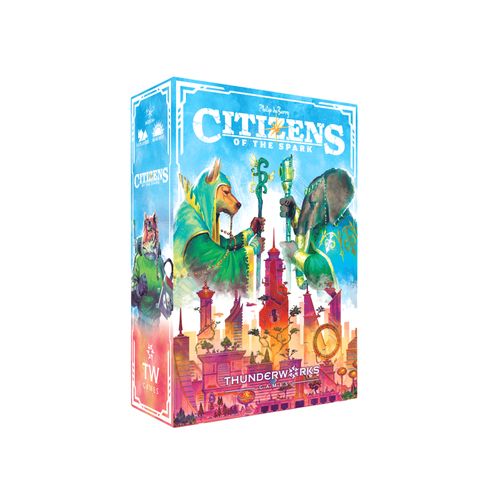
Citizens of the Spark
Citizens of the Spark Rulebook
Table of Contents
Table of Contents
Overview
Citizens of the Spark is a variable setup card game where players take turns attracting citizens, performing actions, and claiming sparks. The more citizen cards a player has of a specific citizen, the more powerful that citizen's action becomes. The player with the most sparks at the end of the game is the winner!
Components
- 300 Citizen Cards — 30 sets / 10 each
- 1 Start Player Token
- 30 Randomizer Cards
- 100 Spark Tokens — 40x1s / 20x5s / 20x10s / 20x25s
- 30 Dividers
- 5 Reference Cards
- 3 Group Tokens (solo play)
- 36 Scyntilla Cards (solo play)
- 1 Solo Reference Card
Citizen Card
- Citizen Name
- Guild Icons
- Actions / Abilities
- Level 1 Action
- Level 2 Action
- Level 3 Action
Guild Icons
- Agriculture
- Arts
- Economics
- Military
- Politics
- Any Guild
Action / Ability Types
- Attack
- Reaction
- Ongoing
- When Placed
- End of Game
Game Setup
-
Choose a number of citizens to use based on the number of players:
Players 1-2 3 4 5 Citizen Sets 7 8 9 10 Either choose a recommended card set from the back page of this rulebook, or use the deck of randomizer cards to select random citizen sets.
Do not use more than four underlined citizens.
First Game Suggestion: Choose the citizens listed in the FIRST GAME card set on the back of this rulebook.
-
Collect all ten citizen cards of each chosen citizen. Leave all unused citizen cards in the game box.
-
Shuffle the citizen cards together to create the citizen deck. Place the deck face down near the center of the table, leaving space for a discard pile.
-
Deal four citizen cards to each player from the deck. Each player chooses two and discards two. All players simultaneously reveal and place their chosen cards in front of them. This is their .
Actions and Abilities
Citizens may have actions and/or abilities.
- Actions are performed during the Perform an Action phase and are discarded.
- Abilities activate only under specific circumstances and are not discarded when activated.
| Icon | Type | Color |
|---|---|---|
| — | Action | White |
| Flame | Attack Action | Orange |
| Shield | Reaction Ability | Purple |
| Circular arrows | Ongoing Ability | Gray |
| Hand placing a card | When Placed Ability | Yellow |
| Hourglass | End of Game Ability | Pink |
Actions and abilities usually have three strength levels, determined by the number of cards in the citizen's stack. A player may perform actions or abilities up to the strength level.
- One card: The player may perform only the level 1 action or activate the level 1 ability (one flower).
- Two cards: The player may perform the level 1 or 2 action or activate the level 1 or 2 ability (one flower or two flowers).
- Three or more cards: The player may perform any action or activate any ability on the card (one flower, two flowers, or three flowers).
The variable flower icon refers to the current strength of the citizen card and is used to indicate which level action or ability to use.
Example: A player with two Scout cards in their city may perform the Scout level 2 action, placing two cards from the deck into their city.
Many actions and abilities make use of a slash (/) to mean "per". When using one of these actions or abilities, count the number of objects or symbols indicated to determine how many spark tokens are awarded.
Example: A player performs the Champion's action, counting the number of guild icons in one neighbor's city to determine how many spark tokens they receive.
A card that is used to perform an action is considered part of the player's city, but cannot be discarded or manipulated by actions.
Example: When a player performs the Scientist's action, they may not discard the active card as part of its action.
How to Play
Citizens of the Spark is played over a series of turns until the citizen deck runs out. Each turn is divided into three phases: Attract Citizens, Perform an Action, and Clean Up.
I. Attract Citizens
The active player selects one of the three groups of citizen cards from the assembly and places them in their city, in the order they choose.
Activate any When Placed abilities on placed citizen cards.
The player also collects any spark tokens next to their selected group from the assembly. At the start of the game, there are no spark tokens in the assembly.
- If a placed card matches a citizen card already in the player's city, add the new card face up on top of the existing stack of cards with the same name. Position the new card so that the top portion of the lower card(s) can be seen.
- If a placed card does not match any of the cards in the player's city, place it face up in their city to create a new stack.
Example: Isaac selects the third group of citizen cards from the assembly and collects the two spark tokens next to the group. He adds the Philosopher to his existing stack and starts a new stack for the two Warriors, since he does not currently have any Warriors in his city.
II. Perform an Action (optional)
After attracting citizens, the active player may perform an action from one citizen stack in their city that has an action or attack action (flame icon). Then, all other players may follow the active citizen.
Activate:
- Choose a stack of one or more citizen cards in the player's city.
- Move the top card from the chosen stack above the player's city. This is the active citizen card and signals which citizen is being activated, and which player is the active player whose action may be followed.
- Choose an action to perform on the active card based on the strength level of their citizen stack, which includes the active card (See p.6, Actions and Abilities) and perform the action.
The active card is not discarded until the Clean Up phase (see p.10).
Follow:
After the active player performs an action, each opponent, in clockwise order, may follow that action, if able.
To follow, the opponent must have at least one copy of the active citizen in their city (unless otherwise noted, e.g. Performer).
If an opponent chooses to follow, they:
- Move their top copy of the active citizen card to a space above their city.
- Choose an action to perform on the follower citizen card based on the strength level of their citizen stack, which includes the follower card and perform the action.
- Discard the follower card.
Then the next opponent in clockwise order may follow, until all opponents have either followed or passed.
After attracting citizens, Isaac decides to perform a Philosopher action. He moves the top card from his stack of Philosophers above his city to designate it as the active card, and chooses to perform the level 2 action (two flowers), since he has two Philosophers. He determines that Claire's city to his left has the most Arts guild icons (3) so he gains 6 sparks (2 sparks per Arts guild icon).
Claire follows Isaac's action, playing a Philosopher of her own. Since she has only one, she can perform only a level 1 action. She also chooses her own city to count Arts guild icons and gains 3 sparks (1 spark per Arts guild icon). She then discards the Philosopher she used to follow.
Finally, Keith decides to also follow Isaac's action. Keith has two Philosophers and performs a level 2 action. Claire already followed before him and discarded her Philosopher, leaving her with two other Arts guild icons in her city. Keith determines that all players now have two Arts guild icons in their cities, so he chooses his own city and gains 4 sparks (2 sparks per Arts guild icon). He then also discards the Philosopher he used to follow.
III. Clean Up
Once all opponents have followed or chosen not to follow, the active player discards their active citizen card to the discard pile.
Then, prepare the assembly for the next player's turn.
-
Add one spark token next to each of the remaining groups of citizen cards in the assembly.
There is no limit to the number of spark tokens allowed next to a group.
-
Reveal cards from the citizen deck and place them face up in the assembly until there are three groups of cards from which the next player can choose.
The active player's turn is complete. The next player in clockwise order becomes the new active player and takes a turn.
The start player token does NOT move to the next player.
Game End
When the citizen deck runs out (either as a result of an action or during the Clean Up phase), the end of the game is triggered.
Immediately shuffle the discard pile and place it face down to create a new citizen deck. If the deck ran out during the Perform an Action phase, finish performing any actions with the new deck.
Continue taking turns until the player to the right of the start player completes their turn. This way, all players will take an equal number of turns.
Final Scoring
Determine the final score for each player by totaling the spark tokens collected during the game, plus:
- Gain one spark token for each citizen card in their city, including converted citizens. (See p.13, Converted Citizens).
- Gain spark tokens for each End of Game ability in your city.
The player with the most spark tokens has built the greatest city, receives the blessing of the Transmission, and is the winner!
In the case of a tie, the tied player with the most citizen cards in their city is the winner. If players are still tied, the prophecy was misinterpreted, and all tied players share the blessing of the Transmission and the victory.
Scoring Example
Isaac determines his final score:
- He collected 31 sparks during the game.
- He earns 10 sparks for having 10 citizen cards in his city.
- His level 2 (two flowers) Advisor earns him 12 sparks.
- His level 3 (three flowers) Guardian earns him 20 sparks for having 5 military guild icons on citizen cards in his city.
Isaac's final score is 73 sparks!
Core Concepts & Game Terms
Active Citizen Card: The citizen card chosen by the active player during the Perform an Action phase.
Assembly: Groups of citizen cards in the central area of the table.
Attack Action (flame icon): Actions that affect opponents' cities. When playing an attack action, opponents resolve all of their Reaction abilities before the attack action is resolved.
Citizen Deck: Players may count the number of remaining cards in the citizen deck at any time.
Citizen Stack (person icon): One or more citizen cards placed on top of one another in a player's city, including face-down converted citizens.
City: The area in front of a player where they place citizen cards.
Discard: Any card in a stack may be discarded, including converted citizens.
Discard Pile: Players may look at cards in the discard pile at any time, but may not change their order.
End of Game Ability (hourglass icon): Activated during final scoring.
Follow: Perform the same action as the active player, but the following player uses the strength level of their own stack.
Follower Citizen Card: The citizen card chosen by a player to follow during the Perform an Action phase.
Gain (spark icon): Take a spark token from the supply, place it in the player's area.
Neighbor: The city immediately to the left or right of a player's city. In a two player game, each city has only one neighbor.
Ongoing Ability (circular arrows icon): Activated when a specified condition is met. Each stack's ongoing ability may be activated once per action.
Place: Add a citizen card face up into a player's city. Add the card to a matching stack of citizen cards, or create a new stack if there are no matching cards.
Reaction Ability (shield icon): Activated when a player is affected by another player's Attack action. They are resolved before the attack action and are not discarded.
Spark Tokens (spark icon): Tokens in the supply are unlimited. If the supply runs out, use a suitable replacement.
Take: Remove card(s) or spark token(s) from an opponent's play area and add it to the player's play area.
Trade: Exchange citizen cards from a player's city with citizen cards from a different city or the assembly, as described by the ability. The player taking the action determines which cards are exchanged. A player may not trade their active/follower citizen card or a converted citizen, though they can trade other copies of the active/follower citizen card. If the number of cards in the active citizen's stack is altered as a result of a trade, the strength level of the action does not change.
Variable (variable flower icon): Some cards use the variable flower icon to refer to the current strength level of a stack. For example, if there are three or more cards in a stack, then this icon means strength level 3 (three flowers).
When Placed Ability (hand placing icon): Activated when a player places a citizen card (including during setup) or receives one as a result of a trade. When placing multiple citizen cards, fully resolve each card's ability before placing additional cards.
Converted Citizens
Some actions allow players to convert citizen cards. Converted citizens increase the strength level of a stack without having to match the stack's citizen. To convert a citizen card, flip it face-down.
Converted citizen cards:
- Are placed at the bottom of any stack in the player's city.
- Are considered a copy of other citizen cards in the stack, but do not have guild icons.
- Are considered citizen cards for actions, abilities, and final scoring.
- Cannot be used to perform actions, but they increase the strength level of their stack.
- May be taken but not traded.
- Cannot be converted a second time or converted back to its front side.
Citizen cards placed during an action cannot be placed on a stack containing only converted citizens.
If a stack consists of only converted citizen cards, discard the stack after the current action is completed.
Example: Isabel has a stack with two face-down converted citizen cards and one Scholar card. On her turn, she moves her Scholar above her city and performs the level 3 scholar action.
She draws another Scholar card as part of the action. Since her stack of Scholar cards contains only converted citizen cards, she must place the new Scholar card in a new stack.
The converted citizen cards from the active Scholar's stack are moved to the discard pile before other players follow.
Example: Simon has a stack with one face-down converted citizen card and one Scientist. On his turn, he moves the Scientist above his city and performs the level 2 Scientist action. He chooses to discard the converted citizen card from the uncovered stack to resolve the Scientist's action.
Citizen Card Notes
Agitator
The Agitator may not trade converted citizens from either city. The Agitator that is chosen as the active or follower citizen card may not be traded, though other copies of the Agitator may be. This does not reduce the strength level of the action.
Collector
During final scoring, when calculating the Collector's End of Game ability, count all citizen cards including converted citizen cards.
Diviner
If placed during setup, or when added to a player's city as a result of an action, activate the Diviner's When Placed ability.
Executioner
Each opponent chooses which card(s) to discard. Players may discard any card from a stack, including converted citizen cards.
Mediator
The Mediator may not trade converted citizens. The Mediator that is chosen as the active or follower citizen card may not be traded, though other copies of the Mediator may be. This does not reduce the strength level of the action.
Medic
If the Medic's action allows a player to place more cards than are remaining in the discard pile, place all cards currently in the discard pile. Any remaining placements are lost.
Mentor
A player who chooses to convert zero citizen cards still collects spark tokens for the strength level of the action performed. The Mentor that is chosen as the active or follower citizen card may not be converted, though other copies of the Mentor may be. This does not reduce the strength level of the action.
Poet
A player may use the Poet's effect only on their own action (either as the active player or while following). Once a player completes their active or follower card's action, the Poet's effect is no longer active. Only one Poet may be discarded per performed action or follow.
Performer
The action's strength level is determined by how many copies of the Performer a player has. For example, if the active player performs a level 1 Medic action and a player follows with a level 3 Performer, they may perform a level 3 Medic action. When copying a citizen that discards all copies of itself (e.g. Executioner, Soldier), discard all Performers instead of the indicated card. The Performer may never copy a Poet.
Pupil
If a player is dealt four Pupil cards during setup, discard all four cards and draw four new citizen cards from the deck. If there are no stacks in the player's city when placed, immediately discard the Pupil, gaining no spark tokens. After the Pupil is converted it no longer has the trash-can icon. If the Pupil is converted by another card's action or ability, the Pupil's ability does not trigger and no sparks are gained.
Recruiter
The Recruiter may add the converted citizen card to the player's Recruiter stack, but it does not increase the strength level of the current action.
Saboteur
Gain the spark tokens from the supply. Do not discard spark tokens next to the chosen group in the assembly.
Scholar
If the Scholar's action allows a player to draw more cards than are left in the deck, that player draws the last cards from the deck, triggering the end of the game. Then draw the remaining cards from the reshuffled deck.
Scientist
Players may discard any card from a stack, including converted citizen cards.
Scout
If the Scout's action allows a player to draw more cards than are left in the deck, that player draws the last cards from the deck, triggering the end of the game. Then draw the remaining cards from the reshuffled deck.
Trader
The Trader may not trade converted citizen cards from either city. The Trader that is chosen as the active or follower citizen card may not be traded, though other copies of the Trader may be. This does not reduce the strength level of the action.
Recommended Card Sets
| 1-2 Players | 3 Players | 4 Players | 5 Players | |
|---|---|---|---|---|
| First Game | Advisor, Bandit, Champion, Outcast, Rancher, Scientist, Scout | Merchant | Warrior | Diplomat |
| Short Game | Collector, Executioner, Medic, Performer, Philosopher, Poet, Scout | Diviner | Saboteur | Scholar |
| Low Interaction | Collector, Mediator, Merchant, Rancher, Saboteur, Scientist, Scout | Medic | Diplomat | Scholar |
| High Interaction | Executioner, Mediator, Medic, Outcast, Soldier, Trader, Tyrant | Diviner | Agitator | Poet |
| Convert Focused | Agitator, Collector, Guardian, Mentor, Performer, Pupil, Recruiter |
Setup Reminder
| Players | 1-2 | 3 | 4 | 5 |
|---|---|---|---|---|
| Citizen Sets | 7 | 8 | 9 | 10 |
| Cards per Group | 2 | 2 | 3 | 3 |
| Discard | 15 | 15 | 0 | 0 |