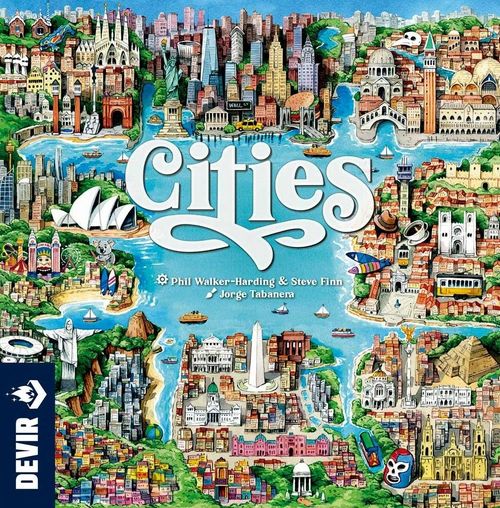
Cities (2024)
Cities Rulebook
Table of Contents
Table of Contents
Components
- 1 game board
- 32 city tiles
- 4 starting tiles (with colorless back)
- 48 feature tiles
- 4 city achievement boards (double sided)
- 32 scoring cards
- 4 player aid cards
- 1 star token
- 100 building pieces (25 each in red, blue, green and yellow)
- 32 worker pawns and 12 achievement rings (8 + 3 each in 4 player colors)
- 4 scoring tokens (1 in 4 player colors)
- 1 cloth bag
Overview
The game is played over 8 rounds (or 4 rounds in a 2-player game). Each round, players use workers to collect 1 scoring card, 1 city tile, 1-2 feature tiles, and 2-4 building pieces.
City tiles are made up of park, water, and building spaces. Building pieces are placed on building spaces of matching colors to form buildings, which can be 1-4 stories high. Scoring cards, and the city achievement boards, provide objectives for players to complete to score points at game end.
Whoever scores the most Victory points has built the most fantastic neighborhood and wins the game!
2-Player Variant
For a longer 2-player game, play 7 rounds instead and build a neighborhood of 3x5 tiles.
Setup
- Place the game board in the center of the table.
- Each player chooses a player color and takes the 4 corresponding worker pawns (or 8 in a 2-player game), 3 achievement rings, 1 scoring token and 1 player aid card.
- Choose any city achievement board and place it above the game board. Return the unused achievement boards to the box. Play with New York City or Rio de Janeiro for your first game. In 2-player games the middle space for each achievement is not used, so you should cover it with 1 achievement ring of a color which is not in use.
- Shuffle all the scoring cards together and place them in a face-down draw pile to the left of the game board.
- Shuffle all the city tiles together and place them in face-down draw piles below the scoring cards and near the board.
- Place the feature tiles face-down, mix them, arrange them into stacks, and place them below the city tiles.
- Place all the building pieces in the bag.
- Randomly choose a start player, who takes the star and places it in front of them.
- Lay out the 4 starting tiles in view of all players. Starting with the player to the right of the start player and going counter-clockwise, each player chooses a starting city tile and places it in front of them. This is the start of their "neighborhood." Return any remaining starting tiles to the box.
Start of a Round
A. Draw 4 scoring cards and place 3 face-up and the last 1 face-down in the top row of the game board.
B. Draw 4 city tiles and place 3 face-up and the last 1 face-down in the second row of the game board.
C. Draw 6 feature tiles and place 5 of them face-up and place the last 1 face-down in the third row of the game board.
D. Create sets of building pieces by pulling pieces from the bag and placing 1 in each of the first ten squares in the last row of the game board. Do not put building pieces on the spaces with a question mark.
Gameplay
Play begins with the player holding the star token and moves clockwise around the table.
Each turn, the active player takes an item (or group of items) from the board and then places 1 of their workers in the designated worker space next to or under the item(s) taken. After the start player's first turn of the round, they place the star token on the indicated bottom right space on the board.
In a 3-4 player game, each player may place only 1 worker per row each round. In a 2-player game, they must place 2 workers per row over the course of the round.
Workers, however, may be placed in any order (e.g., you may place your first worker in the 3rd row).
Each row provides a different resource to be used in the game. When a player chooses a face-down item, it is turned face-up and taken. The players may not look at a face-down item until it is chosen.
The rest of the turn depends on which row the worker was placed in:
In this example, you take the city tile and then place your worker in the worker space under the chosen city tile. All the items (or sets of items) on the board have a designated worker space next to or under the items.
Scoring Card Row
The player takes the scoring card, places their worker on the designated worker space, and places the card face-up on the table beside their neighborhood.
City Tile Row
The player takes the city tile and places their worker in the designated space. Next, the player places the city tile face-up into their neighborhood. It must be placed fully adjacent to an existing tile, though it may be rotated to any orientation. The tiles have 3 types of spaces: city, park, and water. Any type of space may be placed next to any other type.
A player's neighborhood may never exceed 3 tiles in length and 3 tiles in width.
Feature Tile Row
The player takes the feature tile(s), places their worker in the worker space, and then places each feature tile face-up on a space of the same type in their neighborhood. Feature tiles with a blue background are placed on water spaces; tiles with a green background are placed on park spaces; and tiles with a grey background are placed on building spaces with no building pieces on them. Only 1 feature tile may be placed per space. If the player cannot legally place a tile, or chooses not to place it, it is removed from the game.
Building Pieces Row
The player takes the building pieces from 1 space (or, in the case of the last space, they draw 2 random pieces from the bag) and then places their worker in the designated worker space. Each building piece can be placed on a building space of the corresponding color or can be stacked on top of a piece of the same color (up to 4 pieces high). If the player cannot legally place a piece, or chooses not to place it, it is removed from the game.
Special Feature Tile. The feature tile with the grey box changes the color of any space to a "wild" space, so that any color of building piece may be placed on that space. Once a piece is placed, only pieces of the same color may be placed on top of it.
City Achievement Boards
At the end of the player's turn, they check to see if they have fulfilled any achievements listed on the city achievement board. If they have, they place 1 of their rings on the highest vacant number under that achievement. A player may claim multiple achievements on the same turn, but may only claim each achievement once per game. After checking for achievements, the player's turn is over and the player to their left takes their turn.
The following rules apply to all achievements:
- "Adjacent" means orthogonal not diagonal.
- An "area" means a group of orthogonally connected spaces.
- All number requirements are a minimum, not exact (unless stated).
- A special feature tile counts as an empty city space of any color for the purposes of achievements.
- If you claim an achievement but later in the game no longer meet its requirements, you do not remove your achievement ring from the board.
End of a Round
Once all the workers have been used, the round is over. The player with the worker closest to the star space (the rightmost worker in the fourth row) takes the star token and becomes the first player for the next round. In a 3-player game, the remaining scoring card, city tile, feature tiles and building pieces are removed from the game.
End of a Game
After the 8th round (or the 4th round in a 2-player game), the game is over.
Each player places their scoring token near the scoring track. The players calculate their scores as follows and move their disc on the track accordingly.
City achievement board The points listed under any achievement rings they placed on the city achievement board.
Water and park spaces For each area of orthogonally connected water spaces in their neighborhood, score 1/3/6/10 points for 1/2/3/4 different feature tiles in that area. Each area may score only 1 set. Do the same with park spaces.
Monument feature tiles Each monument feature tile (which shows a "2") awards 2 Victory points.
Scoring cards The Victory points listed on each of their scoring cards whose requirements have been met. Each scoring card scores for every occurrence of the shown requirement in their neighborhood.
The same configuration of spaces or building pieces may be scored by multiple scoring cards.
The player with the most Victory points wins!
In the case of a tie, the player with the most Victory points from achievements wins.
For a detailed scoring example, you can check the red player's (the one at the bottom) current situation in the back of the box. He has managed to score 57 Victory points (10 for the City achievement board, 6 for Water and 3 for Park spaces, 2 for Monuments and 36 for Scoring Cards).
Visit https://devirgames.com/cities for a how to play video.