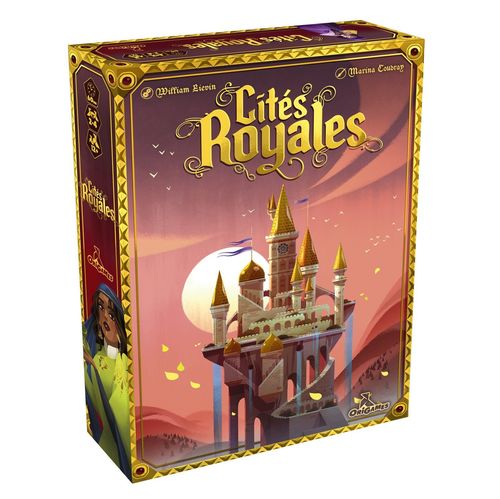
Cités Royales
Cités Royales Rulebook
Table of Contents
Table of Contents
Goal of the Game
Collect cards over the course of the Seasons. Keep them to build them in your Cities and earn Victory Points (VP), or use their effects to gain an advantage, even if it means losing majorities... and allies.
You score VP at the end of each Season for each of the Cities in which you have the most Influence. The Noble with the most VP at the end of the game will be crowned!
Players: 1-4. Time: 60 min. Age: 12+.
Contents
- 12 City boards (4x3) in the Nobles' colours
- 4 Noble tokens to mark Victory Points
- 4 Market tokens to indicate that a Noble has bought
- 4 Hero or Heroine of the People cards
- 85 Subject cards (13 purple, 13 yellow, 13 pink, 13 red, 13 blue, 13 green and 7 white)
- 5 Market half-cards
- 1 double-sided Victory Point track
- 4 Season cards
- 4 Player Aid cards
Setup
- Set up the Victory Point track near the play area, according to the number of Nobles (1-3 or 4), and place the Season cards in a pile beside it (only 3 Seasons for games with 4 Nobles). The Seasons are used to count the rounds.
- Shuffle all the Subject cards and place them face down to form a draw pile. Leave room beside this pile for the discard pile.
- Draw 4 cards and lay them out without looking at them, face down and in a row, below the Victory Point track. This is the Reserve. When the draw pile is empty, shuffle the discarded cards and the 4 cards of the Reserve, then rebuild the draw pile and the Reserve.
- Draw 4 additional cards and lay them face up below the Reserve. The cards must all be of different colours (if you draw a card of a colour already present, discard it and draw another in its place). All the cards placed this way make up the Market.
- Place the Market half-cards at the start of each row of the Market (1st row, 2nd row, 3rd row, 4th row, 5th row).
- Each Noble chooses a colour and takes:
- 6a. 1 Noble token, placed on the "0" space of the Victory Point track, and 1 Market token.
- 6b. 3 City boards, set up in front of you (in the order purple-yellow > pink-red > blue-green).
- 6c. 1 Player Aid card, placed with the "Before purchase" side face up.
- 6d. 1 Hero or Heroine of the People card, placed face down (monochrome side) in front of you.
- Each Noble then draws 3 cards and looks at them without showing them. Simultaneously, give 1 card of your choice face down to your opponent on the left and 1 other to the one on the right. Keep the 3rd and take into your hand the cards you received. In a 2-Noble game, give 2 cards to your opponent.
- Then choose 1 card from your hand to build. The Nobles reveal their card simultaneously and build it by placing it in the City of the matching colour (without triggering its effect). This card must not be white.
The Noble who builds the card with the lowest Influence (value) starts the game. In case of a tie, priority goes to the tied card built furthest to the left. If the tie persists, the youngest starts.
Game Overview
The game is played in Seasons (4 Seasons with 1, 2 or 3 Nobles; 3 Seasons with 4 Nobles). Each Season has two phases: PHASE 1: FOUNDING OF THE CITIES (in turn order, until every Noble has bought cards) and PHASE 2: END OF SEASON (simultaneous).
PHASE 1: FOUNDING OF THE CITIES
Play these steps in order, then it is the turn of the person on your left.
A. Play a Card (optional)
Discard a card from your hand, or the highest card of one of your Cities, to trigger its effect (see "Card Effects").
Example: Éloïse discards a 2 from her pink City and performs the action "Draw 1 card and add it to your hand".
Anatomy of a Card
- Effect: Activates when the card is discarded. All cards of the same Influence have the same effect.
- Influence: This is the purchase cost of the card, but also its value for calculating majorities.
- Colour: The City it belongs to.
Subject cards range from 0 to 6. The 0 cards are unique, whereas the cards from 1 to 6 come in two copies of each colour. The white cards are all unique and can be built in any City (see "Construction Rules").
Card Effects
- 0 - The Void: Discard 1 face-up card from the Market. There is only one 0 card per colour. 0s do not allow control of a majority. Remove cards that might interest your opponents!
- 1 - The Villager: Take the highest card of one of your Cities back into your hand. You cannot take back a covered card. Protect your cards by bringing them back to your hand!
- 2 - The Jester: Draw 1 card and add it to your hand. Your opponents will not know what you have in hand!
- 3 - The Assassin: Discard the highest card of one of your Cities or of an opponent's City. You cannot discard a covered card. Regain majorities by eliminating opposing cards!
- 4 - The Merchant: Take 1 face-up card from the Market without paying its cost and add it to your hand. No need to wait for your purchase phase to get the card you really need!
- 5 - The Knight: Move the highest card of any City to one of yours. You cannot choose a covered card, nor one that you cannot build. With the Knight, you can move a Joker (an opponent's or one of your own) and build it alone (without needing another card) in one of your Cities. Regain majorities or prevent your opponents from using certain card effects... by stealing them!
- 6 - The Astrologer: Draw 3 cards. Build 0, 1 or 2 of them following the construction rules and discard the others. The effects of these cards are not triggered. Speed up the construction of your Cities, at your own risk!
B. Buy Cards from the Market (once per Season)
You can only buy once per Season. You cannot buy cards if the 2nd row is not complete (4 cards on the row).
- Determine your purchasing capacity. Count the number of cards (face down and face up) in the Market. Each card counts for 1; the total is your purchasing capacity.
- The cost of a card is its Influence value. A card of Influence 6 costs 6. If you do not use all your purchasing capacity, the remainder is lost.
- You can buy as many face-up cards as you wish if your purchasing capacity is sufficient.
- Take the purchased cards and add them to your hand. Rearrange the Market so that there are no gaps in the rows. The order in which cards are placed does not matter.
- Place your Market token on the Season card of the current Season. It indicates that you have already bought during this Season. Then flip your Player Aid to its AFTER PURCHASE side.
Example: Éloïse chooses to buy cards, which she can do since the 2nd row is complete. With a total of 11 cards in the whole Market, her purchasing capacity is 11. Éloïse adds to her hand the yellow 4, the yellow 5, the blue 2 and the pink 0 (4 + 5 + 2 + 0 = 11). Finally, she places her Market token on the Season card to indicate that she has bought during the current Season.
If you are not the last Noble to buy, your turn ends. Do not add a card to the Market; it is the turn of the person on your left.
If you are the last Noble to buy, your turn ends and everyone moves on to PHASE 2: END OF SEASON.
C. Add a Card to the Market (mandatory)
Draw 1 card and add it face up to the Market, to the right of the highest row. Each row can hold only 4 cards. When a row is complete, start a new one.
- As long as you are adding cards to the 2nd row, nothing happens. Your turn ends; it is the turn of the person on your left.
- From the 3rd row onward, when you add a card, compare the contents of the Market with the colour of the added card.
-
If there are 0 or 1 cards of the same colour as the drawn card, simply add it to the Market. In addition, if you have not bought cards this Season and there is at least 1 set of 2 cards (or more) of another colour in the Market, gain 1 Victory Point (2 VP on the 4th row, 3 VP on the 5th row).
Example: Éloïse adds a green 1 to the Market, which has only one green card (6). She gains 1 VP because she added it on the 3rd row and there is a set of 2 yellow cards in the Market.
-
If there are already 2 cards (or more) of the same colour as the drawn card, discard them, then add the new card. You have just caused a Revolt!
Example: Éloïse adds a yellow 1 to the Market, which already has 2 yellow cards (4 and 5). She discards these 2 cards because she has just caused a Revolt.
-
Revolt
-
If you had not yet bought cards during this Season, each other Noble gains Victory Points according to the row from which you caused the Revolt. If you added a card on the 3rd row, the other Nobles gain 1 Victory Point (2 VP on the 4th row, 3 VP on the 5th row).
Causing a Revolt forces you to BUY CARDS FROM THE MARKET (see above) if you had not yet done so for the current Season. Then flip your Hero or Heroine of the People card face up (coloured side). Your turn ends.
-
If you had already bought cards, the other Nobles do not gain VP. Trigger the effect of the weakest card discarded during the Revolt. Then it is the turn of the person on your left.
Note: If you cause a Revolt and must buy cards, you must do so even in the rare cases where, after discarding, the Market would contain fewer than 4 cards.
Hero or Heroine of the People
Two sides: face up (coloured) and face down (monochrome).
If your Hero or Heroine of the People card is face up (coloured), then when you ADD A CARD TO THE MARKET you may draw 2 cards (instead of 1) and choose the one you add to the Market (discard the 2nd card). Then flip your Hero or Heroine of the People card face down (monochrome).
If you cause a Revolt, resolve it. You then get your Hero or Heroine of the People card back face up (coloured).
Even if you have already bought cards from the market for the current Season, you can still use your Hero or Heroine of the People card.
Note: If your Hero or Heroine of the People card is still face up at the end of the game, you gain 2 Victory Points.
PHASE 2: END OF SEASON
This phase takes place simultaneously for the Nobles. It is divided into 2 steps that must be played in order.
A. Construction of the Cities (optional)
It is time to build and/or expand your Cities! Remember that only the Nobles whose Cities are the most influential in each colour will gain Victory Points at the end of the Season.
Secretly select the cards from your hand that you wish to build and reveal them simultaneously. Keep your unbuilt cards in hand for the next Season.
Construction Rules
To build a card, you must observe the following conditions:
- each card must be built in your City of the same colour, except Joker cards (white), which can be built in any City as long as they are paired with a card of the colour of the City in which you build it. A Joker card can therefore never be built alone (see "Joker Cards");
- each City can have only one card of each Influence value (even if it is a Joker);
- you must build a card with an Influence value higher than the highest card already in the City (if there is one). Place it on top of the column of cards, offset so as to leave the Influence of the others visible (bottom right);
- you cannot rearrange the cards in your Cities, only add to them in ascending order.
Example of construction: Éloïse decides to build her yellow 4 and 5, and her red 1 and 6. She cannot build her green 1, because her green City already has a card of higher Influence (2). She decides not to build her pink 6, because she thinks she will not have the majority this round. She prefers to keep her 6 for the next round. She prepares her 4 cards to build face down, reveals them at the same time as the other Nobles and builds them in the corresponding Cities.
Joker Cards
In Cités Royales, there are 6 colours of Cities, but 7 colours of cards.
The white cards are considered Jokers that can be built in any City together with another card of the colour of the chosen City. The usual construction rules apply: the coloured card may have a lower or higher Influence than the Joker. Thus, if you build a white 4 in your pink City, you must build it with a pink card that is not a 4.
Victory Points of the Cities
- Purple City: Gain 1 VP for each Crown visible in this City. (Only purple cards have crowns.)
- Yellow City: Gain 1 VP per card in your City that has the most cards. (It may be the yellow City.)
- Pink City: Divide the total Influence of this City by 3. Gain the result in VP, rounded down (minimum 1 VP).
- Red City: Gain 1 VP for each of your Cities that has at least 2 cards, including the red City. If none of your Cities has 2 or more cards, you gain 1 VP.
- Blue City: Gain 1 VP for each of your Cities that has a Villager (1) and/or a Jester (2). A City with both a Villager and a Jester only gives you 1 VP. If none of your Cities has a Villager or Jester, you gain 1 VP.
- Green City: Gain 1 VP per set of 3 cards in all your Cities combined (minimum 1 VP).
B. Majority Calculation (mandatory)
Compare the total Influence of the Cities of each colour to determine who wins the Victory Points.
For each colour, add up the Influence of all the cards making up your City to find its total Influence. Compare it with that of the other Nobles. The Noble whose City has the most Influence (minimum 1) gains the corresponding Victory Points (see "Victory Points of the Cities"). Advance your Noble tokens on the Victory Point track by the corresponding number of VP.
In case of a tie, the tied Nobles all gain the Victory Points.
Example of majority calculation and Victory Points
Total Influence of the Cities, in the order purple, yellow, pink, red, blue, green:
-
Éloïse: 12, 0, 2, 5, 7, 6
-
Will: 3, 3, 0, 10, 7, 6
-
Purple Cities: Éloïse wins the majority with 12 Influence against 3 for Will. She has 4 visible crowns on her cards and therefore gains 4 VP.
-
Yellow Cities: Éloïse has no yellow card. Will wins the majority with 3 Influence. His biggest City is the red one with 3 cards, so he gains 3 VP.
-
Pink Cities: Éloïse wins the majority with 2 Influence; divided by 3, she gains 1 VP. Will has no pink card.
-
Red Cities: Will wins the majority with 10 Influence. He built his white 3 with his red 5. He has 3 Cities with at least 2 cards. He therefore gains 3 VP.
-
Blue Cities: Éloïse and Will are tied with 7 Influence; they both win the VP of their blue City. Éloïse has 4 Cities that have 1s and/or 2s, so she gains 4 VP. Will has only 1, so he gains 1 VP.
-
Green Cities: Éloïse and Will are tied again with 6 Influence. There are 10 cards in total in Éloïse's Cities; divided by 3, she gains 3 VP. Will has 9 cards in his Cities, so he also gains 3 VP.
Éloïse gets a total of 12 VP for this Season. Will gets 10 VP.
End of a Season
The game ends at the end of the 4th Season with 1, 2 or 3 Nobles (or of the 3rd Season with 4 Nobles).
At the end of a Season, discard the current Season card to reveal the new one. The Noble to the left of the last person who bought cards starts the new Season.
Leave the remaining cards in the Market and, if needed, add cards until the 2nd row is complete. The cards must all be of a different colour (if you draw a card of a colour already present, discard it and draw another in its place).
Take back your Market token.
If it was the last Season, the game ends.
Catch-up Bonus
At the end of the Season, if there are one or more Bonus spaces (black background) between you and the Noble who has the most Victory Points, draw 1 card for each Bonus space. The distribution of the Bonus spaces is different for 1-3 Nobles and for 4 Nobles.
Example: At the end of the 1st Season, Éloïse has 6 VP and Will leads with 12 VP. There is a Bonus space (the 10) between Éloïse and Will. Éloïse therefore draws 1 card before the start of the new Season.
End of the Game
Each Hero or Heroine of the People card that is face up gives 2 Victory Points to its Noble.
The Noble with the most Victory Points is then crowned king or queen and wins the game!
In case of a tie, the tied player with the most cards built in their Cities wins the game! If the tie persists, the tied Nobles form an alliance and share the victory and the throne.
Solo Mode
Cités Royales also offers a solo mode. You play against a Regent that you simulate. The basic rules of the game remain unchanged, but the Regent builds his Cities differently.
Solo mode is played over 4 Seasons and without a Hero or Heroine of the People. Set up your City boards and your Noble token on the Victory Point track, as well as City boards and a Noble token for the Regent.
At the Start of the Game
- Draw 2 cards and add them to the Regent's Cities.
- Then draw 4 new cards:
- build 1 card in one of your Cities;
- build 1 card for the Regent (you must choose a card he does not already have);
- keep the 2 remaining cards in hand.
Construction Rules for the Regent's Cities
When he builds, the Regent can place cards beneath the cards already placed, always respecting ascending order.
PHASE 1: FOUNDING OF THE CITIES
The game is played normally, except that there is no turn for the Regent. Play a succession of turns until you buy cards.
When you perform the action ADD A CARD TO THE MARKET, draw 2 cards, select one that you add to the Regent's Cities and add the other to the Market.
Note: You must always choose 1 card that the Regent can build when possible. If there is none, add the card of your choice to the Market and discard the other.
Reminder: You cannot buy cards if there are not 4 cards on the 2nd row, unless you must buy because of a Revolt.
PHASE 2: END OF SEASON
Build the cards from your hand following the usual rules. The Regent builds nothing during this phase.
Royal Taxes
After gaining Victory Points and before ending the Season, the Regent steals the highest card of your City of the colour that gained you the most Victory Points during this Season. The Regent does not steal a card at the end of the 4th Season.
Clarifications:
- If he steals a card he already has, discard it.
- If you have not gained any Victory Points, he steals the highest card of your most Influential City instead.
- If several Cities gained you the same number of Victory Points, he steals the card from the City with the highest Influence (in case of a tie, you may choose which).
Catch-up Bonus
As in a standard game, if you are behind the Regent, draw 1 card for each Bonus space between you and him. If the Regent is behind, he will draw and build the cards directly in his Cities (discard them if he already has them).
At the End of the Season
Discard Market cards of your choice until only 4 face-up cards remain.
End of the Game
Compare your Victory Points with the Regent's and look up your score in the Table of Legends below.
Table of Legends
| Legend level | Result |
|---|---|
| The Regent beats you by 10 VP or more. | Could do better; not certain that History will remember your name. |
| The Regent beats you by less than 10 VP. | You will get a few lines in a history book, which is already not bad. |
| Tie between you and the Regent. | People talk about your Cities in the taverns of the Market. Keep going! |
| You beat the Regent by 10 VP or less. | The neighbouring Cities envy you, congratulations! |
| You beat the Regent by 11 to 20 VP. | There is no greater prestige than yours across the provinces! |
| You beat the Regent by 21 to 30 VP. | Cities? Wonders rather! They will still be talked about in 200 years! |
| You beat the Regent by 31 VP or more. | Your Cities will shine forever in History and serve as an example. Congratulations! |
More Challenge?
For expert Nobles, here is a challenge to take on.
Royal Taxes
After gaining Victory Points and before ending the current Season, transfer cards from your Cities to the Regent's Cities.
- At the end of the 1st Season, the Regent steals the highest card of your City that gained you the most Victory Points.
- At the end of the 2nd Season, he steals the highest card of the 2 Cities that gained you the most Victory Points.
- At the end of the 3rd Season, he steals the highest card of the 3 Cities that gained you the most Victory Points.
Will you manage to take up the challenge and beat the Regent?
Rules Summary
PHASE 1: FOUNDING OF THE CITIES (turn by turn)
A. Play a Card (optional): Discard a card from your hand OR discard the highest card of one of your Cities to trigger its effect.
B. Buy Cards from the Market (once per Season): You can only buy cards once per Season, following the purchase rules.
- Purchasing capacity = number of cards in the Market and the Reserve.
- Cost of cards = Influence of the Market cards.
Once you have bought, place your Market token on the current Season card. This ends your turn. When every Noble has bought cards, move on to PHASE 2: END OF SEASON.
C. Add a Card to the Market (mandatory): If you do not buy this turn or if you have already bought during this Season, add a card to the Market to end your turn. From the 3rd row, check the contents of the Market.
- If there are 0 or 1 cards of the same colour as the drawn card, add it to the Market.
- If you have not yet bought and...
- there is at least 1 set of 2 cards of another colour in the Market, gain 1 VP (2 VP on the 4th row, 3 VP on the 5th row).
- there are already 2 cards of the same colour as the drawn card, discard them, then add the new card. You cause a Revolt.
- If you have already bought and...
- there is at least 1 set of 2 cards of another colour in the Market, nothing happens.
- there are already 2 cards of the same colour as the drawn card, discard them, then add the new card. Then perform the effect of the discarded card with the lowest Influence.
Reminder: Do not forget to use your Hero or Heroine card if needed.
As long as not all Nobles have bought cards, resume at the start of PHASE 1: FOUNDING OF THE CITIES.
PHASE 2: END OF SEASON (simultaneous)
A. Construction of the Cities (optional): Build cards from your hand in your respective Cities. The built cards must have a higher Influence than the cards already built.
Reminder: Jokers can be built in any City if they are built with another card of the right colour (not a Joker).
B. Majority Calculation (mandatory): Check the majorities to award Victory Points to the Nobles.
CATCH-UP BONUS: Draw 1 card per Bonus space between you and the Noble with the most Victory Points.
Then, discard the current Season card to reveal the next one and start a new Season. If all the Season cards have been revealed, it is the END OF THE GAME.
VP of the Cities
- Purple: +1 VP per visible Crown in this City.
- Yellow: +1 VP per card in your City that has the most cards.
- Pink: +X VP = total Influence of this City / 3, rounded down, minimum 1 VP.
- Red: +1 VP per City with 2 cards, including the red one, minimum 1 VP.
- Blue: +1 VP per City with a card (1) or (2), minimum 1 VP.
- Green: +1 VP per set of 3 cards, rounded down, minimum 1 VP.
Card Effects
- 0: Discard 1 face-up card from the Market.
- 1: Take back into your hand the highest card of one of your Cities.
- 2: Draw 1 card and add it to your hand.
- 3: Discard the highest card of an opponent's City or of one of your Cities.
- 4: Take 1 face-up card from the Market without paying its cost and add it to your hand.
- 5: Take the highest card of a City and build it in one of your Cities.
- 6: Draw 3 cards. Build 0, 1 or 2 of these cards and discard the others.