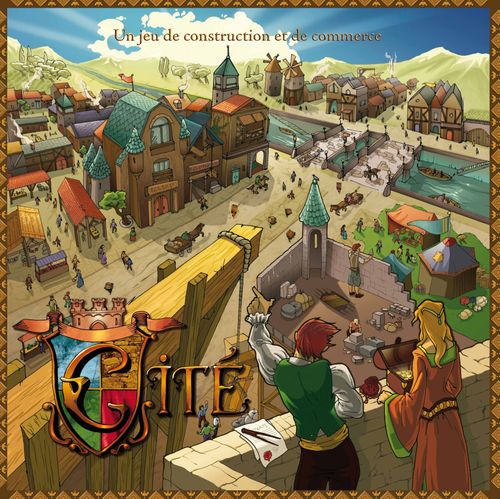
Cité
Cité Rulebook
Table of Contents
Table of Contents
- Goal
- Setup
- The First Turn
- Turns 2 to 7
- How Much Does It Cost?
- Buildings and Their Functions
- Transformation Workshops
- End of the Game
- Grand Jeu and Advanced Rules
- FAQ (Foire aux Questions)
- FAQ (continued)
- FAQ: Grand Jeu
- FAQ: Advanced Rules
- FAQ: Option
- Options
- Advice for Experienced Players
- Learning Through Play
Goal
To win, the player must build the largest district, measured in number of Cases. For example: a Bank is worth 1 Case. A Mill is 4 times bigger and is worth 4 Cases.
Cité is designed for three or four players.
Setup
At the start of the game, each player takes on a profession (Sawyer, Stonemason, Blacksmith or Weaver), thereby holding the monopoly on one particular Resource (Wood, Stone, Metal or Cloth). Each player takes the buildings to be built that match their profession: Green for the Sawyer, Yellow for the Stonemason, Blue for the Blacksmith and Red for the Weaver.
On your first few games, you will not use the Ports, the Canals, the Shopping Streets, the Grand'Places or the Investment cards.
Each player is then assigned, by random draw, a district of the District Sheet. Buildings may only be built in your own district.
Place the District Sheet (4-player version) in the centre of the table at the start of the game.
We recommend putting the Resources in small bowls to draw them more easily. Also place beside each player a discard bowl in which they can pay their Resources during the Construction phase and draw from during the Production phase.
Note for 3 players: with only 3 players, there is no Weaver. Everyone may build one (and only one) Small Weaver's Shop.
The First Turn
The first Turn is the only one with a special procedure.
During the first Turn, each player may build, for free, the equivalent of 7 Cases.
Example: Béa places 1 Bank, 1 Small Forge, 1 Trading Post and 1 Large Forge (4 Cases).
Construction starts from a single central point. There is no game board as such, but buildings must be built according to the "district borders" which divide the table into four quarters. These borders extend in a straight line indefinitely beyond the District Sheet. Each player builds in their own district (see the District Sheet).
Because placement has a particular strategic aspect in this Turn, it is exceptionally possible to move buildings as many times as you wish.
Gift for beginners: at the start of your very first game, you receive 3 Gold as a bonus!
We advise building at least 2 Small Shops, or your Large Shop, on the first Turn.
Turns 2 to 7
The game lasts a maximum of 7 Turns (including the 1st placement Turn). From the 2nd Turn on, each Turn is divided into 3 phases: Production, Negotiation and Construction.
1st phase of the Turn: Production
At the start of each Turn, players collect the Resources corresponding to the production of their buildings.
Example: here is what the Blacksmith player collects:
- 2 Small Forges yield 2 Metal
- The Large Forge next to the Mill yields 10 Metal
- The Bank yields 1 Metal, 1 Cloth and 1 Gold
In total: 13 Metal, 1 Cloth and 1 Gold.
2nd phase of the Turn: Negotiation
Players freely exchange, at prices they set themselves, the Resources they hold. You will see later that it is vital to have a varied set of Resources. Everyone's Resources are visible to all.
In this game, everything is negotiated: Resources, placement of buildings... Promises, commitments and other contracts between players must be respected.
3rd phase of the Turn: Construction
To build, you need Resources. To get Resources, you need to build…
- You may only build in your own district.
- Each player may build buildings of their own colour.
- A new building must be adjacent to another of your own buildings.
- Adjacent buildings benefit their owners as well as their competitors on the other side of a border.
- Negotiation may take place again with the other players during the Construction phase: in reality, these two phases are simultaneous.
- There is no turn order during the Construction phase: all players build at the same time.
Example: Albert builds a Mill on the border of his district. Mills double the production of adjacent Shops. If Béa builds a Weaver's Shop on a Case adjacent to the Mill across the border, she also benefits from its effects, and her Cloth production from that Shop is doubled.
How Much Does It Cost?
Each building consists of a number of Cases (for example, 1 Case for a Weaver's Shop, 4 Cases for a Mill). The "Case" is the basic unit of the game: it determines not only the size but also the price of a construction in the City and its value at final scoring.
The price of a Case varies according to the number of different Resources available.
It is very important to have the greatest possible variety of Resources available. The more numerous and varied the Resources you have, the faster construction becomes, as the table below shows. The Resources are Wood, Stone, Metal, Cloth, Gold, Jewels, Furniture, Sculptures, Locks, Weapons and Glass.
Construction Price Table
| Number of different Resources available | Construction cost, in Resources | Number of Cases built |
|---|---|---|
| 1 | 10 | 1 |
| 2 | 8 (4+4) | 1 |
| 3 | 6 (2+2+2) | 1 |
| 4 | 4 (1+1+1+1) | 1 |
| 5 | 5 (1+1+1+1+1) | 2 |
| 6 | 6 (1+1+1+1+1+1) | 3 |
| 7 | 7 (1+1+1+1+1+1+1) | 4 |
| 8 | 8 (1+1+1+1+1+1+1+1) | 5 |
| 9 |
Example: To build a Bank of one Case, if John has only Stone and Metal, each Case will cost him 4 Stones and 4 Metals. If, on the other hand, he had 8 different Resources, he could build 5 Cases: a Bank and a Mill, for example. And all this for only 8 Resources!
To build a Manufactory, which is 9 Cases, you would need for example a collection of 11 different Resources (8 Cases) and another collection of 10 identical Resources (1 Case).
Buildings and Their Functions
5 Small Shops (1 Case each)
Scierie (Sawmill), Carrière (Quarry), Forge (Forge), Tisserand (Weaver's Shop) and Comptoir (Trading Post). Each yields 1 Resource at the start of each Turn: Wood, Stone, Metal, Cloth and Gold respectively.
4 Large Shops (4 Cases each)
Grande Scierie (Large Sawmill), Grande Carrière (Large Quarry), Grande Forge (Large Forge) and Grand Tisserand (Large Weaver's Shop). Each yields 5 Resources at the start of each Turn: Wood, Stone, Metal and Cloth respectively.
The Bank (1 Case)
The player may place up to three Resources (identical or different) in the Bank. At the start of each following Turn, the Bank returns to the player, as interest, the same number of Resources that were placed in it. Resources placed in the Bank may be withdrawn or changed freely at any time during the Negotiation and Construction phases of each Turn.
The Flea Market (Puces) (1 Case)
Allows exchanging any one Resource for a Gold, ONCE per Turn. Works in the Turn it is built.
The Mill (4 Cases)
Doubles the production of adjacent Shops.
It is very effective to place it from the start of the game so that your neighbours benefit from it, by placing it on a border, if you negotiate this possibility dearly. For example, you may demand the payment of 3 Resources each Turn. Unlike the Inn below, the Mill doubles the production of both Small AND Large Shops.
The Guild (4 Cases)
Produces one Case per Turn. In practice, during the Construction phase, build one extra Case. For each Inn adjacent to your Guild, build one more extra Case.
The Inn (Auberge) (4 Cases)
The Inn has several functions. Everyone finds what they are looking for at the Inn!
- Doubles the production of adjacent Small Shops.
- A transformation building (2 Cases) yields 1 extra Resource per transformation for each Inn it is in contact with.
- Example: a Sculptor in contact with 2 Inns transforms 1 Cloth and 1 Stone into 3 Sculptures.
- Adjacent Guilds generate one extra Case.
- Example: a Guild adjacent to 2 Inns generates 3 Cases per Turn.
The Market (Marché) (4 Cases)
Allows exchanging 4 Resources for 1 new Resource. The Market may be used as many times as desired per Turn. Works in the Turn it is built.
The Paved Street (Rue Pavée) (3 Cases)
Buildings touching the Paved Street are considered adjacent. The Paved Street "links" the buildings together.
The Manufactory (Manufacture) (9 Cases)
Any new building next to the Manufactory costs 2 Cases less to build (the minimum cost remains 1 Case).
Transformation Workshops
Transformation workshops do not differ from other buildings, except that they allow two different Resources to be combined to create new Resources, rarer and more precious. They may be used as many times as desired per Turn. They work in the Turn they are built. They span 2 Cases.
- Glassworks (Verrier) (2 Cases): 1 Stone + 1 Wood = 1 Glass
- Sculptor (Sculpteur) (2 Cases): 1 Cloth + 1 Stone = 1 Sculpture
- Locksmith (Serrurier) (2 Cases): 1 Metal + 1 Wood = 1 Lock
- Joiner (Menuisier) (2 Cases): 1 Wood + 1 Cloth = 1 Furniture
- Jeweller (Bijoutier) (2 Cases): 1 Metal + 1 Stone = 1 Jewel
- Armourer (Armurier) (2 Cases): 1 Cloth + 1 Metal = 1 Weapon
Example: If I possess a Joiner card, I can put 3 Cloth and 3 Wood into the common pool in exchange for 3 Furniture.
A transformation building yields 1 extra Resource per transformation for each Inn it is in contact with.
Example: a Locksmith in contact with an Inn transforms 1 Metal and 1 Wood into 2 Locks. (The source prints "Serrurerie" here; it is the Locksmith (Serrurier) building.)
Reminder: on your first games, do not use the Shopping Streets, the Grand'Places, the Ports, the Canals and the Investment cards.
End of the Game
When a player has built all of their buildings, the game ends at the end of that Turn. Otherwise, the game ends at the end of the 7th Turn. The player whose district has the most Cases has won.
Unused Resources are counted at 10 Resources per 1 Case. In case of a tie between several players, the remaining Resources are taken into account to break the tie.
See the example of scoring at the end of the Advanced Rules.
If you are not first, still observe your progress, in number of Cases built, from one game to another. A fine progression is already a fine personal victory!
Grand Jeu and Advanced Rules
If all players have already played at least three games, use the Grand Jeu rules.
Grand Jeu: New Buildings
- Shopping Street (Rue Commerçante) (3 Cases): Each building next to the Shopping Street yields 1 Gold per Turn. A building next to several Shopping Streets yields several Gold per Turn. Rule of commercial exclusivity: if you build the Shopping Street on the first Turn, you may not build the Flea Market (Puces) before the 6th Turn.
- Grand'Place (8 Cases): When you build a new building next to the Grand'Place, you may pay for each of its Cases either at a price of 2 Gold, or at the normal rate of the Construction Table. The Grand'Place is 8 Cases because its central Case is empty and buildable.
Example: diagram of a Grand'Place with buildings around it.
Advanced Rules
If all players have already played at least one game of Grand Jeu, you may, if you wish, play with the Advanced Rules.
Investment cards ("INVESTISSEMENT"). Form a pile with the 24 Investment cards, shuffled and face down. During a Turn, a player may decide to invest in an Investment card drawn from the top of the pile. An Investment card is bought at the same price as one Case of construction.
- Cards may be played at any time, unless the card says otherwise. Cards that modify the victory conditions must be kept until the end of the game to be effective.
- Once used, an Investment card must be returned under the pile.
- Investment cards may also be exchanged or sold to the other competitors.
- Each player can see how many Investment cards their neighbour holds. However, the effect of an Investment card may stay hidden from the others until it is used.
- If you hold 6 Investment cards in hand, you may not receive any others.
- You may discard an Investment card without playing it.
Card examples shown on the page (the scan shows the card faces only partly legible, so they are not reproduced in full):
- "Tonlieu": play this card between two Turns. All players except the one with the largest district (or those tied for the largest district) take 4 Gold.
- Other sample cards shown on the page, "Foncier valorisé" and "Jour de Marché", are only partly legible in the scan and their text is not transcribed here. The full wording of the 24 Investment cards is not printed in the scanned manual pages.
Advanced Rules: Canals and Ports
(Page 7 continues the list of new buildings under the same heading. The source layout does not mark a boundary between the Grand Jeu and the Advanced Rules at this point; the Canal and Port are placed here because they draw Investment cards.)
- Canal (3 Cases): At the end of the Production phase, the Canal yields one Investment card for each other Canal and each Port with which it is in contact through one single Case.
- Port (4 Cases): Your boats bring back treasures from their various expeditions. At the end of the Production phase, draw 2 Investment cards and keep one. Discard the other under the pile.
Examples (from the source's diagrams):
- Each of these Canals yields one Investment card to its owner.
- These two Canals do not yield an Investment card, because they are in contact through two Cases.
- Each of these Canals yields 2 cards per Turn.
- This Canal makes 2 Investment cards be drawn per Turn. This Port makes 2 Investment cards be drawn per Turn, of which only one is kept.
- Two Canals may also be connected by a Paved Street. In that case, each Canal yields 1 Investment card, regardless of the number of Cases in contact with the Paved Street.
Example of End-of-Game Scoring
Albert has a district of 25 Cases.
Elsa has a district of 55 Cases and has 4 Resources left.
Cécile has a district of 53 Cases and has 20 Resources left, equivalent to 55 Cases.
Déïle has a district of 54 Cases and has 16 Resources left, equivalent to 55 Cases and 6 Resources. DÉÏLE WINS!
FAQ (Foire aux Questions)
Do I keep Resources I saved from one Turn to the next? Yes.
What do I do with Resources I have spent? Return them to the common pool.
Are two buildings that touch diagonally adjacent? No.
Legend: (M) = Mill. In this situation, the Small Shops marked (b) benefit from the opposing Mill, but the Small Shops marked (a) do not.
Can I place the Gold I receive as a beginner's gift in the Bank on the first Turn? Yes. (The manual adds: "I see you understand quickly, this game is made for you.")
Can I exchange and build on the first Turn with the Gold I receive as a beginner's gift? Yes.
Can I exchange the Gold I receive as a beginner's gift at the Flea Market? Yes.
Does an opposing Mill built at the limit of my district benefit me? Yes.
Do the effects of 2 Mills stack? Yes. The production of a Shop next to 2 Mills is multiplied by 4 (next to 3 Mills, by 8…).
Does a Mill or an Inn double the production of a Trading Post (Comptoir)? Yes.
Does a Mill double the production of the Large Shops? Of course.
Does a Mill double the effects of a transformation building (a 2-Case building)? No.
Does a Mill double the production of a Bank? No.
I placed 1 Wood, 1 Gold and 1 Sculpture in the Bank. On the next Turn I find 2 Wood, 2 Gold and 2 Sculptures. Will I find 4 Wood, 4 Gold and 4 Sculptures on the Turn after? No, you may only leave 3 Resources in the Bank. (Note: you may also withdraw them all and put others in.)
My best friend offers me a deal that looks interesting. Is he trying to scam me? Yes.
How many buildings do I have? Each player has 5 Small Shops of their own profession. Each player also has every other building, one copy each, except the transformation buildings (2 Cases each). Of the 6 existing transformation buildings, each player has 3 different transformation buildings, one copy of each.
And with 3 players? With 3 players, you have one extra Small Weaver's Shop. The remaining Small Weaver's Shops, the Large Weaver's Shop and all the other Weaver buildings are set aside.
And when there are no more Resources left to draw, can I no longer produce them? This should not happen. If it does, note the extra Resources you own on a sheet of paper.
Can I move a building? Except on the first Turn, once a building has been placed it is final: it cannot be moved.
Is it possible to destroy another player's district? No, this is not Age of Empires.
Can I build over another building? What a strange question… No, of course not.
Can I build outside the District Sheet? Yes, of course. However, your buildings must always touch another of your buildings.
If I have 8 Resources of 2 different types, for example 7 Wood and 1 Gold, can I build a Case? No, you need the same number of each: 4 Wood and 4 Gold.
FAQ (continued)
I have a collection of 8 different Resources that I spend to build 5 Cases. I immediately build a Mill (4 Cases). Can I build the other Case later? You keep the right to build that Case for the whole Turn. At the end of the Turn, all unused "building rights" are lost.
With 9 Resources, can I build 6 Cases? Yes, but only if they are 9 different Resources.
Can I exchange "building rights"? No.
Can I go back on a promise made during negotiations? During the game, players may conclude various agreements and contracts, in particular to exchange Resources. In this domain they enjoy total freedom. Each player decides whether to accept, to negotiate, or simply to refuse an agreement. There is no good or bad deal: the player is the sole judge of what suits them, and the only thing that matters is that the deal suits them. This freedom is very advantageous but also carries obvious risks.
In return, players must show honesty. A contract may be completely unbalanced in its content, but once concluded it must be respected. In case of disagreement, the other players act as a jury of prud'hommes (lay arbitrators).
Everything can be bought or sold: Resources, Investment cards, the use of certain buildings, or even their location. It is moreover entirely possible for an agreement to last several Turns in a row.
Example: John may offer Béatrice to let her benefit from his Inn by placing it on the border between their two districts, in exchange for which she pays him 2 Resources per Turn until the end of the game. Once such an agreement is concluded, Béatrice may no longer refuse to pay the promised Resources.
Can a deal be made under which a player is forbidden to negotiate with a third player? No, it cannot; this is the first exception to the rule above. This kind of deal does not necessarily have to be honoured.
Can I decline to carry out a Resource exchange during a negotiation? The second exception to the respect of promises concerns immediate Resource exchanges. As long as the Resource exchange has not physically taken place, you may continue or break off the negotiation. However, you may not promise, for example, to give 3 Gold for 5 Wood, then take the 5 Wood and not give the 3 Gold.
Can I go back on an exchange I have just made? Exchanging is exchanging; taking it back is stealing.
If I am unable to honour a promise, what happens? This has never happened in the hundred or so test games of the game's development. However, if it did, you should try to honour your commitments before any other business. If you cannot, you must try to catch up on the following Turn. A player who, in the opinion of the majority, has made promises they could not keep loses one place in the final ranking.
I forgot to honour a commitment. What happens? If you forgot to honour a commitment, you must try to catch up on the following Turn. If your commitment concerned the location of a building, you may exceptionally move it.
Can I conclude a whispered contract? No, everyone must be able to hear what is said around the table.
Can a contract be concluded between 3 or 4 players? Yes.
Can I still exchange Resources after I have started building? Yes, because the Negotiation Phase and the Construction Phase are simultaneous.
Can the building I have just built be used immediately? All transformation buildings can be used immediately, in the same Turn. All production buildings begin to take effect at the next Production Phase, at the start of the following Turn.
At the Market, can I obtain manufactured Resources such as Sculptures or Jewels? Yes. One may buy any Resource on the Market, even if no player has a production unit for that Resource. For example, there is no need for a Jeweller for Jewels to be bought on the Market.
Can I harvest the Resources produced by a Small Shop I have just built thanks to my Guild? From the next Turn onwards.
Does a Guild act in the Turn it is built? No; it generates its first Case in the following Turn.
My Guild was built in the previous Turn. I have not yet placed the Case it produces. I spend 7 different Resources to build an Inn next to it. What happens? The Inn acts immediately: the Guild therefore produces 2 Cases.
Must I place a Case built thanks to my Guild next to the Guild? No, not necessarily.
With the Flea Market, can I take a "manufactured" Resource, such as a Sculpture or a Furniture? Yes.
Must a Stonemason's Shop, for example, be adjacent to a Sculptor in order to transform Stone into Sculpture? No, not necessarily.
Can I produce several Sculptures per Turn? Yes. The Sculptor, like all 2-Case buildings, may be used as many times as desired per Turn.
Do the effects of two Manufactories stack? Yes. If you build next to two Manufactories, you benefit from a cost reduction of 4 Cases. The minimum cost remains one Case.
Is it possible to reduce the cost of buildings already built, thanks to a Manufactory or an Investment card for example? No, what has been spent cannot be refunded.
Can I cumulate the effects of several Manufactories and several Investment cards to reduce the Case cost of building a building? Yes, but the minimum cost is always 1 Case.
Are the Canals and the Streets "Buildings" in the sense of the rules? Yes.
FAQ: Grand Jeu
Does a building (for example a Mill) that has two Cases in common with a Shopping Street yield 2 Gold? No, 1 Gold. There is only one Gold per building, whatever the number of Cases it shares with the Street.
Is a Shopping Street built on the border of my district beneficial to me? Yes.
If two Shopping Streets are built next to each other, do they each earn one Gold per Turn? Yes.
What happens when a Paved Street connects 2 Shopping Streets? Each building along the Paved Street generates 2 Gold. The Paved Street itself generates 2 Gold. Each Shopping Street is adjacent to the other and therefore generates 1 Gold. It is a very powerful arrangement.
If I build the Flea Market on the first Turn, could I build the Shopping Street on the second Turn? Yes.
Does the Mill double the Gold that a building produces thanks to a Shopping Street? No, don't dream.
Does the Mill double the effects of a Port, a Shopping Street, the Grand'Place or a transformation building? No.
Can one build in the middle of the Grand'Place? Yes. One single one-Case building may be built in the centre of the Grand'Place. In that case, it may be built at a price of 2 Gold.
When I build a new building next to the Grand'Place, may I pay for its Cases partly at the price of 2 Gold and partly at the normal rate of the Construction Table? Yes.
With the Grand'Place, can I buy an Investment card for 2 Gold? No.
FAQ: Advanced Rules
Can I keep an Investment card for another Turn? Yes. Cards may be kept for later. They may even never be played.
Does an Investment card that I keep in hand count as a Case in the final scoring? No.
If I build a Port or a Canal, does it yield Investment cards straight away? No. Your first cards arrive at the end of the Production Phase of the following Turn.
If, during the Production Phase, I draw a card thanks to my Port that affects production, can I use it straight away? No. You draw your card at the end of the Production Phase. For example, if you draw the card "Your Mill triples the production of adjacent buildings instead of doubling it for this Turn," you cannot use it in this Turn. You must wait until the start of the following Turn.
Does a Canal next to two Ports yield 2 Investment cards per Turn? Yes.
Are two Canals touching the same Port connected (as by a Paved Street)? No.
Can I obtain cards thanks to the 7 free Cases I may choose in the first Turn? Yes. It may even happen that, thanks to one of these cards, you build more than 7 Cases in the first Turn.
Card "Family Business" (Entreprise familiale): what does it do? If this card is applied to a Bank, the Bank generates interest a second time (maximum 3 Resources). A building next to a Shopping Street yields extra Gold. A Port or a Canal will not give you more cards. A Guild will not produce any more Cases.
For a building to count as "surrounded" in the sense of the cards, must there be a building at each of its corners? No, corners are not taken into account.
FAQ: Option
Option "Time is Gold": regarding the Gold I have just taken, can I deposit it in the Bank straight away? No, since you can no longer act during this Turn.
Options
Here are some variants of the rules for experienced players.
Option: The Handicaps
A player who has won their last game starts the next game with one Case fewer. If they win again, they start with 2 Cases fewer, and so on. When they lose, they recover one Case.
Option: Time Is Gold (for 45-minute blitz games)
The author's favourite variant.
At the start of the Negotiation phase, place 3 Gold Resources in the middle of the table (2 Gold Resources for 3 players). When a player has finished a Turn, they take one of the Golds. The player who finishes last does not gain one this Turn, because there is always one Gold fewer than the number of players. So you must play quickly. If there is no longer enough Gold available, place in the middle of the table whatever remains.
Example: in the 5th Turn, only 2 units of Gold remain in the box. In that case, place only 2.
The Turn ends when the last player declares that they have finished playing.
Nota bene: once a player has finished their turn, the player who takes a Gold no longer has the right to interact with the other players, nor to buy anything whatsoever. The Golds are placed from the first Turn. On the first Turn, once a player has taken a Gold, they can no longer change the position of their buildings.
Option: Simultaneous (for 30-minute blitz games)
For experienced players who want a very fast game, but with somewhat fewer interactions.
There are no more Turns. Each player decides independently when they wish to harvest. A player may not harvest more than 8 times in the game. At each harvest, the player draws one stroke of a house drawn on a sheet of paper (the manual shows a house outline with a cross inside it, as a diagram).
So, when the house is finished, the player knows that they can no longer harvest Resources.
This is a speed game: the first player who has built everything wins the game. If no player manages to build everything, the player with the most Cases at the end of the game wins (see "End of the Game").
This option is not compatible with the Investment cards. Play this option with the rules of the First Games or the Grand Jeu. This option cannot be combined with the option "Time Is Gold".
Option: Interdistrict (Interquartier)
You may build your buildings in another player's district, provided that player agrees to each building. You must specify which building you want to build and where. Your buildings built in another player's district remain yours.
At the end of the game, count the number of Cases of your buildings (not the number of Cases in your own district) to find your score.
A variant full of interaction and possibilities!
Advice for Experienced Players
Try to have everything built in 6 Turns. If you do not manage it, watch whether another player is likely to do so. Then build everything you can to reach second place.
After testing a hundred or so possibilities, we can say there is no ultimate combination. On the first Turn, play according to what the others play. Develop your building and commercial strategy according to the placements of the other players, and to the rare and abundant Resources.
Try to forge partnerships from the first Turn. For example, place your Mill next to another player and ask them for 9 Resources on the second Turn in exchange, or 3 Resources per Turn.
Learning Through Play
CITÉ improves your negotiation skills. The game also illustrates the economic theory of comparative advantage and the Heckscher-Ohlin theorem. According to the theory of comparative advantage, when a country specialises in the production for which it is, relative to its partners, the most advantaged or the least disadvantaged, it is then assured of winning at the game of international trade. In your practice of CITÉ you will find the interests and the limits of these theories. The winner is often the one who has made the most exchanges.