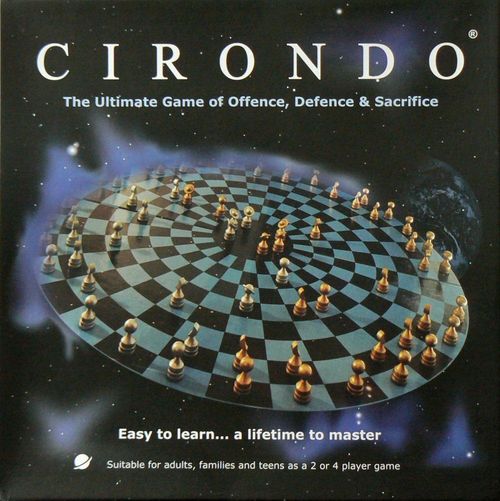
Cirondo
Cirondo Rulebook
Table of Contents
Table of Contents
Remember
Players may only move one of their Stellar during each turn.
Players may only move in one direction on each move.
No two Stellars may occupy the same space and no stellar may jump over another.
A Stellar is taken (eliminated from the board) when an opponents Stellar lands on it.
The path of any Stellars move is limited by the void, the outer edge of the board or by another Stellar occupying a space on that path.
The Stellar
- 16 Moons
- 16 Planets
- 4 Solar Systems
Hints
Remember this is a game of defence as well as offence; be prepared to protect the areas that you occupy by keeping a constant check on spiral and orbital paths. Solar Systems are most destructive in the opponent's outer orbit.
Winning the game
When a player has only one stellar remaining on the board defeat must be conceded on that player's next move - unless, the opponent also has only one Stellar; the winner is then the player with the higher powered Stellar (if the Stellar are of equal power then the result is a draw). A Solar System has the highest power, then a Planet, then a Moon.
The Rules
Overview
The object of the game is to conquer the galaxy by eliminating your opponent from the board. This can be achieved by a vast array of strategies using your Moons, Planets and Solar Systems (known collectively as Stellar) to skilfully attack opponents.
Getting Started - A Brief Overview
To start the game, each player in turn moves one of their Moons one space towards the centre of the void. Moons can only move forwards one space at a time and can only take a piece moving one space forwards diagonally. As play progresses the Planets can be used to defend and attack. Planets can move either forwards or backwards as many spaces as you like in an arc. When moons reach the inner most orbit they are replaced by a Solar System - the most destructive piece. Solar Systems can move in any one direction at a time and any number of spaces.
2 Player Game
At the start of the game each player occupies one half of the board. Each player has a specific number of Stellar of one colour, either gold or silver (or you may customise your colour in the league area only).
Board Set Up
The Planets are automatically set up along the outer ring (orbit) of one half of the board and the Moons along the next inner ring (orbit) in the same half. Solar Systems come into play when the Moons reach the inner most orbit.
Moves
Moon
Normally a Moon stellar can only be moved directly forward (i.e. towards the void) one space. The exception is when the Moon takes an opponents stellar. It can only take an opponents stellar by Moving one space diagonally in either direction towards the void.
When a Moon reaches the inner most circle it is immediately sucked into the void and re-emerges as a Solar System on the space previously occupied by the Moon (The Moon is now removed from the game!).
Planet
A Planet may only move diagonally along the arcs. It can move as many number of spaces along the arcs, towards or away from the void. If an opponents stellar is in its path it can stop on any space before it or land on the same space to eliminate it from the board. It must not deviate from the arcs path.
Solar System
When a Solar System is in play it can move any number of spaces in any one direction i.e. directly towards or away from the void; along an arc towards or away from the void; or in an orbit around any ring.
Elimination
When a player lands his stellar on an opponents stellar, the opponents stellar is eliminated and removed from the board. It is then the turn of the next player.