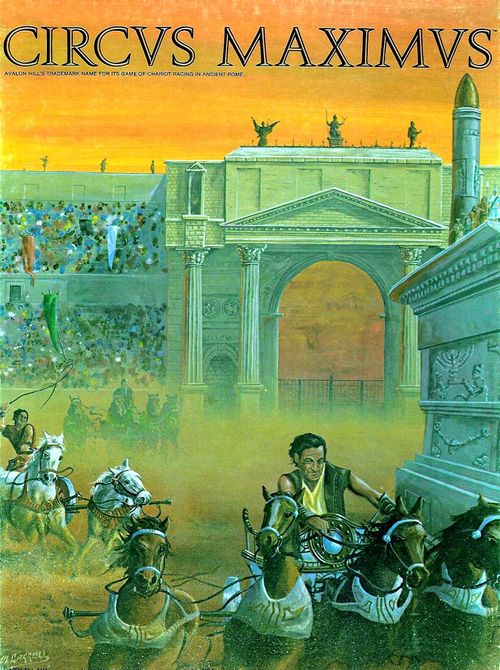
Circus Maximus
Circus Maximus Rulebook
Table of Contents
Table of Contents
1. Introduction
CIRCUS MAXIMUS is a tactical simulation of chariot racing in ancient Rome. The game is played by two to eight players, each controlling one or more chariot teams. The game provides all the information needed to recreate this historic sport easily and accurately in an exciting format.
Each chariot is represented by a pair of counters which are moved as a single unit across the mapboard's square grid according to the individual movement abilities of each vehicle.
Orders for movement are written for each chariot on a racing information sheet hereafter referred to as a Log. The chariots are then moved one at a time per these written orders, and any attacks against rival chariots are made. Very careful planning, maneuvering, and an element of luck are needed to finish first . . . or to finish at all.
To those reading these rules who are new to the hobby of simulation gaming, or "wargaming" as it is more commonly known, a word of explanation is in order. CIRCUS MAXIMUS is a game that simulates reality in a game format. It represents the results of long research to accumulate facts and data to duplicate conditions as they were at the time of the actual event. Simulations come in many different forms. A scene being staged and shot for a movie is a "visual" simulation of reality. A scene described in a book can be regarded as a "written" simulation. Similarly, the mapboard, counters, and rules contained in this box constitute a "gaming" simulation of the "real thing". Absolute realism in any type of simulation is, of course, impossible, but within the framework of this game, the major factors and problems confronting the participants in ancient races are duplicated. Through the use of this game, players can gain increased appreciation of "how it really was" and what influenced the actual participants in their actions. However, unlike written or visual simulation, the game player does not merely take a passive role in reading or watching the simulation, but becomes an active participant in it and enjoys the vicarious adventure without any of the consequent dangers or discomfort.
2. Components
2.1 MAPBOARD: The mapboard forms the playing surface on which the counters are placed and moved. An oval track divided into spaces (hereafter referred to as squares) is printed on the mapboard, and is used to determine movement and position of the counters. This "active" area of the map is called the "track". An oval shaped area enclosed by the track is called the "spina". This inactive core or center is called the "spina". The mapboard also contains many of the charts necessary for resolving the race.
2.2 GAME COUNTERS: Included in the game is a sheet of die-cut playing pieces. These are color-coded for easy identification. Each color identifies a different "faction", and each player takes one or more factions depending on the number of players. Each faction has the following counters: a Team Counter and a Car Counter.
NOTE: When the team and car counters are combined, one behind the other on the track, as illustrated above, they are referred to as a "chariot". The following counters may replace the car counter in the Advanced Game: the Dragged Driver Counter, the Dismounted Driver Counter, and the Wrecked Car (Wreck) Counter.
NOTE: The Dolphin and Egg counters are used to mark the laps, and belong to no faction. The Sesterces counters represent money and are used only in the Campaign Game version of the game and are explained therein. The Color counters are used to determine the order of movement during each turn.
2.3 CHARIOT RACE LOG is used to write down movement orders for the chariots, and to record damage and actions affecting the car, horses, and driver.
2.4 RULES MANUAL contains all the information necessary to play the game. The rules are divided into a Basic Game, Advanced Game, and Campaign Game. It is recommended that players become proficient at one level of the game before proceeding to the next.
2.5 BETTING SHEET is used only in the Campaign Game to place bets and determine betting odds.
2.6 NOT INCLUDED, but necessary for play, are a pencil for each player, three six-sided dice, and an opaque cup or mug.
Replacement Parts
For a current replacement Parts/Price List, send a stamped self-addressed envelope to: The Avalon Hill Game Company, 4517 Harford Rd., Baltimore, MD 21214. For full-color catalog describing all our many exciting simulation games available both by mail and in discriminating retail outlets where simulation games are sold, see Current Parts/Price List for price.
Basic Game
3. Setup & Prepare for Play
3.1 Between two and eight people can play; the more the better. If there is a ninth participant he should assume the role of the racing steward. A tenth participant could act as the Money Changer in a Campaign Game.
3.2 Place the eight chariots randomly in their starting locations with the car counter of each chariot resting on a gray square containing the word "Lane", and the corresponding team counter on the square in front of it. Place the eight "Color" counters into a cup.
3.3 FACTION SELECTION—Each player, in turn, selects one Color counter (sight unseen) from the cup. The color selected is his faction. If there are two or four players repeat this process until all eight colors have been selected. If there are 3, 5, 6 or 7 played proceed to 3.4.
3.4 After all players have one faction, each player then rolls all three dice with the player rolling the highest total drawing a second faction, and the player rolling the next highest total drawing a second faction, etc. until all factions have been taken. This results in some players having more factions than others, but is balanced by weaker players tending to "gang up" on stronger players during the race. However, a player controlling more than one chariot cannot attack another chariot under his own control.
3.5 Each player fills in the necessary information for each chariot he controls on a Chariot Race Log sheet. Each sheet has separate areas, showing information about the team, car and driver, current movement, and damage suffered during the course of the race. The various categories are as follows:
PERFORMANCE CHART—A graphic illustration of how Preparation Points can be allotted to influence the type and quality of chariot available to each player.
FACTION—The color of the player's chariot.
DRIVER'S NAME—This information is not necessary. It is added only to personalize the game; use a fictional name and become Ben Hur or Messala, or merely use your own name.
DRIVER MODIFIER—A number representing the driver's overall skill (see 3.61).
CURRENT DRIVER MODIFIER—A number representing the driver's skill during the current game turn only. The Current Driver Modifier (hereafter referred to occasionally as CDM) is not entered into the CDM boxes until the CDM differs from the Driver Modifier, in which case the CDM is written in the first unmarked CDM box. Thereafter, as the CDM changes the latest CDM is entered in the next unmarked box.
DRIVER HITS—A record of damage sustained by the driver during the race. Damage is recorded by marking off empty boxes from right to left.
CAR—Mark the box indicating the type of chariot selected—light, normal, or heavy (see 3.62). Damage to the car is recorded by marking the boxes of the respective wheels from left to right so that the last marked box contains the total damage points sustained by the wheel to date.
HORSE/TOTAL SPEED/DAMAGE—Each horse will receive a number representing its speed. Each horse also has a damage record (in boxes); the number of boxes is equal to the horse's speed.
TEAM SPEED—The combined speed of all horses in a team. Whenever a horse suffers damage the team speed decreases, and the new team speed is entered in the next unmarked box.
ENDURANCE—A number of boxes equal to the team endurance at the start of the race. As endurance is used during the course of the race, boxes are marked from right to left such that the last unmarked box contains the current number of endurance points remaining.
TURN SPEED—Write the planned speed of the chariot in the corresponding turn box prior to the start of each game turn.
NOTE: Boxes are used on the Chariot Race Log to record losses during the game. At the start of the game, darken all boxes completely. During the game, as each box is lost, check it off with a simple "✓" or "x" so as to be able to instantly differentiate between those capabilities with which the game was begun and those capabilities which were lost due to damage incurred during the course of the game. Example: If a horse had a speed of 6, you would enter "6" in the Total Speed section of the HORSE/TOTAL SPEED/DAMAGE assembly, count out six white boxes from left to right, and then darken entirely the four remaining boxes on that line. Later, if the horse suffers a point of damage the "6" box is checked off. Once the race begins players may not conceal the information on their Chariot Race Log and must freely divulge it to any inquiring player.
3.6 Initially, all chariots have the same specification possibilities as listed on the Performance Chart above "0" Preparation Points. Each player may improve his chariot's specifications by adding a total of four Preparation Points to the various categories. Each player secretly indicates his Preparation Point allotments by crossing out the Preparation Point column which he is using in each category. When filled out correctly there will be only one column darkened in each category, and the sum of the numbers darkened in the Preparation Points row will be four. When all players have finished writing, the players take turns revealing their Preparation Point allocations and making the necessary die rolls to complete their specifications.
3.61 The Driver Modifier selected is entered on the Chariot Race Log in the Driver's Modifier box. A die is then rolled on the Driver Hits chart and modified by the Driver Modifier (the die roll is added to the modifier). This total determines the total hit capacity of the driver which is entered in the Log by completely filling in excess boxes such that the last white box contains the number of hits the driver can sustain. A driver can never have more than 10 hit boxes regardless of his Driver Modifier.
3.61 Driver Hits Chart
| Die Roll | 1 | 2 | 3 | 4 | 5 | 6 | 7 | 8 |
|---|---|---|---|---|---|---|---|---|
| Driver Hits | 5 | 6 | 6 | 7 | 7 | 8 | 9 | 10 |
3.62 Cars always have ten hit boxes regardless of car type. When a car receives damage during ram attacks, the car type of the opposing chariot influences the damage sustained.
3.63 The Team Speed category determines the row of the Team Speed Chart to be cross indexed with a subsequent die roll to determine the Team Speed. The four numbers in each box of the Team Speed Chart represent each horse's speed/strength rating. The first (lefthand) number is the speed of horse number one, the second is the speed of horse number two, etc. Write this number in the Total Speed box and then darken the excess damage boxes in each line for each horse.
3.63 Team Speed Chart
| Category/Die | 1 | 2 | 3 | 4 | 5 | 6 |
|---|---|---|---|---|---|---|
| 2 | 7447 | 7536 | 7545 | 7436 | 6446 | 7435 |
| 1 | 6445 | 6435 | 5445 | 6335 | 5435 | 5335 |
| 0 | 5434 | 4444 | 5325 | 5424 | 5324 | 4334 |
3.64 The Endurance category determines the row of the Team Endurance Chart to be cross indexed with a subsequent die roll to determine Team Endurance. Write the number in the Team Endurance box and then darken all excess endurance boxes on the Endurance record.
3.64 Team Endurance Chart
| Category/Die | 1 | 2 | 3 | 4 | 5 | 6 |
|---|---|---|---|---|---|---|
| 2 | 74 | 71 | 68 | 65 | 62 | 59 |
| 1 | 55 | 52 | 49 | 46 | 43 | 40 |
| 0 | 36 | 33 | 30 | 27 | 24 | 21 |
3.7 Place three "Egg" counters on the "spina" (central oval inside the track) by the start and finish lines. Place the three "Dolphin" counters at the opposite end of the "spina".
3.8 The start lanes are printed in gray on the mapboard. No attacks are allowed from the gray squares during the initial turn of the race. Once the chariots leave these gray squares to enter the black squares, the gray squares are ignored thereafter. The finish line, at the end of the third lap, is at the end of the backstretch as shown.
(Diagram: oval track showing FINISH at the top of the backstretch, START at the bottom, and SPINA labeling the central island.)
3.9 Select one player or a non-playing bystander to act as the racing steward. He will announce the start of each turn and determine order of movement by randomly drawing the colored counters from a cup one at a time.
4. Basic Description of Play
Players record their planned Turn Speed for the coming turn. The Turn Speed can be any number up to the total of the Maximum Team Speed and CDM. Each player must evaluate the situation: the proximity of opposing chariots, corner speeds, endurance factor expenditure, possible attacks, and defensive maneuvers. The chariots are then moved one at a time per their marked speeds. All attacks and results are determined. This cycle is repeated for each chariot during the turn. When all chariots have moved, another turn begins.
5. Sequence of Play
5.1 MOVEMENT NOTATION—Each player secretly writes his Turn Speed for the coming turn in the "Turn Speed" section of his Chariot Race Log.
5.2 MOVEMENT ORDER PREPARATION—All faction (color) counters are placed in a cup and mixed by the racing steward.
5.3 FIRST MOVEMENT PHASE—A counter is drawn from the cup, and the faction with the matching color takes its move. The moving player may make attacks while moving. The other players may not move their chariots, except to avoid attacks (see 9.3), or as a mandatory result of attacks.
5.4 SECOND MOVEMENT PHASE—A second counter is drawn from the cup, and the faction with the matching color takes its move, as in the first movement phase.
5.5 FURTHER PHASES—Additional counters are drawn and movement phases taken until all other factions in the cup are removed. At this point, all factions have moved once and the turn is over. In the Advanced Game rules, certain end of turn movement by dismounted drivers may occur after all normal movement phases are complete, but in the Basic Game play now reverts to step 5.2 and is continued until the end of the race.
6. Movement
6.1 MOVEMENT NOTATION—"Turn Speed" is the number of movement factors the chariot can use in the upcoming movement phase without voluntarily straining his horses (see 6.5).
6.11 At the start of each turn all players secretly write down the actual speed including any change for driver modifier that their chariot will use in the coming turn. This number is written in the "Turn Speed" section of the Chariot Race Log.
6.12 The written "Turn Speed" cannot exceed the total of maximum team speed and Current Driver Modifier. However, it can be any amount less than that amount, including no movement at all. A chariot may never move "backwards" or against the main flow of the race except as a result of braking (see 6.6).
6.2 MOVEMENT EXECUTION—The "Turn Speed" selected and written (above) represents a number of movement factors the chariot must use in its ensuing movement phase.
6.21 Movement Factors (hereafter referred to as MF) can be used for one or more of the following actions, which can be combined in any order during the turn. Actions can be repeated during the turn, as long as MFs are available:
a. Forward movement
b. Lane change movement
c. Braking the movement of the chariot
d. Movement to avoid a blocking chariot (sideslip)
e. Making an attack on another chariot
f. Evading as a response to an enemy attack. The actual evasion movement is done earlier, at the instant of the enemy attack (i.e., during the enemy's movement phase). However, the MF expenditure is taken during the evading chariot's next movement phase, whether this occurs during the present turn or the next turn.
6.22 At no time may a chariot expend less MFs than the "Turn Speed" notation. All MFs must be used up during a chariot's movement phase. Therefore, chariot movement requires a certain amount of advance planning.
6.23 At no time may more than one car or team counter occupy the same square.
6.3 FORWARD MOVEMENT—A chariot moving straight ahead in its own lane expends one (1) MF for each new square entered.
Example: The chariot moves ahead three squares, using three MFs.
6.31 A chariot moving straight ahead into a corner (squares with curved sides) may not expend more MFs than the number printed on the mapboard in that corner lane without suffering a penalty.
6.311 Maximum safe corner speeds for each corner lane are printed on the mapboard in the first and last corner space of each lane.
6.312 If a chariot expends more MFs during its Movement Phase than the safe speed for its corner lane, it is straining in the corner and may also flip (see Corner Strain, 7.32).
6.32 Maximum safe corner speeds apply to a chariot as long as either part of the chariot, team or car, is in the corner.
6.4 LANE CHANGE MOVEMENT—A lane change is either toward the inside (to the left, closer to the "spina"), or toward the outside (to the right, away from the "spina"). A lane change to the inside costs two (2) MFs. A lane change to the outside costs one (1) MF.
6.41 When making a lane change while the team is on a straight stretch, move the chariot one square forward, and then directly sideways, left or right, depending on the type of lane change. Diagonal movement is not allowed.
Example: Lane change to the inside (2 MFs). Lane change to the outside (1 MF).
6.42 When making a lane change while the team is in a corner, a different procedure is used.
6.421 An inside corner lane change requires that the chariot move forward one square, and then sideways and backward to the new square.
Example: Corner lane change to inside (2 MFs). This lane change is not allowed if square A is occupied (6.45).
6.422 When making a corner lane change to the outside, move the chariot forward one square, and then sideways and forward to the new square.
Example: Corner lane change to outside (1 MF). This lane change is not allowed if square B is occupied (6.45).
6.423 Note that certain corner squares are laid out parallel to each other as opposed to slightly forwards or backwards. When making a lane change in these squares the lane change is always forward and sideways. There is no additional forward or backward movement after the sideways move.
("x" indicates parallel corner squares.)
6.43 When a chariot makes an inside corner lane change, it is subject to the Maximum Safe Speed of that new lane. If it exceeds the new Maximum Safe Speed, it is straining in the corner and must check the Corner Strain Table.
6.44 A chariot in the innermost lane (number one) which changes lane to the inside crashes into the wall of the "spina" and flips. The same is true of a chariot in the outermost lane (number eight) which changes lane to the outside thus crashing against the wall below the galleries.
6.45 Whenever making a lane change of any type there must be two unoccupied squares in the lane moved into—one for the team and one for the car. A chariot can never be left half in one lane and half in another.
6.5 STRAINING—There are two different forms of straining.
6.51 CORNER STRAIN—A chariot that exceeds the maximum safe speed in a corner lane is straining in a corner.
6.511 For each MF used during that movement phase in excess of the lowest maximum safe speed corner lane entered, the chariot loses one endurance point. Note that the actual number of MFs expended in a corner during the move that is compared to the maximum safe speed for that corner lane.
Example: Assume a chariot avoided attack by evading to the inside. This lane change, executed at the moment of the attack, was made at the cost of two MFs from its next Movement Phase. These two MFs, although not "used" during the Movement Phase, do count as total speed expended in determining strain/flip points for purposes of Corner Strain and Chariot Flip chances.
6.512 In addition to endurance costs, any chariot exceeding the maximum safe speed in a corner lane is subject to flipping (see Corner Strain, 7.32).
6.52 VOLUNTARY STRAINING—A player may voluntarily whip his horses to gain extra speed. The driver of the chariot must have his whip to use voluntary straining. All drivers start the race with a whip but may lose it during the course of Lash Attacks (see 9.43).
6.521 Voluntary straining is prohibited if the chariot has no endurance remaining, or the CDM is negative (see Jostle, 7.33), or if the driver will attempt to cut a horse free.
6.522 Voluntary straining must be announced at the start of the driver's movement phase before he begins his move, and after all players have written their Turn Speed for the coming game turn.
6.523 Voluntary straining is resolved by rolling a die and adding the resulting number to the recorded turn speed for the turn. In effect, the chariot's MFs are increased by the amount of the die roll. Note that straining can increase the MFs of a chariot beyond the team maximum speed.
6.524 Each MF added by voluntary straining reduces the chariot's remaining endurance factors by a like amount. If the die roll were "3", and three MFs were added, three endurance boxes would be checked off.
6.525 A team may not add more MFs than it has endurance factors remaining. Any voluntary straining number in excess of the number of remaining endurance factors is treated as equal to the number of remaining endurance factors. This is the only case where a player can use a number less than the voluntary straining roll to add to his recorded turn speed.
Example: A chariot with a "Turn Speed" of 11 enters the innermost corner lane where the maximum safe speed is eight. The chariot must lose three endurance points and check the Corner Strain Table. Had he elected to whip his own horses at the start of the turn and rolled a voluntary straining result of "2", his turn speed would be 13 and he would lose two endurance points for the whipping and another five endurance points for straining in the corner.
6.6 BRAKING—Braking may be used to either reduce speed by consuming movement factors, or to avoid attacks. Braking is allowed only if the chariot has endurance factors remaining. Once all endurance boxes have been used, further braking is not allowed.
6.61 A player "brakes" during his move simply by announcing he is braking one or more movement factors. Instead of moving the chariot, for each movement factor braked, he checks off one endurance box. For example, if a chariot comes up against an obstacle or corner with two MFs remaining, rather than take a chance he could brake for those two factors, and use up two endurance boxes instead of making further movement.
6.62 A chariot that brakes to avoid attack will do so during the attacker's movement phase. No movement factor adjustment is carried over into the defending chariot's next movement phase, but the endurance factors lost by braking are immediately marked off and the chariot is immediately moved backward one square. A chariot that brakes to avoid attack consumes two (2) endurance factors. A chariot cannot brake to avoid attack if another team or obstacle is in the square directly behind it.
6.7 SIDESLIP—Sideslip moves are allowed if called for by one of the combat table results or if all other means of movement are blocked, or if the driver can demonstrate that by not making a sideslip move at that point he would be forced to enter a blocked position (not a potentially blocked position) later during that same turn.
6.71 A chariot is blocked if another chariot is directly ahead of it, so that normal ahead and normal lane change movement is impossible without running into the back of the blocking chariot.
6.72 Blocking may occur at the start of a chariot's movement phase, or any time during the turn. A player may deliberately drive his chariot into a blocked position.
6.73 The sideslip move costs three (3) movement factors. The chariot is then moved directly sideways into an adjacent lane. The sideslipping chariot may change lanes either left or right, as desired. In either case, the movement cost is three factors. When sideslipping in the corner the "sideways" move must be to an adjacent square which is totally beside the occupied square or partially behind it.
Example: Sideslip in a corner lane.
6.74 A blocked chariot may be unable to sideslip due to other blocking chariots. In that case, it must brake to use up any remaining movement factors. If that is also impossible, due to lack of sufficient endurance factors, the chariot uses up all remaining endurance factors (if any) and then becomes the target of an involuntary ram attack by the blocking chariot ahead against its horses (see 9.6).
6.8 ATTACKING—Only a moving chariot can make attacks (although combat results might force a defending chariot to move in such a way as to conduct an involuntary ram attack of its own). An attack made by a chariot uses one (1) movement factor. A car cannot make more than one attack from the same square during the same movement phase.
6.9 EVADING—If a chariot is attacked it may conceivably evade by losing movement factors from its next turn. (See Evasion, 9.31.)
SPECIAL: During the first game turn only, all factions must roll a die at the start of their movement phase and deduct the result from their team speed for that turn. This does not prohibit the driver from announcing another die for voluntary straining but he must announce that option before seeing the first die roll. This rule simulates the loss of speed generated by movement from a dead start.
NOTE: It is recommended that players get in the habit of moving only their team counter as they make their move, leaving the car counter in the square it occupied at the start of the Movement Phase as a reminder of where the chariot began its move in case players should forget the movement factors they've expended up to that point, or there is a question regarding the legality of a move. Once the move is completed and accepted by the other players, the car counter can then be placed behind the team counter to reform the chariot.
7. Chariot Flip
7.1 A chariot is in danger of flipping whenever it strains in a corner, or whenever it has a damaged wheel. Each is a separate procedure, and a chariot with a damaged wheel straining through a corner would have to check twice in a movement phase, once for each cause.
7.2 STRAINING IN A CORNER—Whenever a chariot uses more MFs than the printed safe maximum speed for its corner lane, it must check the Corner Strain Chart.
7.21 The Corner Strain check occurs as soon as the chariot enters the first corner square at excess speed. If the chariot survives the check and is able to continue moving, no additional checks are needed during that turn for that corner lane.
7.22 If the chariot changes to a new corner lane on the inside, with a lower safe maximum speed, a new, updated corner strain check with an increased number of strain/flip points is instantly made, even if one has already been made that movement phase. However, if the chariot changes lanes to the outside, to a lane with a higher safe maximum speed, no new check is required because of it during that movement phase even if the chariot is still exceeding the safe maximum speed in its new lane.
7.23 If the chariot is again straining in the corner during its next movement phase, the chariot must check again, etc.
7.3 To determine what happens to a chariot while straining in a corner use the following procedure:
7.31 Take the total speed of the chariot (the written Turn Speed plus MFs gained through voluntary straining or enemy lash attacks) and subtract from it the safe maximum speed for the corner lane the team occupies. The difference is the number of strain/flip points. For example, if a chariot with a total speed of 12 enters a corner lane with a safe maximum speed of 8, the chariot has four (4) strain/flip points.
7.32 Corner Strain Chart
| Dice Roll Minus Driver's Current Modifier | 1 | 2 | 3 | 4 | 5 | 6 | 7 | 8 | 9+ |
|---|---|---|---|---|---|---|---|---|---|
| 4 or less | — | — | — | — | — | — | — | — | S |
| 5 | — | — | — | — | — | — | — | S | SS |
| 6 | — |
7.32 Roll three dice and subtract the CDM algebraically from the result. Note that if the Current Driver Modifier was negative in an addition to the three dice roll, the subtraction of that negative number actually results in an addition to the three dice roll (or in mathematical terms x - -n = x + n). Cross index this result with the strain/flip points on the Corner Strain Chart.
7.33 CORNER STRAIN CHART RESULTS:
— = No effect. Chariot safely negotiates the danger.
S = Sideslip. Chariot moves one lane to the outside. This is not a normal lane change. There is no movement cost for this event, but a chariot which must sideslip cannot willingly change lanes to the inside for the duration of that turn.
J = Jostled. Driver is jostled. Reduce driver's current modifier by three (-3). Driver is unable to use any straining including voluntary straining and cornering over the safe maximum speed (such as would be caused by making an inside corner lane change) for the balance of this turn and all following game turns in which its Current Driver Modifier is negative. Thus, all MFs gained during the present movement phase as a result of voluntary straining would be negated except for those necessary to reach the corner square at which the "J" result occurred. Endurance costs for any lost MFs must still be paid.
SS = Double Sideslip. Chariot immediately moves two lanes to the outside and may not use any straining for the balance of this turn (see J above) and the next game turn. This is not a normal lane change. There is no movement cost for this event, but a chariot which must double sideslip cannot willingly change lanes to the inside for the duration of that turn.
LH = Left outside horse injured. Check Horse Injury Chart.
RH = Right outside horse injured. Check Horse Injury Chart.
FP = Flip. Chariot flips, crashes, and is eliminated from the race. In the Basic Game it is simply removed from the board. See the Advanced Game for more detailed results.
7.34 If a chariot is forced to sideslip as a result of the Corner Strain Chart, and cannot because another chariot already blocks those squares, the sideslipping chariot immediately makes an involuntary ram attack (9.6) against the chariot that is blocking the sideslip to determine the result. A chariot forced to take a double sideslip by the Chariot Flip Chart but cannot even sideslip one lane because of the presence of an adjacent team need not sideslip at all, but suffers a double CDM penalty (-6) in the resulting Involuntary Ram Attack. If after sideslipping one lane, the chariot is confronted by a blocking chariot, only normal Current Driver Modifier penalties (-3) would apply in the ensuing Involuntary Ram Attack. A chariot cannot sideslip because it is already adjacent to the outside wall if it will flip instead.
7.35 If a driver is jostled, the reduction in his driver's modifier is only temporary, but it takes effect immediately, and can affect the remainder of the current movement phase and game turn.
7.351 Write the new driver modifier in the "CDM" box. Example: A driver with a normal driver modifier of 1 is jostled, his Current Driver Modifier is -2 (1 - 3 = -2).
7.352 When a driver is jostled the maximum turn speed is decreased by three (3) because the combined team speed plus CDM is always used to derive maximum turn speed. Therefore, a chariot may not use more movement factors than the total of the team and the CDM.
Example: A 4444 team and a +1 Driver normally has a maximum speed of 17. If the driver is jostled, the maximum speed becomes 14 (16 + -2 = 14).
7.353 If the current movement phase in which the jostle result was suffered used more movement factors than the new speed resulting from that "J" result, the excess movement factors are lost except for those excess MFs needed to have the chariot reach the square in which it suffered the "J" result.
7.354 The Current Driver Modifier is increased by +1 at the start of every turn until it equals the Permanent Driver Modifier. Thus, the maximum turn speed of our 4444 chariot in the example above on the turn after its jostle result would be 15.
7.355 As a reminder of the prohibition against straining in the next turn caused by a "J" or "SS" result, circle the current and next turn number on the Turn Speed Log.
7.356 The affects of "J" results are cumulative. Thus, a jostle result could theoretically reoccur before a previous one has worn off causing the CDM to be reduced by three as opposed to the permanent driver modifier being reduced by three.
7.4 FLIP DUE TO WHEEL DAMAGE—If a chariot's wheel has taken two or more points of damage in a ram attack, an immediate flip check is needed to see if the wheel falls off.
7.41 Any chariot with a wheel already damaged from previous attacks must check for flip (due to losing the wheel) at the start of any movement phase in which it will use "14" or more MFs, and/or if a chariot is straining in a corner lane at a speed of "14" or more it must check for flip twice—once for each cause.
7.42 Wheel damage flip checks are made as soon as the affected player rolls two dice. If the dice total is greater than (>) the current total damage to the wheel there is no effect. If the dice roll is equal to (=) the current total damage of the wheel, one more damage point is suffered by that wheel, but it remains on the chariot. If the dice total is less than (<) the current total damage of the wheel, the wheel flies off, eliminating it from the race.
7.43 If both wheels are damaged, make a separate check for each wheel each time a check is required. Thus, one wheel might remain on, while the other is lost, and flips the chariot.
8. Endurance
8.1 Each chariot team has an Endurance Factor, and a series of boxes for checking off the loss of endurance factors.
8.2 Endurance Factors are lost due to the following reasons:
STRAINING—One factor lost (-1) for each additional movement factor gained through voluntary straining.
STRAINING IN A CORNER—One factor lost for each excess speed used in a corner.
BRAKING TO USE MOVEMENT—One factor lost for each movement factor consumed.
BRAKING TO AVOID ATTACK—Two factors lost to avoid each attack.
SUFFER LASH ATTACK—Possible loss of one to six factors per attack (see 9.41).
8.3 Each endurance factor lost is immediately checked off on the Chariot Race Log. Endurance loss is permanent. It cannot be re-gained during a race.
8.4 If a chariot has 0 endurance left, the following rules apply:
8.41 The chariot may not use straining for the rest of the race. It must take all corner squares at the safe maximum speed for its lane, or automatically flip. However, team speed reductions (8.43-.44) are calculated first prior to determining if the chariot may be exceeding the safe corner speed.
8.42 The chariot may not brake for the rest of the race, including braking to avoid attacks.
8.43 The chariot's current team speed is reduced by one at the start of every subsequent game turn for the rest of the race. Thus, if a chariot used its last endurance factor during turn 15, on turn 18 its maximum team speed would be reduced by three plus any injuries the horses may have sustained up to that point. This reduction of team maximum speed is not treated as a horse injury.
8.44 The driver's permanent modifier is immediately reduced by one (-1) for the rest of the race. This may result in a negative driver modifier. Such adjustment of the driver modifier would further affect the chariot's maximum speed beyond the penalty listed in 8.43.
8.5 Reducing a team's endurance factor below 0 has no additional effect. If a team with no remaining endurance is subjected to a lash attack, it neither gains temporary speed as a result nor suffers additional penalty.
9. Combat
9.1 GENERAL RULES—The player taking his movement phase may attack other non-moving chariots providing his chariot does not occupy the gray squares used only at the start of each race. Only the moving chariot can attack, other chariots cannot voluntarily attack until their own moves. The moving chariot is termed the "attacker", the target of the attack is the "defender".
9.11 Each attack made by a chariot costs one (1) movement factor. Attacks are made during movement and as a part of movement. A chariot can move, attack, continue moving, etc.
9.12 A chariot may make multiple attacks against the same defender (one movement factor used for each attack), or it could make separate attacks against different defenders (again one factor for each), or a combination of both.
9.13 Attacks may be initiated at any time during a chariot's movement, including at the start and at the end of movement, providing movement factors are available and used.
9.14 A car may make only one attack per movement phase from the same square.
9.2 ATTACK PROCEDURE—The attacker's car must be directly beside (in a lane adjacent to) the defender's chariot to make an attack. To attack in a corner lane the attacking car must be in a square which is not partially behind the defending car's (or team's—depending on the object of the attack) square.
9.21 If the attacker's car is beside the defender's team, the attack is against the horses on that team. If the attacker's car is beside the defender's car, the attack is against the driver or car of the defender's chariot.
9.22 The attacker announces the type of attack when he is alongside. The attack can be either a "Ram" or "Lash" attack.
Example: The attacker (red) is not directly beside the black chariot and therefore cannot attack. However, if black were the attacker he could attack red's car or driver. Furthermore, if black's horses were in square A, red could still not attack because he is behind black's horses and not beside them with black's car due to the parallel corner space—red's space not overlapping with black due to the parallel corner space.
9.3 DEFENSE PROCEDURE—Once the attack is announced, the defender has three options. He can either:
HOLD—Do nothing, and receive the attack, or
BRAKE—Expend two endurance points, and move backwards to avoid the attack (see Braking, 6.62), or
EVADE—Make an instant lane change and avoid the attack (see Evasion, 9.31).
9.31 EVASION—A chariot evades by making a lane change away from the attacker. Normal lane change movement and procedure is used (see 6.4).
9.311 Depending on the lane change (to inside or outside), one or two movement factors are used. These are subtracted from the team speed available (but not necessarily his written move) for the evading chariot's next movement phase.
9.312 A lane change in a corner may cause straining, and a chance of a chariot flip, if the chariot evades to the inside, and its current turn speed exceeds the safe maximum speed of that lane.
9.313 If a chariot is unable to make a normal lane change away from the attacker, it cannot evade. Note that the walls of the track and/or other chariots may block a lane change, and thus prevent evasion.
9.32 In order to brake or evade, the defender must roll two dice and add his CDM to the result. The attacker does likewise. If the defender's total is equal to or greater than the attacker's total, the defender can brake or evade normally as he desires. If the attacker's total is greater than the defender's, however, the defender must hold and receive the attack.
9.4 LASH ATTACK—Lash attacks can be against either the horse team or the driver, depending on which element of the defender's chariot is beside the attacker's car.
9.41 An attack against the horse team is resolved by comparing the attacker's die roll and his CDM total to the die roll and CDM total of the defender. If the defender's total is equal to or greater than the attacker's total, the defender loses one endurance factor and gains (at his option) one MF during his coming movement phase. However, if the attacker's total is greater than the defender's total, the defender loses endurance factors equal to the difference between the two totals and must gain the same number of MFs during his next movement phase.
9.42 Attacks against the driver are resolved by both drivers rolling two dice and adding their CDMs to their respective dice rolls. The defender's total is then subtracted from the attacker's total. The result is the attacker's "lash" factor. Lash factors lower than -4 are treated as -4, factors higher than +5 are considered +5. The attacker then compares the lash factor with a two dice roll on the Driver Lash Attack Table.
9.42 Driver Lash Attack Table
| Dice Roll \ Lash Factor | -4 | -3 | -2 | -1 | 0 | +1 | +2 | +3 | +4 | +5 |
|---|---|---|---|---|---|---|---|---|---|---|
| 2 | M | M | B | G | W | M | S | — | M | G |
| 3 | G | M | G | B | B | W | B | S | G |
9.43 DRIVER LASH ATTACK TABLE RESULTS ARE:
— = No Effect.
B = Brake. Defender must brake as if avoiding attack. No movement factor loss is applied, but the chariot is moved backwards one square and expends two endurance factors. If unable to brake, the defender suffers a "W" result instead.
S = Swerve. Defender must move sideways one lane away from the attacker. This lane change causes no loss of movement factors. However, if forced to make a corner lane change to the inside which would place the defender in a corner above the posted safe corner speed according to the speed of his "last" executed move, the defender would have to immediately roll on the corner strain table as well as pay any associated endurance costs for straining in the corner. If the lane change is blocked by another chariot an involuntary ram attack occurs against the blocking chariot. Note that a defender in lanes one or eight would be forced to swerve into the wall and flip.
M = Movement Loss. The defender rolls a die, and reduces his team maximum speed by that amount for his next movement phase.
W = Wound. Driver loses one box from Driver Hits. In addition, the defender suffers a movement factor loss (as per M above) during his ensuing movement phase. When all driver hit boxes are lost, the driver collapses and his chariot crashes. When half or more than half of the driver's original hit boxes are lost, the permanent Driver Modifier is reduced by one for the duration of the race. If a driver is reduced to one third or less of his original starting hit boxes, the permanent driver modifier is again reduced by one for the duration of the race.
G = Whip Grabbed. Attacker loses his whip and can no longer make lash attacks or voluntarily strain his team. Check off the "Whip Lost" box of the Chariot Race Log. The attacker can still strain in the corners by exceeding the safe maximum speed. The grabbed whip is discarded unless the defender currently has no whip, in which case he can keep the one he grabbed.
9.5 VOLUNTARY RAM ATTACK—Attacks against the horse team are resolved by rolling two dice and consulting the table below.
9.5 Horse Injury Table
| Dice Roll* | Horse Injury |
|---|---|
| 0 to 5 | no injury |
| 6 to 8 | 1 injury point |
| 9 or 10 | 2 injury points |
| 11 | 3 injury points |
| 12 | 4 injury points |
| 13 | 5 injury points |
| 14 | 6 injury points |
| 15 | 8 injury points |
*If the attacker's car has scythe blades (heavy chariot), the attacker adds three (+3) to his dice roll. If the attacker's car is light, the attacker subtracts three from his dice roll.
9.51 Injury points are used to check off damage boxes for the horse closest to the attacker's car. Injury points in excess of the horse's remaining damage boxes are ignored. Each box checked off reduces the team speed by one. This applies immediately. If the team speed falls below the currently planned "Turn Speed", the turn speed must be reduced accordingly.
9.52 When all damage boxes for a horse are checked off, the horse falls to the track. The chariot cannot move again until the horse is cut free. Even mandatory movement effects (as a result of combat) that would normally be ignored although any endurance or injury penalties from such an attack are still applied as applicable, except that the team cannot be attacked on the side where the dead horse has fallen until the horse is cut free (even after a successful attempt). A chariot which attempts an attack on such a target is still subject to any and all negative results which accrue. The CDM of any chariot which must attempt to cut a horse loose before it can move again is always 0 (unless already negative) for purposes of receiving attacks. When a horse is killed, the team loses a fourth of its remaining endurance factors (fractions rounded down). If the team loses a second horse, it loses a third of its remaining endurance factors, and if it loses a third horse it loses half of its remaining endurance factors.
9.53 A horse can be cut free at the start of the chariot's movement phase by rolling one die for each remaining horse, subtracting the driver's CDM from the total, and subtracting the remainder from that turn's written turn speed. The chariot may then use any remaining movement factors to move during the same movement phase. If the result is a negative number the attempt to cut the horse free failed and must be attempted again in the following turn. Only one "cut free" die roll is allowed per player turn. The driver may not voluntarily strain his horses while cutting a horse free.
9.54 CAR ATTACKS—Attacks against a defender's car are resolved by first determining which car(s) is damaged. The attacker rolls three dice, adds his CDM, and then subtracts the defender's CDM from the total. The resulting number is then found on the "Damage to Cars Table".
9.54 Damage to Cars Table
| Dice Roll & CDM Difference Total | Result |
|---|---|
| 6 or less | attacker's car damaged |
| 7, 8, or 9 | both cars damaged |
| 10, 11, or 12 | no effect |
| 13 or more | defender's car damaged |
9.55 For each car damaged, a second roll of two dice is made on the Wheel Damage Effect Chart to determine how many damage points the wheel suffers. Damage points are applied to the wheel nearest the opposing chariot. For each point of damage, check off one wheel damage box.
9.55 Wheel Damage Effect Chart
| Dice Roll* | Wheel Damage |
|---|---|
| 0 to 4 | 1 point |
| 5 to 7 | 2 points |
| 8 or 9 | 3 points |
| 10, 11 | 4 points |
| 12 | 5 points |
| 13 | 6 points |
| 14 | 7 points |
| 15 | 8 points |
*If the opposing chariot has scythe blades (heavy), the chariot suffering the damage must add three (+3) to the roll. If the opposing chariot is light, subtract three (-3) from the dice roll.
9.56 Whenever wheel damage is taken, the chariot must immediately check for flip (see Chariot Flip, 7.4). If all wheel boxes are checked off, the wheel is completely destroyed, and the chariot flips, eliminating it from the race.
9.6 INVOLUNTARY RAM ATTACKS—A chariot may be forced to ram another because of a forced movement result on the Chariot Flip and/or Driver Lash Attack charts. The chariot thus attacked may attempt to hold, brake, or evade normally.
9.61 If just a chariot's team is forced into another car, it receives a ram attack as if the opposing chariot attacked the horse team. Use the procedure in 9.5 to resolve, adding three to the dice roll if the opposing chariot has scythe blades, or subtracting three if the opposing chariot is light.
9.62 If a chariot's car is forced into another team or car, it is resolved as a normal ram attack, with one exception. The driver of the chariot making the involuntary attack must deduct three (-3) from his CDM for all attack procedures. The normal CDM is restored as soon as the involuntary attack is resolved.
9.63 In both of the above cases, reduce the maximum team speed of the attacking chariot by one for the following movement phase. The attacking chariot would not change lanes, even if the defender vacated the blocking square by braking or evading. The attempted involuntary attack replaces the "S" result.
10. Ending the Race
10.1 When the first chariot leaves a stretch and enters a corner, remove one of the Egg or Dolphin markers from the "spina" at that corner. This signifies that half of a lap has been completed.
10.2 When all three Dolphin counters have been removed, and only one Egg marker remains, the chariots are in the last stretch. The first chariot to complete this stretch, and remove the final Egg, transforms the current game turn into the final game turn.
10.3 Chariots are not obliged to take the corner after the last stretch. When they cross the finish line they are removed from the race, being careful to note remaining movement factors.
10.4 If two or more chariots cross the finish line on the same turn, the chariot with the greater number of remaining movement factors wins the race.
10.5 If two or more chariots cross the finish line on the same turn and with equal movement factors remaining, the winner is the chariot which crossed the finish line first by virtue of having his faction counter drawn from the cup prior to the other equal finisher(s).
STOP! You have read all that is necessary to play the Basic Game of CIRCUS MAXIMUS. We suggest you play it at least once to gain familiarity with the basic rules before proceeding to the more complicated versions which follow.
Second Edition
This is the second edition rulebook for CIRCUS MAXIMUS and supersedes the earlier version. Players should check to make sure they are familiar with the same set of rules before beginning play. The rule sections which underwent some degree of change between the editions are: 6.45, 6.62, 6.7, 7.33, 9.22, 9.311, 9.41-.43, 9.52-.53, 9.61, 12.4, 14.2, 15.25, 16.5-.7, and 23.1.
Game Questions
Questions on the play of this game will be gladly answered upon receipt of a self-addressed envelope bearing sufficient return postage. Questions on the actual design or history relating to the game itself cannot be answered. This type of information is available only in the pages of our bi-monthly gaming magazine, THE GENERAL, advertised elsewhere in this rulebook. Sorry, but absolutely no game related questions can be answered by phone.
Advanced Game
The Advanced Game provides greater detail in an important area of the game: what happens once a chariot is wrecked. In the Basic Game, the wrecked car, runaway teams, and dragged drivers all play a role in the continuation of the race. These rules add greater realism (and simulated bloodshed) to the game, but at the cost of additional playing time and complexity.
11. Reaction Time
11.1 Now that players are familiar with the game system, it is in the best interests of an enjoyable game for all concerned to quicken the pace so as to both shorten the playing time, and more closely reflect the lightning reflexes needed by a charioteer. Despite some initial complaints, ultimate player enjoyment will be greatly increased by ridding the game of those inevitable plodding players who seem to take forever to make their moves. In the Advanced Game all players are expected to have sufficient familiarity with the game to keep pace and abide by these rules.
11.2 Once moved from a square, a counter may not be returned to that square to "redo" its move except as a result of an illegal move cited by another player.
11.3 When the racing steward calls out the color (faction) to be moved next he should also count out the seconds elapsed ( . . . one thousand one, one thousand two, etc.) as the player begins moving his team. The moving player has a maximum of five seconds to begin movement. Failure to move (including announcing an attack or decision to voluntarily strain) in this time period results in forfeiture of the player's control over the team during that movement phase. The team is moved straight ahead in its current lane a number of spaces equal to its written turn speed for that turn, without making any attacks, braking, and changing lanes only if forced to due to blocking chariots where possible.
11.4 Actual physical counting of squares by drawing one's finger across the mapboard prior to movement is prohibited. Such counting should be done mentally as play proceeds and not the driver's actual turn. The fact that a player's faction was the first (or last) drawn during a turn is no excuse.
11.5 There is no time limit for the resolution of attacks and other necessary chart checks.
11.6 Once a player has started to move, time should not be a problem, but if it is, the steward should once again start his five second countdown during which the moving player must either announce an attack or move to a new square.
11.7 At the conclusion of each game turn, the steward announces the number of the upcoming game turn and commences his five second countdown. Any player whose turn speed is not written at the end of the countdown must duplicate his last recorded turn speed (if that is not possible due to combat results sustained in the interim, substitute the maximum speed possible) in the upcoming turn.
11.8 If the steward is also playing a faction, an assistant steward should also be appointed to conduct the countdown when the steward is moving his own chariot.
11.9 Once players become proficient at playing under such time pressures, the five second time limit should be lowered accordingly.
12. Wreck Location
12.1 When a chariot flips and crashes, it is not removed from play as in the Basic Game. Instead, the car and team part. The car portion of the chariot sails through the air and lands somewhere on the track, causing an obstacle, but not until the completion of the current mover's movement phase.
12.2 When a chariot is wrecked, roll two dice and find the result on the Wreck Location Chart. Place a "wreck" counter on that square of the track.
12.2 Wreck Location Chart
| Dice Roll | Wreck Location |
|---|---|
| 2 | 1 lane left, 3 lanes forward |
| 3 | 2 lanes right, 5 squares forward |
| 4 | remain in square of flip |
| 5 | same lane, 2 squares forward |
| 6 | same lane, 1 square forward |
| 7 | 1 lane right, 3 squares forward |
| 8 | 1 lane left, 1 square forward |
| 9 | 1 lane right, 4 squares forward |
| 10 | 3 lanes right, 2 squares forward |
| 11 | 4 lanes right, 6 squares forward |
| 12 | 3 lanes left, 4 squares forward |
12.3 If the wreck would land outside the track due to lane changes, it instead hits the wall and remains in the edge lane. It then travels forward the appropriate number of squares in that same edge lane, and lands.
12.4 If the chariot wreck lands on another chariot, the falling wreck causes an immediate ram attack on the chariot team or car, as appropriate. The falling wreckage has no driver, and therefore no driver modifier is applied. The chariot being hit by the falling wreckage may attempt to brake or evade normally (if possible) to avoid the ram attack. If the wreck remains in the same square with that chariot, that chariot at the start of its move must chance the Running Over Wreck chart unless it is attacked prior to that and successfully brakes or evades off the wreck.
13. Critical Injuries
13.1 Whenever a "W" (wound) result occurs during a Driver Lash Attack, the normal penalties apply but in addition the defender must roll two dice and consult the Critical Hits Table for further developments.
13.1 Critical Hits Table
| Dice Roll | Results |
|---|---|
| 2 | Defender entangled by whip and pulled out of car (see Dragged Drivers, 16). Attacker loses his whip. |
| 3 | Severe Wound—Reduce Driver Modifier by one. |
| 4 | Arm Wound—Defender must halve all future voluntary strain die rolls (fractions rounded up) and the resulting endurance costs for the duration of the race. |
| 5 | Eye Wound—Vision obscured. Defender may not evade (9.31) future attacks from the side of the chariot on which he was just lashed. Defender may brake normally, and evade attacks from the opposite side of the chariot normally. |
| 6 | Defender taken by surprise. Repeat original lash attack with one less lash factor. The attacker need not pay an extra movement factor for this additional attack. |
| 7 | Deep Wound—Take one more hit vs. driver. |
| 8-11 | No Effect. |
| 12 | Defender entangled by whip. Both players roll two dice and add their current number of unmarked driver hit boxes. The driver with the highest total pulls his opponent from his car (see Dragged Drivers, 16). Regardless of outcome, attacker loses his whip. |
14. Running Over Wrecks
14.1 The creation of wrecks in rule 12 leaves an obstacle on the track which negates the passage rules. If a chariot cannot avoid a square containing a wreck or chooses to deliberately enter that square it must observe special penalties.
14.2 A chariot is moved over the wreck square at the normal movement cost, but should (does not have to) deduct endurance factors equal to the roll of one die. When it clears the wreckage and appears in the square beyond, roll three dice, deduct the CDM from the total, and consult the Running Over Wrecks Chart. If a chariot is unable to clear a wreck during its move (i.e. it does not have enough MFs to move beyond the wreck) it flips.
14.3 Add one to the dice roll for every endurance factor less than the roll which the chariot was unable (or unwilling) to pay for the jump attempt.
14.3 Running Over Wrecks Chart
| Dice Roll Minus CDM | Result |
|---|---|
| 8 or less | No Effect. Chariot passes over wreckage safely. |
| 9-10 | Driver jostled. Treat as a normal "J" result. |
| 11 | Car Damaged. Roll one die for each wheel, subtract three (-3) from each roll, and take the result as damage points on the wheel. A final die roll result of 0 or less means no damage was sustained on that wheel in the jump. |
| 12-13 | Horses hobbled. Roll a die for each horse, subtracting three (-3) from each roll. The result is the number of damage points suffered by each horse. Reduce its speed and the team maximum speed accordingly. |
| 14 | Horses seriously hobbled. Treat as above but without any subtraction from each die roll. |
| 15-16 | Chariot Flip Danger. Check as if straining in a corner (maximum safe speed over a wreck is one). |
| 17 or more | Chariot Flip. |
15. Runaway Teams
15.1 When a chariot flips, the car wrecks but the team remains and completes its move. That team is now a "runaway team".
15.2 On each subsequent turn the team moves without a chariot when its faction counter is drawn. It is moved just like a normal chariot, and controlled by the owning player—or in his absence the player who was last in place at the end of the last completed game turn (in case of ties, last place is determined by possession of the outermost lane)—with the following special restrictions.
15.21 The team can change lanes only to avoid another chariot, team, wreck, or to evade an attack.
15.22 The team must move at maximum speed each turn. It cannot slow down or voluntarily strain.
15.23 The team cannot make any attacks, but can be braked.
15.24 A runaway team ignores safe maximum speeds in corners. It can travel at any speed safely in a corner, since there is no longer a car to flip.
15.25 A runaway team may be attacked, but since no car and driver exist, only the team can be attacked, by lash or ram attack, as the attacker desires. The team could evade automatically. If a horse is killed, the team must remain in that square where it is treated as a "wreck" henceforth except that any check to run over the "wreck" must add 3 to the dice roll (14.2). Any horse injuries are applied to both the jumping team and the "wreck" team.
16. Dragged Drivers
16.1 Whenever a chariot flips, the driver will be dragged along behind the runaway team. Place a "dragged driver" counter in the square behind the runaway team, to replace the car counter.
16.2 The dragged driver can attempt to cut himself free at the conclusion of the movement phase in which his chariot flipped before rolling for injuries sustained in that turn. He rolls two dice, subtracts his driver modifier, and if the total is less than or equal to his number of unmarked driver hit boxes, he is free. Even if freed, however, the driver counter is dragged a number of squares equal to the adjusted freeing dice roll (up to, but not greater than the distance actually traveled by the team at the point of the flip).
16.3 At the conclusion of each movement phase in which he has been dragged by the team, he rolls one die and suffers half the resulting number of "hits" or injury points. These hits are marked off the "Driver Hits" section of the Chariot Race Log. When all boxes are marked off, the driver is dead, and no longer can run in the race or continue in the Campaign Game.
16.4 If a driver survives while being dragged long enough to cross the finish line, he can still win or place in the race provided he is still alive at the end of the turn in which he finishes the race. A car is not necessary for victory, only for one's personal health!
16.5 A dragged driver can be subjected to ram attacks by the team portion of an attacking chariot by placing the attacking team on the same square as the dragged driver. The dragged driver cannot brake or evade—he must accept the attack. The attacker automatically counts as having a driver's modifier of 0. An attacker cannot suffer "wheel damage" during a ram attack vs. a dragged driver. Any "wheel damage" suffered by the dragged driver is instead converted to double the number of injury points. This is the only type of attack which can be made on a dragged driver, and is the only time a team can make a ram attack of any kind. There is no modification to the dice roll for heavy or light cars as it is the team which attacks, even though the attack is resolved on the Wheel Damage Effect Chart with the amount of wheel damage specified being turned into an equivalent number of body hits.
16.6 If a runaway team carries a dragged driver over a wreck, the driver is automatically killed.
16.7 When a driver is dragged from his car by a critical hit, the driver counter is placed on the car counter. The team continues as a runaway team except that it has to check for chariot flip when exceeding a safer corner lane speed. The dragged driver is still subject to ram attack by an opposing chariot (as in 16.5), except that the attack is made from a square directly behind the empty chariot, instead of from the dragged driver's square.
17. Running for Cover
17.1 When a dragged driver cuts himself free, the dragged driver counter is replaced by a plain driver counter, representing the man on his feet. The runaway team moves off, and the driver is free to move as he desires at the end of the following game turn.
17.2 An individual driver on the track can move one square for each two remaining unmarked driver hit boxes (fractions rounded up) per turn. The driver may not move diagonally, although he may move in any direction.
17.3 An individual driver in an edge lane (lanes one or eight) can climb the wall and escape into the stands or the "spina" to survive the race. To climb the wall, the driver must move along the wall (from one wall square to another wall square) and roll an even number with one die. He may not roll twice from the same square, however, so once he begins moving along a wall he may not reverse direction. The driver may roll to climb once for every space moved along the wall.
17.4 An individual driver on the track can be run down by any chariot during normal chariot movement. If a chariot hits a driver, the driver loses MFs equal to the roll of one die when the chariot enters his square. This loss applies only for that turn, and represents speed loss caused by hitting the driver. Should this speed loss result in the chariot being unable to reach the driver's square it is deducted from the next turn's maximum speed instead. The driver on foot is instantly killed and removed from play.
17.5 An individual driver on the track cannot otherwise be attacked, and cannot himself attack.
17.6 Any number of drivers on foot can occupy the same square. The order of their movement after the completion of the normal game turn move is of no consequence.
18. Enlarged Field
18.1 If more than eight players are present, or if there are only five players each wanting to operate two chariots, the game can accommodate more participants. Each additional chariot tends to increase the congestion, bloodshed, and playing time accordingly.
18.2 Place the extra chariots randomly directly behind any of the eight chariots set up in the first row such that the first square they pay a MF to enter will contain the word "Lane" printed in gray.
18.3 Faction selection then takes place as per 3.2 and 3.3.
18.4 When the race begins, the color counters for all second row chariots are not placed in the cup until after all first row chariots have completed their movement phase. Starting with the second game turn all color counters are placed in the cup to determine order of movement.
The Campaign Game
The Campaign Game consists of tying ten individual games together to simulate an entire racing season. The overall winner is not necessarily the player who wins the most races but rather the player who gets the maximum efficiency out of his racing stable of teams and drivers and bets on them wisely. Besides the addition of wagering and financial arrangements, the Campaign Game is interesting due to the inter-race relationships which can develop between races as achievements and penalties accrue from race to race with consequences which can drastically alter the future of future races.
19. Solitaire Play
Although CIRCUS MAXIMUS is primarily a multi-player game it can be played solitaire by those so inclined. The player takes the role of each faction in turn, but makes attack decisions only for one—his own. In essence, the player is playing his chariot against all other chariots on the field. Aside from maneuvering for the most advantageous inside position, the main decisions are when and how to attack other chariots.
You may whip your faction with your normal actions as you desire, but whenever an attack opportunity appears for the other seven chariots on the field, roll a die, and attempt to make an attack only if the die roll is equal to or greater than some predetermined range which you set up to reflect each driver's individual personality. A driver with a low die roll number needed to make an attack is bloodthirsty and liable to make many attacks, while one with a higher die roll requirement concentrates on the handling of his team. If the die roll is only equal to the number needed to attempt an attack, the attacker must attempt a lash attack. If the die roll is greater than that needed to attempt an attack, the attacker (remember, you act in his best interests) may attempt to make an attack of his choice. Be sure to build different types of chariots among the field varying the combination of Preparation Points to get a wide spectrum of possible combinations, but always save your favorite Preparation Point allocation for yourself.
20. The Racing Season
20.1 Each faction is allowed the following resources to start the Campaign Game: 10,000 sesterces in money. The amount of money owned by each player is always noted on a sheet of scrap paper. Five different chariots with driver, car, speed, and endurance determined as in the Basic Game. None of the four component parts of a chariot may be interchanged with any of the others. In otherwords, no chariot can start a race with more than four Preparation Points of component parts (except where earned by experience points or purchase (see 23.4).
20.2 The season consists of ten races. Each race is run using the following procedure:
20.21 All players secretly record before each race how they will spend their money. Money may be spent for additional teams, drivers, cars, skullduggery, and security. A player need not spend all his remaining money nor must he enter every race. However, by not entering a race he makes it easier for his opponents to win.
20.22 Each player selects what team, driver, and car he will use for his faction, and starting positions are randomly assigned. Each faction can enter a maximum of two chariots per race but no faction may enter a second chariot until all other factions have been given an opportunity to enter at least one in the front row.
20.3 All players place their bets and the race is run using all Advanced Game rules.
20.4 Race winners and placers (2nd, 3rd, & 4th place finishers) are announced, and all bets paid off.
20.5 Injuries and recovery times are determined and recorded. Any experience points earned are spent or recorded for accumulation purposes.
21. Spending Money
21.1 The basic unit of currency in the Roman world was the "sesterce". Sesterces will hereafter be simply referred to as "s". All players should keep a ledger of their current "fortune", what money they have spent, and what money they have received. Each player is responsible for keeping his own ledger on a separate sheet of scrap paper, but must be prepared to prove the "balancing of his books".
21.2 Players may loan each other money at whatever interest and payment terms are mutually agreed upon. All such agreements should be written. Failure to repay a loan as agreed upon results in default, and the player involved must auction off drivers, teams, and/or horses to repay the loan at the instant it is due. If he cannot raise sufficient funds, he goes bankrupt, must withdraw from the game, and any remaining property is auctioned off to the other players, piece by piece to pay his creditors. Any amount thus raised in excess of his debt is claimed by the "bank" (returned to the game) in the form of taxes. Debtors are usually sold into slavery, and therefore may later appear as an "owned" driver for one of the remaining factions.
21.3 The only limit on the amount of money a player can spend, at any one time, is the amount he has. Players can never "overdraw" their account and go into the "red". They must acquire the cash to spend (through winnings, loans, sale of material, etc.).
21.4 New teams of horses are purchased one horse at a time. However, all horses must be purchased in groups of four, as a complete team. Horses cannot be switched between teams. Exception: single horses can be purchased to replace killed horses (see 21.41).
21.41 To purchase a horse, a player spends some multiple of 500s between 500s and 4,000s. He rolls two dice, and compares the amount spent with the dice roll on the New Horse Speed Chart. The result is the speed and strength of the new horse.
21.41 New Horse Speed Chart
| Dice Roll | 500 | 1000 | 1500 | 2000 | 2500 | 3000 | 3500 | 4000 |
|---|---|---|---|---|---|---|---|---|
| 2 | 3 | 4 | 5 | 6 | 7 | 8 | 8 | 8 |
| 3 | 2 | 3 | 4 | 5 | 6 | 7 | 7 | 8 |
| 4 | 2 | 2 | 3 | 4 |
21.42 A new horse need not be placed in the same position within the team which the replaced horse occupied. The owner could move one of the inside horses to the outside and place the replacement in the middle.
21.43 Whenever a new horse is added to a team that team's prior Endurance total is reduced by the roll of one die to represent the problems caused within the team by breaking in a new horse into the running tempo. Regardless of the speed of the new horse, the endurance of the team can never equal or exceed that of the original team prior to the replacement.
21.5 New drivers can be purchased only to replace a killed or injured driver. A driver with a 0 modifier costs 1,500s, a +1 modifier 2,500s, and a +2 modifier 4,000s. The driver purchased can have a Driver Modifier less than, equal to, or greater than the driver he is replacing, but any team being driven by a new driver loses a number of endurance factors equal to the roll of one die.
21.6 Each car costs 500s regardless of type. New cars can be bought only to replace wrecked ones, and must remain in the same class (light, normal, or heavy) as the one it replaces.
21.7 All four horses of a team are one group. Horses of different teams may not be traded, exchanged, or otherwise switched. Each team may only acquire a new horse if one of the original complement is lost in a race. The same is true of the other component parts of a faction's chariot stable.
22. Recovering from Injuries
22.1 After each race, driver, horses, and car may have suffered injury or damage. This is repaired after the race is over. Only a certain amount of repair is possible after each race, so frequently a chariot will not be at full strength for the next race and the faction will find it prudent to substitute another chariot from its stable.
22.2 Drivers and horses recover from injury at the rate of one point restored per race. Thus, after the race, one point is restored. After the next race, another point is restored, etc., until the driver or horse returns to original strength.
22.21 Losses due to drugging or bribery are automatically repaired after a race, in addition to the one point of "standard" repaired.
22.22 Neither the driver nor a horse can exceed its original hit allowance. Recovery is used only to bring the driver and/or horse back to its original (including experience generated speed boxes) level.
22.3 If a car is still running at the end of a race (i.e., both wheels are still on the car), the car is completely repaired after the race, with all damage "erased". If a car is lost during the race but was not wrecked, it is lost and cannot be repaired.
22.4 If a driver or team has unrepaired injury, they are normally prohibited from racing. A chariot with a perfectly healthy driver and team must be used instead. If a player lacks any excess healthy teams or drivers for a faction, he may still use injured ones, but must use the chariot with the least injury points yet unrepaired (i.e., that closest to being healthy).
23. Experience
23.1 If a faction finishes in fourth (4th) place or better in a race, it receives experience points as per the Experience Point Chart. In addition, it gets a bonus if the gap in squares (or MFs) between it and the next chariot behind it is six (6) or more, and another bonus if the gap is 11 or more squares (in addition to the six square gap bonus). If the field has been reduced by flips so that no chariot has finished behind it, the finishing distance bonus would automatically apply.
23.1 Experience Point Chart
| Place in Race | Normal Experience | Finishing Distance Bonus: 6+ Squares | Finishing Distance Bonus: 11+ Squares |
|---|---|---|---|
| First Place | 14 points | 3 extra | 5 extra |
| Second Place | 8 points | 2 extra | 3 extra |
| Third Place | 4 points | 1 extra | 2 extra |
| Fourth Place | 1 point | 1 extra | 1 extra |
23.2 Experience is recorded for each team and each driver separately. For example, if a chariot came in first, and the second place chariot was 12 or more squares (or MFs) behind the driver of the winning chariot would receive 20 (12 + 3 + 5) experience points, and the team would also receive 20 experience points.
23.3 Experience points can be accumulated indefinitely. Experience points can also be "spent" to increase team and/or driver ability, but only the driver or team possessing those points.
23.4 For every 25 experience points spent by a driver, the driver's modifier increases one (+1). A driver's modifier may increase infinitely, there is no maximum limit, but the number of driver hits (3.61) never increases.
23.5 For every 10 experience points spent by a team, one horse's speed and/or damage rating is increased by one (+1). No horse may be rated more than eight (8) until all horses are rated at least six (6). No horse may increase beyond ten (10), regardless of experience.
23.6 A player could also spend 10 team experience points to increase team endurance. For every 10 team experience points spent in this manner, the owner may add endurance factors equal to the roll of two dice.
23.7 Experience generated increases in team speed do not cause change in endurance and vice versa. Each expenditure of experience points is a separate transaction entirely unrelated to the other.
24. Skullduggery
24.1 A player may attempt to impair the performance of one rival faction in each race through various underhanded devices. These devices are bribing drivers, drugging horses, and/or sabotaging cars.
24.2 Each skullduggery device used against a faction costs a separate sum. The same device could be used against the same faction in different races but must be paid for separately before each race. Two or three different devices could be used against the same faction in the same race.
Example: A player could not bribe the driver of another faction twice in a race, but he could both bribe a driver and drug the horses and/or sabotage the car of the same faction.
24.3 BRIBERY—A driver may be bribed to either not attack a specific team in the upcoming race; or to reduce speed during the upcoming race. A driver cannot be bribed to both reduce speed and attack. Separate bribes for each cannot be offered.
24.31 Bribes are secretly recorded as to amount and type at the start of the race, and put aside. Regardless of the results of bribery, the money is considered spent when the bribe is written. Bribes may never be withdrawn once made.
24.32 To determine results of a bribe, use the following procedure:
At any time during the race a player may reveal a bribe. At that time, the bribe is resolved. Bribes have no effect until revealed. If a bribe is forgotten to reveal, the money is still spent, but to no effect. Bribes cannot be carried over from one race to another.
When a bribe is revealed, the player who is the target of the bribe reveals any security money paid to the driver to protect against bribes. This security money is subtracted from the bribe amount paid, and the result is the net bribe.
If the net bribe is in favor of the briber, and meets the necessary minimum sum, the bribe may be successful. If so, it takes effect immediately for the duration of the race.
24.321 NO ATTACK BRIBES—If the net bribe is at least 500s, a die is rolled. The bribe takes affect on any die roll which when multiplied by 500s does not exceed the net bribe. Only one such die roll may be made per bribe. The bribed driver will not make any attacks against the faction which bribed him. Any current attack is cancelled, and no further attacks may be made. If the faction which drugged the driver attacks, the bribe is off, and the driver can make an attack.
24.322 REDUCE SPEED BRIBES—If the net bribe is at least 500s, a die is rolled. The bribe takes affect on any die roll which when multiplied by 500s does not exceed net bribe. Only one such die roll may be made per bribe. The bribed driver will reduce the team speed by one for each complete multiple of 500s of net bribe up to a maximum of 3000s for the remainder of the race.
24.4 DRUGS—A player may spend 500s or more to drug the horses of another faction's team. Drugging is secretly planned, but must be revealed just before the chariot makes its first move.
24.41 To resolve drug effects, the player who drugged the horses reveals the amount of money he spent, and then the player with the drugged horse reveals the money spent for security against drugging (if any). If the drugger spent more money, the drugs may take effect.
24.42 If the drugger spent 500s more than the defender spent for security, one horse of his choice suffers one (1) injury point. For each additional 500s, another injury point is inflicted. These points can all be on the same horse, or spread out among the various horses of the team, as the drugger desires.
24.43 All drug injuries and collapses are temporary, and apply for that race only. The horse is not permanently injured by drugs. Even a collapsed horse can be revived after the race with no ill effects.
24.5 SABOTAGING CARS—A player must spend 1000s or more to sabotage the car of another faction. As with drugs, sabotage is secretly planned, and revealed just before the chariot makes its first move.
24.51 To resolve sabotage effects, the player who made the attempt reveals the amount spent, and then the player being sabotaged reveals money spent for security against sabotage. If the saboteur spent more, the sabotage will take effect on any die roll which when multiplied by 100s is less than or equal to the difference of the amounts spent for sabotage and security.
24.52 If the sabotage is effective and the saboteur spent 100s more than security, two points of damage is suffered by one wheel (saboteur's choice) of the car. For each additional 1000s spent, another point of damage is suffered.
24.53 Car sabotage is permanent damage to the car.
25. Security
25.1 Before each race, at the same time skullduggery is secretly planned, each player may also secretly spend money on security for his chariot(s). This helps protect against skullduggery.
25.2 Security money must be paid for a specific type of protection, as listed below:
Stop Bribery: protects against all types of bribery.
Stop Drugging: protects against all types of drugs.
Stop Sabotage: protects against car sabotage.
25.3 Security money can be spent to stop two or all three types of skullduggery, but a separate sum must be paid for each type of protection.
25.4 Security money is paid by the race, for each race. The money is considered spent regardless of whether any actual skullduggery occurs during the race, never carries over to another race. Security money can never be recovered.
25.5 Security money can be used as many times as skullduggery is attempted against its particular classification for that race.
Example: The drug attempt of one faction does not lessen the security invested by the defender against the drug attempt of yet another faction. Each skullduggery attempt is resolved independently of all the others.
25.6 Security money does not provide absolute protection. It simply makes skullduggery more difficult and expensive. See the skullduggery rules for the effect of security money on the various skullduggery results.
26. Betting
26.1 All players must bet on every race. Bets must be in 100s increments. The maximum bet is unlimited, subject to the financial resources of the wagerer. Each player must bet on his own faction. In addition, he may bet on as many other factions as he desires, but the total of those bets may not exceed the amount he bets on his own faction unless he does not enter a team in the race. In addition, players may make side bets between themselves. Once a bet is placed, it may never be removed or taken back.
26.2 BETTING PROCEDURE BEFORE THE RACE—Players secretly record all bets on a sheet of scrap paper, and then reveal their bets. A marker representing the amount of sesterces each bets is then placed in the appropriate box on the betting sheet. Betting odds are now determined and noted. Add the total of all bets placed on the entire race. For each chariot, add the total bets placed on that chariot, and divide that into the total bets for the race. The result, rounded down to the nearest whole number is the odds for that particular chariot. Example: A total of 30,000s is bet on the entire race. A total of 4,900s are bet on the red chariot. Therefore, 30,000/4,900 yields 6.12, rounded to 6, or 6-1 odds.
26.3 BETTING PROCEDURE DURING THE RACE—Players may bet at the end of the first, and again at the end of the second lap of the race. A bet made during the race on a faction may never exceed the amount that player bet on that chariot before during the same race. Bets made during the race do not change payoff odds. Odds will remain the same.
26.4 PAYOFFS—Only the winning faction will pay off. Normally, multiply the odds times the money bet for the payoff. Therefore, if red was listed at 6-1 odds, and a player bet 1,500s on red, when he won, the player would get 6 × 1,500s = 9,000s.
26.41 Payoffs must come from the money bet. In some cases money bet is insufficient for the payoffs. In this case, the player who is to receive the smallest sum has his amount reduced by the difference. If that is not enough, then the player to receive the next smallest sum is shortchanged, etc. This represents the effect of "breaking the bank", and the tendency of money-changers to respect big spenders more than small spenders.
26.42 If there is any extra money bet that does not pay off, that money is lost (i.e., is taken by the money-changers).
26.5 In those rare instances when there are more players than factions, the extra players may assume the role of wealthy betters with a 10,000s bankroll. They are free to bet on any faction without limits imposed due to faction connections. Independent betters may still take part in skullduggery, or lend funds to a participating faction for their use. Betters win the Campaign Game by amassing a larger fortune than any other player.
Designer's Notes
CIRCUS MAXIMUS is by no means a difficult game to learn or play. There are certain abstractions in the game that must be mentioned to allow the players to gain a better understanding of what is represented.
The movement system may seem a little peculiar in that movement is not simultaneous. Simultaneous movement would have been the ideal for a game such as this, but to include simultaneous movement would mean slowing the game down drastically. As it is, the game is limited to three laps when in reality, the Romans ran a seven lap race. This three lap limit was set to ensure that the game did not take five to six hours to play. All of the combat is based on this three lap race, in short it is compressed and made a little nastier to compensate for the reduced duration.
A few words on combat are in order. Admittedly, the Roman races were very dangerous for the participants . . . hence, the added attraction to the rowdy spectator crowds, because besides the simple problems of taking a corner too fast and ending up in pieces, the charioteers must assist a rival's demise. When charging around the track, it must be kept in mind that this is a race, and the use of attacks should be limited to critical points.
The chariot used by the Romans was generally just a platform large enough for the charioteer to stand in and could be easily picked up and lifted over the head. In short a light chariot that was not designed to plow into things very often. An added incentive not to cause excessive damage to the opposing team rests on the fact that, to better facilitate control of the team and car, the charioteer would tie the reins around his waist. Should the chariot flip, the charioteer will get a chance to practice belly surfing on the sand, but this simply leaves him prone on the track in the midst of a thundering herd of horses. The charioteer is equipped with a small, very sharp knife to cut himself free of these reins.
Very careful planning is in order to ensure that a team does not blow its endurance too early in a race. Particularly if these points are lost because of mistakes in judgement such as entering a corner lane too fast. A blown team must count on nothing but luck to place. Ideally, a team should burn up the last of its endurance crossing the finish line, never before.
The strongest, and sometimes fastest, horse has always been posted on the far left hand side in the Roman races. This is reflected in the rules, and if new teams are constructed this advice should be followed to the letter.
In the Circus, betting was what it was all about. Romans were absolutely fanatic about betting, and even the most impoverished of citizens would scrape whatever pennies together so it could blow at the track. It should be stressed that in the Campaign Game version, the acquisition of bucks is the keynote, not the winning of races.
What must be kept in mind while playing the Campaign Game is that the purpose of the game is to have a good time. Don't feel that a personal vendetta is in order because every time you start the race, you find that your wheels are glued on with spit.
A final word on combat . . . remember that this is a race. In the first edition everyone tended to get carried away with combat. By the end of the first lap the track usually looked like the Kursk battlefield with only two chariots still in the running and one of those walking. Although Avalon Hill redeveloped the game to restrict this type of occurrence, keep in mind that it is not always to your advantage to attack. This is a game of aggressive racing skill.
Quick Reference Charts
The back pages of the rulebook reproduce the game's key charts together as a player-aid summary, so they can be consulted during play without paging through the full rules.
3.61 Driver Hits Chart
| Die Roll | 1 | 2 | 3 | 4 | 5 | 6 | 7 | 8 |
|---|---|---|---|---|---|---|---|---|
| Driver Hits | 5 | 6 | 6 | 7 | 7 | 8 | 9 | 10 |
3.63 Team Speed Chart
| Category/Die | 1 | 2 | 3 | 4 | 5 | 6 |
|---|---|---|---|---|---|---|
| 2 | 7447 | 7536 | 7545 | 7436 | 6446 | 7435 |
| 1 | 6445 | 6435 | 5445 | 6335 | 5435 | 5335 |
| 0 | 5434 | 4444 | 5325 | 5424 | 5324 | 4334 |
3.64 Team Endurance Chart
| Category/Die | 1 | 2 | 3 | 4 | 5 | 6 |
|---|---|---|---|---|---|---|
| 2 | 74 | 71 | 68 | 65 | 62 | 59 |
| 1 | 55 | 52 | 49 | 46 | 43 | 40 |
| 0 | 36 | 33 | 30 | 27 | 24 | 21 |
13.1 Critical Hits Table
| Dice Roll | Results |
|---|---|
| 2 | Defender entangled by whip and pulled out of car (see Dragged Drivers, 16). Attacker loses his whip. |
| 3 | Severe Wound—Reduce Driver Modifier by one. |
| 4 | Arm Wound—Defender must halve all future voluntary strain die rolls (fractions rounded up) and the resulting endurance costs for the duration of the race. |
| 5 | Eye Wound—Vision obscured. Defender may not evade (9.31) future attacks from the side of the chariot on which he was just lashed. Defender may brake normally, and evade attacks from the opposite side of the chariot normally. |
| 6 | Defender taken by surprise. Repeat original lash attack with one less lash factor. The attacker need not pay an extra movement factor for this additional attack. |
| 7 | Deep Wound—Take one more hit vs. driver. |
| 8-11 | No Effect. |
| 12 | Defender entangled by whip. Both players roll two dice and add their current number of unmarked driver hit boxes. The driver with the highest total pulls his opponent from his car (see Dragged Drivers, 16). Regardless of outcome, attacker loses his whip. |
14.3 Running Over Wrecks Chart
| Dice Roll Minus CDM | Result |
|---|---|
| 8 or less | No Effect. Chariot passes over wreckage safely. |
| 9-10 | Driver jostled. Treat as a normal "J" result. |
| 11 | Car Damaged. Roll one die for each wheel, subtract three (-3) from each roll, and take the result as damage points on the wheel. A final die roll result of 0 or less means no damage was sustained on that wheel in the jump. |
| 12-13 | Horses hobbled. Roll a die for each horse, subtracting three (-3) from each roll. The result is the number of damage points suffered by each horse. Reduce its speed and the team maximum speed accordingly. |
| 14 | Horses seriously hobbled. Treat as above but without any subtraction from each die roll. |
| 15-16 | Chariot Flip Danger. Check as if straining in a corner (maximum safe speed over a wreck is one). |
| 17 or more | Chariot Flip. |
21.41 New Horse Speed Chart
| Dice Roll | 500 | 1000 | 1500 | 2000 | 2500 | 3000 | 3500 | 4000 |
|---|---|---|---|---|---|---|---|---|
| 2 | 3 | 4 | 5 | 6 | 7 | 8 | 8 | 8 |
| 3 | 2 | 3 | 4 | 5 | 6 | 7 | 7 | 8 |
| 4 | 2 | 2 | 3 | 4 |
7.32 Corner Strain Chart
| Dice Roll Minus Driver's Current Modifier | 1 | 2 | 3 | 4 | 5 | 6 | 7 | 8 | 9+ |
|---|---|---|---|---|---|---|---|---|---|
| 4 or less | — | — | — | — | — | — | — | — | S |
| 5 | — | — | — | — | — | — | — | S | SS |
| 6 | — |
7.33 CORNER STRAIN CHART RESULTS: — = No effect. Chariot safely negotiates the danger. S = Sideslip. Chariot moves one lane to the outside. There is no movement cost for this event, but a chariot which must sideslip cannot willingly change lanes to the inside for the duration of that turn. J = Jostled. Driver is jostled. Reduce driver's current modifier by three (-3). Driver is unable to use any straining including voluntary straining and cornering over the safe maximum speed (such as would be caused by making an inside corner lane change) for the balance of this turn and all following game turns in which its Current Driver Modifier is negative. Thus, all MFs gained during the present movement phase as a result of voluntary straining would be negated except for those necessary to reach the corner square at which the "J" result occurred. Endurance costs for any lost MFs must still be paid. SS = Double Sideslip. Chariot immediately moves two lanes to the outside and may not use any straining for the balance of this turn (see J above) and the next game turn. This is not a normal lane change. There is no movement cost for this event, but a chariot which must double sideslip cannot willingly change lanes to the inside for the duration of that turn. LH = Left outside horse injured. Check Horse Injury Chart. RH = Right outside horse injured. Check Horse Injury Chart. FP = Flip. Chariot flips, crashes, and is eliminated from the race. In the Basic Game it is simply removed from the board. See the Advanced Game for more detailed results.
9.42 Driver Lash Attack Table
| Dice Roll \ Lash Factor | -4 | -3 | -2 | -1 | 0 | +1 | +2 | +3 | +4 | +5 |
|---|---|---|---|---|---|---|---|---|---|---|
| 2 | M | M | B | G | W | M | S | — | M | G |
| 3 | G | M | G | B | B | W | B | S | G |
9.43 DRIVER LASH ATTACK TABLE RESULTS ARE: — = No Effect. B = Brake. Defender must brake as if avoiding attack. No movement factor loss is applied, but the chariot is moved backwards one square and expends two endurance factors. If unable to brake, the defender suffers a "W" result instead. S = Swerve. Defender must move sideways one lane away from the attacker. This lane change causes no loss of movement factors. However, if forced to make a corner lane change to the inside which would place the defender in a corner above the posted safe corner speed according to the speed of his "last" executed move, the defender would have to immediately roll on the corner strain table as well as pay any associated endurance costs for straining in the corner. If the lane change is blocked by another chariot an involuntary ram attack occurs against the blocking chariot. Note that a defender in lanes one or eight would be forced to swerve into the wall and flip. M = Movement Loss. The defender rolls a die, and reduces his team maximum speed by that amount for his next movement phase. W = Wound. Driver loses one box from Driver Hits. In addition, the defender suffers a movement factor loss (as per M above) during his ensuing movement phase. When all driver hit boxes are lost, the driver collapses and his chariot crashes. When half or more than half of the driver's original hit boxes are lost, the permanent Driver Modifier is reduced by one for the duration of the race. If a driver is reduced to one third or less of his original starting hit boxes, the permanent driver modifier is again reduced by one for the duration of the race. G = Whip Grabbed. Attacker loses his whip and can no longer make lash attacks or voluntarily strain his team. Check off the "Whip Lost" box of the Chariot Race Log. The attacker can still strain in the corners by exceeding the safe maximum speed. The grabbed whip is discarded unless the defender currently has no whip, in which case he can keep the one he grabbed.
9.5 Horse Injury Table
| Dice Roll* | Horse Injury |
|---|---|
| 0 to 5 | no injury |
| 6 to 8 | 1 injury point |
| 9 or 10 | 2 injury points |
| 11 | 3 injury points |
| 12 | 4 injury points |
| 13 | 5 injury points |
| 14 | 6 injury points |
| 15 | 8 injury points |
*If the opposing chariot has scythe blades (heavy chariot), the attacker adds three to his dice roll. If the opposing chariot's car is light, the attacker subtracts three from his dice roll.
9.54 Damage to Cars Table
| Dice Roll & CDM Difference Total | Result |
|---|---|
| 6 or less | attacker's car damaged |
| 7, 8, or 9 | both cars damaged |
| 10, 11, or 12 | no effect |
| 13 or more | defender's car damaged |
9.55 Wheel Damage Effect Chart
| Dice Roll* | Wheel Damage |
|---|---|
| 0 to 4 | 1 point |
| 5 to 7 | 2 points |
| 8 or 9 | 3 points |
| 10, 11 | 4 points |
| 12 | 5 points |
| 13 | 6 points |
| 14 | 7 points |
| 15 | 8 points |
*If the opposing chariot has scythe blades (heavy), the chariot suffering the damage must add three (+3) to the roll. If the opposing chariot is light, subtract three (-3) from the dice roll.
12.2 Wreck Location Chart
| Dice Roll | Wreck Location |
|---|---|
| 2 | 1 lane left, 3 lanes forward |
| 3 | 2 lanes right, 5 squares forward |
| 4 | remain in square of flip |
| 5 | same lane, 2 squares forward |
| 6 | same lane, 1 square forward |
| 7 | 1 lane right, 3 squares forward |
| 8 | 1 lane left, 1 square forward |
| 9 | 1 lane right, 4 squares forward |
| 10 | 3 lanes right, 2 squares forward |
| 11 | 4 lanes right, 6 squares forward |
| 12 | 3 lanes left, 4 squares forward |