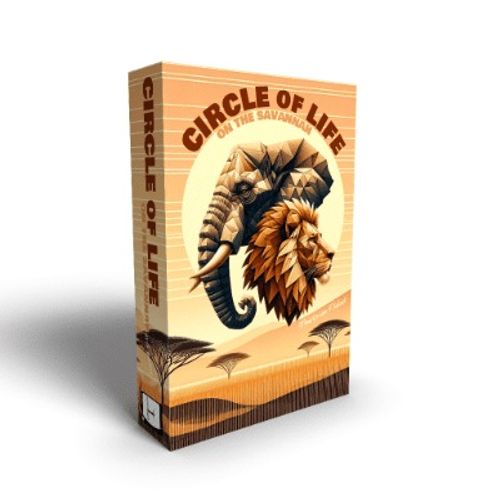
Circle Of Life: on the Savannah
Circle Of Life: on the Savannah Rulebook
Table of Contents
Table of Contents
Goal
This game is about "eat or be eaten" and "live and let live". Animals alive at the end of the game will give you rewards... but at the same time the other players will try to eat/kill your animals and steal your points as also killed animals are worth points at the end of the game. Will you become the king of the savannah?
Contents
- 64 animal cards
- 50 tokens - 10 tokens per color
- Game Rules
Cards Explained
Each animal card shows, from top to bottom and left to right:
- Level — a number shown in a circle at the top left of the card, used to identify the card for placement and hunting rules.
- Number of cards in game — how many copies of this card exist in the deck, shown at the top right.
- Card color — the color band of the card, corresponding to the animal's group (predators, scavengers, ungulates, large mammals, small mammals, birds, insects, humans).
- To place the token — a marked box on the card art where a player places their token when they play that card.
- Hunt — the hunting actions on the left side of the lower half of the card, listing what the card kills or scares away. These are followed from top to bottom.
- Big Five indicator — a badge showing the card's level, present on cards that belong to the "Big Five" animals.
- On the Savannah — placement restrictions/actions on the right side of the lower half of the card.
- End Game Points — the points the card is worth in hand, alive, or killed, at the end of the game.
Icon key used on the cards:
- An arrow pointing left, followed by a number, means "count, starting from the left."
- An arrow pointing right, followed by a number, means "count, starting from the right."
- A solid circle with a number refers to a specific card color and/or level.
- A dash icon means the action is applicable to that color and all lesser levels.
- A blank/white icon means the action is applicable to all colors and all levels.
Setting Up the Game
- Shuffle the full card deck.
- Every player receives 10 tokens in a chosen color.
- Give every player 3 cards; keep hidden from other players.
- Place 6 cards face up in a row on the table. This is the starting line of the Savannah.
- Place the remaining cards in one pile on the left of this starting line.
Playing a Turn
A. Play a Card
A player must play a card at the start of every turn, by placing a card on the right side of the Savannah. The player places a token on the placed card.
When the player is not allowed to play any of the three cards in hand, an animal of choice must be placed on the discard pile.
B. Play the Actions
On the rightside of the card are restrictions/actions related to the placement of the card. The actions on the leftside are the hunting actions and need to be followed from top to bottom.
Killing an animal: the player killing the animal takes the card from the savannah and places the card on the player's kill pile. These cards are worth points equal to its level at the end of the game.
Scaring away an animal: the respective cards are placed on the discard pile. They are no longer part of the game.
Tokens on the killed/scared away cards are returned to the respective players and can be used again by the players.
The actions often only relate to a given number of cards. An action marked to count from the right, followed by a number, means the action is applicable to that many of the rightmost cards. An action marked to count from the left, followed by a number, means the action is applicable to that many of the leftmost cards. If no restriction is mentioned, the action is applicable to the full row.
When animals are scared away or killed, the other cards do not yet shift places in the line. All actions need to be taken/counted with the line in mind as it was at the start of the turn.
C. Draw a Card
The turn always ends with drawing a card. You must always have three cards in your hand at the end of your turn.
D. Re-order the Cards
Group all animals together which belong to a group. Group the cards by placing cards on the left to join the rightmost card of the group. Shift all cards to the left, so they form one line again.
End of Game
The game ends when the last card is drawn from the card pile.
- The animals still in the Savannah line have survived the game and are still alive. Each player gets points as mentioned on the card for their animals bearing their tokens.
- If the most right card is the human (blue) card, penalty points are given to the holder of this card.
- Count the penalty points per card still held in your hand.
- Sum up all level points for every animal card in your kill pile.
- When you have all five animals of the BIG FIVE at least once in your kill pile, you receive a bonus of 25 points.
- Sum up all points of 1 to 5 and you have your final score.
Player with most points wins.
Animal Cards
Insects
There is only one level (1).
Insects may be played next to other insects, but not directly next to any other LEVEL 1 animal.
End Game Points:
- Minus 1 point for every insect in hand.
- Living insects are worth 12 points.
- Killed insects are worth 1 point.
Small Mammals
There are 3 levels of small mammals (1-2-3).
Level 1 small mammals group with each other.
Placement instructions:
- Level 1: most right card is not a level 1 card.
- Level 2: 2nd most right card is not a level 2 card.
- Level 3: 3rd most right card is not a level 3 card.
End Game Points:
- Minus 2 points for every small mammal in hand.
- Living small mammals are worth 10 points.
- Killed small mammals are worth 1/2/3 (level) points.
Birds
There are 3 levels of birds (1-2-3).
Placement instructions:
- Level 1: most right card is not a level 1 card.
- Level 2: 2nd most right card is not a level 2 card.
- Level 3: 3rd most right card is not a level 3 card.
End Game Points:
- Minus 3 points for every bird in hand.
- Living birds are worth 8 points.
- Killed birds are worth 1/2/3 (level) points.
Ungulates
There are 2 levels of ungulates (1-3).
Level 1 ungulates group with each other. Level 3 ungulates group with each other.
Placement instructions:
- Level 1: most right card is not a level 1 card.
- Level 3: 3rd most right card is not a level 3 card.
End Game Points:
- Minus 4 points for every ungulate in hand.
- Living ungulates are worth 5 points.
- Killed ungulates are worth 1/3 (level) points.
Large Mammals
There are 4 levels of large mammals (1-2-3-4).
Placement instructions:
- Level 1: most right card is not a level 1 card.
- Level 2: 2nd most right card is not a level 2 card.
- Level 3: 3rd most right card is not a level 3 card.
- Level 4: 4th most right card is not a level 4 card.
The Rhino, Hippo and Buffalo kill any predator in when the green cards outnumber the red cards.
When the player of an elephant has most animals on the savannah, all humans, scavengers and predators are killed.
End Game Points:
- Minus 6 points for every large mammal in hand.
- Living large mammals are worth 2 points.
- Killed large mammals are worth 1/2/3/4 (level) points.
Humans
There is only 1 level of humans (5).
Remove all cards left of the seventh card.
End Game Points:
- Minus 15 points for every human in hand.
- Minus 10 points if the human card is the right one.
Predators
There are four levels of predators (2/3/4/5).
Placement instruction: not allowed to be placed next to a predator.
When lion is placed, all cards left to the 8th card from the right are placed on the discard pile.
End Game Points:
- Minus 10 points for every predator in hand.
- Living predators are worth 1 point.
- Killed predators are worth 2/3/4/5 (level) points.
Scavengers
There are 2 levels of scavengers (4/5).
Placement instruction: not allowed to be placed next to a scavenger.
When a scavenger makes a kill, a card must be taken from the other players' "kill"-pile.
All cards left of the sixth card from the right are placed on the discard pile.
End Game Points:
- Minus 4 points for every scavenger in hand.
- Living scavengers are worth 5 points.
- Killed scavengers are worth 4/5 (level) points.
Closing Note
The rulebook closes with a reflection on Africa's predator-and-prey balance, credited to author Christopher McDougall, echoing the game's central tension between eating and being eaten.