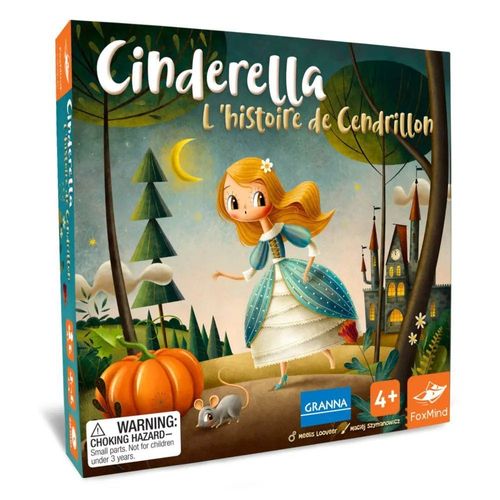
Cinderella
Cinderella Rulebook
Table of Contents
Table of Contents
Goal of the Game
In this cooperative game you and your friends try to help Cinderella find, in time, everything she will need at the ball. The result of the die roll determines how you can help Cinderella.
You win if you find all the items and figures before the clock shows twelve.
Contents of the Box
- 1 game board with a clock
- 12 basic tiles (6 pairs: 2 mice, 2 horses, 2 slippers, a gown and gloves, a rat and a coachman, a pumpkin and a carriage)
- 12 special tiles (3 each: mirrors, cauldrons, hourglasses, magic wands)
- 1 magic wooden die
- 1 cardboard figure of Cinderella (the active player token)
- this rulebook
Basic Variant
Setup
- Place the board in the box as shown in the picture. Place the assembled construction in the middle of the table so that all players have easy access to it.
- Set the clock hand to the 12 o'clock position.
- Shuffle the 12 basic tiles (2 mice, 2 horses, 2 slippers, a gown and gloves, a rat and a coachman, a pumpkin and a carriage). Then lay the face-down tiles on the table so that they form a rectangle of 3 x 4 tiles. Leave a gap of about 1 cm between the tiles, which will make handling them easier during the game.
- Place the die next to the face-down tiles.
- Now it is time to choose the starting player. It is the person who was most recently at a ball or a party. That player receives the Cinderella figure and becomes the active player.
Gameplay
On their turn, the active player rolls the die and performs the action shown on it. Then they pass the Cinderella figure to the next person, going clockwise. That player now becomes the active player.
Die Result
Magic wand (one side of the die) The player turns over one chosen tile so that all participants can see the picture on its other side. Then the player puts the face-down tile back in the same place.
Example: Joasia, Krzyś and Kasia are playing. Joasia was the most recent at a ball, so she starts the game. On her turn she rolls the die. The result is a magic wand. Joasia chooses one of the tiles and turns it over, showing it to the other players. The tile shows a picture of a gown. Joasia puts the face-down tile back in the same place she picked it up from, and passes the Cinderella figure to Krzyś.
Cauldron (two sides of the die) The player secretly peeks at one chosen tile, so that the other participants cannot see what picture is on its other side. Then the player puts the face-down tile back in the same place without revealing what was on it.
The player must remember what was on the tile. This knowledge may be useful later in the game.
Example: Krzyś makes his roll after Joasia's turn is over. The die shows the cauldron icon. Krzyś chooses one of the tiles and peeks at it in secret, so that only he can see what is on it. Without telling the other players, Krzyś puts the face-down tile back in the same place he picked it up from. He must remember what was on the tile. Perhaps this knowledge will come in handy in this game. Krzyś passes the Cinderella figure to Kasia.
Hourglass (three sides of the die) This player's turn consists of two moves performed in a set order: searching for a pair, and then moving the clock hand.
Searching for a pair: The active player tries to find a pair of elements that Cinderella needs to go to the ball. The player turns over one of the tiles so that all players can see what is on it. If the other players know where the matching tile to this pair is, they may help the search by pointing at one tile with a finger (each player may point at one tile). Then the active player secretly peeks at a second tile of their choice. If both tiles (the first one revealed openly and the second one peeked at in secret) form a pair, the player turns both tiles picture-side up and places the won pair next to the clock. If the tiles are not a pair, the player puts the face-down tiles back in the places they were taken from, without revealing to the other players what was on the second tile.
Moving the clock hand: The active player who rolled the hourglass and finished the search for a pair moves the clock hand forward by exactly one hour. (If the hand moves with difficulty, you may slightly loosen the rivet on the underside of the clock board.)
Example: The active player is Kasia. The side of the die she rolled shows the hourglass. Now Kasia must find a pair. She turns over a tile that shows a picture of a slipper. The other players point at tiles (one each) on which, as they think, the second slipper is located. Kasia secretly peeks at a tile of her choice. Unfortunately, she did not find the pair of slippers. Kasia puts the tiles back in their places, without revealing to the other participants what was on the second tile. At the end of her turn she moves the clock hand forward by one hour and passes the Cinderella figure to Joasia.
End of the Game
The game can end at two moments:
- The players find all the pairs before the clock strikes twelve, and so they win the game.
or
- The clock strikes twelve, but the players have not found all the pairs. In this situation the players lose.
Magic Variant
If you have already mastered the basic variant, you may try your skills in the variant using special tiles.
Setup
- Set up the clock in the box and place it in the middle of the table, so that every participant has easy access to it.
- Set the clock hand to the 12 o'clock position.
- Shuffle the special tiles and randomly deal one to each player. Players place the received tiles face-up in front of them on the table.
- Randomly choose 4 special tiles and shuffle them together with all the basic tiles. Then lay the face-down tiles on the table so that they form a square of 4 x 4 tiles. Leave a gap of about 1 cm between the tiles, which will make handling them easier during the game.
- Set the unused special tiles aside. They do not take part in the game.
- The youngest participant begins the game.
Gameplay of the Magic Variant
The game proceeds very similarly to the basic variant. The difference is the use of special tiles. Those found among the basic tiles have no value for the players; their role is to make finding pairs harder. However, the special tiles that the players received at the start of the game have magical properties. A player may use the property of a special tile once per game, on their turn, after rolling the die. After using a tile, it must be set aside; it no longer takes part in the rest of the game.
Mirror: If the player holding this tile rolls the hourglass on the die, they may peek at three tiles (instead of two) during the search for a pair in this turn. The first one is revealed to all players, but the other two are peeked at in secret. If the first peeked-at tile forms a pair with the revealed tile, the player may peek at one more tile.
Magic wand: If the player holding this tile rolls the magic wand on the die, they may turn over two tiles (instead of one) during this turn and show them to the other players. Then they put both face-down tiles back in the places they were taken from.
Cauldron: If the player holding this tile rolls the cauldron on the die, they may peek at two tiles (instead of one) during this turn, without revealing them to the other players. Then they put both face-down tiles back in the places they were taken from.
Hourglass: If the player holding this tile rolls the hourglass on the die, they do not move the clock hand during this turn.
Advanced Variant
The setup and gameplay of the advanced variant are identical to the magic variant, with one exception: pairs from the individual groups must be sought in a specific order.
First, the players must find the pairs from the purple group, that is:
- the pair of mice,
- the pair of horses.
If they find these, they may move on to searching for the pairs from the pink group, that is:
- the pair of slippers,
- the gown and the gloves.
Once they have found those too, they must find the pairs from the yellow group, that is:
- the rat and the coachman,
- the pumpkin and the carriage.
Other Variants of the Game
To make the game easier for the youngest players, you may introduce the rule that when the clock strikes twelve, the participants have one last joint chance to find the pairs. They must, without any mistakes (and in the correct order in the advanced variant), name all the pairs. If they make no mistakes, they win the game. If they make even one mistake, they lose.
It is also possible to make the game easier or harder for the players by decreasing or increasing the number of special tiles laid out on the table during the magic and advanced variants. Of course, after adding or removing tiles, the layout will no longer be a 4 x 4 square.