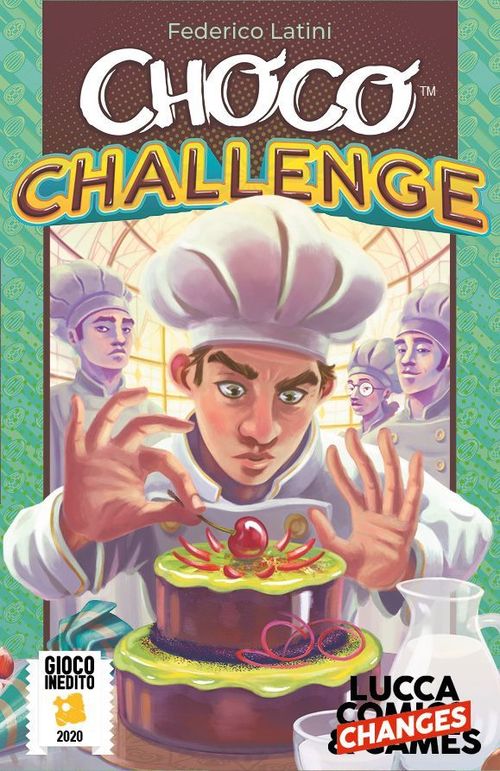
Choco Challenge
Choco Challenge Rulebook
Table of Contents
Table of Contents
Contents
110 cards:
- 40 Base cards (5 sets of 8 cards, identifiable by the color on the back. Each set includes 2 each of cocoa, butter, sugar, and milk)
- 36 Ingredient cards:
- 21 Fillings (8 nuts, 7 rum, 6 cherries)
- 15 Spices (5 cinnamon, 4 vanilla, 3 ginger, 2 mint, 1 chili pepper)
- 20 Dessert cards: each shows the cost, which equals its value in Crowns (5 × 4-cost = 4 points, 5 × 5-cost = 5 points, 4 × 6-cost = 6 points, 3 × 7-cost = 7 points, 2 × 8-cost = 8 points, 1 × 9-cost = 9 points)
- 13 Chocolatier's Tool cards (5 whisks, 4 pastry bags, and 4 measuring cups)
- 1 First Player card
These Rules
Set Up
- If you are playing with five players, use all of the cards. If there are four players, remove from play the Chocolatier's Tool and Dessert cards with the "5 players" symbol: they will not be used. If there are three players, also remove those with the "4-5 players" symbol.
- Each player receives a whisk and a Base set of one color (place unused sets back in the box as they will not be used). Keep your whisk face up in front of you. Shuffle your Base Set face down to create your own personal draw pile.
- Shuffle the Ingredient deck. Use it to set up the market: a row of 6 face up Ingredient cards on the table. Set any Spices you draw on the left end of the row and any Fillings on the right. Then place the Ingredient deck, face down, to the right of the market row, close to the Fillings.
- Divide the Desserts by type, and place them in face-up piles on the table.
- Put the other Chocolatier's Tools (pastry bags and measuring cups) in the middle of the table in two face-up piles.
- The youngest player receives the First Player card and starts the game.
Example. Set-up with 4 players. (The example diagram shows the Spices, Fillings and Ingredients piles, the Desserts and Tools piles in the middle, and each player's seat with the First Player card.)
Goal Of the Game
During each round, you have to decide how much to risk by drawing cards from your personal pile: the number of different cards you draw will represent your "purchasing power." But be careful: If you draw a card you already revealed, you have to stop, possibly losing your turn!
If you are too cautious, you will give your opponents an advantage. But if you risk too much, you will end up getting nothing.
Turn after turn, you will add Ingredient cards from the market to your personal draw pile. These cards will increase the strength of your draw pile (and allow you to get the precious Desserts) and they will provide victory points at the end of the game.
The Game
The game is played in turns in clockwise order, starting with the First Player. On your turn, draw cards from your personal draw pile with the risk of Busting: your choice will also affect your opponents, because if you don't Bust they will get a chance to draw extra cards.
A Game Turn
On your turn, perform these actions in order:
- Reshuffle: Gather the cards you drew the turn before (which are face up in front of you from the previous turn) and the cards in your discard pile and reshuffle everything into your personal draw pile. (Skip this step for your very first turn.)
- Draw: Draw and place face up in front of you the top card from your personal pile. If you didn't Bust (see "Busting," next page) you can decide to stop or to repeat this action. If you decide to stop, you can buy a card (see next step).
- Buying: If you stopped without Busting, you may acquire from the market the single card which lies the same number of cards from the Ingredient deck as the number of cards you drew. For example, if you drew 3 cards, you can buy the third card counting from the deck. If you drew 7 or more cards, you can buy any card from the market. Put the card you bought in your personal discard pile.
Moreover, if you didn't Bust, you can take a Dessert card from the middle of the table whose cost is not more than the number of cards you drew (e.g., if you drew 7 cards, you can take a Dessert worth 7 points or less). Keep your Desserts face up in front of you in your scoring pile. You cannot have two identical Desserts. You may take a Dessert even if you didn't buy an Ingredient. Desserts, just like Chocolatier's Tools, are never shuffled into your personal draw pile!
Busting: If you draw a card that matches one you already drew this turn, you have Busted: You must discard that card and your turn is over! However, if you have any Chocolatier's Tools available, you may discard one (put it back in its pile) and keep playing. Using a Tool is not mandatory. Important: If you Bust, you may not acquire any cards this turn!
Whether you Busted or stopped, keep your drawn cards (those not discarded) in front of you: They may be useful during your opponents' turns (see "Drawing Extra Cards").
Chocolatier's Tools allow you to continue your turn without Busting. Each time you draw a card that would make you Bust, you may discard it along with one of your Tools and keep playing. You then decide whether you want to stop or draw again. When used, a Tool always goes back to its pile in the middle of the table (if you are the first player to discard a Whisk, start a face-up pile in the middle of the table; later in the game, you can take a Whisk again). The discarded Ingredient card goes to your own discard pile.
Example. William draws a cocoa card. It's his first card so he has not Busted. Now he can choose to stop or to draw again. He draws again: he reveals a butter. He chooses to draw a third card and reveals a second butter: he has Busted! He must discard the second butter. This would normally end his turn, but he uses his Whisk to keep playing, returning it to the middle of the table. Instead of drawing again, he decides to stop and buys the cherries from the market with his "purchasing power" of 2. He adds the cherries to his discard pile and leaves the two drawn cards in front of him until his next turn. (The example diagram shows the drawn cards.)
Refilling the Market
There must always be 6 Ingredients in the market. At the end of your turn, if you bought a card, replace it with the top card from the Ingredient deck: Place the new card at the end of the row farthest from the deck if it's a Spice or at the closest end if it's a Filling, sliding the other cards to fill the gap as needed.
Note: If the Ingredient deck runs out, the game ends, but only after your opponents have had a chance to draw their extra cards (see "Drawing extra cards").
Example. William bought a Filling and must refill the market. He draws a Spice, which he places at the end farthest from the deck, sliding the other cards over. (The example diagram shows the market row before and after.)
Drawing Extra Cards
Starting in the second round (i.e., starting with the first player's second turn), at the end of your turn your opponents have a chance to receive an extra card if you stopped without Busting. Compare the number of cards you drew that now lay in front of you with the number in front of each of the other players in clockwise order:
- If that player drew more cards than you, they may draw the top card from the Ingredient deck and add it to their discard pile.
- If that player drew fewer cards than you, they may take a Chocolatier's Tool they do not already have from the middle of the table and put it in front of them.
- If that player drew the same number of cards as you, they do not draw an extra card.
After each opponent has had a chance to draw their extra card, the turn passes to the next player.
Example. William's turn is over and all the other players check to see if they drew more or fewer cards than he did. Since Sabrina has drawn 3 cards, she can now draw the top card of the Ingredient deck. She sees from the card back that it's a Spice, so she decides to draw it and add it to her own discard pile. Alex has two cards, so he does not draw an extra card. Luis has just one card in front of him, so he takes a Chocolatier's Tool he does not already have: a pastry bag. (The example diagram shows the players' drawn cards.)
End of the Game
The game ends at the end of any player's turn during which:
- the Ingredient deck runs out
- or
- three Dessert piles are empty.
The current turn is completed, including the possibility of drawing extra cards. If the Ingredient deck is empty, players who get to draw an extra Ingredient card may choose one directly from the market.
Now, gather all of your cards and count your Crowns (on your Base set, your Ingredient cards, and your Desserts). The player with the most Crowns wins!
Ties are broken in favor of the player with the First Player card, or the one closer to the First Player counting clockwise.
Example. William has just taken the last 6-point Dessert, which was the third Dessert pile to run out: the game ends at the end of his turn, after all his opponents have had a chance to draw their extra card. Then the Crowns are tallied:
- William has a total of 41 points: 17 in his pile and 24 on his Desserts.
- Sabrina has a total of 31 points: 16 in her pile and 15 on her Desserts.
- Luis has a total of 31 points: 16 in his pile and 15 on his Desserts.
- Alex has a total of 37 points: 18 in his pile and 19 on his Desserts.
William is the winner!