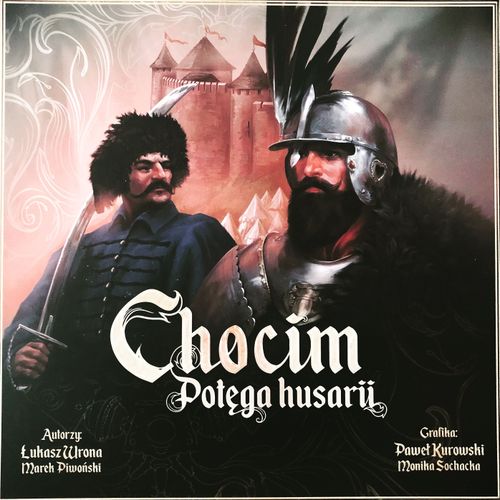
Chocim. Potęga Husarii
Chocim. Potęga Husarii Rulebook
Table of Contents
Table of Contents
- Components
- Setup (Przygotowanie gry)
- Victory (Zwycięstwo w grze)
- Game Flow (Przebieg gry)
- Unit Deployment (Rozmieszczanie jednostek)
- Adjacency of Spaces (Sąsiadowanie pól)
- Control of Spaces (Kontrola pól)
- Actions (Działania)
- Effects (Efekty)
- Battles (Starcia)
- Supplies (Zapasy)
- Morale (Morale)
- Fortifications (Umocnienia)
- Negotiations (Negocjacje)
- Quick Reference (Skrót zasad)
Components
Board and component list as printed in the rulebook (the illustrated page shows the layout).
Board (PLANSZA): depicts the battlefield. It includes:
- Time track (Tor czasu): one space equals one week. Scenario circumstances for weeks 4 and 5 are printed beside it.
- Phase track (Fazy): the six phases of each week.
- Common field (Pole wspólne): the forefield (przedpole) and the neutral area.
- Defence level track (Poziom obronności) and the three defensive lines of the Commonwealth (I, II and III line of defence).
- Ottoman spaces (Pola Osmańskie) and Commonwealth spaces (Pola Rzeczpospolitej).
- Actions (działania) printed on each space (see Actions, page 17 of the printed rulebook).
Units (57 units):
- Commonwealth (Rzeczpospolita): cavalry (jazda) (8), infantry (piechota) (6), Cossacks (Kozacy) (7).
- Ottoman Empire (Imperium osmańskie): spahis (17), janissaries (janczarzy) (12), Tatars (Tatarzy) (7).
- The "any Polish unit" and "any Ottoman unit" symbols on the component page are legend symbols for the unit types, not extra pieces.
Dice: 15 dice.
Tokens (30):
- Morale (Ottoman and Polish morale tokens).
- Supply (zapasów) tokens (Polish and Ottoman).
- Extra commander card tokens (dodatkowej karty wodzów), Polish and Ottoman.
- Bonus token (premii) for the first winner of a pitched battle, one token.
- Week tokens (tygodnia).
- Phase token (fazy).
- Approaches token (aproszy), which tracks the trenches.
- Defence level tokens (obronności), values 0 to 3.
Player boards (2 PLANSZE GRACZY): each side has a board with a supply track (tor zapasów), a morale track (tor morale), a broken units field (pole jednostek rozbitych), a mutinied units field (pole jednostek zbuntowanych) and a removed units field (pole jednostek usuniętych).
Commander cards (KARTY WODZÓW): 20 Commonwealth and 25 Ottoman. Commanders (dowódcy) show a command value (wartość dowodzenia) and up to two stratagems (fortel); officers (oficerowie) show a single effect.
Diplomacy cards (55 KART DYPLOMACJI): each card has an argument strength (siła argumentu): 15 cards of strength 1, 25 of strength 2 and 15 of strength 3 (see FAQ).
Claim cards (5 KART ROSZCZEŃ): each has a value (wartość karty).
Setup (Przygotowanie gry)
- Place the battle board in the middle of the table. Place the week marker on the first week space and the phase marker on the preparation phase. On the battle action (walna bitwa) in the forefield, place the bonus token face up. Place the approaches token on position 0 of the approaches track. The track is on the trenches (szańce) space.
- Place all units on the main board:
- Commonwealth: place 1 infantry unit on the defence action of the Redoubts (reduty), the Church (cerkiew) and the Bridgehead (przedmoście), and 1 cavalry unit on the defence action of the Lisowczycy Bastion (bastion lisowczyków). Place the remaining infantry and cavalry in reserve (R) on the Hetman's Camp (obóz hetmański). Place all Cossack units in reserve in the Cossack wagon fort (tabor kozacki).
- Ottoman Empire: place all janissary units in reserve on the Sultan's Tents (namioty sułtańskie), all spahi units in reserve in the Spahi Camp (obóz spahisów), and all Tatar units in reserve in the Tatar basket (kosz tatarski).
- On both sides of the main board (on the longer or shorter edges, as you prefer), place the player boards. Place the morale and supply markers on their tracks, on the spaces marked with the letter S.
- Next to the board place the commander card decks. From each deck, draw and lay out face up in front of the players three commander cards:
- Commonwealth: Grand Hetman of Lithuania (Hetman wielki litewski), Regimentarz, Cossack Hetman (Hetman kozacki).
- Turks: Sultan, Grand Vizier (Wielki Wezyr), Tatar Khan (Chan tatarski).
- Shuffle the diplomacy cards and draw 7, laying them face up next to the board.
- Claim cards are needed only during negotiations, so you may set them aside for now.
- Place the extra commander card tokens on the Polish and Ottoman Knightly Circle (koło rycerskie) and Council (narada) actions.
- Place the dice next to the board.
Victory (Zwycięstwo w grze)
The game can end immediately if:
- The Ottoman morale marker falls, in the summary phase of any week, to the lowest level (mutiny, bunt). This is an immediate victory for the Commonwealth.
- The Hetman's Camp (obóz hetmański) is captured in an assault (szturm). This is an automatic victory for the Ottomans.
If no such situation arises by the end of the fifth week, negotiations (Negocjacje) begin. The winner is then the player who gains more points during the negotiations (see Negotiations, page 29 of the printed rulebook). Whoever acquired more diplomacy cards during the regular game has the better chances of winning.
Note: Negotiations may also begin earlier if, after the summary phase:
- The supply marker of either side reaches the lowest supply level (famine, głód).
- The Commonwealth morale marker falls to the lowest level (rokosz, a confederation revolt).
Game Flow (Przebieg gry)
The game consists of two parts: the siege (oblężenie) and the negotiations (negocjacje).
The siege lasts five turns, called weeks (tygodnie) in the rulebook. Each week follows the same pattern and is divided into six phases:
- Preparation phase (faza przygotowań)
- Action phase (faza działań)
- Diplomacy phase (faza dyplomacji)
- Effects phase (faza efektów)
- Supply phase (faza zapasów)
- Summary phase (faza podsumowania)
If, after the fifth week, none of the victory situations above has occurred, the negotiations begin.
Note: Negotiations may also begin earlier (see Victory above).
Preparation Phase (Faza przygotowań)
Players may perform these steps simultaneously. In each week:
- Draw commander cards from your own commander deck so that the Commonwealth player has 7 cards in total and the Ottoman player has 8 cards in total. The limit may be 1 higher if the Knightly Circle (koło rycerskie) or Council (narada) action was used in the previous week. The special extra card token reminds you of this and is exchanged for an extra card. Officer cards are kept face down in your hand, away from your opponent; commander cards are kept face up on the table in front of you.
From week 2 onwards, the preparation phase also includes:
- Flip over the commander cards that were used in the previous week.
- Check the circumstances described on the time track for the current week:
- In week 4:
- The Grand Hetman of Lithuania dies: the Commonwealth player removes the Chodkiewicz commander card from the game and returns it to the box. In its place they receive an extra random commander card. They also receive 1 random diplomacy card from the deck.
- Cold and rain: the Ottoman player removes 2 units of their choice from the game.
- In week 5:
- News of an approaching relief force encourages the defenders: the Commonwealth player still receives 1 extra commander card in exchange for the Chodkiewicz card, plus 1 random diplomacy card from the deck.
- Snow falls at Chocim: the Ottoman player removes 3 units of their choice from the game.
- In week 4:
- Return the bonus token on the pitched battle action (walna bitwa), if it was flipped in the previous week (the side marked with a diplomacy card).
- Check the morale level. If required, move from the board to the mutinied units field (pole jednostek zbuntowanych) the units of the type and number specified on that track.
- Place 7 new face-up diplomacy cards from the diplomacy deck next to the board.
- Place the used extra commander card tokens back on the board, on their corresponding actions.
Action Phase (Faza działań)
Players alternately perform one play each, using commander cards. The Commonwealth player always begins this phase. The phase ends when both players have used all their cards or both have passed. A player who passes cannot return to play. They keep any unused officer cards in hand.
Play (zagranie): a play consists of using a commander card in one of two ways:
- Use the command value (wartość dowodzenia) and deploy (see Unit Deployment) up to that number of units, or fewer, to spaces and to the actions chosen on those spaces (see Actions).
- Carry out a stratagem (fortel), which is one of the two on a commander card, or the one on an officer card. A stratagem is the text printed on the card, read literally. The text of the card always takes precedence over the rules.
After a play, put the card on the discard pile of used cards (in the case of an officer) or turn it over (in the case of a commander).
Example printed in the rulebook: the card "Pospolite ruszenie z Siwasu" (Hasan Pasha) has a command value of 2. Thanks to this, the Ottoman player may deploy 2 Turkish units of any kind to any space open to the Ottomans. But if the player declares the stratagem, the card's reward is that 2 janissaries are deployed to the specified action, the Pilaf (pilaw), which gives an additional immediate effect (the reward printed on the card: deploy 2 janissaries on the pilaw action and increase morale by 1).
Notes printed in the rulebook:
- Because the Commonwealth player has one card fewer and begins first, the Ottoman player will usually be the one to play two cards in a row.
- There is no need to match the played card to the type of unit being deployed. For example, the card "Chorągiew husarska JWP starosty lipnickiego Jana Mikołaja Boratyńskiego" (a hussar banner) may also be used to deploy infantry and Cossacks. The units depicted on the cards are for illustration only.
Diplomacy Phase (Faza dyplomacji)
In this phase the players alternately take one diplomacy card each from the 7 on the table. The player who starts depends on the situation on the board:
-
The Ottoman player takes the first card if they control any Polish space.
Example printed in the rulebook: the Ottoman player starts.
-
If that situation does not arise, the starting player is the player who has fewer units on their own broken units field.
Example printed in the rulebook: the printed reference tables give each side's broken units grouped by count. For the Ottoman player, 3–5 broken units count as 1, 6–8 as 2 and 9 or more as 3. For the Commonwealth player, 2–4 broken units count as 1 and 5 or more as 2. The example compares these figures.
-
In case of a tie, the Commonwealth player begins.
Example printed in the rulebook: the first player will then have 4 cards and the second only 3.
Effects Phase (Faza efektów)
The effects are resolved in this order: first the neutral effect of the pitched battle (walna bitwa). After that, the Commonwealth player and then the Ottoman player resolve their effects, in any order.
Linked actions are resolved together:
- Raid (rajd) is resolved together with Plunder (plądrowanie).
- Pursuit (pościg) is resolved together with the Expedition to Kamieniec Podolski (wyprawa do Kamieńca Podolskiego).
- Digging approaches (kopanie aproszy) is resolved together with filling in approaches (zasypywanie aproszy).
Resolve all actions marked as effects (see Actions and Effects, page 17 of the printed rulebook). If the conditions are met, carry out the result or strength of the effect. In each case, the units return to their reserve immediately.
Supply Phase (Faza zapasów)
Players may perform the actions of this phase simultaneously.
All units consume supplies. During this phase, check how many supplies were eaten and what the state of the stores is:
- Count how many units you must feed: count all units on the board, on the broken units field and on the mutinied units field. At the beginning of the game this number is lower than the starting number of units (36 for the Ottomans and 21 for the Commonwealth), after subtracting the number of units on the removed units field.
- For every three units, rounding up, lower the supply level by 1.
Example printed in the rulebook: the Ottomans have 25 units in total, of which 22 are on the board, 2 are on the broken units field and 1 is on the mutinied units field. Their supply level drops by 9 spaces.
Summary Phase (Faza podsumowania)
This phase may be performed simultaneously by both players.
-
Return to camps: move all remaining units from the plan (plan) and support (wsparcie) actions back to the appropriate reserve. Units on the defence (obrona) and control (kontrola) actions may remain in place or also be moved to the reserve.
Note: If the Cossack wagon fort (tabor kozacki) is lost, the Cossack units return to the reserve at the Hetman's Camp.
-
Sick and wounded: count the units on the broken units field and apply the morale changes:
- Commonwealth: 0–1, no effect; 2–4, morale decreases by 1; 5 or more, morale decreases by 2.
- Ottomans: 0–2, no effect; 3–5, morale decreases by 1; 6–8, morale decreases by 2; 9 or more, morale decreases by 3.
-
Died of wounds: automatically remove 1 unit of your choice from the broken units field (move it to the removed units field).
-
Feeding: check where the supply marker stands:
- On the space marked as double rations (podwójne racje): raise morale by 1.
- On the space marked as shortages (braki): lower morale by 1.
- On the space marked as famine (głód): negotiations. Immediately discard 1 diplomacy card of your choice; after the summary phase, proceed automatically to the negotiations.
-
Hungry and cold: as the supply level falls, check the information printed to the right of the supply track, which states how many units must be removed from the game. To do this, look at the supply token's position and remove the indicated number of units. First remove any units from the broken units field, then selected units from the board.
Unit Deployment (Rozmieszczanie jednostek)
Unit deployment is the most important element of the game. It represents leading troops out of camps and taking up positions on the battlefield, or carrying out special orders. Deployed units, with a few exceptions, cannot be moved again in the same week.
Deployment means moving units from one or more reserves, in a number equal to or less than the command value of the commander card played, to one other space ("from many places into one"). On the destination space the units may be placed on one or more of the available actions.
Reserves:
- Commonwealth reserve: the Hetman's Camp (obóz hetmański) (cavalry, infantry, and Cossacks after the loss of their wagon fort) and the Cossack wagon fort (tabor kozacki) (Cossacks).
- Ottoman reserve: the Sultan's Tents (namioty sułtańskie) (janissaries), the Spahi Camp (obóz spahisów) (spahis), and the Tatar basket (kosz tatarski) (Tatars).
Example printed in the rulebook: the player plays a commander card with a command value of 2. They then move 2 cavalry units from the reserve (the Hetman's Camp) and add them to a single unit already on the expedition to Kamieniec action.
Example printed in the rulebook: the player plays a commander card with a command value of 3. Under the deployment rule, they move 3 cavalry units from the Hetman's Camp to the Castle (zamek), occupying the procession (procesja) and knightly circle (koło rycerskie) actions there.
Example printed in the rulebook: after playing a commander card with a command value of 3, the player decides to use one cavalry and one infantry unit from the Hetman's Camp, plus one Cossack unit from the wagon fort. They move these to the Redoubts (reduty) space, occupying the filling approaches (zasypywanie aproszy) action with the Cossacks and infantry, and placing the cavalry on defence (obrona).
Not allowed: a move in which a player tries to move units to more than one space. Example printed in the rulebook: from the Cossack wagon fort to the forefield and to the redoubts is an illegal move. Only the stratagem of certain commanders may change this rule.
Note printed in the rulebook: units in reserve are the basic resource you have each week. Some commander stratagems allow units to be deployed more efficiently. These include, among others:
- moving units to several different spaces and actions, which may result in more than one clash during a single play (for example Jan Karol Chodkiewicz, Grand Vizier);
- moving units from defence, or even from the broken units field (for example Stanisław Lubomirski);
- withdrawing units that were sent to actions back to the reserve (for example the Cossack banner of the starosta of Kamieniec, Stefan Potocki).
Adjacency of Spaces (Sąsiadowanie pól)
For the purposes of deploying units and of the actions pitched battle, assault and counterattack, the adjacency of individual spaces must be established.
- The forefield (przedpole) is adjacent to every space of the first line of the Commonwealth, including the bridgehead (przedmoście).
- The bridgehead is adjacent to the castle (zamek), across the bridge over the Dniester.
- The Cossack wagon fort is adjacent only to the forefield and to the Lisowczycy Bastion (bastion lisowczyków), because a steep ravine separates it from the Hetman's Camp.
The Ottoman player may deploy units:
- to all Ottoman spaces;
- to the forefield;
- to first-line Commonwealth spaces;
- to second-line Commonwealth spaces, if the space on which they want to take an action borders another first-line Commonwealth space that they control;
- to the third-line Commonwealth space (the Hetman's Camp), if they control any second-line space and the first-line space adjoining it.
When deploying to Commonwealth spaces, the pitched battle action must be taken into account (see Pitched Battle, page 20). Commonwealth troops may effectively block Ottoman assaults.
The Commonwealth player may deploy units:
- to a space that is controlled by the Commonwealth, or to the forefield, only if an unbroken line of spaces controlled by the Commonwealth exists between the space the units come from and the target space. This also applies when units already deployed are deployed again (with a stratagem).
Control of Spaces (Kontrola pól)
Control is tied to unit deployment.
- The Commonwealth controls its own space if there is no Ottoman unit on the control (kontrola) action on that space.
- The Ottomans always control their own spaces. They control Commonwealth spaces if at least one of their units occupies the control action on the space.
- The forefield is the only space that may be controlled by both sides at the same time, if both sides have the minimum number of units on the pitched battle action. Both armies stand facing each other.
Actions (Działania)
Each space carries between one and four actions. Deployed units must always be assigned to specific actions. There are three types of action:
- Plans (plan): all events directly connected with the clash of units and armed combat. In the game they are linked to rolling dice.
- Support (wsparcie): actions that increase the chances of success in the clashes described above.
- Effects (efekt): auxiliary works that allow both sides to survive during the siege and to increase their strength during clashes and the approaching negotiations. Effects are resolved in the effects phase.
Each action is described by:
- its shape (kształt), which shows the type of action;
- its result (skutek), showing what happens and when;
- the required number and type of units: the minimum and maximum (wymagana liczba i rodzaj jednostek, minimum i maksimum);
- any linked action (powiązane działanie);
- for defence actions, the defence level (poziom umocnień) and the number of dice rolled in combat, which depends on the unit type (skuteczność jednostek).
Plan
A plan is resolved immediately when it is declared.
A player may declare a plan when they have on that action at least the minimum required number of units. If they deploy enough units to reach the maximum, they must declare it immediately. A player may declare a plan only directly after placing units on it.
Assault (Szturm)
Assault is the only way for the Ottomans to take a Commonwealth space and control it. If the defence (obrona) action of that space holds no Commonwealth unit, and the Ottomans meet the deployment conditions (see Adjacency of Spaces), and they use the minimum number of units shown, they may immediately deploy onto the control action.
Every Commonwealth space contains an assault action combined with control (except the Hetman's Camp), as well as defence.
Each assault action has dots that show how many additional units, above the maximum, may be deployed on that space. This is possible because of control of adjacent spaces (1 unit for each adjacent space). These additional units do not, however, change the moment at which the assault must be declared.
Example printed in the rulebook: the Ottomans control the Cossack wagon fort and the redoubts and plan an assault on the Lisowczycy Bastion. They already have four units there, then add two more. Although, thanks to control of adjacent spaces, they may add as many as 7 units, adding only the sixth (and not adding another in the same play) means the assault takes place automatically.
Printed illustration: a player who adds 1 unit to an assault may declare the assault or not. A player who adds 4 units (reaching the maximum) must declare the plan.
If the Ottomans declare an assault on a space where Commonwealth units are on the defence action, the clash must be resolved immediately (see Battles, page 25).
Although all Ottoman units may take part in an assault, the dice rolled when taking all spaces except the bridgehead are only granted for janissaries and spahis used. On the bridgehead the Tatars may also contribute dice (see the efficiency table below). Outside the forefield and the bridgehead, Tatars can at most absorb losses.
Defence (Obrona)
Defence is tied to the assault action and to the defence level (poziom obronności). Units placed here are the defenders if an assault occurs. The limit states how many units may be placed on this action.
The exceptions are the Hetman's Camp and the Cossack wagon fort: in their defence, all units on that space that are not deployed on other actions take part, that is, all units remaining in reserve. The defence level increases the chances of the defenders (see Battles, page 25).
During the summary phase the player does not have to withdraw units from this action.
Control (Kontrola)
If the Ottomans leave a space while leaving the control action empty, the Commonwealth automatically regains control of that space.
For safety, you should place your own units on defence.
Immediately after the Ottomans capture a Commonwealth space, they may move from the assault action the number of units allowed by the limit to the control action. If they meet the conditions for deploying units (that is, they have access to it), they may also do so when the Commonwealth space has been left empty. They may also add new units to this action in the later course of the game.
During the summary phase the player does not have to withdraw units from this action.
Control is linked to the counterattack. Ottoman units deployed here defend the space during a counterattack. The number of dice is calculated from the data on the assault action.
Counterattack (Kontratak)
This action is the only way to retake spaces lost by the Commonwealth. A counterattack may only be made against spaces to which the Poles have access, analogously to unit deployment (see Adjacency of Spaces).
Counterattack triggers an immediate resolution of a clash (see Battles, page 25).
Pitched Battle, Plan (Walna bitwa)
Hostile armies stand facing each other in battle order and prevent each other from approaching the enemy camps.
Note: the pitched battle action is not only a plan but also an effect (see Pitched Battle, effect, page 25).
Pitched battle is the only action on which units of both sides may be deployed. If, at the moment of deployment, the active player has accumulated at least the minimum number of units needed, and there are already enemy troops on that space, they may declare a pitched battle. They may also decline (for example hoping to strengthen their forces in later plays). They must, however, reckon with the fact that their opponent, by adding new troops, may decide for them!
Note: as soon as a player reaches the maximum number of units, they must immediately resolve the pitched battle, provided the opponent has some units on their side. A later arrival of hostile units also triggers the clash automatically.
Units on the pitched battle action also have an additional effect: they restrict the opponent's access to certain actions (deployment blocks):
- If at least 4 Commonwealth units are on the pitched battle action, the Ottomans may not deploy any new units to any assault action.
- If at least 5 Ottoman units are on the pitched battle action, the Commonwealth may not deploy units to the filling approaches (zasypywanie aproszy), night sortie (nocna wycieczka) and foraging expedition (wyprawa po łupy) actions. Units already on those actions are still counted in the effects phase.
- If both sides meet these conditions, both blocks apply together.
Support (Wsparcie)
Support is an action that lets you strengthen the plan you are preparing: assault, pitched battle, counterattack or defence. Support is triggered at a moment chosen by the player:
- Ottoman, with an ambush (zasadzka), when conducting the pitched battle.
- Ottoman, with siege ladders (budowa drabin), when conducting an assault.
- Polish, with a flank attack (atak z flanki), when conducting the pitched battle.
- Polish, with a cannonade (kanonada), when conducting defence or counterattack.
Each unit used for support raises the result of one chosen die in the chosen clash by one pip. It is not possible to raise the result on one die by more than 1. Support must be declared before the dice are rolled (see Battles). After support is carried out, the units used return to reserve.
Effects (Efekty)
An effect is an action that is resolved in the effects phase. The effects are: Pursuit (pościg), Plunder (plądrowanie), Pilaf (pilaw), Digging approaches (kopanie aproszy), Bombardment (ostrzał), Council (narada), Intrigues (intrygi), Expedition to Kamieniec Podolski (wyprawa do Kamieńca Podolskiego), Fortifications (fortyfikacje), Night sortie (nocna wycieczka), Procession (procesja), Raid (rajd), Foraging expedition (wyprawa po łupy), Filling approaches (zasypywanie aproszy) and Knightly circle (koło rycerskie). The pitched battle also has an effect (see Pitched Battle, effect, under Battles).
Supply Effects (Efekty związane z zapasami)
Plunder (plądrowanie) (Ottoman): each spahi unit raises the supply level by 1, and each Tatar unit raises it by 2.
Note: the Polish raid action (rajd) must also be taken into account.
Raid (rajd) (Commonwealth): placing any one unit reduces by 2 the supply that the Ottoman player gains from plunder. If the Ottomans do not plunder, the raid has no effect.
Note: the printed summary on the last page lists this action as cavalry only ("jazda na działaniu rajd"). The effect text above is the one printed on the action; see the note under Quick Reference.
Expedition to Kamieniec Podolski (wyprawa do Kamieńca Podolskiego) (Commonwealth): each infantry and Cossack unit raises the supply level by 1, and each cavalry unit raises it by 2.
Note: the Ottoman pursuit action (pościg) must also be taken into account.
Pursuit (pościg) (Ottoman): each Tatar unit placed reduces by 1 the supply that the Polish player gains from the expedition to Kamieniec. If the Commonwealth sends no units to get supplies, pursuit has no effect.
Foraging expedition (wyprawa po łupy) (Commonwealth): each Cossack unit deployed lowers the Ottoman supply level by 1 and raises the Commonwealth supply level by 1.
Trench and Fortification Effects (Efekty związane z aproszami i umocnieniami)
Digging approaches (kopanie aproszy) (Ottoman): the approaches token moves forward 1 space on the approaches track for each janissary unit deployed.
Note: the filling approaches action (zasypywanie aproszy) must also be taken into account.
Filling approaches (zasypywanie aproszy) (Commonwealth): the approaches token moves back 1 space for each infantry or Cossack unit deployed on it.
Note: the digging approaches action (kopanie aproszy) must also be taken into account.
Example printed in the rulebook: the digging approaches action has 3 janissary units, and the filling approaches action has 1 infantry unit and 1 Cossack unit. The approaches token moves forward by 1 space.
Bombardment (ostrzał) (Ottoman): after deploying a total of three infantry or Cossack units, the Commonwealth player may raise the fortification level of any one space by 1, but no higher than level 3, marking this with the appropriate token.
For each janissary unit deployed, the Ottoman player may apply one bombardment effect. The type of effect depends on the position of the approaches token on the approaches track, which shows how close the Turkish trenches have been dug to the Polish fortifications. The player may carry out any combination of the available effects, and the same effect may be applied more than once. The available effects are those at or below the token's position, as the printed example shows.
- Token on space 4: the Commonwealth supply level may be lowered by 1.
- Token on space 5: the Ottoman player may force the withdrawal of 1 Commonwealth unit of their choice from defence (obrona) back to reserve.
- Token on space 6: the defence level of a chosen space may be lowered by 1.
Example printed in the rulebook: the bombardment action has 3 janissary units, and the approaches token is on space 5. The Ottoman player decides to force the withdrawal of 2 Commonwealth units from the defence action on the Walls (wały), and to lower the Commonwealth supply level by 1.
Fortifications (fortyfikacje) (Commonwealth): after deploying a total of three infantry or Cossack units, the Commonwealth player raises the fortification level of any one space by 1, but no higher than level 3. Mark this with the appropriate token.
Effects Related to Morale, Commander Cards and Diplomacy
Night sortie (nocna wycieczka) (Commonwealth): each Cossack unit deployed lowers the Ottoman morale level by 1.
Council (narada) (Ottoman): if the player deploys 3 spahi units here, they may take the extra commander card token from this action. In the preparation phase of the next week the token is exchanged for one more commander card from the deck (the limit of 8 cards then does not apply).
Knightly circle (koło rycerskie) (Commonwealth): if the player deploys 2 cavalry units here, they may take the extra commander card token from this action. In the preparation phase of the next week the token is exchanged for one more commander card from the deck (the limit of 7 cards then does not apply).
Pilaf (pilaw) (Ottoman): if 4 janissary units are here, the Ottoman morale level is raised by 1.
Intrigues (intrygi) (Ottoman): if 3 Tatar units are here, the Commonwealth player must discard 1 random diplomacy card from among those they hold.
Procession (procesja) (Commonwealth): if 3 Polish cavalry units are here, the player may: (a) force the Ottoman player to discard 1 random diplomacy card from among those they hold; (b) raise their own morale level by 1.
Pitched battle (walna bitwa), effect: the pitched battle action is also an effect, and it is resolved first in the effects phase. Its result depends on the combination of units placed here:
- If at least 4 Commonwealth units are on the action, the Ottoman morale level is lowered by 1.
- If at least 5 Ottoman units are on the action, the Ottoman morale level is raised by 1.
- If both conditions are met, the morale level does not change.
Battles (Starcia)
Since the siege of the camp at Chocim is ongoing, armed confrontations seem unavoidable. This may be a pitched battle in the forefield, a Turkish assault on Polish positions, or a Polish counterattack to retake spaces lost earlier. All battles arise from players carrying out actions of the plan type. During a battle, plans may be strengthened by support actions.
Battles are resolved with dice. Dice results are as follows:
- 1–3: no effect.
- 4 or 5: a hit (trafienie).
- 6: a rout (rozbicie).
Each unit type rolls a number of dice that depends on the battle type (see the efficiency table under Quick Reference).
Pitched Battle (Walna bitwa)
The aim of a pitched battle is to rout the opponent on the forefield and drive them back to their camps, that is, to their reserve. The winner raises their own morale level. The player who first wins a pitched battle in a given week receives an extra diplomacy card (by flipping the bonus token). As a side effect of such a clash, the winning troops also return to reserve (the forefield is left empty).
Every success in a pitched battle raises the winner's morale level, regardless of the number of enemy units defeated.
Assault (Szturm)
The aim of an assault is to take control of a Commonwealth space. This happens when there are no Commonwealth units on the defence action of that space. Then Ottoman units may be placed on the control action.
Note: when there are no Commonwealth units on the defence action of a space, the Ottomans simply place units on the control action in order to take the space. In this way they enter the abandoned enemy positions.
Counterattack (Kontratak)
The aim of a counterattack is to retake a space lost earlier, by driving out all Ottoman units from it.
Assaults and counterattacks are the actions used to capture or retake spaces. They succeed if the defender is completely driven out.
Battle Procedure (Procedura walki)
Pitched battle:
- Both players are attacking sides.
- The clash is resolved by rolling dice. Count how many dice you will roll.
- Both players declare whether, and to what extent, they use support.
- Roll all the dice you are entitled to, taking turns. The order of rolling does not matter.
- Both players modify results on chosen dice, if they use support (ambush and flank attack).
- Both players count their hits and routs, that is, the results of 4, 5 and 6.
- The winner of the pitched battle is the side with the greater total of hits and routs.
- Each player moves to their own broken units field one unit for each 6 the opponent rolled.
- Both players move all remaining units back to their reserves.
- The player who won the first pitched battle of that week draws a diplomacy card from the 7 on the table and replaces it with a new one. They flip the bonus token to the other side to show that they have used the bonus.
Assault or counterattack:
- Identify the attacker and the defender:
- In an assault, the attacker is the Ottoman player and the defender is the Commonwealth player. Only units on defence/reserve count; the others are treated as if they were not there.
- In a counterattack, the attacker is the Commonwealth player and the defender is the Ottoman player. Only units on control count.
- The clash is resolved by rolling dice. Check how many dice you will roll. Each action describes the efficiency of the units used there. Control uses the assault rules.
- Both players declare whether, and to what extent, they use support.
- Roll all dice you are entitled to, taking turns. The order of rolling does not matter.
- In an assault, the attacker lowers the result on each die by the fortification level (defence level) of the assaulted space.
- Both players modify results on chosen dice, using the declared support. Units used from support actions are moved to reserve.
- Simultaneously, rout: move one unit for each 6 the opponent rolled to your own broken units field.
- If there are still any defenders and/or attackers left, count hits, that is, your results of 4 and 5. Subtract the smaller number from the larger and note the difference. The player with fewer hits must withdraw units to reserve equal to that difference. In case of a tie, neither player withdraws units to reserve.
- If, after all results have been applied, the defence/control action still has defending units, the assault or counterattack fails, and the remaining attacking units return to reserve.
- If the defence/control action no longer has any hostile unit, the assault or counterattack has succeeded. The attacker must, however, keep at least one unit, which they could place on control. The Ottoman player may leave the remaining units in the number indicated by the action's limit. Surplus units return to reserve.
- If, on other actions of the space captured by the Ottomans, there are Commonwealth units, they are moved to reserve immediately.
Note: because the number of dice is limited, you will sometimes need to remember or write down the most important results, so that the opponent can roll.
Example of an assault printed in the rulebook: the Ottoman player plays the card "Pospolite ruszenie z Kaffy" and declares the use of its stratagem (deploy 2 units to the pitched battle or the assault action; if a clash occurs, add +1 to the result on 2 chosen dice). On the assault action of the Walls (wały) they have gathered 3 units, which is not enough to begin the plan. Using the card's stratagem, they add 2 janissaries. They therefore have 5 units available (1 Tatar, 3 janissaries, 1 spahi), and may declare the assault as a consequence of their play. They also use all the units on the siege ladders (budowa drabin) support action (add +1 to one result for each janissary on that space to the chosen clash). The Ottoman player will roll 7 dice (6 for the janissaries, 1 for the spahi and 0 for the Tatars). After seeing the result, they may raise the result on 4 different dice by 1 (adding the stratagem and support together). The Commonwealth defender opposes this with 3 infantry units, which receive no bonus, so they roll 6 dice. The Ottomans roll 6, 5, 5, 4, 4, 3, 3. The fortification level of the walls changes these to 4, 3, 3, 2, 2, 1, 1, which would mean only one hit. The Ottoman player then uses the declared support, raising the results of 4 dice by 1, for a final modified result of 5, 4, 4, 3, 2, 1, 1 (assuming the Ottoman raises the best rolls). No hostile unit is routed, but the Ottomans score 3 hits, which may force the defender to retreat. The Commonwealth rolls, rather unluckily, only one 6 and one 4; all other results are below 4. The Ottomans lost 1 unit in the clash, and they decide to sacrifice the Tatars as useless for further assaulting. The Commonwealth's 1 rout moves a unit to its broken units field. With 1 hit against the Ottomans' 3, the difference is 2, so 2 Polish infantry withdraw to the camp, and one remains on the walls. The assault is not fully successful, so the remaining Ottoman units withdraw to their camps. The janissaries on the siege ladders action return to reserve as the final effect of this clash.
Pitched battle example printed in the rulebook
On the pitched battle action there are 4 Ottoman units (1 Tatar, 1 janissary, 2 spahis) and 3 Commonwealth units (2 cavalry, 1 Cossack). The Polish player, playing a commander card, deploys 3 more units (2 infantry, 1 cavalry) and declares a pitched battle. The Ottoman player declares a support action (1 Tatar unit on the ambush action). The Ottomans roll 4 dice: 1, 3, 5, 6. The Poles roll 9 dice: 1, 2, 2, 3, 4, 4, 4, 5, 6.
It is more advantageous for the Ottomans, using the support, to change the 5 into a 6. This gives them 2 routs. The Pole has 4 hits and 1 rout. The Ottomans move one unit they choose (a spahi) to their broken units field, and the Pole moves two (a Cossack and an infantry unit). The Commonwealth wins the battle, five to two, and raises its own morale level. As this is the first pitched battle of the week, the Polish player takes a chosen diplomacy card from the table and replaces it with a new one from the deck, and flips the bonus token. Both players withdraw the remaining units to their own reserves.
Supplies (Zapasy)
Supplies are both food and cannonballs and gunpowder, without which armed combat is impossible.
The current supply level is marked by a token on both players' boards. Supplies are first increased in the effects phase (plunder, as modified by raid; the expedition to Kamieniec, as modified by pursuit; and the foraging expedition), and then decreased in the supply phase. Every 3 units (rounding up) on the board, on the broken units field and on the mutinied units field (that is, all units not removed from the game) require the supply level to be reduced by 1 in this phase. Printed example: 35 Ottoman units in the game use up 12 supplies.
The current supply level affects:
- an earlier move to negotiations (famine);
- the morale level (shortages lower it, double rations raise it);
- the removal of units from the game in the summary phase;
- the number of diplomacy cards that must be discarded when the deck is prepared for negotiations.
Morale (Morale)
Morale is as important as supplies. It shows each side's willingness to fight.
The current morale level affects:
- an automatic defeat for the Ottomans (mutiny, bunt);
- an earlier move to negotiations (rokosz, the Commonwealth revolt);
- the number of diplomacy cards that must be discarded when the deck is prepared for negotiations;
- the number and type of units that must be moved to the mutinied units field in the preparation phase.
Note: a change in morale during the week does not affect mutinied units.
The Commonwealth raises its morale level:
- in the action phase, after winning a pitched battle, and through certain of its own commander stratagems (fortel);
- in the effects phase, as a result of the procession (procesja);
- in the summary phase, as a result of double rations.
The Commonwealth lowers its morale level:
- in the action phase, after losing a space in a failed defence, and through certain commander stratagems played by the opponent (fortel);
- in the summary phase, through shortages in supplies and through broken units.
The Ottomans lower their morale level:
- in the action phase, through certain commander stratagems played by the opponent (fortel), and by losing a pitched battle;
- in the effects phase, through the pitched battle (when the Commonwealth holds the space) and the night sortie;
- in the summary phase, through shortages in supplies and through broken units.
The Ottomans raise their morale level:
- in the action phase, after winning a pitched battle, after capturing a space in an assault, and through certain of their own commander stratagems (fortel);
- in the effects phase, through the pitched battle (holding the space) and the pilaf;
- in the summary phase, as a result of double rations.
Fortifications (Umocnienia)
Each Commonwealth space has a defence level shown next to the defence (obrona) action. It reflects the quality and strength of the fortifications built or incorporated into the position: trenches (szańce), bastions, redoubts, walls (wały), palisades (zasieki) or the old Chocim castle.
The defence level is used in defence and in assaults. All results on Ottoman dice during assaults must be lowered by the defence level, but not below 1. Fortifications do not work for the Ottomans during a counterattack.
During the game the fortification level may:
- rise, as a result of the fortifications effect and of commander stratagems, but not above level 3;
- fall, as a result of the bombardment (ostrzał) effect and of commander stratagems.
Fortification tokens (values 0 to 3) show the changes. If a token of the right value is not available, a combination of several may be used.
Negotiations (Negocjacje)
After the siege comes the time for negotiations. The war must be turned into peace.
The side that holds the stronger position on the battlefield has the greater chance in the negotiations. For both sides the supply and morale levels matter. For the Commonwealth, the lost spaces are also important, and for the Ottomans, the lost units.
The negotiations consist of two parts: preparing the deck and the war of words (walka na słowa).
Preparing the Deck (Przygotowanie talii)
-
Both players discard diplomacy cards of their own choice, which they gathered during the siege, starting with the weakest, of value 1.
-
Begin by taking into account the state of:
- supplies: next to some rows of the supply track, on the left, is information on how many cards must be discarded, depending on the row the marker is on;
- morale: next to some spaces of the morale track is information on how many cards must be discarded, depending on where the marker is placed.
-
The Commonwealth discards as many cards as it has spaces under Ottoman control.
-
The Ottomans in turn discard one card for every 5 units removed from the game (mutinied units are still treated as taking part in the game), rounding down.
-
Neither player may hold fewer than 7 cards. If that would happen, the player keeps cards up to 7.
Official FAQ addition (1 November 2021, see the companion document): "If negotiations occur earlier than after the fifth week, the minimum number of cards kept is 5 after the fourth week and 3 after the third week or earlier."
-
Players inform each other of the number of cards they finally hold.
Players should use all their diplomacy cards. If any remain, they cannot be used.
Printed example: the Ottoman player placed 5 diplomacy cards on the claim "Mołdawia lennem Polski" (Moldavia a vassal of Poland). The Commonwealth player used 4 cards. After revealing, the Ottoman player's total strength is only 7, and the Polish total is 12. In this situation the Pole takes the card, but face down, because the claim value (6), added to the Ottoman cards (7), is 13, one more than the Polish total of 12.
The deck built this way corresponds to the player's negotiating abilities.
War of Words (Walka na słowa)
- Shuffle all 5 claim cards. Draw the first card and place it in the middle of the table.
- Claim cards have a value.
- The players simultaneously (on "three, four...") place, along their respective edges, any combination of their own diplomacy cards next to the claim card. When placing cards, they declare how many cards they have placed (but not the sum of their strengths!).
- Repeat step 3 for each next claim card until the claim deck is exhausted.
- Players should use all their diplomacy cards. If any remain, they cannot be used.
- After all claim cards have been played, the players reveal all the diplomacy cards placed.
- Then, in any order, they check who won each claim:
- The claim card is taken by the player whose diplomacy cards have, in total, the greater argument strength (siła argumentów). In case of a tie, the player who used more diplomacy cards wins. If the tie remains, nobody takes the card.
- a. If the winning player used argument strength equal to or greater than the combined value of the claim card and the opponent's used diplomacy cards, they take the card face up.
- b. If the winning player used argument strength less than the combined value of the claim card and the opponent's used diplomacy cards, they take the card face down.
- The claim card is taken by the player whose diplomacy cards have, in total, the greater argument strength (siła argumentów). In case of a tie, the player who used more diplomacy cards wins. If the tie remains, nobody takes the card.
Note: the value of a claim card for the Tatars and the Sich (Cossacks) is different for the Ottomans and the Commonwealth.
- Winner of the negotiations: the player who gains claim cards of greater total value wins the negotiations, and with them the whole game. Only cards taken face up count. In case of a tie in the total value of claim cards, the player who gained the larger total number of face-up and face-down cards wins. If the tie remains, the winner is the player with the greater number of diplomacy cards (those they had available before the war of words began).
Quick Reference (Skrót zasad)
Clashes (Starcia):
- Identify the type of clash.
- Identify the defender and the attacker.
- Total the number of dice rolled.
- Declare the use of support.
- Roll the dice.
- Modify the result using the fortification level (if applicable), then using the declared support or stratagem.
- Apply the routs.
- Count the hits.
- In a pitched battle, the player with more routs and hits wins.
- In an assault and a counterattack, the player who empties the enemy units from the space (by routs and the difference in hits) wins.
Unit efficiency (number of dice rolled):
| Unit | Pitched battle | Assault / Control / Defence / Counterattack |
|---|---|---|
| Spahis | 1 | 1 |
| Janissaries | 1 | 2 |
| Tatars | 1 | Bridgehead: assault/control 1; assault/control on other spaces 0 |
| Cavalry | 2 | 1 |
| Infantry | 1 | 2 |
| Cossacks | 1 | Wagon fort: defence 2; other defence and counterattack 1 |
Dice results: no effect (1–3); hit (4, 5); rout (6).
Morale (Morale):
The Commonwealth lowers its morale when: it loses its own space; the opponent plays certain commander stratagems; supplies are short; units are routed. The Commonwealth raises its morale when: it wins a pitched battle; it plays certain commander stratagems; the procession takes effect; there are double rations. The Ottomans lower their morale when: the opponent plays certain commander stratagems; they lose a pitched battle; the Commonwealth holds a space in a pitched battle; the night sortie takes effect; supplies are short; units are routed. The Ottomans raise their morale when: they win a pitched battle; they capture a Commonwealth space; they play certain commander stratagems; the pilaf takes effect; they hold the pitched battle space at the end of the turn; there are double rations.
Winning conditions (Warunki zwycięstwa):
- Commonwealth victory: the Ottoman morale marker, in the summary phase, is on the mutiny space.
- Ottoman victory: the Hetman's Camp is captured in an assault.
- Victory by negotiation: after the fifth week.
Supplies (Zapasy):
- Gaining supplies:
- Expedition to Kamieniec Podolski: cavalry +2 supply levels; infantry and Cossacks +1 supply level; minus 1 supply for each Tatar unit on the pursuit action.
- Plunder: Tatars +2 supply levels; janissaries and spahis +1 supply level; minus 2 supply for cavalry on the raid action.
- Using supplies: 1 supply level for every 3 units in the game (rounding up) on the board, on the broken units field and on the mutinied units field. After the supply phase, the effects of high and low supply levels must be applied.
Note: the printed quick reference lists janissaries among the units raising supply under plunder (+1), and cavalry only under raid (−2). The effect texts on the actions themselves (see Effects above) state spahis for the plunder increase and any unit for the raid. The effect texts are transcribed as printed; the quick-reference wording is noted here as a discrepancy within the printed rulebook.