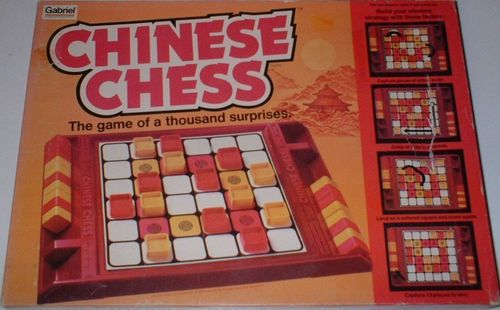
Chinese Chess
Chinese Chess Rulebook
Table of Contents
Table of Contents
Object of the Game
To capture 13 pieces of any colour or combination of colours.
How to Play
1. Set up the board
Place YELLOW and RED playing pieces on the board according to diagram. See Illustration A.
Illustration A: Setting up the board. The 6 x 6 board is set up as follows (Y = YELLOW piece, R = RED piece, . = empty space; rows listed top to bottom):
Y Y Y Y Y Y
R R R R R R
Y Y . . Y Y
R R . . R R
Y Y Y Y Y Y
R R R R R R
The printed diagram marks each player's side with a "PLAYER" label at the top and bottom of the board.
2. Choose your tactics
Decide who goes first, then decide who will jump same-coloured pieces and who will jump different-coloured pieces. You may move a piece of either colour at any time, regardless of which tactics you choose. You may only jump horizontally or vertically – diagonal jumping is not allowed. When you jump a piece, you must remove that piece from the board.
Same-coloured player
You must jump the same-coloured pieces (RED over RED or YELLOW over YELLOW). See Illustration B.
Illustration B: Jumping strategy for a same-coloured player. Here RED jumps RED. (Likewise, YELLOW can jump YELLOW.)
Different-coloured player
You must jump the different-coloured pieces (RED over YELLOW or YELLOW over RED). See Illustration B1.
Illustration B1: Jumping strategy for a different-coloured player. Here RED jumps YELLOW. (Likewise, YELLOW can jump RED.)
3. It pays to jump to a coloured square
Same-coloured player
When the player moving the same-coloured pieces jumps to a same-coloured space (RED on a RED space or YELLOW on a YELLOW space), that player can take another turn. See Illustration C.
Illustration C: Same-coloured player's strategy. YELLOW jumps YELLOW, captures the piece and lands on a YELLOW square. The same-coloured player gets another turn.
Different-coloured player
When the player moving different-coloured pieces jumps to a different-coloured space (RED on a YELLOW space or YELLOW on a RED space), that player can take another turn. See Illustration C1.
Illustration C1: Different-coloured player's strategy. YELLOW jumps RED, captures the piece and lands on a RED square. The different-coloured player gets another turn.
4. Making multiple jumps
A player choosing to jump may make more than one jump in one turn. You capture more pieces by making multiple jumps and sometimes can get an extra turn. Remember: you may only jump horizontally or vertically.
Same-coloured player
Look at Illustration D to see how to make multiple jumps.
Illustration D: Multiple jump for a same-coloured player. In one move YELLOW jumps horizontally, jumps another YELLOW vertically and a third YELLOW horizontally, capturing 3 pieces in one move. That player does not get another turn.
Different-coloured player
Look at Illustration D1 to see how to make multiple jumps.
Illustration D1: Multiple jump for a different-coloured player. In one move YELLOW jumps RED horizontally, jumps another RED vertically and a third RED horizontally, capturing 3 pieces in one move. That player does not get another turn.
5. If you can't jump, slide!
If there isn't a jump available to you or you don't want to jump for strategic reasons, you can slide – that is, move any piece horizontally or vertically in one direction, any number of free spaces. See Illustration E.
Illustration E: You may slide... Either player moving this YELLOW piece may slide in the direction of the arrow.
6. Don't shift the last piece moved by your opponent
You cannot play that piece, but you can jump and capture it. See Illustration F.
Illustration F: YELLOW was the last piece moved by a same-coloured player. The different-coloured player may not move the YELLOW piece.
But the different-coloured player may jump and capture the YELLOW piece!
Storing Pieces and Winning
Store your pieces in the long well on your side of the board. The long well holds 13 pieces – when you're the first to fill it, you're the winner!