Chinese Checkers
Chinese Checkers Rulebook
Table of Contents
Table of Contents
Setting Up
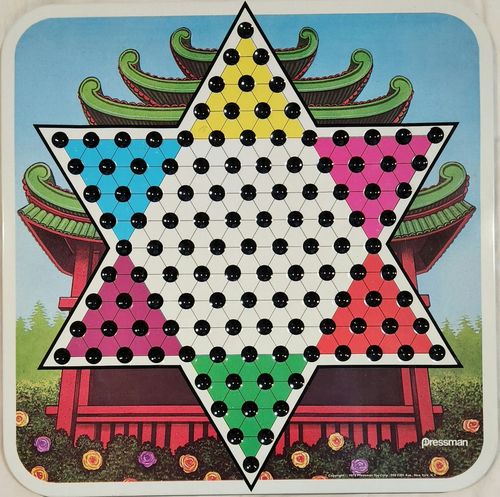
Chinese checkers is largely the same game as halma, but the board is shaped like a 6-pointed star, and the playing spaces are points distributed in a triangular grid pattern, rather than the squares of a grid as in halma.
Pieces for two, three, four or six players are set up around the points of the star.
- Chinese checkers, set out for six players: each player's pieces fill one point of the star.
- When four play, the unused starting points should lie opposite one another.
- When three play, the players' starting points should be evenly spaced around the board.
- Two players should start opposite one another.
Moving the Pieces
The following rules apply as in halma, until otherwise stated.
- Players decide, at random or by agreement, who takes the first turn. Play then moves clockwise around the board.
- A player takes his turn by moving one of his pieces in one of the following ways:
- a piece may be moved to an adjacent point;
- a piece may jump over a single adjacent piece of any colour into the empty point beyond. Further jumps may optionally be made by this piece in the same turn, to whatever number the player pleases, while the piece is in a position to do so.
- Jumping over an opponent's piece does not capture it. All pieces stay on the board throughout the game.
A consequence of using the star-shaped, triangular-grid board is that pieces have only six directions of movement, as opposed to eight in halma.
Ending the Game
- The game is over when a player has moved all of his pieces into his opponent's marked starting positions, at the opposite corner of the board. He is then declared the winner.
Further Information
If readers are interested in learning more about these games, they can consult the following books for further information.
- Botermans, J. et al. The World of Games, pp. 110-111. New York: Facts on File, Inc., 1989.
- Loader, J & Loader, J. Making Board, Peg & Dice Games, pp. 139-141. Lewes: Guild of Master Craftsman Publishers Ltd., 1993.
- Murray, H. J. R. A History of Board Games Other than Chess, pp. 51-52. Oxford: Oxford University Press, 1952.
- Parlett, D. The Oxford History of Board Games, pp. 133-134 & 135-136. Oxford: Oxford University Press, 1999.
Copyright © Damian Walker 2011 - http://boardgames.cyningstan.org.uk/