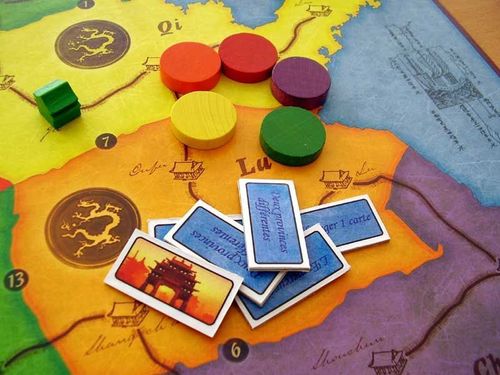
China: Das Duell
China: Das Duell Rulebook
Table of Contents
Table of Contents
Contents
The different game components must be carefully punched out before the first game.
- 5 influence cards, one per province colour.
- 6 special cards (one side in English, one side in French).
Setup
The setup is identical to that of the normal 3-player game, with the following exceptions:
- Place the pieces of the third colour beside the game board. This colour belongs to the Emperor. The Emperor is controlled by each player in turn. The Emperor's score marker is not used.
- Place 3 cards for the Emperor face up beside the board.
- Keep the 5 influence cards within easy reach.
- Each player receives a set of 3 special cards, which they place face up in front of them.
Course of Play
The course of play is identical to that of the normal 3-player game, with the following exceptions:
-
When a player has placed a piece, they do not discard the card they played. Instead they keep it face up in front of them. If they have placed two pieces, they
(Note: the printed sentence ends here in the source. The French sheet is cut off mid-sentence on the printed page and the rest of the instruction is not given. It is transcribed as printed and not completed.)
-
Each time a player places a card in front of them, count the cards of the played colour revealed by both players. If the kept card is the first card of that colour, the player receives the corresponding influence card and places it in front of them. If it is not the first card of that colour, and the player has at least as many cards of that colour in front of them as their opponent, they take the corresponding influence card from their opponent, if they do not already have it, and place it in front of them. Influence cards therefore pass from one player to the other throughout the game.
-
After their normal turn, the player takes control of the Emperor. Using the Emperor's cards, they may place one Emperor piece (palace or emissary) on the board under the normal rules. They then refill the Emperor's cards to 3 from the face-down draw pile. The Emperor may settle in an unoccupied province only if it cannot do otherwise.
Scoring
The intermediate and final scoring rules are identical to those of the normal 3-player game, with the following exceptions:
- When scoring palaces, the player who holds the influence card of the colour of the province being scored also scores the Emperor's points, in addition to their own points.
- When scoring emissaries and palace chains, the Emperor's points are not awarded.
Example: In the province of Chu, Archibald has 5 palaces and the purple influence card. Barnabé has 1 palace, and the Emperor has 2. Archibald therefore scores 8 points (for his palaces) + 5 points (for the Emperor's palaces), a total of 13 points. Barnabé scores only 2 points for his palaces.
Special Cards
Each card may be used only once per game.
- The Emperor places first: The player may play the Emperor before their turn.
- 2 different provinces: The player may play in two different provinces this turn.
- Exchange 1 card: The player may exchange one card from their hand with one of the 2 face-up cards on top of the draw pile. The Emperor's cards may not be exchanged.
Variant
For a lighter version of these two-player rules, play without the influence cards. Palace points are then scored normally. The Emperor's points are awarded to no one.
Tile Sheet Labels
The tile sheets (pages 6 and 7 of the source) carry these bilingual special-card labels, English first, then French:
- "The emperor places first" / "L'empereur joue en premier"
- "2 different regions possible" / "2 provinces différentes"
- "Change card" / "Échanger une carte"
The tile sheets also carry five unlabelled dragon tokens in purple, yellow, green, orange and red, and several unlabelled sunset-gate tiles. These have no printed text and are not described by the rules sheet.