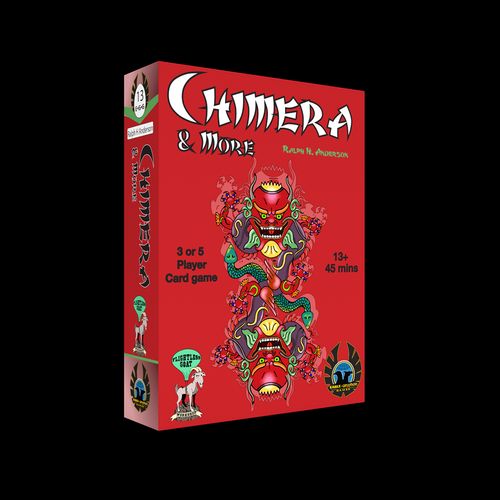
Chimera & More
Chimera & More Rulebook
Table of Contents
Table of Contents
Components
Chimera uses a 54-card deck:
- 4 cards each of ranks 1 through 12 and H
Chimera for 5 uses a 90-card deck:
- 6 cards each of ranks 0 through 12 and H
Rank 2 cards depict a "Fortune Toad" and are worth +10 points each.
Rank 11 cards depict a "Prosperity Cat" and are worth +5 points each.
Hunters (H), count higher than the ranked cards but have no rank and therefore cannot be used in creating any kind of sequence.
Although suits are depicted for color and remembrance, they have no effect on game play.
- 1 Pi Ya card, which outranks all other single cards except the Chimera and can optionally be used to substitute for any ranked card 1-12 to assist in making a sequence - as indicated around the P in the corner.
- 1 Chimera card, which outranks all single cards.
- 4 Messenger Bird cards marked Q (Qingniao) with special abilities.
The Qingniao (KING-neow) were Blue or Green Birds that appear in Chinese mythology, popular stories, poetry, and religion. Qingniao are especially regarded as the messengers or as otherwise serving the Queen Mother of the West Xi Wangmu.
Preparation & The Deal
Prepare the Deck
- Any player may shuffle and deal each hand.
- The dealer shuffles the cards and then presents them to another player to cut near the middle of the deck. The cut must be at least 15 cards.
- The cut is made towards the dealer to create a new stack.
- After the cut, the dealer takes the top card from the bottom half of the cut (the stack further from the dealer) and places it face up on the new stack created. The dealer then completes the cut by placing the bottom half of the cut deck on top of the face up card.
Deal the Cards
- Place the four Messenger Birds (Q) in the Chimera's Den in the middle of the table. These cards are the same on both sides to make them easy to find.
- Deal a packet of 3 cards to the Chimera's Den. Deal a second packet of 3 cards to the Chimera's Den.
- Deal the remaining cards out to the players:
- 17 cards to each player for 3-Player.
- 16 cards to each player for 5-Player.
The Bid
After picking up and looking at their cards, players will BID to determine who will be the Chimera. The Chimera will play first in the hand and stands to win points by getting rid of all of their cards first. In addition, the Chimera has a chance for additional bonus points. The Hunters will gain points if any one of them plays all their cards before the Chimera.
- The player who receives the face up card during the deal will begin the Bid.
- In clockwise order, players may pass or bid.
- Legal Bids are Pass, 20, 30 or 40 for 3-player or Pass, 30, 50, or 70 for 5-player.
- Players may choose to play 0 - 3 cards face up on the table (see Partnerships below).
- The bidding can start at any of these bid options. For example, a player may want to preemptively bid the maximum, 40 or 70.
- Each Bid must be higher than the last Bid.
- Players may re-enter the bidding after passing.
- Bidding continues until a player bids 40 or 70; or, there are consecutive passes back to the last player to bid.
- If all players pass without any bid, the player who passed first becomes the Chimera with a Bid of 20 or 30. In this special case, the Chimera will get triple the Bid if successful in going out first and no penalty if not. In addition, no cards will be passed and the Chimera will not have a partner and the Chimera will look at both 3-card packets in the Chimera's Den and choose 1 and discard the other.
- The player winning the bid now becomes the Chimera and the bid is recorded on the score pad.
Deciding the Partnerships
3-Player Chimera: Chimera vs. Hunters
- The Chimera in 3-player will play alone against the other two players who now form a partnership as the Hunters. The Chimera will not pass or discard any cards.
Card Passing between Partners 3-Player
The Hunters now simultaneously pass cards to one another face down:
- 0 for a 20 bid
- 1 for a 30 bid
- 2 for a 40 bid
5-Player Chimera: Chimera & Pi Ya vs. Hunters
- The Bid process and passing of cards is changed and expanded in the 5-player game. As part of their Bid, all players may choose to play 0 - 3 cards face up on the table. These cards will serve two purposes. They will help the eventual Chimera choose a partner; and, they will provide the cards available for passing between partnerships before play of the hand begins.
- Beginning with the first bidder, each player may play up to 3 cards face up in front of themselves during their chance to bid.
- Bidding proceeds as normal with this addition until the Chimera is determined. Then each player will have a last chance to play up to 3 cards if they have not done so already.
- If a player preemptively ends the bidding to become Chimera, this is their last chance to play these cards.
- Once all players have completed playing cards face up, the Chimera selects another player as his partner, the Pi Ya, and the remaining players form a partnership as the Hunters.
If all players pass without any bid, the player who passed first becomes the Chimera with a Bid of 30 and the Chimera will get triple the Bid if successful in going out first and no penalty if not. In addition, no cards will be passed and the Chimera will not have a partner. The Chimera may look at both packets of 3 cards and choose 1 pack of 3 and discard the rest.
- The Chimera may also choose to play alone. In this case there is only the partnership of the four remaining players who will play as Hunters. In this case the Chimera also does not play any cards face up. The partners will still pass cards as normal.
Card Passing between Partnerships 5-Player
- The number of cards passed in a partnership is the least number of cards placed face up by a player in that partnership.
- The Chimera and Pi Ya pass an equal number of their face up cards and pick up any remainder back into their hand. The player with more cards face up decides which to pass and which to pick up.
- The Hunters pass an equal number of their face up cards clockwise and pick up any remainder back into their hand. The player(s) with more cards face up decide which of their cards to pass and which to pick up.
The Chimera's Den
- The Chimera adds the 3 face down cards in the Chimera's Den to his hand. This will bring the Chimera's hand size to 20.
- The Chimera takes the 2 groups of 3 face down cards and looks at them without mixing them and decides which group of 3 cards to keep and which group of 3 cards to give to the Pi Ya (partner). This will bring the Chimera and Pi Ya to a total of 19 cards each.
- Each of the Hunters and the Pi Ya take one of the face up Messenger Birds (Q cards) into their hands. This will bring each of the Hunters' hand size to a total of 17. The Pi Ya will now have 20 cards.
Play of the Hand
Players are attempting to play out all of their cards in their hand first.
The Chimera begins the round of play for the hand by playing one or more cards to the table corresponding to one of the legal card combinations (see Legal Card Combinations). This is called leading the trick.
In clockwise order, players may either play to the trick or pass.
-
Subsequent plays to the trick must match the combination led and must be higher in value with the values ranging from 1 - 12, then Hunter, Pi Ya, and Chimera at the top. In 5-player the lowest value is 0 instead of 1.
For example if a 3 is led, the only legal play is a single card higher than 3. If pairs are led, the only legal play is higher ranked pairs, and so on.
Exception: Players may always choose to play a TRAP or a CHIMERA FLIGHT instead of the led combination.
3 Player TRAPS: Four-of-a-Kind. 5 Player TRAPS: Five-of-a-Kind, or Six-of-a-Kind - no Q cards.
- If a Trap is played, now only a Trap of a higher rank or a Chimera Flight can be played. A Chimera Flight is the highest possible play in a trick.
- Traps and the Chimera Flight MAY NOT be played out of turn in 3-Player.
- Traps and the Chimera Flight MAY be played at any time in 5-Player. Players may NOT play a trap on a Messenger Bird (Q) that is played to change the lead.
- Players may pass even if they have a legal play and players who pass may re-enter play before their next opportunity.
- Play continues to the trick until all consecutive players pass around to the last player who played to the trick.
- The player who plays the last cards to the trick wins all the played cards. Players place tricks they have won into a face down pile in front of themselves as Treasure and then lead to the next trick for the hand.
- Any Treasure cards (Fortune Toads, Prosperity Cats or Messenger Birds (Q cards)) taken will be scored at the end of the hand.
End of Hand
3-Player Game
- The hand is over immediately as soon as any player plays their last card(s).
- This player takes all the cards played to this last trick.
- The hand is now scored. Any cards remaining in other players' hands are not counted.
5-Player Game
If the Pi Ya or one of the Hunters plays their last card(s) first:
- This player takes all the cards played to this last trick.
- The Chimera has lost their bid.
- The hand is now scored. Any cards remaining in other players' hands are not counted.
If the Chimera plays their last card(s) first:
- The Chimera has won their bid.
- Play of the hand continues with the next player in clockwise order.
- If everyone passes, the Chimera takes the trick and play continues with the next player in clockwise order leading the trick. Otherwise, play continues normally.
- Normal play continues until the next person plays their last card(s).
- This player takes all the cards played to this last trick.
- The hand is now scored. Any cards remaining in other players' hands are not counted.
Scoring the Hand
If the Chimera played all of their cards first:
- The Chimera will score double the value of the bid for the hand and the Pi Ya will score the value of the Bid. Exception: In an all players pass Bid hand, the Chimera will score triple the bid and there will be no Pi Ya.
- The Chimera also scores Bonuses for the following:
- 25 Points for each Trap played by any player
- 25 points for the Chimera Flight if played by any player
- 25 points for if one or more Hunters did not play any cards during the hand. Do not score for Hunters playing no cards in 5-player Chimera.
- If the Pi Ya is the next to play all of their cards after the Chimera has gone out, the Pi Ya scores the value of the Bid again. In other words, the Pi Ya score now matches the Chimera score for the Bid.
- All players score any Treasure cards in their Treasure pile for the hand.
If one of the Hunters or the Pi Ya goes out first:
- All Hunters score 20 or 30 points for defeating the Chimera.
- The Chimera loses points equal to the Bid and does not score ANY bonus points.
- All players score any Treasure cards in their Treasure pile for the hand.
- The Pi Ya scores no points for the Bid.
Remember that unplayed Treasure cards do not count when scoring a hand. Only Treasure cards in players' Treasure piles are scored.
Treasure Card Summary
Card Rank 2 Fortune Toads — 10 points each as indicated in the center of the lotus flower and the bottom of the card index on the side. 60 Points total.
Card Rank 11 Prosperity Cats — 5 points each as indicated on the medallion on the neck and the bottom of the card index on the side. 30 Points total.
Messenger Birds (Q Cards) — 10 points each as indicated in the center of the cherry blossom and the bottom of the card index on the side. 40 points total.
Examples of Scoring
3-Player Game
The Bid is 20, the Chimera goes out first, one Trap was played and one of the Hunters played no cards.
- The Chimera scores: 40 (for 2 x his Bid of 20) + 25 (for 1 Trap bonus) + 25 (for the no cards played bonus) for a total of 90 points.
- In addition, each player scores points for any Treasure cards they won in a trick this hand.
The Bid is 40, one of the Hunters goes out first and the Chimera Flight was played.
- The Chimera gets -40 points (for his missed Bid) and no bonus.
- The Hunters each score +20 points (for defeating the Chimera).
- In addition, each player scores points for any Treasure cards they won in a trick this hand.
5-Player Game
The Bid is 50, the Chimera goes out first, the Pi Ya goes out second and two Traps were played and two of the Hunters played no cards.
- The Chimera scores: 100 (for 2 x his Bid of 50) + 50 (for 2 Trap bonuses) + NO BONUS (for at least one Hunter playing no cards) for a total of 150 points.
- The Pi Ya Scores 50 for the Chimera going out first and another 50 for going out second.
- In addition, each player scores points for any Treasure cards they won in a trick this hand.
The Bid is 70, one of the Hunters or the Pi Ya goes out first and the Chimera Flight was played.
- The Chimera gets -70 points (for his missed Bid) and does not score any Bonus points.
- The Pi Ya scores no points for the Bid.
- The Hunters each score +30 points for defeating the Chimera.
- In addition, each player scores points for any Treasure cards they won in a trick this hand.
Winning the Game
Play continues until at least one player has scored 400 or more points. The player with the highest score is the winner.
If there is a tie for highest score, play continues until there is a single highest score. This means untied players with a lower score could still win!
If desired, players may change the Score Limit for a longer or shorter game. Recommended Score Limits are 300, 400, or 500 points.
Designer Notes
Chimera was inspired by the extremely popular Chinese gambling card game Dou Di Zhu (AKA Beat the Landlord) and Big Two; and, by Tichu, a popular European card game also based on these same Chinese games.
The art for the game was drawn from Chinese symbolism and mythology. The Chimera and the Pi Ya cards are amalgams of several popular Chinese mythological creatures similar to the western world's Chimera. The Fortune Toads and Prosperity Cats should be familiar to many people as well known Chinese symbols of wealth and prosperity. The Hunters and the Qingniao Messenger Birds come directly from Chinese history and legend.
My personal challenge was to create a 3-player card game, and later, a 5-player version of the card game, that provides the depth of strategy and competitive play of Tichu, a 4-player partnership card game. I hope you enjoy the result!
Legal Combinations
General Notes
- Suits do not matter. They are included to provide variety and to assist in remembering cards played.
- The Chimera Hunters (H) are regarded as higher than any of the ranked cards 0 – 12. However, since they have no actual rank, they cannot be used in any type of sequence.
- The Pi Ya and Chimera together are the Chimera Flight that can be played to win any trick. They can only be played together for this purpose.
- Traps and the Chimera Flight MAY NOT be played out of turn. Traps and the Chimera Flight MAY be played out of turn in 5-player.
- Q Cards may be used to substitute for any Ranked card (0-12) to make any legal combination including playing it as a single card. It can also be used to make 4, 5, and 6 of a kind.
- Alternatively, Q Cards can be used to pass the lead to any other player. The player who played the Q card retains the card in his Treasure pile.
SINGLE CARD
- Cards ranked from low to high: 0, 1, 2, 3, 4, 5, 6, 7, 8, 9, 10, 11, 12, Hunter, Pi Ya, Chimera.
PAIR
- Two cards of the same rank.
- From 0 (low) to 12 (high) topped by Hunters: 9-9 is higher than 4-4. H-H is the highest pair.
SEQUENCE OF PAIRS
- Two or more pairs of consecutive ranks. This is a change for Chimera for 3-players.
- From 0 to 12. Hunters, Pi Ya and Chimera cannot be used.
TRIPS
- Three cards of the same rank.
- From 0 (low) to 12 (high) topped by Hunters: 11-11-11 is higher than 7-7-7. H-H-H is the highest Triplet.
SEQUENCE OF TRIPS
- Two or more triplets of consecutive ranks.
- From 0 up to 12. Hunters, Pi Ya and Chimera cannot be used.
TRIPS WITH AN ATTACHED CARD
- A triplet with any single card added.
- Rank is determined by the rank of the triplet: 7-7-7-5 in higher than 5-5-5-12.
TRIPS WITH AN ATTACHED PAIR
- A triplet with a pair added.
- Rank is determined by the rank of the triplet. 9-9-9-11-11 beats 5-5-5-12-12. Pi Ya and Chimera cannot be used as an attached pair.
SEQUENCE OF TRIPS WITH ATTACHED CARDS
- Two or more triplets of consecutive ranks each with a single attached card.
- Only the triplets have to be in sequence.
- The attached cards must be different from the triplets and from each other.
- Trips of Hunters cannot be included; however, a single Hunter, the Pi Ya or Chimera may be used as a single card but not both.
SEQUENCE OF TRIPS WITH ATTACHED PAIRS
- An extra pair is attached to each triplet.
- Only the triplets have to be in sequence.
- The attached pairs must be different in rank from each other. Hunters can be attached as a pair, but cannot be used as triplets. Pi Ya and Chimera may not be used.
FOUR, FIVE, & SIX OF A KIND
- Four, Five, of Six cards of the same rank. NOTE: 5 and 6 of a Kind can only be made using a Messenger Bird (Q) as natural sets are Traps.
- From 0 (low) to 12 (high) topped by Hunters. For four of a kind: 8-8-8-8 is higher than 3-3-3-3 and similarly for five and six of a kind. Hunters are the highest in each set.
SEQUENCE OF 5 OR MORE
- At least five cards of consecutive rank from 0 up to 12.
- You may play Sequences of 5 to 13 cards.
- Hunters and Chimera cannot be used in a sequence.
- SPECIAL POWER: The Pi Ya can be used as a wild card to fill in one rank for a legal Sequence (0 through 12), for example, 8-9-10-Pi Ya-12; or, 8-9-10-11-Pi-Ya.
QUADRO-PLEX WITH ATTACHED CARDS
- Four of a Kind with two single cards of different ranks attached.
- The four of a kind determines the rank. Hunters may be used as the four of a kind. Hunter, Pi Ya and Chimera can be attached, but you cannot use both the Pi Ya and Chimera in one Quad as attached cards.
QUADRO-PLEX WITH ATTACHED PAIRS
- Four of a Kind with two pairs of different ranks attached.
- The four of a kind determines the rank.
- Hunters can be used (all four as a Quad or two as one of the attached pairs).
QUINTO-PLEX WITH ATTACHED CARDS
- Five of a Kind with two single cards of different ranks attached.
- The five of a kind determines the rank. Hunters may be used as the five of a kind.
- Hunter, Pi Ya and Chimera can be attached, but you cannot use both the Pi Ya and Chimera in one Quinto-plex as attached cards.
QUINTO-PLEX WITH ATTACHED PAIRS
- Five of a Kind with two pairs of different ranks attached.
- The five of a kind determines the rank.
- Hunters can be used (all five as a Quinto or two as one of the attached pairs).
SEXTO-PLEX WITH ATTACHED CARDS
- Six of a Kind with two single cards of different ranks attached.
- The six of a kind determines the rank. Hunters may be used as the six of a kind.
- Hunter, Pi Ya and Chimera can be attached, but you cannot use both the Pi Ya and Chimera in one Sexto-plex as attached cards.
SEXTO-PLEX WITH ATTACHED PAIRS
- Six of a Kind with two pairs of different ranks attached.
- The six of a kind determines the rank.
- Hunters can be used (all six as a Sexto or two as one of the attached pairs).
Quadro-, Quinto- and Sexto-plexes with Attached Cards or Pairs are not Traps and can be beaten by any Trap or the Chimera Flight.
TRAP 3-player: 4-of-a-kind. TRAP 5-player: 5-of-a-kind or 6-of-a-kind. Four of a Kind is NOT a trap in 5-player.
- All natural with no Q cards.
Traps can be played on any combination except the Chimera Flight. Traps may be beaten by Traps that are higher ranked or by traps that have more-of-a-kind. Example: H-H-H-H-H beats 12-12-12-12, but 12-12-12-12-12-12 beats H-H-H-H-H.
CHIMERA FLIGHT
- The Chimera and the Pi Ya played together.
- A Chimera Flight can be played on any combination and beats everything. Both Traps and the Chimera Flight MAY NOT be played out of turn. In 5-player Chimera both Traps and the Chimera Flight MAY be played out of turn.
MESSENGER BIRDS
- A Q Card may be used to pass the lead to another player of their choice by a player with the lead. The player who passed the lead places the used Q Card in their pile of taken tricks and the chosen player makes the next lead.
- Q Cards may be used as attachments.
- Q Cards may be used as a Wild Card in a legal combination as any Ranked Card.
- Q Cards may not be used as a Hunter, Pi Ya or Chimera.
- Q Cards may be used to make pairs, three of a kind and four of a kind.
- Q Cards may be used to fill in a missing card to make a legal straight - in the middle or either end of the straight. A straight can only include cards from 0 to 12.
- Q Cards may NOT be used to make a TRAP. (See Traps above for more information)
- Q Cards will each count for 10 points for any player that has them in their Treasure pile.
- A Q Card may be added to the Chimera Flight.