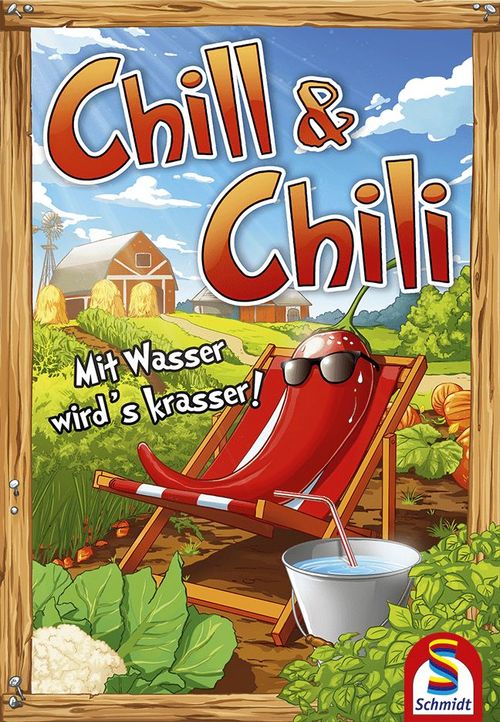
Chill & Chili
Chill & Chili Rulebook
Table of Contents
Table of Contents
Components
- 1 pond board (Teichtableau)
- 1 market board (Markttableau)
- 1 price strip (Preisstreifen)
- 1 well (Brunnen)
- 120 water/coin chips (Wasser-/Münzchips)
- 110 cards
- 90 vegetable cards (18x Corn, 17x Carrot, 15x Tomato, 14x Cauliflower, 14x Pumpkin, 12x Chili)
- 20 accessory cards (5 each of Fertilizer, Watering Can, Wheelbarrow, Scarecrow)
Setup
The player who most recently planted something becomes the starting player. They place the pond board on the box insert and the market board next to the box. They shuffle all vegetable cards thoroughly and deal 5 cards face down to each player. Then they lay out two rows of 4 face-up cards each on the market board (see illustration). The remaining cards are placed as a face-down draw pile on the corresponding space of the market board.
The price strip is placed between the two rows of cards so that the group of 4 coins shown is directly next to the market. The well is placed at the end of the two rows of cards. The accessory cards are sorted into 4 stacks behind the well.
Each player takes 4 chips and places them in front of them with the coin side facing up. With fewer than 5 players, a different number of chips is removed* and returned to the box. All remaining chips (with 5 players, all of them) are placed on the pond board with the water side facing up.
* 2 players: remove 60 chips 3 players: remove 40 chips 4 players: remove 20 chips
Game Flow
A player's turn always begins with pushing one water chip from the pond board into the pond. Because this step is easy to forget, one player is designated at the start of the game as the Gardener, to remind the other players (and themselves) of this first step of the turn whenever necessary.
The player must then choose exactly one of the following 3 actions:
- A Buy a card
- B Plant vegetables or lay out an accessory
- C Take chips from the pond
After a player has performed an action, the next player clockwise takes their turn. That player also begins their turn by first pushing 1 water chip into the pond.
A) Buy a Card
The player must decide whether to acquire 1 accessory card or 1 vegetable card. If they choose an accessory card, they must throw the amount of coin chips shown on the card into the well. They take the accessory card into their hand. Players may own each accessory only once.
Example: Nina buys a Watering Can, which she takes into her hand. She throws 1 coin into the well for it.
If the player chooses a vegetable card, they may either take the top card of the draw pile for free, or buy one of the face-up vegetable cards. For this they must throw 1, 2, 3 or 4 coins into the well, depending on the card's position (see illustration). The prices are printed under the four positions from left to right as 4, 3, 2, 1, so the leftmost card costs 4 coins and the rightmost card costs 1. They then take the acquired card into their hand. A gap created by a purchase is filled immediately: the more expensive cards move to the right (and thus become cheaper), and a new card is revealed from the draw pile in the most expensive position.
Example: Marie buys the tomatoes. She throws 2 coins into the well and takes the card into her hand for it. The carrot and the cauliflower are shifted to the right, and a new card is placed on the empty space directly next to the market board.
The hand limit is 7 cards. If a player would draw an 8th card, they must immediately place one of their cards on the discard pile (Compost) to get back within the limit.
When the draw pile is used up, the compost pile is shuffled and laid out as the new draw pile.
B) Plant Vegetables or Lay Out an Accessory
The player may either:
- plant one vegetable variety, or
- lay out one accessory card in front of them.
Planting a Vegetable Variety
To plant a vegetable variety, a certain number of cards of that variety is required, depending on the variety. All of them must be laid out at once. The number of leaves in the upper right or left corner of each vegetable card shows how many cards of the corresponding vegetable are needed. Tomato, Carrot and Corn each require exactly 2 cards, and Cauliflower and Chili each require exactly 3 cards.
This number must be followed exactly. Laying out more or fewer cards is not allowed, even if the player holds more cards of that variety in hand. However, it is perfectly possible to plant the same vegetable variety in another bed in later rounds.
The laid-out cards are stacked on top of each other so that the suns on the cards can be seen, but only the victory points of the top card are visible. These 2- or 3-card stacks are called beds. At the end of the game, all cards in a bed together score the victory points shown on the top card. For example, 2 carrot cards score 4 victory points at the end of the game.
The pumpkin is a small special case. No fixed number of cards is specified for it. A player may plant 1–5 pumpkin cards together in one bed. For pumpkins, too, the bed is complete after it has been laid out/planted, and no further pumpkin cards may be added to that bed. However, it is perfectly allowed to lay out further pumpkin beds in later rounds. These new beds may also contain a different number of pumpkin cards.
All cards of one vegetable variety always show the same victory points, but they differ slightly in the number of suns and therefore in their water requirement (exception: pumpkin). Cards with fewer suns are more lucrative, because they need less water to produce double victory points (see below).
The following basic rules must be observed:
- Each player may plant any number of beds (including beds of the same vegetable variety).
- In one turn, only one vegetable variety may be planted, with exactly the required number of cards, in one bed.
- A bed may contain cards with different numbers of suns.
- A bed is planted with only one vegetable variety.
- A bed is complete once it has been laid out and cannot be extended later.
Laying Out an Accessory Card
An accessory card in front of its owner provides lasting advantages until the end of the game. The following cards exist:
Fertilizer Whenever the player plants vegetables, they immediately receive the top card of the draw pile for free.
Wheelbarrow Whenever the player plants vegetables, they immediately receive 2 chips from the well. They may choose whether to take the two chips as money or as water drops (see below).
Watering Can Whenever the player takes chips from the pond, they immediately receive 2 additional chips from the well. They may choose whether to take the two chips as money or as water drops (see below).
Scarecrow At the start of their turn, after they have pushed a chip into the pond, the player may take the top card of the draw pile into their hand. Afterwards, however, they must place one card from their hand on the compost. This action does not replace the player's normal turn; instead, the player then takes their normal turn as usual.
C) Take Chips from the Pond
The player takes half (rounded up) of all chips located in the pond. They must then decide whether to use these chips as money or as water.
Money If the player decides on money, they turn all chips so that the coin side faces up and place them in front of them. Chips placed as coins can only be used for paying. They may not later be converted into water.
Water If the player decides on water, they turn all chips so that they show a water drop. They must immediately water their beds with them. The water drops are placed on the suns of the vegetable cards. There is exactly room for one water drop on each sun. The water drops may be distributed freely across different beds, and no bed has to be fully supplied with water drops immediately. In later rounds, water drops may be placed on all suns that are still free. If all suns on all cards are covered, the surplus water drops go into the well. A bed that is completely supplied with water drops scores double victory points at the end of the game. If even one water drop is missing, only the printed, single victory points are scored.
Once again: the chips taken cannot be split between water drops and money. The player must always choose one of the two options.
Example: 11 chips lie in the pond. Nina begrudges the next player the many chips. In addition, she wants to have both of her beds fully watered. She therefore decides to take 6 chips, rounded up. With 1 water drop she covers the last sun on her tomato bed (now worth 10 instead of 5 points at the end of the game) and places 3 more water drops on her carrot bed (now worth 8 instead of 4 points at the end of the game). 2 water drops remain, which she throws into the well. She cannot place the two chips as coins. Alternatively, she could have taken all 6 chips as coins.
Fresh Vegetables
At the start of their turn, a player always has the option of getting fresh vegetables. They may do this once, in addition to their turn. They pay 1 coin, which they throw into the well, and remove the 4 vegetable cards of one row at the market. The cards go onto the compost pile. Then, starting at the market board, they lay out 4 new cards from the draw pile and then carry out their actual turn.
End of Game
When the last chip is pushed into the pond, the game ends as soon as the current player has finished their turn. Each player now counts their points as follows:
- Each bed on which at least 1 sun is still visible scores the basic value of the top card.
- Each bed that is fully supplied with water drops (all suns covered) scores double the value.
- 1 card in hand scores 1 point.
- 3 coins score 1 point.
The player with the most points wins. If there is a tie, the player among them who has planted more beds wins. If there is still no clear winner, there are several winners.