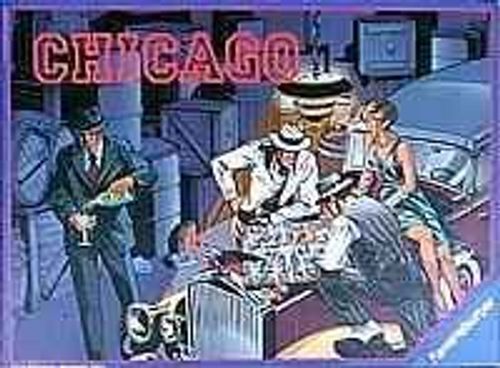
Chicago
Chicago Rulebook
Table of Contents
Table of Contents
Setup
Open the game board in the middle of the table. In each corner of the board is a gray field with a colored mark and a colored arrow of the same color. This field is the player's home bar.
Nominate a player to be banker. He administers money and the rings. At the start of the game he distributes the following to each player:
- 20 thugs to each player.
- 20 chips of the appropriate color.
- 4 rings.
- 125,000 Ft.
Each player puts the 4 rings on some of his game figures.
Place the white round marker on the start of the round chart.
The black move marker goes on field 0 of the gang marker.
The 4 fight dice and movement dice go beside the game board.
Game Board
The board shows a map with streets and buildings. Each quarter has the same layout, with the central place in the middle of the board.
Bars and Casinos: Each bar is a space. Each quarter has a casino and 22 bars of different values. The casino always has a value of 20,000 Ft; the bars have values of from 1,000 to 5,000 Ft.
In each quarter, there is:
- 1 casino worth 20,000,
- 8 bars worth 1,000,
- 6 bars worth 2,000,
- 3 bars worth 3,000,
- 2 bars worth 2,000,
- 3 bars worth 5,000.
A quarter has an overall value of 72,000 Ft.
Note: as printed, the listed buildings of a quarter add up to 68,000 Ft (1 casino at 20,000, 8 bars at 1,000, 6 bars at 2,000, 3 bars at 3,000, 2 bars at 2,000 and 3 bars at 5,000 is 68,000, with 22 bars in total), not the stated 72,000 Ft. The source does not resolve this; the stated figure and the building list are both reproduced as printed.
The entrances are marked with a black arrow. The casinos and bars in the middle all have two entrances. The rest have only one entrance.
The player may exit from a different place than that which they entered.
Each building also has a spot for a colored marker. If there is no marker, the place is unowned. If there is a marker, then that color player owns the bar.
The Streets: Streets are divided into game spaces. On 8 fields at the edge of the board, two arrows are printed. If someone leaves the edge of the board, they may enter from any other edge with two black arrows.
On the four sides of the game board is a chart for handling game turn phases. Then there is a chart for movement points. It goes from 0 to 22. The little black marker on this lets players keep track of how many movement points they have left in their turn.
Game Turns and Phases
A whole game of Chicago runs at most 4 phases (a-d). In each phase, there are 6 rounds.
In phase A, the yellow player begins his turn first. In phase B, the red player goes first. The start player has the job of advancing the game phase marker.
Before the first round of each phase, and before the start of the game, a player can buy extra rings.
Thugs
Values of the thugs: A thug consists of one pawn and at least one ring. A pawn without a ring is worthless and may not be placed on the board. A thug may have four steps of strength and value:
- A 4 ring thug is worth 50,000.
- A 3 ring thug is worth 40,000.
- A 2 ring thug is worth 25,000.
- A 1 ring thug is worth 10,000.
The game starts with the purchase of the first rings. Each player is the head of a gang. The 20 pawns are potential gang members. Recruiting a gang member happens with the purchase of a ring.
The cost of the rings depends on how many rings one is adding to a pawn:
- To make a 1 ring thug costs 10,000.
- To make a 2 ring thug costs 25,000.
- To make a 3 ring thug costs 40,000.
4 ring thugs may not be bought, but must be upgraded through duels. At the start of the game, each player has a 4 ring thug because of the rings he is given at the start. Each player may buy further rings from the bank. There are two restrictions:
- Each player buys only once at the start of the turn. He may only purchase 1 set of 3 rings for a 3 ring thug.
- 1 and 2 ring purchases must be made in volumes that differ by only one. A player may buy 4 1-ring thugs, and 3 2-ring thugs, or may buy 2 1-ring thugs, and 3 2-ring thugs.
Example: Two rings purchased for 10,000 each may not be built onto a 2-ring thug. Each player may then start the game with a 4 ring figure, a 3 ring figure, and differing numbers of 1 and 2 ring thugs.
Each player may also buy 1 and 2 ring thugs during their turns. But 3 ring thugs may only be purchased at the start of a phase.
Starting the thugs: Each player distributes his thugs around the game board. They may be placed on buildings which are already marked with his color.
If a player has just bought a new thug during the game, he must start them on his home bar.
Note: the source states that if a home bar is occupied by an opponent, it may not be used to bring new thugs into the game (see Occupying Bars and Casinos).
Moving Thugs
On a player's turn, he moves pawns with the 12-sided die. He moves the pawns and then puts the movement marker on the field which he has rolled.
Each marker may be moved in any direction on the board. Movement points may be split between thugs as a player wishes. Each building and street counts as a space.
Thugs who win duels may continue moving after the duel is complete. After a player burns his movement points, it is the next player's turn.
Thugs may not move past a blocking thug. Only while a duel is occurring can two opposing thugs rest on a space.
Occupying Bars and Casinos
A player who enters a foreign empty building takes control. He puts one of his chips on the marker space. A chip which already lies there is returned to the owner.
Note: if a home bar is occupied by an opponent, it may not be used to bring new thugs into the game.
If a player moves into a building with an enemy thug, a duel occurs immediately.
Duels
Each time a thug moves onto a space (whether inside or outside of a building), a duel happens.
Thugs fight with the 4 fight dice:
- 1 ring thugs fight with the 1-6 die.
- 2 ring thugs fight with the 3, 3, 4, 4, 5, 6 die.
- 3 ring thugs fight with the 4, 4, 5, 5, 6, 6 die.
- 4 ring thugs fight with the 5, 5, 5, 6, 6, 6 die.
If a 2-ring and a 4-ring thug are fighting, each gets their appropriate die. Both players throw dice one after the other.
The player who rolls the highest number wins. The winning thug gets a ring. The loser dies and leaves the game. The rings go back to the banker, and the pawn is removed from the game and may not be reused.
On a tie, both thugs lose a ring. Each player then takes a new die corresponding to his new rank, and rolls again. A thug who has lost his last ring dies and leaves the game.
Warning: if a player has lost all of his pawns, then he must skip turns until the end of the game. He might still win if he had lots of money.
The spoils for the winner: The winner gets:
- To remove the loser from the game.
- Increased strength.
- A sum of money equal to the value of the dead thug (as he was at the start of the duel).
End of a Phase
At the end of each set of 6 game turns, a phase ends. All players receive the value of bars and casinos they own. Each player counts the value of their buildings marked with their chips. The player then gets that value in cash.
A player who controls all 8 bars in his home territory of 1,000 value or all 6 bars with 2,000 value receives triple value for them (24,000 for the 1,000 bars, and 36,000 for the 2,000 point bars).
After receiving money, the marker is moved to the next phase section. Players have another chance to buy rings (and may buy one extra 3-ring thug).
Game End
The game ends when a player has achieved one of the goals at the end of a phase. If the game makes it to the end of phase D, and no one has reached a goal, the game ends.
Players receive income from bars and casinos, then the player with the most money wins. The value of thugs is added to cash on hand to determine the winner.
Two-Player Game
With 2 players: each player plays two full gangs. They may not transfer money or rings between their gangs.
Variants
Variant I: Normally, only 1 thug may rest on a space. This variant allows you to leave more than one of your thugs on a space. As well, an attacker may move more than one thug into a space before a duel occurs.
When two groups of thugs are in a building, the attacker first decides which two thugs fight. Once their duel is over, the defender chooses the next two thugs who will fight. This continues until one side is vanquished.
Variant II: Ordinarily, just marking a building is enough to gain income. With this variant, you must actually have a thug present in a casino to receive income from that casino. (Bars still work as normal.)