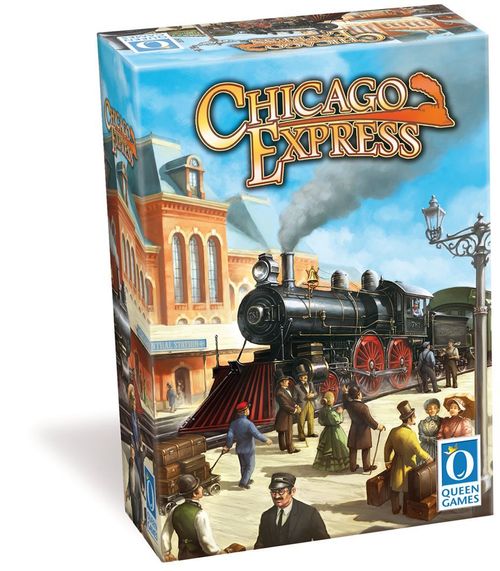
Chicago Express
Chicago Express Rulebook
Table of Contents
Table of Contents
Game Parts
- 1 Game Board
- 1 Railroad Income Display
- 6 tan Display cubes
- 20 purple Development cubes
- 21 red PA cubes
- 3 PA stocks
- 23 blue B&O cubes
- 4 B&O stocks
- 25 green NYC cubes
- 5 NYC stocks
- 27 yellow C&O cubes
- 6 C&O stocks
- 12 black Wabash cubes
- 2 Wabash stocks
- Paper Money (44 x $1, 24 x $5, 24 x $25, 6 x $100)
- These rules
Setting Up
Lay out the Game Board. Place the Railroad Income Display above it. Select one person to be the Banker.
The Banker gives each player their starting money, $120 divided by the number of players.
Put a NYC cube in New York and place a NYC cube on the $8 space on the Railroad Income track. Put the remaining NYC track cubes and the NYC Stocks next to the NYC Treasury, Stock & Track section of the Game Board.
Put a PA cube in Philadelphia and place a PA cube on the $7 space on the Railroad Income track. Put the remaining PA track cubes and the PA Stocks next to the PA Treasury, Stock & Track section of the Game Board.
Put a B&O cube in Baltimore and place a B&O cube on the $6 space on the Railroad Income track. Put the remaining B&O track cubes and the B&O Stocks next to the B&O Treasury, Stock & Track section of the Game Board.
Put a C&O cube in Washington and place a C&O cube on the $5 space on the Railroad Income track. Put the remaining C&O track cubes and the C&O Stocks next to the C&O Treasury, Stock & Track section of the Game Board.
Put the Wabash cubes and the Wabash Stocks next to the Wabash Treasury, Stock & Track section of the Game Board.
On the Industrial City Income Track, put a Tan cube in the "1" box for Detroit, the "3" box for Wheeling and the "4" box for Pittsburgh.
On the Decision Track, put a Tan cube in each of the three "Start" boxes.
Place all 20 purple Development cubes next to the unused Development cubes box on the Game Board.
Initial Auctions
One share of the PA is put up for auction, the Banker starts the bidding. The minimum bid is the PA Railroad's current Dividend, $7. Bidding continues clockwise. If a player passes, they may not re-enter the bidding. If no one bids for a stock during the Initial Auction, the player offering it receives it for free. The money paid for the stock is put in the PA Railroad's Treasury, next to the Game Board.
Next, one share of the B&O is put up for auction, the player who purchased the PA stock starts the bidding. The minimum bid is the railroad's current Dividend, $6. Bidding continues clockwise. If a player passes, they may not re-enter the bidding. The money paid for the stock is put in the B&O Railroad's Treasury, next to the Game Board.
Next, one share of the C&O is put up for auction, the player who purchased the B&O stock starts the bidding. The minimum bid is the railroad's current Dividend, $5. Bidding continues clockwise. If a player passes, they may not re-enter the bidding. The money paid for the stock is put in the C&O Railroad's Treasury, next to the Game Board.
Next, one share of the NYC is put up for auction, the player who purchased the C&O stock starts the bidding. The minimum bid is the railroad's current Dividend, $8. Bidding continues clockwise. If a player passes, they may not re-enter the bidding. The money paid for the stock is put in the NYC Railroad's Treasury, next to the Game Board.
Play begins with the player who purchased the PA share and continues clockwise.
Ending / Winning the Game
The game ends immediately after a General Dividend is paid if any one of four conditions is met:
- 3 or more railroads have built all their track.
- 3 or more railroads have sold all their stock.
- 3 or fewer Development cubes are available.
- Detroit is fully Developed.
The player with the most money wins the game. Ties are possible!
Sequence of Play
During their turn, a player must make an available Decision and slide the Tan cube on that Decision's track to the next box to the right:
- Capitalization
- Development
- Expansion
After the Decision is completed, possible Events may occur:
- Chicago Dividend
- Wabash Opens
- General Dividends
- End of Game
Play continues with the player on the left.
Available Decisions
During their turn, a player must make an available Decision on the Decision track and slide the corresponding cube to the next box to the right. If the Tan cube for that Decision is already in the End box, that Decision is not available.
For Example, if a player chose "Expansion", the player would move the corresponding Tan cube on the Expansion row to the right. If the Tan cube was already in the last rightmost "End" box for Expansion, the "Expansion" decision would be unavailable to that player.
After a Decision is made and implemented (the player may just do nothing after making the Decision), the Decision Tracks are checked. If two of the three Decisions are unavailable (two Tan cubes in the "End" box), General Dividends are paid. Please see the "General Dividends" section.
Expansion
The Expansion Decision allows a player to have a railroad build track. Each railroad has a number of track cubes of its color. Placing a cube in a hex shows that a railroad has built track in that hex. The track built must connect back to that railroad's starting city.
The railroad must pay for the track built with money from its Railroad Treasury. A railroad may build up to 3 tracks during an Expansion. The player making the Expansion Decision must have at least one share of that railroad's stock to have that railroad build track. The player making the Decision decides what track is built.
Railroad Building Costs
Each hex has a cost, either the only number shown in the hex or, in the case of Cities, the first of 3 numbers shown in the hex. If another railroad is already in the hex, building track there either costs more or is forbidden.
City hexes may have multiple railroads in the hex. The first railroad to build track on that hex must pay the cost to build the track. The second railroad building track in the hex pays double the cost. The third railroad pays triple the base cost. The fourth railroad pays 4 times the base cost. The fifth railroad pays 5 times the base cost.
For Example, the first railroad to build into Albany must pay $2, the second railroad $4, the third $6, etc.
Industrial City and Farm hexes may have multiple railroads in the hex. The first Railroad to build Track on that hex must pay the cost to build the Track. The second railroad building track in the hex pays double the cost. The third railroad pays triple the base cost. The fourth railroad pays 4 times the base cost. The fifth railroad pays 5 times the base cost.
Timber and Mine hexes may only have one railroad in the hex. The build cost is the number shown in the hex.
New York, Philadelphia, Baltimore and Washington are Start Cities. Each railroad begins the game with Track in its Start City and may not build track into another Start City.
Increasing Railroad Income
When a railroad builds track into a hex, the railroad may receive income from the hex. Any additional income received must be added to the railroad's income on the Railroad Income track. For example, if the NYC built track into an undeveloped Albany, the NYC income would be increased in the Income Track by 1, the second number shown in the hex. The third number is the Developed income.
A Farm or Timber hex adds nothing to the railroad's income.
A Mine hex adds $1 to the railroad's income.
An undeveloped City adds the amount shown by the second of the three numbers in the hex to railroad's income.
A developed City adds the amount shown by the third of the three numbers in the hex to the railroad's income.
An Industrial City adds its current income to the railroad's income. Its current income is shown on the Industrial City Income Track.
When a railroad builds into Chicago, that Railroad immediately pays a Chicago Dividend to the shareholders of that railroad (please see the Chicago Dividends section). If it was the first railroad to build into Chicago, then after the Chicago Dividends are paid, the Wabash Railroad opens (please see the Wabash Opens section).
Development
The Development Decision allows a player to commercially develop one hex. A hex may only be developed if at least one railroad has built track into that hex, although Detroit is automatically developed after each General Dividends is paid, even if there is no railroad in Detroit. Developing a hex either brings money directly into a railroad's treasury (Timber hexes) or increases the income from a hex (Mines and Cities and Industrial Cities). Farms may not be commercially developed.
When a player develops a Timber, Mine or City hex, they take a purple Development cube from the unused Development cubes box on the Game Board and place it into that hex. Such hexes may be developed only once.
When a player develops an Industrial City, they slide the corresponding Tan cube on the Industrial Income track to the next box to the right. If the Tan Cube is already in the rightmost box for that Industrial City, it may not be further developed.
Developing an Industrial City increases its income. If the B&O and the PA were in Wheeling and it was developed from a 3 to a 4 income, both the B&O and the PA income would be increased by 1 on the Railroad Income track.
Developing a Timber hex immediately pays $2 from the Bank into the railroad's treasury. The railroad receives no increase in income.
Developing a Mine hex increases a railroad's income by $2. Immediately increase the income for the railroad in that hex by two on the Railroad Income track.
Developing a City hex increases its income from the second number in the hex (the undeveloped income) to the third number shown in the hex (the developed income). Immediately increase the income of all railroads in that hex on the Railroad Income track. For example, if both the PA and NYC were in Cleveland and Cleveland was then developed, both the PA and the NYC income would be increased by 2 on the Railroad Income track.
The 4 Start Cities, Farms, and Chicago may not be developed. Detroit is automatically developed after each General Dividend is paid, even if no railroad is in Detroit.
Capitalization
Railroads are Capitalized by the sale of Stock. The player choosing this Decision selects an unsold share of railroad stock in a Railroad's Treasury and puts it up for auction. The minimum bid is the railroad's current Dividend, as if the share of stock was already sold, rounded up. For Example, if a share of the NYC was put up for Auction and two NYC shares were already owned by players and the current NYC income was 23, the minimum bid would be $8. Bidding continues clockwise. If a player passes, they may not re-enter the bidding.
The money paid for the stock is put in the Railroad's Treasury, next to any remaining stock and track cubes.
The Wabash stock may not be put up for auction until after the Wabash Railroad is opened.
Chicago Dividends
After a railroad has constructed track into Chicago, Chicago Dividends are paid to the shareholders of that Railroad. The Dividend paid for each share of railroad stock is the income of that railroad, as shown on the Railroad Income Track, divided by the number of shares sold. Round down. 1.99 is 1.
Wabash Opens
Immediately after the first railroad builds track into Chicago and pays out the Chicago Dividends, play is momentarily suspended while the Wabash Railroad opens. Place a black cube in Fort Wayne. Place a black cube on the Income track: $1 if Fort Wayne is not developed or $3 if Fort Wayne is developed. The current player is the first to bid for the Wabash share of stock. Bidding continues clockwise. If a player passes, they may not re-enter the bidding. If no one bids on the stock, the current player gets it for free. Place any bid money in the Wabash Railroad's Treasury next to the Game Board.
After the share is sold, play continues normally with the next player.
General Dividends
After a Decision is made and implemented, if two of the three Decisions are unavailable (two of the three cubes are in the "End" box), General Dividends are paid.
The General Dividend paid for each share of railroad stock is the Income of that railroad, as shown on the Railroad Income Track, divided by the number of shares sold. Round up. 1.01 is 2.
After General Dividends are paid, reset the Tan cubes on all 3 Decision tracks to the "Start" boxes.
Increase the City Income for Detroit by one. Increase the railroad income for each railroad in Detroit by 1. If the Detroit income was already 8, the game is over.
Acknowledgements
Game Design: John Bohrer (credited as Harry Wu on the original 2007 Winsome Games / Queen Games editions). Graphic Design and Illustration: Todd Sanders.
The license for this game has been kindly granted by Winsome Games. ©2007, 2023 John Bohrer. All rights reserved.