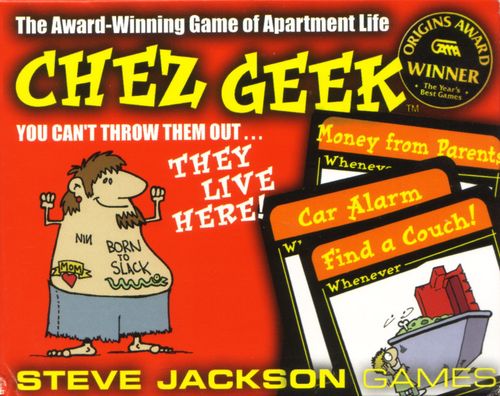
Chez Geek
Chez Geek Rulebook
Table of Contents
Table of Contents
What's in the Box
- ALL the cards ever printed for Chez Geek, including the Slack Attack and Block Party supplements. Counting the special guest cards (see Special Guest Cards), there are 202 Life cards (yellow backs) and 17 Job cards (purple backs). There are also four blank Life cards and one blank Job card, for your own additions.
- These rules.
- Slack tokens.
- The inevitable and obligatory six-sided die.
Setup
There are two types of cards, Life and Job. These go in separate piles. Each player (or roommate) will need table space for his room – that is, the cards he has played for Activities and Things, and the People who have come over to visit.
Job Cards
There are 17 of these; they are purple, front and back. Each Job has three numbers and a special perk or disadvantage.
- Income is how much money you can spend on Shopping or Activities. You get your Income at the beginning of your turn. You can't save Income from turn to turn; any Income not spent on Things or Activities disappears at the end of your turn.
- Free Time is the number of things you can do during your Free Time phase.
- The Slack Goal is the number of Slack points you need to win.
- The perk or disadvantage is something special that your job lets you do or keeps you from doing.
Note: For a 2-player game, it is recommended that the players either take Slacker and Drummer out of the Job pile, or give themselves those cards to start with.
Variable Income and Free Time
Some Job cards have two numbers (e.g., 2/3) for Income or Free Time. Roll a die each turn, on your Roll phase, to see which Income or Free Time you have for that turn. On a roll of 1, 2, or 3, you have the lower number. On a roll of 4, 5, or 6, you have the higher one.
Example: Van Zele is the Drummer. His Free Time is variable (2/3), so Van Zele must roll according to the rules in Variable Income and Free Time. This turn, he rolls a 1, so he has a Free Time of 2.
Life Cards
The rest of the cards have yellow backs – these are the Life Cards that make up the regular deck. There are four kinds, with different colored fronts: Person (green), Thing (blue), Activity (red), and Whenever (orange). If you run out of Life cards during a game, shuffle the discard pile and reuse it.
Note: You may not give cards away or trade them with your roommates, but you may show a roommate your hand if you like, and you may make any deal that you like about how you will play your cards. No deal is binding if someone decides to welsh, though; life is hard in the big city.
How to Play
The dealer shuffles the Jobs and deals one, face up, to each player. He then shuffles the Life cards and deals five, face down, to each player. The player to the left of the dealer goes first. Play proceeds clockwise. Each player's turn has five phases: Draw, Roll, Call People, Free Time, and Discard.
1. Draw
Draw cards from the Life card pile until you have six cards in your hand (seven if you have the Corporate Drone Job). You should never have more than this number of cards in your hand at any time.
2. Roll
Various cards require you to roll a die at the beginning of each turn, either to determine Income or Free Time, or to get rid of a Person. The Roll phase is when you do it.
3. Call People
Person cards represent people who might visit the apartment. They may only be played during the Call People phase. You may call as many People as you want, if you have their cards in your hand. There are two types of Person cards: invited (they give Slack) and uninvited (they have a Slack of 0 or less, and have other bad features, too). Invited People must be Called (see below). Uninvited People are put into play during the Call People phase, but you don't have to Call them. After all, fun people need to be called; jerks just drop in. To play a Person card:
- Announce your intention to have a Person come over, and lay down the card. Then announce whether the Person is coming to your room or another player's room. If the Person gives no Slack, play them now.
- If the Person gives Slack, roll a die. On a roll of 1-2, that Person was not home. Discard the card.
- On a roll of 3-6, the call succeeded and that Person card stays in your room. Any effects that Person has on the game then occur, including Slack awarded to the owner of the room in which the Person was played!
- When you get an uninvited Person to leave your room (see Getting Rid of People), you determine which room the Person goes to next.
- Pet cards count as Person cards, and are played during this phase as well. A Pet requires no roll to Come Over – you just announce it and put it in your room!
Getting Rid of People
On the Roll phase of your turn, you may attempt to get rid of any People in your room, except Cats. To invite someone to leave, roll a die. On 1-3, the Person hangs around and any negative effects take place. On 4-6, you can discard the Person, or send him to any other room that he is not restricted from entering, and he has no effect on you that turn. Except for the turn they enter your room, unwanted People do not have a negative effect until after you roll to get rid of them.
Example: Mike plays Choad Warrior on Pam. Pam discards Microwave Popcorn, a Food card. During Pam's next Roll phase, she rolls to get rid of Choad Warrior, but gets a 3. The Choad Warrior stays, and Pam discards White Russian to appease her unwanted guest. When Pam rolls during her next turn, she gets a 6. Hurrah! Choad Warrior must leave. Since Pam controls the card, she puts it in Mike's room. Turnabout is fair play! Now Mike must discard a card (and so on, and so on, and so on . . .).
4. Free Time
During this phase, you may spend your Free Time by Shopping or doing Activities. Each Free Time allows you to do one Activity or to go Shopping. You may also play cards that give you more Free Time. You must always announce how you are spending your Free Time. Try to sound like it's the most important thing in your life; make your roommates jealous ("Ooo, nice tattoo!"). You must have the card for any Thing you want to buy or any Activity you want to do.
More Free Time
If a card gives you more Free Time, it goes into effect as soon as it is in play. Example: Narcolepsy gives you +1 to Free Time. You can use that Free Time as soon as the card is played.
Shopping
You must announce that you are Shopping. No matter how many Things you buy in one turn, it counts as one Shopping trip. If someone cancels your Shopping, all Thing cards you played return to your hand. (See Canceling, below.) If you still have Free Time and Income left, you may attempt to Shop again.
If no one prevents you from Shopping, you may buy as many Things as you have the Income to afford.
Example: Megan has an Income of 3 and a Free Time of 2. She plays Change in Couch, raising her Income to 4 for this turn. She then announces that she will use her first Free Time to go Shopping. She buys Ultra-Slims (Cost 1) and NT Server Docco (Cost 3), which net her a total of 4 Slack. She puts both cards in her room. During her second Free Time, she will play an Activity card.
Activities
Some Activities have a Cost. If you don't have enough remaining Income to match the Cost, then you may not perform that Activity.
You must announce the Activity that you plan to perform as you play the Activity card. If nobody plays a card to stop you, place the card in your room and gain the appropriate Slack. Some Activities are worth a variable amount of Slack, determined by a die roll. If a result is ever zero Slack (or less), the Activity is considered unsuccessful and the Activity card is put in the discard pile. You have still used up one Free Time in the attempt.
Example: During Eric's Free Time phase, he announces that he will try for some Nookie. He plays a Nookie at Jimmy's card. No one plays a card to stop him, so he rolls and gets a 1. The Slack for a Nookie card is 1 die-1, so Eric's Nookie is worth 0 Slack. With a tear of regret, Eric discards the card and laments his unsuccessful Nookie.
5. Discard
If you have more than five cards, you must discard down to five. You may discard all the way down to one; you can't discard to zero. This rule only applies to discarding. If you can use your whole hand before your Discard phase, more power to you!
Other Stuff You Can Do During Your Turn
Your Whenever cards may be played on anyone at any time, unless the card text specifically prohibits it. Unless otherwise stated, a Whenever takes effect as soon as it is played, and the Whenever card is immediately discarded. If a Whenever has a continuing effect (such as Get a Life), keep it on the table as a reminder, and discard it when its effect is over.
Stuff You Can Do When It's Not Your Turn
- Again, Whenever cards may be played on anyone at any time, unless the card text specifically prohibits it.
- Play a TV card to cancel someone else's Free Time. (See TV Cards, below.)
Marking Slack
If an Activity gives variable Slack, or if anything changes the amount of Slack on any card so the printed value is no longer correct, the owner must place Slack tokens on the card, one for every point of Slack. All roommates must be able to look at your room and count up the tokens, and the printed value on all cards with no tokens, to see how much Slack you have. Red tokens give Slack. Yellow tokens subtract Slack.
Or: Players start with a pile of tokens, as many as their Slack Goal, and then mark each card in their room with the appropriate Slack. When someone runs out of tokens, he knows he's won.
Winning the Game
The first person to reach or exceed the Slack Goal on his Job card immediately wins.
Example: Zvi has the Job card Tech Support (Slack Goal 20). He has 19 Slack currently and buys Cigarettes. Even if Beau plays Bum to take the Cigarettes from Zvi immediately after Zvi plays them, Zvi still wins the game because he had 20 Slack even for that short time. (However, if Zvi had reached his 20th Slack with a Sleep card, then a Canceling card – below – could keep him from winning, because the effect is that the Sleep was never played.)
The winner gets to choose his Job Card for the next game before everybody else draws theirs.
Additional Rules and Definitions
Canceling
A card which can cancel other cards may only affect a target card as that card is being played. Canceled cards are discarded. If the card was an Activity, the Free Time for that Activity is lost. If someone cancels Shopping, all Thing cards that the roommate was trying to buy are returned to his hand. A canceling card has no effect on any card already in play.
A card that is "being played" is a card that a roommate has announced and put in his room. You must play a canceling card before that roommate:
- puts down another card, or
- rolls to see if a Person is coming over, or to see how much Slack a card gives, or
- ends his turn.
Example: Moron with a Chainsaw can cancel a Sleep card. If Tri plays a Sleep card and ends her turn, and then Jamie draws a Moron with a Chainsaw on his next turn, Jamie cannot affect the Sleep card Tri already played. Jamie will have to wait until someone announces that he is playing a Sleep card, at which point Jamie can cancel it.
TV Cards
You may play TV as a normal Activity, or you may play it against a roommate to cancel one of his Free Times. As a roommate announces what he will do with his Free Time (Shopping or performing an Activity), play a TV card on him. He then spends that Free Time watching TV, and the Activity card he attempted to play, if any, is discarded. Thing cards return to his hand. He keeps the TV card in his room and gains 1 Slack.
TV cannot be used to prevent players from Calling People.
Hungry Girl, Clumsy Drunk, Psycho Ex and Choad Warrior
These uninvited People have special rules for their behavior. When Hungry Girl, Clumsy Drunk, or Choad Warrior are played on you, you must immediately discard one card from your room, of the type stated on the uninvited Person's card (Food, Booze, Weed, or Live-In S.O.). You choose what to discard. Each consecutive turn one of these People is in your room, you must discard one card of the appropriate type, until all cards of that type are gone from your room. After these pests eat/drink/destroy all cards of the appropriate type, they still stay in your room until you can get rid of them.
Jobs and Slack
If your job increases the Slack of other cards in your room (such as Waitstaff increasing Sleep Slack), put a marker on the cards to show the extra Slack. If you get a new Job during the game because of You're Fired! or New Job, you keep this extra Slack on cards that you acquired during your old Job. The new Job's special trait only applies to cards played after the Job card comes into play.
Example: Jose has Slacker, and has some Booze in his room. He plays New Job, and draws Professional Research Subject. Jose may keep the Booze he already played, but may not play any more Booze, Weed, or Shrooms cards.
Example: Russ draws the Web Designer card, which gives him 2 additional Slack if someone successfully plays Surf the Net. Vikki has Surf the Net in her room. However, Russ does not get bonus Slack from her Surf the Net card, because it was in play before he drew his new Job.
Double Cards
There are certain cards that fall into more than one category. For example, Hash Brownies counts as both Weed and Food, and Sloths: Nature's Sedatives (from Slack Attack) counts as TV and Sleep. These cards are open to the attacks and benefits of both categories, so Sloths: Nature's Sedatives can be canceled by Car Alarm, but gains Slack from TV Queen.
Noisy Nookie
At any time a player gets Nookie worth 5 or more Slack, the roommates on either side of him lose (if they have it) one Sleep card from their rooms. Yes, this can remove an already-played Sleep card.
Special Guest Cards
This set includes two cards from Chez Goth (Gamer Goth and Menthol Cloves) and two from Chez Cthulhu (Nookienomicon and the "avatar" Computer Games). They have regular Chez Geek backs, so you can leave them in and play with them. Each guest card has a star on the bottom.
Chez Goth and Chez Cthulhu are both compatible with Chez Geek, but they add new Jobs, new People and Things, and new game mechanics. With Goth, you get Gloom. With Cthulhu, you get Sacrifices and Madness!