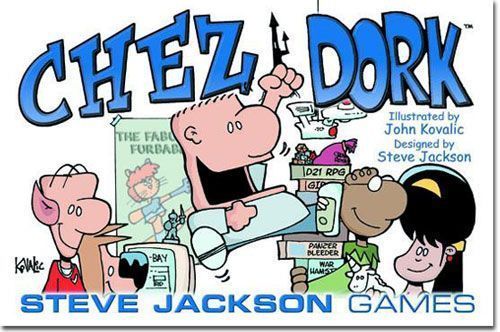
Chez Dork
Chez Dork Rulebook
Table of Contents
Table of Contents
Setup
Each player will need table space for the cards representing his Stuff. You'll also need a few dozen markers (coins, chips, glass beads, whatever) to represent money. All card values are in multiples of $10, but when you start trading among yourselves you may (for instance) ask $11 for a $10 item. Please, though, no bidding in game-pennies . . . keep it in dollars.
Distribute the character standups any way you like. The dealer then shuffles the cards and deals 5, face down, to each player. The rest of the cards go in the middle of the table. You'll draw from these. Put the discards beside the deck; if you run out of cards, reshuffle the discards.
The player to the left of the dealer goes first. Play goes clockwise.
The Characters
There are six characters. Using the plastic bases, stand your character in front of you. Each character has a special Obsession (see below) and a special advantage or disadvantage (or both). Except for Carson, who is just weird.
The Cards
The deck is made up of 70 Stuff cards and 42 Special cards. Stuff cards represent neat things to collect. Special cards represent good luck for you, or trouble for your opponents.
Turn Phases
On your turn, you go through these phases, in this order.
1. Collect Income
Take $30, unless you have a card or advantage that gives you more. Note that you may never give money to another player except as part of a Trade or in payment for an Auction.
2. Draw
Draw cards from the deck until you have 5 cards in your hand. If you want to draw more cards, you can buy as many as you want at this time for $10 each.
3. Make a Deal
Trade with one other player, or Auction some of your Stuff to all the other players, or do one Trade and one Auction. You may only Trade or Auction items you already own . . . not cards from your hand. See below. (If you own no Stuff, skip this phase!)
If your trades bring your point total to 25 or more, you win immediately.
4. Buy Stuff
During this phase, you may spend your money on . . . Stuff! Take a card from your hand, spend the printed value of that item, and put it in front of you. It's yours now.
You may buy as much Stuff as you can afford, but you don't HAVE to spend all your money. You don't have to spend ANY of it. But what's money for, if not to buy Stuff?
If your purchases bring your point total to 25 or more, you win immediately.
5. Discard
You may now discard any cards you don't want in your hand. You must discard enough to reduce your hand size to 5 or less. You must discard face up, one at a time, in case Igor wants to grab your discards.
Other Things You Can Do on Your Turn
Some Specials may be played on your turn. Read the cards.
Things You Can Do When It's Not Your Turn
- Many Special cards can be played when it's not your turn. Read the cards.
- On other players' turns, you can offer to make Trades . . . or you can bid in their Auctions.
Obsessions
Your Obsessions control what you think is neat, and therefore how many points you get from the Stuff you buy.
Every character has a permanent Obsession, shown on the standup (Bill has two). Each character (except Bill) can also have one temporary Obsession from a Special card. You may play a temporary Obsession on yourself at any time, or on another player at any time when it is not his turn.
There are 16 Temporary Obsession cards, each with two different Obsessions, one on each end. When you get one, place it under your character as shown. You pick the end that's showing – that's the Obsession you acquire.
If you get a new temporary Obsession, it replaces your previous one. The old one is discarded. You must immediately rearrange your Stuff (see below). Nothing ever changes or removes your permanent Obsession, and your temporary Obsession may not duplicate your permanent one.
Note that Carson and Bill are exceptions. Bill has two permanent Obsessions and cannot have temporary ones. Carson has NO permanent Obsession! He may have up to three temporary Obsessions at a time, though he starts with none at all.
Your Hand: Playing Your Cards
The Stuff cards in your hand represent dorkish treasures that you have found for sale – but you don't own them yet. You have to scrape up the money to buy them. When you buy Stuff and put it on the table, it is "in play" and you own it. You can't sell, trade, or auction off the cards in your hand, or cash them in with "Dump It Now." You haven't bought them yet.
Each Stuff card has the following information:
- Name of the item. Duh.
- Value. This is your cost to buy the item from your hand.
- Points. This is what the item is worth toward victory once you buy it. If it fits your Obsession, point value is doubled!
- Obsession. This is the particular interest this Stuff fits. Some cards fit up to three Obsessions.
The Special cards are, well, specials. (You've played a card game before, right? Right.) A Special may be played at any time unless the card itself says otherwise. If a Special contradicts the printed rules, do what the card says.
First laid, first played!
Giving Cards Away
You may not give cards away, or even trade them except as part of a Deal (below). You may show other players your hand if you want to, and you may make any deal that you like about how you will play your cards. Except for a Deal, no promise is binding if someone decides to break it.
Canceling
A Special which cancels other cards may only affect a target card as that card is being played. It has no effect on any card already in play. Canceled cards are discarded.
A card that is "being played" is a card that someone has announced and put on the table. You must play a canceling card before that person:
- puts down another card, or
- ends his turn.
Winning the Game
The point value of Stuff is printed on the cards. All Stuff that matches one of your current Obsessions counts double. The first person to get 25 points worth of Stuff immediately wins and enters Dork Nirvana. If two or more people hit 25 at the same time, due to a trade, they both (or all) win, but the one with the most points wins biggest. Once someone reaches 25 points and declares victory, the game is over . . . you can't play a Special on him, because he's already won.
To keep track of point value, line up your Stuff where you can admire it, just like in real life. The top row is the Stuff that matches your current Obsession(s). The bottom row is other Stuff. Count the points on the top row, double it, and add the points from the bottom row, and you have your current score.
You MUST rearrange your Stuff every time your Obsessions change. If you fail to do so, you cannot win until it is rearranged to show the new point value.
Redoubling Points: All point-doubling cards are cumulative. A Limited Edition is worth 2× points. If you have an Autographed Limited Edition, it's worth 4× points. If it fits one of your Obsessions, it's worth 8× points and will probably give you the game right there!
However, Stuff that happens to fit more than one of your Obsessions doesn't count extra for that. It's still doubled, but not redoubled.
Making Deals
There are two kinds of Deals you can make during your turn. You may only make one of each kind of Deal each turn, unless you get a Special that allows more.
Trades
A trade with another player consists of giving them any amount of Stuff and/or money, in return for any amount of Stuff and/or money. You may only trade with one player (but you can listen to everyone's offer). You cannot include cards from your hand in a trade. You can include real-world snacks, Stuff, and personal services in a trade, but we don't want to hear about it unless it's really good.
Auctions
Pick any of your Stuff in play to auction off. It may be more than one card, but it all goes as one lot. You may not bid against yourself; you must let everyone bid; you must sell to the highest bidder if your minimum bid is reached. You may set a minimum bid or minimum allowable. (Some special cards and character advantages can interfere with an auction result.)
No one can bid more money than they have in front of them, in cash. If they want to play a card to get more cash, they must do so before bidding further. You must give them time to do so.
If nobody bids, you keep the Stuff.
Note that Clearance and Special Offer don't affect auction prices!