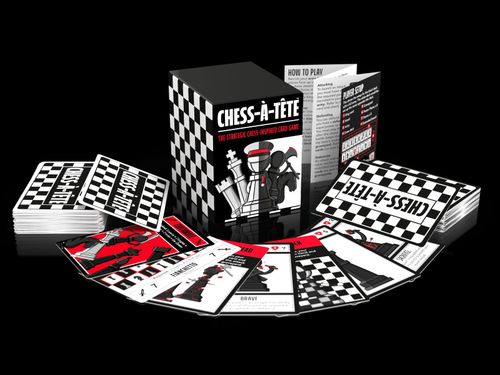
Chess-à-Tête
Chess-à-Tête Rulebook
Table of Contents
Table of Contents
Objective
The objective of Chess-à-Tête is to defeat your opponent by meeting one of the following victory conditions:
Defeat the King: Claim victory by initiating an attack with power exceeding your opponent's total Board hit points.
Checkmate: Fulfil all the required conditions stated on the Checkmate card and play it.
Deck Exhaustion: Force your opponent to run out of cards in their Draw Deck. When your opponent can't play a card from their Hand on their turn, they lose.
Game Set-Up
Choose Your Decks
White or Black. Both are identical, but the White Deck always goes first.
Place Your Kings
Begin your Board by placing your King card face-up in front of you. (Your Board is simply the play area in front of you. You don't need a physical chess board to play.)
Tip! The King card has a red colour on the reverse side, so it's easy to spot.
Shuffle and Draw
Shuffle your deck, draw SEVEN cards to form your starting Hand, keep these cards to yourself and place the rest face-down to form your Draw Deck. Always begin each turn with SEVEN cards in your Hand.
Turn Structure
Each player's turn consists of up to THREE actions. You may take fewer than THREE actions, but you must play at least one card per turn. These actions can include:
Adding Cards to Your Board
You can add up to THREE Piece Cards to your Board per turn. These can either be Pawns, Power Pieces or Royal Pieces.
Playing Action Cards
Play an Action Card to gain instant or ongoing advantages, or to disrupt your opponent. You may play up to THREE Action Cards per turn and some may be played Out-of-Turn.
Playing Combat Cards
Play a Combat Card from your Hand to initiate an attack. Only ONE Combat Card may be used per turn.
Burning Cards
You may burn cards from your Hand and draw the same number from your Draw Deck. Each burn counts as one action. You can burn up to THREE cards total per turn.
Tip! Be careful of burning cards too often. Remember, if you run out of cards in your Draw Deck, and you can't play from your Hand, you lose!
End of Turn
At the end of your turn, draw cards from your Draw Deck until you have SEVEN cards in your Hand. If you already have SEVEN, don't draw. If you play any cards Out-of-Turn, immediately draw until you have SEVEN cards again.
Board Building
Your Board consists of the Piece Cards you play in front of you. These Piece Cards are used for both attacking and defending. The following piece limitations apply unless otherwise specified by an Action Card:
Pawn Limit: You may have a maximum of 8 Pawns on your Board.
Power Piece Limit: You may have a maximum of 2 Knights, 2 Rooks, and 2 Bishops on your Board.
Royal Piece Limit: You may have exactly 1 King and 1 Queen on your Board.
The below image shows a typical fully-populated Board set-up for the Black Deck. The White Deck would be set-up the same, facing the Black Deck.
Tip! If you are short on table space, stack your pairs on top of each other.
The printed diagram is labelled as follows:
- Hand (7 Cards)
- Board Area (16 Piece Cards)
- Draw Deck
- Graveyard
- Combat Card (In-Play)
- Action Card (In-Play)
Combat
Throughout the game, you may use Combat Cards to launch attacks on your opponent and use them to defend against attacks. These range in power from 2 to 12, and each requires specific combinations of Piece Cards on your Board in order to deploy them. As the power of a Combat Card increases, so does its requirements.
Declare the Attack
Play a Combat Card and show that you have the required Piece Cards on your Board.
Defending an Attack
The defending player now has the opportunity to respond to the attack. They may defend by either playing an Action Card that can suppress or block the attack, or by playing a Combat Card from their Hand with a power value equal to or greater than the attacker's. To do so, they must also have the required Piece Cards on their Board, as specified by the Combat Card.
Successful Attack
If your opponent can't (or chooses not to) defend, your attack is successful. The defender must send Piece Cards of their choosing from their Board to the Graveyard to absorb damage. The total value of the lost Piece Cards must be equal to the power value of the attack. When calculating damage taken by Piece Cards, round down to the nearest whole number. Attacks do not affect Piece Cards if they don't completely exceed their hit point value.
Stalemate
If both the attack and defence is of equal power value, the battle results in a Stalemate. Both players must send all mobilised Piece Cards used to deploy their Combat Cards, and the Combat Cards themselves, to their respective Graveyards.
Counter-Attack
If the defensive power is greater than the attacker's, the attacker must send all mobilised Piece Cards used to deploy their Combat Card to the Graveyard. Both players must send their Combat Cards and any Action Cards used to their respective Graveyards.
Combat: Attacking
In the example below, the attacker plays a Combat Card with 4 power. They have the required Piece Cards on their Board, so the attack is valid. Piece placement on your Board doesn't need to match the layout shown. Only the correct Piece Cards and quantities matter.
Some Pawns have abilities that can bolster an attack. For example, a Drummer Pawn adds 1 power to an attack; or if you have TWO Drummer Pawns, they add 3 power in total.
You may also play Action Cards with your Combat Card to boost its power. For example, the Siege Action Card raises a 4 power attack to 6, making it harder for your opponent to defend. Each additional card played counts as a separate action.
Combat: Defending
The defender now has the opportunity to respond with a Combat Card. In the example below, the defender has matched the attacker's power with a Combat Card of 4 power and has the required pieces on their Board. This results in a Stalemate.
If the defender can't match the attacker's power with a Combat Card, they must lose pieces from their Board equal to the attack's value in hit points. In this example, facing a 4 power attack, the defender might choose to lose either:
- 1 Power Piece (2 hit points) and 2 Pawns (1 hit point each) = 4 hit points
Or:
- 2 Power Pieces (2 hit points each) = 4 hit points
If the defender only had 1 Power Piece and 1 Pawn, plus their King, the 4 power attack is rounded down to 3. The Pawn and Power Piece are destroyed, but any leftover damage does not affect the King. A piece can only be destroyed if the damage meets or exceeds its hit points.
You can't defend with a Combat Card of lower power than the attack in an attempt to partially reduce it. The defensive Combat Card must meet or exceed the attacking power to avoid taking damage.
Card Symbols
Hit Point Value: Each Piece Card has a hit point value, representing its durability. When a piece is destroyed it is sent to the Graveyard. Pieces can't return from the Graveyard unless specified by an Action Card or Pawn ability.
Power: Combat Card power value, damage taken if combat is successful.
First Ability: This ability can be activated when the first Pawn of a pair is present on the Board.
Second Ability: This can be activated when TWO Pawns with the same name are present on your Board.
Instant Ability: These abilities activate immediately when the card is played and provide one-time effects, such as drawing additional cards or directly inflicting damage.
Out-of-Turn Ability: Certain cards have a special Out-of-Turn icon, allowing them to be played outside of your standard turn sequence. Only cards with this icon, such as the Checkmate and Block Action Cards, may be played Out-of-Turn.
Ongoing Ability: These abilities remain in effect from the moment the card is played (On-turn only) until it is removed from the Board (either destroyed or otherwise). Ongoing abilities can provide buffs to your Board (e.g., increasing hit points or combat value) or debuffs to your opponent.
Gear Card: (Expansion packs only) These are cards that you can equip to Piece Cards on your Board to provide them with buffs.
Trap Card: (Expansion packs only) These are placed face-down on the Board and are triggered by specific actions taken by your opponent.
The card-type icons are: Combat Card, Action Card, Checkmate Card.
Piece Card Types
- Pawn Piece Card
- Bishop Piece Card
- Queen Royal Piece Card
- Knight Power Piece Card
- Rook Power Piece Card
- King Royal Piece Card
Combat Card Requirements
All red-highlighted pieces on a Combat Card must already be on your Board to play it for an attack or defence.
Any ONE of the pieces within a red striped square can be used to deploy the Combat Card.
Glossary
Action: One of the three moves you may perform during your turn.
Attack: When a Combat Card is played to attack.
Defend: When a Combat Card is used to defend.
Destroy: Send a card directly to the Graveyard.
Inflict: Damage dealt to an opponent that can't be defended by a Combat Card.
Pawn: Refers to all Pawn Piece Cards.
Pieces/Piece Cards: Refers to all cards you are able to add to your Board, Pawns, Rooks, Knights, Bishops, Queen and King.
Power Piece: Refers to Rooks, Knights and Bishops.
Royal Piece: Refers to your King and Queen.
Sacrifice: When a card is sent to the Graveyard from your Hand or Board to trigger an ability or bonus.
Stalemate: When the attack and defence of opposing Combat Cards are equal.
Turn: A player's opportunity to play up to THREE cards and initiate any combat or abilities.
Additional Information
FAQ
Visit our website for detailed gameplay information, including specific card details, situational outcomes, and video playthroughs. Due to the many variables in Chess-à-Tête, it's not possible to cover every scenario. However, we regularly update the site with additional guidance and resources to support your gameplay. If you have any questions that aren't covered, please use our feedback submission form, and we will get back to you as soon as possible.
House Rules
Some players enjoy adding custom rules to tailor their experience. Common variations include allowing players to view their Graveyard at any time or using a Mulligan rule to redraw a poor starting Hand and reduce luck. Feel free to experiment with your own twists, but for balanced and competitive play, we recommend playing with the official rules.
Deck-Building
The Classic Edition is designed for custom deck-building using cards from its corresponding expansion packs. To ensure balance, only combine cards from the Classic Edition base game and Classic Edition expansions when creating a custom deck.
Follow a one-for-one rule: if you remove a card (e.g., a Pawn), you must replace it with a card of the same type (another Pawn). This keeps your deck balanced and tournament-ready.
Basic deck-building criteria:
- 2 Royal Pieces (1 King, 1 Queen)
- 1 Checkmate Card
- 18 Pawns
- 12 Power Pieces (Knight, Rook, Bishop in any combination)
- 14 Combat Cards
- 10 Action Cards
We regularly update our website with deck-building tips, updates and guidance to help you get started.