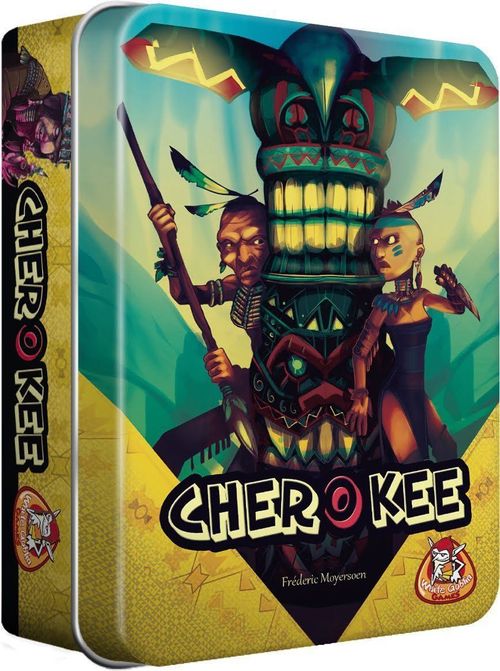
Cherokee
Cherokee Rulebook
Table of Contents
Table of Contents
Components
106 cards:
- 6 clans
- 72 tribesmen
- 28 feathers
Object of the Game
Try to place your tribesman in the highest position in the hierarchy.
Clans
There are 6 clans, consisting of men and women. Each sex is represented by 6 cards. Men's cards have values from 4 to 9, women's from 3 to 8. Although men are stronger, women have the advantage in a tie.
Setup
Shuffle the clan cards and deal one to each player face down. Players may look at their clan cards but during the game must keep them face down in front of them. The remaining clan cards are not needed in the game and are put back in the box face down.
Shuffle the tribesman cards and lay them out in a hierarchy pyramid as shown in the illustration, of 8 levels with a base of 8 cards. Deal the remaining tribesman cards to the players equally; these are the players' hands.
Sequence of Play
One player, chosen at random, starts the game. On his turn a player expels a tribesman from the pyramid, fills the vacated positions with worthy successors, and finally adds one card from his hand to the last gap in the base of the pyramid. Play continues clockwise until the end.
Expulsion
To expel a tribesman from the pyramid, a player chooses a tribesman adjacent to it, of any clan (not necessarily his own), with a higher value (the number on the card). A player may attack only sideways or upward, and never downward.
Example: the blue man can attack in 3 directions.
Combined Attack
A player may combine the values of two or more tribesmen of the same clan if they are adjacent to the same target. The defender (the one being attacked) cannot combine his value with neighbouring tribesmen.
Example: yellow tribesmen combine their values to attack the red man.
Age
Tribesmen higher in the pyramid are older and weaker than those lower down. Their value is reduced by one when attacked from below. This is equally true of a combined attack from below and from the side.
Example: the value of the yellow man is reduced to 5 when he is attacked by the pink woman below.
Consequences of an Attack
The player discards the card of the expelled tribesman to the discard pile and moves the attacker into the vacated position. If there are several attackers, the position is taken by the contender with the highest value. If the contenders have equal values, the woman wins.
Example: the blue man has a higher value than the green woman, so he moves up and takes the vacated position.
Filling Vacant Positions
The newly vacated position must be occupied by one of its successors. The successor with the highest value takes the vacated position. All positions that become vacant are filled in this way, down to the base of the pyramid. In case of a tie in values, the woman takes the position.
If tribesmen of the same sex contend for a position, the player himself chooses which of them takes that position. To fill the remaining position in the base of the pyramid, the player chooses a card from his hand and places it in that position.
Example: 2 contenders have the same value; the red woman has the advantage by sex in case of a tie over the pink man and takes the position.
End of the Game
When all players have run out of cards in hand, the game comes to an end.
Sort the feather cards by value from 7 down to 1 and place them as follows:
- top - 7
- second row - all 6s
- third row - all 5s
- and so on.
Note that the row at the base of the pyramid yields no points.
Each player reveals his Clan card. According to the position of each member of the player's clan, each tribesman earns one feather card (victory points) from the feather cards of the row in which that tribesman is located. Players count all points (feathers) on the collected feather cards. The player with the most points wins the game. In case of a tie, the player with more women in the pyramid wins.
Hint
Pay close attention to the attacks of other players. You will gain a great advantage if you guess which clan your opponent received.
Variants
A variant is possible in which players play openly and do not hide their clan: players keep their clan cards on the table face up. Then two more neutral clans are placed openly on the table (in this case, if three play, one clan is not used; if two play, two clans are not used).
A player may attack only with his own tribesmen or with tribesmen of neutral clans.
The other rules are unchanged.