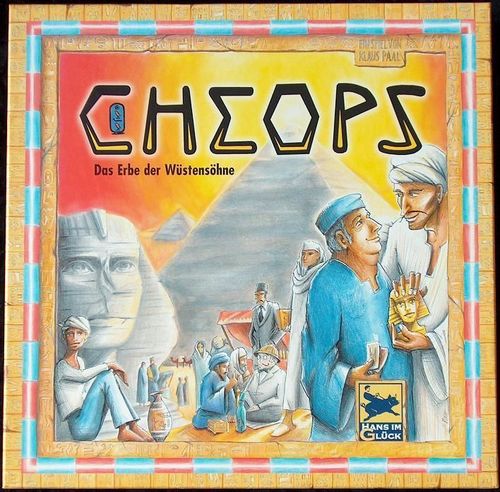
Cheops
Cheops Rulebook
Table of Contents
Table of Contents
Components
- 1 game board
- 66 treasures (Scarabs) in 6 colors: 11 per color
- 16 Price Boards: 6 of Type I, 6 of Type II, and 4 of Type III
- 64 Family tiles of four different family members: 16 tiles per family member
- 4 Friends of the Family tiles (neighbors)
- 12 Law Tiles
- 50 Money Cards: 30 one piaster cards and 20 five piaster cards
- 1 set of rules
For 2-5 players.
Get Ready
The six pale columns above the pyramid are where the Price Boards will go. Place a matching treasure (scarab) on the colored dot above each column. Shuffle the Price Boards face down by type and select two per type. Place the six Price Boards you selected face up on the columns.
The remaining 60 treasures are placed on the blocks of the Pyramid except for the six blocks marked with an eye. It doesn't matter how you distribute the treasures across the Pyramid. Identical treasures may be placed next to each other.
Next, turn the 12 Law tiles face down and shuffle them. Select six and place them face down on each of the eyeball spaces on the pyramid. The remaining six are kept face down and are out of the game.
Each player takes one of each of the four different Family Member tiles. The rest of the Family Member tiles are placed face up in three stacks.
The 4 Neighbor tiles are set face up to the side of the board.
The Two Important Actions
On your turn, you take a treasure or a Law tile from the pyramid. That is the First Action.
If you take a treasure, then you must decide to sell it for the current marketprice or to store it in your warehouse. If you take a Law tile, then you must apply the law (see Law Tiles below). That is the Second Action.
Each player must perform the two actions in the same order on their turn.
How Do You Take a Treasure or a Law Tile?
Choose a block on the pyramid that contains either a treasure or a law tile.
Next, select one of your Family Member tiles and place it on one of the blocks on the pyramid that contains either a treasure or a law tile. The Family Member tile remains on the pyramid and you take the treasure or law tile for yourself.
Egyptian Customs
- You must start at the bottom of the pyramid.
- You may send a Family Member to the next higher row in the pyramid only if the two blocks below the block you want to visit both contain Family Member tiles. You may always visit any available block on the lowest row.
- You may never place identical Family Member tiles next to each other on the pyramid. "Next to" includes all six directions (see the illustration in the middle of the left hand margin of page two). This is the "Neighborhood Rule".
- If none of your Family Member tiles may be placed, then you may not take a treasure or a law tile — maybe things will change by your next turn.
- If you are able to place a Family Member then you must place one.
What's Up With Selling or Warehousing?
When you take a treasure you must IMMEDIATELY decide whether to sell it or to place it in your warehouse.
Selling Treasure
When you sell a treasure you receive the current marketprice from the bank. The marketprice starts at 10 piasters but two of the law tiles may change it to 5 or 15 piasters (and one can change it back to 10).
The sold treasure is placed on the next lower free number on that treasure's Price Board. The number under the lowest treasure on a Price Board is currently what all of the like colored treasures will be worth at the end of the game. Remember, the Price Board prices only come into play at the end of the game. Selling treasures only gets you the current marketprice for all treasures of all colors.
You should keep your money in a single stack so that no one is sure how much you have.
Warehousing Treasure
If you don't sell your treasure for the marketprice, then you just place it before yourself and it is considered to be in your warehouse. You will not be sure how much your warehoused treasures will bring until the end of the game. At the end of the game, the value of a treasure corresponds to the highest (as in location) free space on that treasure's Price Board. This value is the same for all treasures of the same color irrespective of who owns the treasure.
Now you see how both Actions work together: treasures sold for the marketprice are placed on their respective price boards and change the value of the remaining treasures.
The Neighbor Tiles
The 4 Neighbor tiles sit next to the board. At the beginning of your turn you can spend 20 piasters to buy a Neighbor tile. The money goes to the bank. The Neighbor tile is placed on the pyramid following the same rules for the placement of Family Member tiles, and you sell or warehouse whatever treasure you take with the Neighbor tile, or execute the law of whatever law tile you may take, just as you would if you were placing a Family Member tile. Then you still get to place one of your own Family Member tiles. In other words: Buying a Neighbor Tile is like buying a second turn.
Draw a New Family Member Tile
At the end of your turn, you may take the topmost Family Member tile from one of the three Family Member tile stacks. If you do not want to draw a Family Member or if you just forget to do so, then you will have one fewer family member tile to choose from on your next turn.
If you ever start your turn without a Family Member tile to play then you are out of the game.
Price Boards
Each treasure has its corresponding Price Board. During the game, the six Price Boards will have their prices covered by sold treasures. You cover the prices starting at the top of the board and working down. A Price Board must always leave its lowest number uncovered, so as soon as the next-to-the-bottom number has been covered, that Price Board is considered "full" and no more treasures of the matching color may be sold — they must be warehoused instead.
Game Over and the Final Assessment
The game ends when one of the following happens:
- The Pyramid is empty (of treasures and law tiles).
- No one can place a Family Member.
- Two Price Boards are full.
Now each player counts up his cash and adds to this sum the value of his warehoused treasures. Remember: the value of your warehoused treasures are found on the corresponding Price Board, and on the Price Board the value is the uppermost uncovered number.
Example of Final Assessment
Everything is self-evident except for the values for the blue and black (schwarz) treasures.
The blue Price Board's uppermost free number is "x5". This means that you count up all of the treasures of that color in all of the warehouses and multiply by 5. The result is the value of each treasure. So, between the players Ali, Cleo, and Ramses there are six warehoused blue treasures. 6 x 5 = 30 piasters for each blue treasure.
The black (schwarz) Price Board's uppermost free number is 20/15, with the 20 printed smaller than the 15 and underlined. This means that if any one player owns more of this treasure than the others, then that player uses the smaller-printed, underlined number as the price of each of his treasures and everyone else uses the other number. So, between Ali, Cleo, and Ramses, Ali has the most black treasures so he receives 20 piasters per black treasure and Cleo and Ramses each receive 15 piasters per black treasure.
The Law Tiles
If you take a law tile you must immediately translate the hieroglyphic and follow its instruction. Each law specifies both where the law tile is used and what it does.
Law 1: Place it on the current marketprice space (found above the pyramid). Henceforth, the current marketprice is 5 piasters.
Law 2: The same as Law 1 except that now the current marketprice is 15 piasters.
Law 3: Place this anywhere on the game board. It means that the game ends when 3, not 2, Price Boards are full. The other two ways of ending the game (empty pyramid and unplayable family members) are still in effect.
Law 4: Place this under a Price Board that does not already have a law under it. What it means: henceforth, no treasures of this color may be placed in any warehouse. They must all be sold for the current marketprice. If the Price Board is full, then any other treasures are worthless and when they are taken from the pyramid they are placed in the box out of the game.
Law 5: Place this under a Price Board that does not already have a law under it. What it means: Henceforth, no treasures of this color may be sold at the marketprice. They must all be placed in a warehouse.
Law 6: Place this under a Price Board that does not already have a law under it. What it means: It doesn't mean anything. It just blocks anyone from placing any other law under the Price Board because only one law may be under a Price Board at a time.
Law 7: Place this on any uncovered number on any Price Board. What it means: It replaces whatever number it covers.
Law 8: Place this law back in the box. What it means: it allows you to remove a previously placed law tile, or a law tile that someone is holding, from the game.
Law 9: Immediately pay 25 piasters to the bank or remove this law from the game. What it means: If you pay the 25 piasters you may keep this law in your warehouse and at the end of the game it counts as any treasure you like. In other words, you bought a Joker.
Laws 10, 11, and 12 can be used immediately or saved to be used on a later turn.
Law 10: Take a treasure from your warehouse and sell it at the marketprice. The treasure's Price Board cannot yet be full and you can't sell a treasure if its Price Board is restricted by Law 5.
Law 11: Name a field on the Pyramid and, following the Neighborhood Rule, place one of your Family Member tiles there and take the treasure.
Law 12: Switch the positions of any two treasures on the pyramid, or name a treasure on the pyramid and exchange it with one of the treasures in your warehouse.