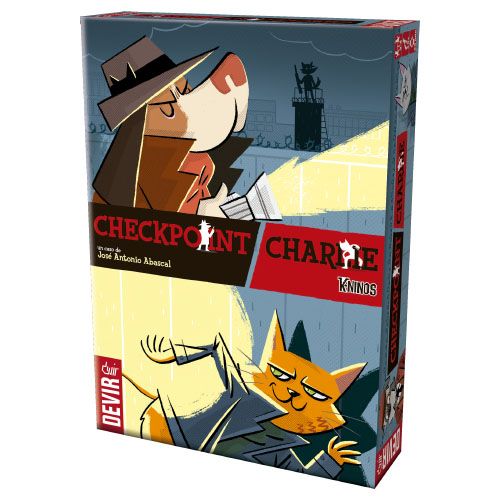
Checkpoint Charlie
Checkpoint Charlie Rulebook
Table of Contents
Table of Contents
Game Contents
- 32 suspect cat cards
- 5 investigator dog cards
- 5 investigator dog tokens
- 1 Stasi officer card
- 5 clue tokens
- 1 cloth bag
- 30 scoring markers (5 of which are optional)
The Goal of the Game
Each investigator dog wants to be the best of all and capture the most wanted spies. To do this, you need to put your clues together, guess which clues the other players hold, and match them to the suspects that come into play until you figure out who the infiltrated agent is. The wanted group of spies is made up of a boss and their assistants, and you earn points by capturing them. The investigator who reaches 10 points first, or the one with the most points after 5 rounds, is the winner.
Setting Up a Game
- All players choose an investigator dog card and place it in front of them, visible to the other participants. All players take the matching investigator token.
- Place all the scoring markers face down and shuffle them.
- If the optional "Stasi Officer" rule is being used, leave his card near the suspect deck and replace one black -1 scoring marker with the Stasi Officer marker (see "The Stasi Officer").
- If the optional "Café Adler" rule is being used, replace the corresponding scoring markers listed below (see "Café Adler").
- The player who woke up earliest will be the starting player for the first round.
Setting Up Each Round
- Place 5 clue tokens in the cloth bag. All players draw a clue from the bag and, after examining it, place it under their investigator card without letting the others see it. The player chooses which side to leave face up, and that chosen side is the one that counts as the clue.
- In games with 5 players, shuffle the 32 suspect cards and place the deck face down in the center of the table. In games with 3 or 4 players, split the suspect deck into two similarly sized piles. Shuffle the investigator cards that were not chosen (2 cards in games with 3 players, or 1 card in games with 4 players) into the first pile. Place the first pile on top of the second pile to create a complete suspect deck.
- The player who captured the spymaster in the previous round will be the starting player. If nobody discovered who the spymaster was, the starting player remains the same as in the previous round.
The Sequence of a Round
There are two phases in each round. In the first phase, characters from the suspect deck are revealed so that they can be accused, or not, of being espionage suspects. In the second phase, the round ends and all investigators receive their due scoring marker.
Phase 1: Suspects and Accusations
The Clue Tokens
All clue tokens show an opposite characteristic on each of their faces. Players will have a single clue at the start of each round. Each clue indicates one of the following characteristics of the spymaster hiding among the suspects:
- whether he wears a hat or not;
- whether he wears glasses or not;
- whether he wears a coat or a sweater;
- whether he is gray or orange; and
- whether he carries a newspaper under his arm or not.
Suspects Revealed
Starting with the starting player and alternating turns clockwise, each investigator draws a card from the suspect deck and shows the card to all players at the same time. Then, the investigator checks whether the character on the card matches the clue under their investigator card (for example, that he is wearing glasses). If it matches, the character is considered a suspect and is placed face up in front of the player who holds the matching clue, near the center of the table. If other suspect cards have already been placed there, the new card is placed with them in a row, keeping them all visible. If the character does not match the player's hidden clue, it is not considered a suspect and is placed in the discard pile (all investigators have their own discard pile).
Players continue playing this way, in turns, revealing their suspects until all players but one have announced their accusations.
In games with 3 or 4 players, when an investigator card is drawn from the deck, a clue token is pulled from the cloth bag and flipped like a coin. The side that lands face up will show another clue about the suspect, which will be public and visible to all investigators from then on.
Even if there are public clues, all players must pay attention to their own clue when considering whether a character is a suspect or not. You may examine your hidden clue whenever you want.
Accusing a Suspect
Taking the revealed suspects into account, each investigator will examine the other investigators' rows of suspects and try to figure out what their hidden clues are. They must use these deductions along with their own clue and the public clues to guess who the spymaster is, and then choose him from among the cards visible on the table so far. When a player believes they have finally figured out who the boss is, they must place their investigator token on top of the accused suspect's card. This is their accusation, and it can be made at any time during the game, even when it is not their turn.
Each investigator may make only one accusation per round and cannot accuse a suspect who has already been accused by another investigator.
Even if an investigator has already made an accusation, that player must continue drawing cards from the suspect deck and placing them on the table as suspects or not. Players must continue this way until all but one of the investigators have accused a suspect.
You may not manage to gather all the clues in time, and another investigator may accuse the suspect you believed was the spymaster. Your rival will earn more points for being sharper, but you can still capture the boss's assistants! The assistants match four of the five clues that indicated the boss. If you manage to capture these lesser spies in time, you still have a chance to earn some points.
The round ends when all investigators but one have accused their suspects. For example, in a game with 4 players, the round ends when three of the players have made their accusations. The end of the round can be forced if the suspect deck runs out. In that case, all investigators must immediately make their accusations (and pay attention to the order in which players make their accusations!).
Phase 2: Scoring
First, each player lifts their investigator card so that their clue becomes visible. Check the accused suspects against the five revealed clues (each player's clues and the public clues).
Distribution of the Scoring Markers
- The investigator who accused the suspect that matches all five revealed clues (that is, capturing the spymaster) earns a random gold marker.
- Investigators who accused a suspect that matches four of the five revealed clues (matching the assistants) earn a random white marker.
- Investigators who accused innocent cats (suspects that match three or fewer clues) earn a black marker.
- The last investigator, who failed to make an accusation, also earns a black marker.
- If the round ends and the spymaster is not revealed because his card is still in the suspect deck, but all players have already made their accusations, then the player who failed to make an accusation earns a white marker instead of a black one. That is the advantage of waiting a little before making hasty accusations.
The markers players earn stay hidden until the end of the game, so that only their color is visible. Gold markers are worth 3, 4, or 5 points; white markers are worth 1 or 2 points; and black markers are worth 0 or -1 points. Some markers allow special actions during this phase. This will be explained in the optional rules.
The End of the Game
The game can end in three different situations:
- an investigator announces that the sum of all their scoring markers has reached 10 points;
- the scoring markers, of any color, run out; or
- the fifth round ends.
If the scoring markers of any color are running out, they are always drawn in the order of accusation for that round, and some players may not receive a marker. The investigator who failed to make an accusation that round is the last to draw a marker.
Finally, turn over all your markers and add up the points earned. The player with the most points is the best investigator. If there is a tie, the player with the most gold markers wins. If the tie persists, the win is shared and both tied players win.
Optional Rules
The Stasi Officer
The Stasi was the secret police of the German Democratic Republic (GDR) and was known as one of the most effective intelligence agencies in the world. In your games, they will watch all suspects closely and pay special attention to foreign investigators who get close to their borders.
There is a black marker for the Stasi officer. When setting up the game, if you decide to use this special rule, replace one black -1 marker with the marker corresponding to the Stasi officer. Leave the replaced marker in the box, as it will no longer be used in the game.
This new marker indicates that a Stasi officer is following you, and it limits your investigative activities. If you draw this marker at the end of a round, show it immediately and then place the Stasi officer card next to your investigator. Once all players have drawn their scoring markers, return the Stasi officer marker, face down, to the marker pool. You will have to play the next round with your clue token visible, so that everyone can see it.
After all accusations have been made in the following round, but before the scoring markers are collected, place the Stasi officer card back into the suspect deck. For now, you have managed to shake him off.
If you draw this marker during the final scoring phase, keep it with your other markers, and it has a value of -2.
Café Adler
The Café Adler, in Berlin, was located just 5 meters from the Wall and quickly became a den of spies. It was very popular among allied officers, the armed forces, and curious onlookers. Café Adler offers players a perfect, unique spot to monitor Checkpoint Charlie while enjoying a tasty snack.
There are four Café Adler scoring markers: one gold, two white, and one black. If you decide to use this special rule, when setting up the game, replace one gold 3-point marker, two white 1-point markers, and one black -1 marker with the corresponding Café Adler markers. Leave the replaced markers in the box, as they will no longer be used in this game.
When one of the players draws a Café Adler marker, that player may swap it for another investigator's marker (without seeing what the other one is), as long as it is the same color. They may do this right after drawing the marker, or in any later round (but only during the scoring phase). In the second case, the marker must remain face down until it is used. The investigator who receives the Café Adler marker in the swap must keep it face up and may not trade it again. The player who made the swap keeps the new marker face down, as usual.