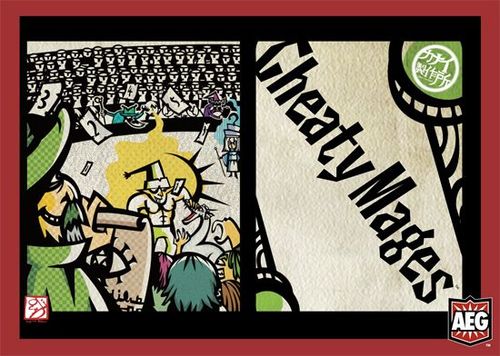
Cheaty Mages!
Cheaty Mages! Rulebook
Table of Contents
Table of Contents
Game Overview
In this game, the players take the role of mages who have mastered a number of spells. They have all come to the arena, a place where fierce monsters battle and the greedy gamble on the outcome. The mages hope no one sees the spells they use in order to help the fighter (monster) they bet on win.
But the arena rules do not allow this! There are judges viewing the rounds, sometimes strict, sometimes forgiving, and always on the lookout. And beware, for some judges are so harsh, they may turn your spells against you!
The mage who uses his or her spells most wisely will lead his or her chosen fighters to victory and gain riches! The mage with the most money when the game ends is the winner.
Notice to Players: This edition of Cheaty Mages includes several card changes and rule updates from the original Japanese edition. Designer Seiji Kanai recommended each of these changes, we hope you enjoy the updated game!
Components
This box contains everything you need to play.
- Rulebook (this book)
- 120 cards (72 spell cards, 10 fighter cards, 8 judge cards, 6 sets of 5 betting cards)
- 30 coin chips (18 x 1, 6 x 5 and 6 x 10)
Spell Cards (black backed) — 72 cards
These cards represent the spells the players cast during the game. These strengthen or weaken the monsters, or affect the other players.
- Name: The name of the spell.
- Mana: The magic surge of the spells. Generally, the larger the effect, the higher the mana. If the spells on a fighter exceed a certain amount of mana, the judge will intervene.
- Illustration: A visual representation of what the spell does.
- Type: The type of spell. The way to play the spells varies with type.
- Effect: The effect of the spell. The numbers written within the red mark are how the fighter's power is affected.
Fighter Cards (red backed) — 10 cards
These cards represent the monsters fighting in the arena. All cards specify the fighter's power and the prize money that is paid should the fighter win.
- Name: The name of the fighter (monster).
- Illustration: What the fighter looks like.
- Power: The fighter's strength. The higher the number, the more likely he or she is to win, but the lower the prize money.
- Prize: The amount of money that players who bet on this fighter will receive if the fighter wins.
- Special Ability: Any special ability of the fighter.
In this box, only the Skeleton and the Ghost have a special ability.
Judge Cards (blue backed) — 8 cards
These cards represent the judges who watch over the arena fight. They watch for spells cast on the fighters, they disallow the use of certain spells and may intervene if too many spells are cast.
- Name: The name and nickname of the judge. The nickname roughly describes the judge's personality.
- Illustration: What the judge looks like.
- Mana Limit: The amount of mana that the judge will overlook. If the amount of mana on a fighter exceeds this limit, the judge will intervene with his or her "Judgement". If the amount of mana on the fighter is equal to or less than the Mana Limit, nothing happens.
- Judgement: How the judge intervenes if the amount of mana exceeds his or her mana limit. There are two types of intervention: Dispel and Eject (see the Judgement section below).
- Special Effect: Any special effect of the judge. Some have specific limitations for spells or unique judgements.
Betting Cards (yellow backed)
6 sets of cards numbered 1 to 5. The cards represent the fighter (in number order) upon which the player places his or her bet.
Coin Chips
30 chips (18 x 1, 6 x 5 and 6 x 10). The counters you use for money in denominations of 1, 5 and 10.
Preparation
Step 1: Give a set of betting cards (5 different cards) to each player.
Step 2: Shuffle the 72 spell cards, the 10 fighter cards and the 8 judge cards separately, and place them face down in the middle of the table. These three piles are called the spell draw pile, fighter draw pile and judge draw pile.
Step 3: Each player draws cards from the spell draw pile to form his or her hand. The number of cards drawn depends on the number of players.
- 3-4 players: 8 cards
- 5 players: 6 cards
- 6 players: 5 cards
Step 4: Place the coin chips within easy reach. Give each player 2 coins to start the game.
Round Sequence
This game is played for three rounds. Each round consists of the following 9 steps.
1. Determine the Starting Player
Randomly select a starting player using some appropriate method. (In this game, it's a small disadvantage to begin.)
2. Select the Fighters
Draw 5 cards from the fighter draw pile and place them in a vertical row. These are the fighters for this round, and they are placed as shown, numbered 1-5, number 1 being the top card and 5 the bottom. (If you play with less than 6 players, you can use the surplus betting cards to show which fighter is which number.)
3. Select the Judge
Draw the top card from the judge draw pile. This is the judge for the current round.
4. Place Bets
The starting player takes a good look at his or her cards, the fighters and the judge and decides where to place his or her bet. You can place a single, double or triple bet. All players are free to select the bet they think is best.
- Single Bet: Select one of your five betting cards and place it face down in front of you. If this fighter wins, you get double the amount of prize money printed on the winning fighter's card.
- Double Bet: Select two of your five betting cards and place them face down in front of you. If one of these fighters wins, you get the amount of prize money printed on the winning fighter's card.
- Triple Bet: Select three of your five betting cards and place them face down in front of you. If one of these fighters wins, you get half the amount of prize money printed on the winning fighter's card (rounded up).
In this game, you don't pay for the placed bets.
Players may not look at other players' betting cards. Place the unused betting cards away from the gaming area (but keep each player's unused betting cards separate from the other players').
After the starting player has placed his or her bet(s), other players can place theirs, in clockwise order.
After the round is over, all of a player's used and unused betting cards are returned to the player, so that he or she may use them again in the next round.
5. Play Spells
When all players have placed their bets, it's time to cast some spells on the fighters.
The starting player chooses one card from his or her hand and plays it. The way to play the spells varies with the type.
- Enchant: Enchant spells target fighters and are played face down beside the fighter you're targeting. These cards are always placed face down.
- Direct: Direct spells also target fighters and are played face up beside the fighter you're targeting. These cards are always placed face up.
- Support: Support Spells can target a lot of things. Generally, the effect of a Support Spell is resolved immediately, and the card is then discarded.
Some Support Spells have the keyword Enduring. Enduring Support Spells are not discarded as soon as they are used, but continue to have their effect while active, and are left face up in play. They are written as "Enduring / X", where "X" is the target for the spell. The target can be other spells, fighters, judges, and even players.
- Forbidden: In addition, some spells are marked as Forbidden. There is no special playing rule for Forbidden spells, but some judges disallow them directly, as they are very powerful. All Forbidden spells have a red illustration.
When the starting player has played a card, and the effect has been resolved, it is the turn of the player to his or her left to do so and so on, going clockwise.
If a player doesn't have any cards in his or her hand, or wants to save his or her cards for the future, he or she can pass his or her turn. Once a player has passed, he or she may not play any more spells for the rest of the round.
As long as players haven't passed, they may play a new spell card each time it's their turn to do so.
Detect Magic: Players may also use the special "Detect Magic" ability. By discarding any card from their hand, the player may choose one fighter and look at all face down cards currently on that fighter. This counts as playing a spell.
This goes on until all players have passed.
When all players have finished playing spells, all face down cards played on the fighters are turned face up.
6. Judgement
It's time for the judges to do their job.
If the amount of mana on one or several of the fighters exceeds the judge's mana limit, the judge intervenes. There are two types of judge interventions: Dispel and Eject.
- Dispel: All spells on this fighter are discarded from play.
- Eject: A more severe punishment, this fighter is ejected from the round. The fighter's card is turned over, is removed from the round and has no impact on the result for that round.
Note: Some judges have special effect. Please refer to the cards.
7. The Result of the Round
When the judges have cast their judgement, the fighters are compared. Add the spell effects to each fighter's power. The fighter with the highest power is declared the winner. If there is a tie for first place between fighters, the fighter with the highest base power wins.
All players turn their betting cards face up, and those who have bet on the winning fighter receive their prize money.
Example: If the Dark Elf (prize 4 gold) wins, the players who have placed a single bet on her receive double the amount, 8 gold.
8. Draw Cards
When all players have received their prize money, players draw new cards. Players may discard cards before they draw new ones if they wish. The number of cards drawn, and the hand limit depends on the number of players. Players may never draw cards so that they exceed their hand limit. New cards are not drawn after the third (last) round.
- 3~4 players: Draw 4, hand limit 8
- 5~6 players: Draw 3, hand limit 6
9. End of Round
After cards are drawn, the round ends. The fighters are returned to the fighter draw pile, and it is shuffled. All spells placed on the fighters during the round are placed in the discard pile. The judge for the previous round is discarded and is not used again for the rest of the game. All betting cards are returned to their player, so that he or she may use them again next round.
The starting player for the next round is the player who begins the round with the most money. If two or more players tie for having the most money, the starting player is decided randomly from amongst those players. Then return to step 2: Select the Fighters.
End of Game
The game ends once the third round has ended (don't draw new cards after the third round). The player with the most money wins. If several players tie for most money, the player with the most cards left in his or her hand is the winner. If players tie for that too, the game is a draw.
Rule Appendix
The Discard Pile: The discard pile is open information. All players may look at the spells discarded due to the effect of spells like Dispel Magic.
Disallowed Use of Cards: If a card is or has been played illegally (either a card disallowed by the judge, or a direct spell played face down etc.) the card is discarded.
When All Fighters Are Ejected: In some rare cases, a combination of a strict judge and over-zealous mages can result in all fighters being ejected. In this case everyone simply scores zero for the round. Move to the next round normally. The overall round count doesn't increase.
Discarding Enduring Spells: If something that has an enduring spell attached is discarded, the attached Enduring spell is also discarded. For example, the current Judge has Confusion on him and someone plays Dimension Door. The Confusion will leave play along with the Judge.
Foul Play! In the final round of the game, the mages will pull out all their tricks to win! In round 3 disallowed spells may be played, using the following rule:
You may use one disallowed spell by paying 2 gold. If the card remains in play when played, rotate the card 90° clockwise.
Card Text Appendix
Fighter Cards
About the Undead special ability: This ability inverts the + and – of the power of the spells cast on the fighter. So spells that normally weaken the undead, and strengthening spells will weaken them. Spells with other effects (for example, Cause Unpopularity) still have the same effects.
Example: If the spells Healing (Power +4) and Magic Missile (power –2) and Paralyze (Power –8) are played on the Skeleton, his resulting Power will be 3–4+2+8=9.
Judge Cards
Ferine the Capricious: This judge's mana limit and judgement varies each time it's drawn. The card that is drawn to decide mana limit and judgement is discarded. (Example: if Meteor Strike is drawn (Direct spell), the mana limit is set to 10 and judgement is Eject.)
Lester the Show-off: Aside of his normal mana limit and judgement, this judge also casts Dispel on all fighters having a total of 4 mana or less cast on them. If "Confusion" is cast on this judge, this special judgement of his is also omitted.
Spell Cards
Alteration: If the target spell is face down, it should remain face down when moved to another fighter.
Dimension Door: "Dimension door" is a spell to change judges for the current round, but as it's a Support spell, it cannot be used against judges who disallow Support spells.
Dispel Magic: This card can only target cards on the game area, and cannot be used to cancel a Support spell that another player just cast.
Mana Boost/Mana Seal: These spells have no effect on the fighter's power, they only affect the amount of mana on the fighter.
Metamorphosis: When a fighter has been exchanged with this spell, the power, prize money and special ability are those of the new monster.
Reflection and Anti-Magic Field: Anti-Magic Field targets a fighter, hence it cannot target a fighter with Reflection.
Summary
Cheaty Mages is played over three rounds. In each round, follow these steps:
- Deal each player Spell Cards based on the number of players.
- Shuffle the Fighter cards and deal out 5 Fighters face up.
- Draw the top card of the Judge deck and place him or her face up as the judge for the round.
- All players place bets on the fighters.
- Players then, in turn, play spells on the Fighters until all players pass.
- Reveal the spells and then move onto Judgement.
- Award prize money.
- Refresh Hands.
- Reshuffle the Fighter & Spell Decks, and start again at the top of this list. Do not reshuffle the Judges, simply draw a new judge for each round.
The player with the most prize money after Round 3 is the winner!