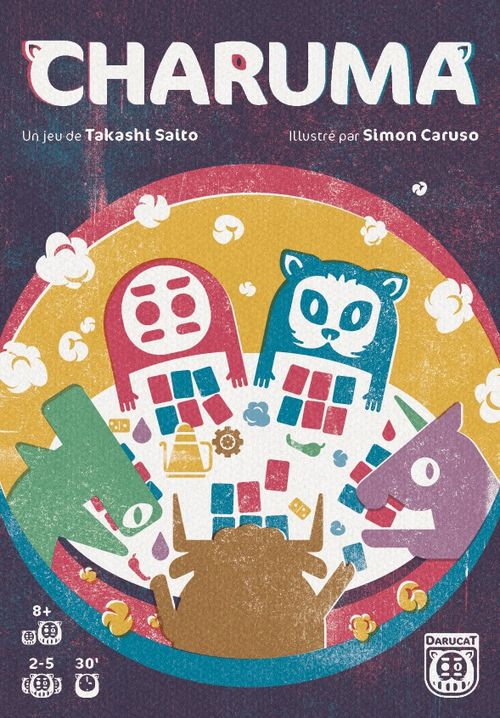
Charuma
Charuma Rulebook
Table of Contents
Table of Contents
Components
- 40 cards showing blue Cats and red Darumas, numbered from Ace (A) to 10. There are two copies of each card.
- 5 Player Aids.
- 1 Charuma token for the First Player.
- 5 Bid tokens with a value of 0.
- 55 Victory Points tokens.
In Japan, a Daruma is a papier-mâché doll depicting a Buddhist monk. Its purpose is to help you achieve a goal. After defining your goal, draw an eye on your Daruma and keep it in full view until you reach it. Then draw on the other eye, restoring the Daruma's sight as a sign of gratitude.
Aim of the Game
Keep playing rounds until someone reaches the score required to end the game. Whoever has the most points at the end of the game wins.
Setup
Deck preparation:
- 2 players: Remove all cards numbered 2, 3, 4 and 5.
- 3 players: Remove the cards numbered 4 and 5.
- 4 or 5 players: Keep all the cards.
Each player receives:
- 5 points (three 1-point tokens and one 2-points token).
- A Bid token and a Player Aid in its colour.
- Then randomly determine who will start the game and give them the Charuma token.
Starting the Round
- Shuffle the cards and deal 2 cards face down to each player. (Players can look at their cards).
- Then deal groups of 6 cards (1 group per player) face up in the middle of the table. For a 5-player game, deal out groups of only 5 cards.
- Set aside the remaining cards until the next round.
Bidding Phase
During the bidding phase, each player must bid their victory points to claim a group of face-up cards. For all bids, the minimum bet is 0 pt with the Bid token, and the maximum bet is 5 pts.
The First Player bids first. Then, proceeding clockwise, each player must bid for:
- A group of cards without an existing bid.
OR
- A group of cards with an existing bid, by raising that bid. The outbidded player takes back their points. They will have to bid again when it is their turn to play.
The bidding phase ends when everyone has placed an uncontested bid. All bidded points are lost. Everyone collects their designated group of cards, which they lay face up in front of them.
Example: Bidding Phase
Owl bids 1 pt for the middle group.
Gear bids 0 pt for the leftmost group.
Coffeepot bids 2 pts for the middle group. Owl retrieves what they had bid.
Owl then opts to bid 0 pt for the rightmost group.
Now that everyone has a settled bid, this phase is complete.
Advice: Play a trial round ignoring the bidding phase. This will give you a clearer understanding of the card values and the number of points in play each round, before moving on to actually bidding points. For this trial round, randomly pick a group of face-up cards.
Feel free to play some more rounds without bidding. You can even play full games without bidding. This makes Charuma a more family-friendly game, with a little less control over the gameplay.
Trick-Taking Phase
Continue playing tricks until you have no more (hidden or open) cards in hand.
The First Player starts (or "leads") the first trick by playing from their hand:
- 1 (red or blue) card.
OR
- 2 cards with the same value, forming a pair. This pair can be red, blue or two-tone.
Then, proceeding clockwise, the other players must play:
- The same number of cards.
- If you have an open card or pair of the led colour in your hand, you must play it.
- If you do not have the led cards open in your hand, you may play any cards you want, with no colour restrictions. But you cannot win the trick.
- You can always use hidden cards to follow the led colour.
- You are not obliged to play a higher value card (or pair).
Example: Trick-Taking Phase
Owl plays a two-tone pair of 8s.
Coffeepot does not have an open two-tone pair in her hand. She must therefore play any 2 cards (with no restrictions), but cannot win the trick. If she can form a two-tone pair using her hidden cards, she is free to play it.
Gear has an open two-tone pair of 6s in his hand. He must play that pair. If he is able to form another two-tone pair with his hidden card, he can choose which pair to play.
Important note: You are not allowed to look at cards played during previous tricks.
Winning a Trick
When everyone has played, the highest-value card (or pair of cards) of the led colour wins the trick.
In the event of a tie, the card (or pair) played last wins the trick.
The Ace (A) is the weakest card (= 1) unless the trick also contains a 10 of the same colour, in which case, the Ace becomes the strongest card (= 11).
Similarly, a pair of Aces beats a pair of 10s with the same colours.
Whoever won the trick plays first the next trick.
Example: Winning a Trick
Gear plays a red 5.
Coffeepot plays their red Ace.
Owl plays their red 10.
Coffeepot wins the trick with her Ace which was promoted by the 10.
If Owl had played their red 2, Gear would have won the trick with his 5.
The example would be the same with pairs. Against a pair of 10s, a pair of Aces of the led colour would have won the trick.
End of Round
The round ends when players have played all their cards. Scores are determined by adding up the points from tricks and bonuses:
Points from tricks:
- 1 trick = 1 pt.
- 1 trick won with a pair = 2 pts.
Tip: You can easily count points from tricks by counting the cards as follows:
- With 2 players: 2 cards = 1 pt.
- 3 players: 3 cards = 1 pt.
- 4 players: 4 cards = 1 pt.
- 5 players: 5 cards = 1 pt.
Bonus points:
- For each Ace in your tricks: +1 pt.
- For the person who won the last trick: +2 pts.
Each player takes their victory points from the reserve. Pass the Charuma token to the player with the fewest points in the game and in case of a tie, to the nearest tied player clockwise.
Note that the last trick often scores more points: the points for the trick, 2 pts bonus for the last trick, and there are often still Aces in play.
Scoring Example
Note that there is no need to keep won tricks separately. In a 3-player game, you score 1 pt per 3 cards.
- Gear — Tricks: 4 pts; 2 Aces: +2 pts. Total: 6 pts.
- Coffeepot — Tricks: 3 pts. Total: 3 pts.
- Owl — Trick: 1 pt; 1 Ace: +1 pt; Last trick: +2 pts. Total: 4 pts.
End of the Game
Keep playing rounds until someone triggers the end of the game by reaching the score shown below:
- 2 or 3 players: 25 pts.
- 4 or 5 players: 20 pts.
Whoever has the most points at the end of the game wins. In the event of a tie, play one more round.
Player Aid
Setup
Deck preparation:
- 2 players: Remove all cards numbered 2, 3, 4 and 5.
- 3 players: Remove the cards numbered 4 and 5.
- 4 or 5 players: Keep all the cards.
Each player receives:
- 5 pts (three 1 pt tokens and one 2 pts token).
- A Bid token and a Player Aid in its colour.
- Then randomly determine who will start the game and give them the Charuma token.
Start of Round
- Deal 2 cards face down to each player.
- Deal groups of 6 cards face up (1 group per player). For a 5-player game, deal out groups of only 5 cards.
- The First Player starts the bidding and then starts the trick-taking phase for the round.
End of Round
- Pass the Charuma token to the player with the fewest points in the game and in case of a tie, to the nearest tied player clockwise.
Notes
- An Ace is worth 1, unless played against a 10 of the same colour, in which case, it is worth 11.
- In the event of a tie, the card (or pair) played last wins the trick.
- If your hand includes open cards of the led colour, you must play that colour.