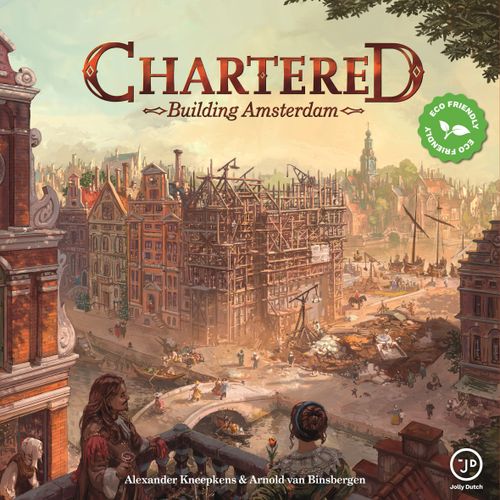
Chartered: Building Amsterdam
Chartered: Building Amsterdam Rulebook
Table of Contents
Table of Contents
Game contents
- 4 Boards
- 1 Stock chart
- 9 Sets of 9 stock cards, 1 stock token and 1 HQ
- 62 Normal warehouses
- 10 Broken roofs
- 114 Building cards (made up of building plot cards and level cards)
- 15 Stock events cards
- 10 Action cards
- 150 Money tokens
- 2 Punchboard helpers
Aim of the game
In Chartered: Building Amsterdam, you will build warehouses to found chartered companies. Throughout the game you will be able to buy stocks in these companies. As you expand the companies, their value grows. At the end of the game, the combined value of all your stocks and cash will determine who is richest - and therefore, the winner of the game!
Setup
To play Chartered: Building Amsterdam, we distinguish between beginning players and advanced players. For the first few games we suggest to strictly follow the setup guidelines set out below. After you have gotten used to the game mechanics, please feel free to adjust any of the starting conditions such as the placement of the boards.
- The first step in the setup is to take all four boards from the box and place them together as indicated in the overview. (For additional board setups, please check the overviews at the end of this rulebook.)
- Take all warehouses and place them within reach of the players. You don't need to evenly divide them, as anyone can take any warehouse that hasn't been placed on the board yet.
- Place the stock chart next to the board in a convenient way. At least one player should be able to easily reach it to keep track of all company values.
- Take all building cards and separate out the level cards. Take four level cards: one fourth level, one third level and two second levels. Shuffle these four and set them aside by placing them face down next to the stock chart to be used for stock events.
- Shuffle the stock event cards and place them as a deck face down next to the stock chart and the four face down level cards. In a two player game, take the top two stock event cards and place them face up next to the deck. In a three to five player game, add a third card.
- Dependent on the number of players, deal each player a number of building plot cards (while still keeping all level cards separate) and give them a starting capital. The overview indicates the numbers.
- Take the building plot cards that have not been dealt to players, shuffle in all level cards except for the four that are set aside with the stock chart. These cards will form the face down building card deck. Place the deck next to the boards and take the top five cards to form a face up open market.
- Hand each player two action cards. Players place these in front of them.
- Separate out each of the nine stock cards per company and create a deck per company. On top of these stock cards, place the stock token of this company and the headquarters (HQ) of this company.
- All money that has not been used for the starting capital of the players is used to form the bank. This pile of money must be visible to all players and all players can add to or take from it as needed during the game.
- Place the broken roofs within reach of all players.
Randomly select a starting player (or decide who begins as a group). You are now ready to begin!
| Number of players | Starting hand | Starting capital |
|---|---|---|
| 2 | 10 cards | f350 (3x f50, 2x f100) |
| 3 | 9 cards | f300 (2x f50, 2x f100) |
| 4 | 9 cards | f300 (2x f50, 2x f100) |
| 5 | 8 cards | f250 (3x f50, 1x f100) |
Quick overview
Players take their turns in clockwise order until the game ends - when one of the players places the last available warehouse on the board. Every turn a player either purchases cards to add to their hand, or plays card(s) from their hand to build a warehouse and receive a payout.
Any time the value of a company on the stock chart changes (this can be up or down), the player who caused the change receives the new value of the company as a payout (regardless of their existing stock holdings in the company). Using level cards makes companies grow faster. Mergers can expedite the growth even more, or have one company be absorbed by another company.
At the end of the game, all your stock value and cash is added together to determine your final net worth. The richest player wins!
Companies in the game: Gunpowder, Coal, Porcelain, Silk, Spices, Sugar, Herring, Tea, Tabacco (Tobacco).
Each building plot card shows a building plot number (indicating where on the board you can build a warehouse) and a district icon (referring to one of the four boards).
A player's turn
On your turn, you can choose one of three options:
- Purchase new building cards (drawn from the deck or selected from the open market) to your hand.
- Play a building card from your hand.
- Sell up to two stocks you own.
The first option is rather short, the second option however is where difficult choices have to be made. The third option is a fall back that you will want to avoid.
Turn option 1: Purchase new building cards
Although players start with a certain number of building cards, they will have to get new cards throughout the game. A player may therefore use their turn to purchase new building cards. The standard purchase option is to pay f50 to the bank and take two new building cards. These building cards may be taken from the face down building card deck, the open market, or one from each. If there is a level card in the open market and the player wants to take it, you are only allowed to take that one level card instead of two cards. If you take one or two cards from the face down deck and they are level cards, you're in luck as you don't have to show your cards to the other players (and they will not know if you got level cards or building plot cards).
When a player takes one or more cards from the open market, those cards are replaced with the top card(s) of the market deck at the end of that player's turn.
All cards purchased are added to your hand and you do not have to show them to others. However, note that there is a hand maximum of 15 cards, and you cannot discard cards from your hand. So, if you have 14 cards in your hand and decide to purchase new cards, you can only purchase one card. If you already have 15 cards in your hand, you are unable to purchase any new cards.
Refreshing the open market
Instead of the standard purchase option, you can pay f100 to the bank. If you do so take the entire open market and shuffle these cards back into the deck. You then draw a new open market. Only after that, do you decide which cards you want to take from the (new) open market or draw deck.
End of your turn
If you chose to purchase new building cards in your turn, it is the only thing that you do in that turn. You do not get to purchase stock cards or play building cards. After your purchase, your turn ends.
Turn option 2: Play a building card
You can use your turn to play a single building card from your hand. This can be a building plot card or a level card. Place the card face up on the discard pile, then take a warehouse and place it on the board at the location written on the card you played. There are four potential outcomes:
- A. You found a new company.
- B. You expand an existing company.
- C. You merge two or more companies.
- D. You build a warehouse that is not connected to anything else.
Founding a company, in short: 1. Discard building plot card and place a warehouse. 2. Place company headquarters. 3. Place stock token on stock chart. 4. Receive payout. 5. Buy or sell stock.
A. Founding a new company
You found a new company when the warehouse you build connects to one or more warehouses already on a board, and the warehouse(s) on the board did not already form a company. Normally this means that if there is a single warehouse somewhere on the board and you build a warehouse (vertically or horizontally) next to it you found a new company. Sometimes there might be two or more non-connected warehouses and your newly built warehouse connects them together, thereby founding a new company with more than two warehouses.
Note that you can only found a new company if there is at least one company headquarters (HQ) available to be placed on the board.
When you found a new company, you take the HQ of the available company you founded and place it on top of the warehouse you just built. This HQ is purely decorative, it does not represent any value but is meant to indicate which company the connected warehouses belong to.
You then take the stock token of the founded company and place it on the stock chart. The placement of the token depends on the number of (normal) warehouses in the company: a standard newly founded company will consist of two warehouses. Each warehouse in the company represents f10 in value. So a standard newly founded company will be worth f20 on the stock chart, and founding with more warehouses will be worth more.
Example: Bernadette, on her turn, decides to start a company. She discards card C1 to build a warehouse at that location, connecting warehouses B1 and D1. She chooses the coal company and takes the corresponding headquarters and places it on the warehouse. Because the company is founded with three warehouses, the value of the company is f30. Bernadette places the stock token at f30 on the stock chart. She receives a payout of f30 for building the warehouse. Because she built a warehouse she gets to trade at the end of the turn. She chooses to buy two stocks in the coal company. Since she founded the company this turn she gets a discount and buys them for f30 each.
There are two special situations possible when you found a new company:
- Founding a company diagonally. If you build a warehouse that is diagonally adjacent from an existing warehouse, you can still (as an exception) found a new company. You build your new warehouse and take the HQ that you want, you then place the HQ on one of the two available building plots that would connect the existing warehouse and your newly built warehouse. You can decide which plot to use. The HQ that is placed here is just a placeholder that does not represent value, the building plot underneath can still be used. If the building plot underneath is built, a warehouse is added under the HQ.
- Founding a company with two cards. Founding a new company is the only situation in the game where you are allowed to play two building cards from your hand if it means that you get to found a new company (so this is an exception!). Even if that would result in the above mentioned diagonal founding situation. However, you may not play two cards to found a new company if just playing one of them would already have been enough to found a new company. The idea is to make it easier to found a new company, not to give you a larger than necessary head start.
Spacing
Whenever you want to found a new company, you need to check that the newly founded company has enough free space around it. All buildings of the new company must be at least 2 plots away from any other company building. This is to prevent the companies from being merged within 1 player's turn.
Payout
Anytime you change the value of a company in this game, the player that caused the change receives a payout: the new value of the company. This means that in a standard 'founding a new company' situation where two warehouses form a new company, the founding player caused this new value; and therefore receives f20 from the bank.
Stock trading
Whenever you have built a warehouse, you can trade up to two stocks. That means you can buy two new stocks in any (available) company, sell two of your own stocks, or buy one and sell one. Normally, the minimum value of a stock is f50 as highlighted on the stock chart. This means that if you purchase two stocks in a company that is actually worth f40, you still have to pay the minimum of f50 per stock so a total of f100 for the two stocks.
When you found a new company, you get a small advantage: only on this turn you are allowed to purchase up to two stocks in the newly founded company at its true value instead of the minimum f50.
NOTE: Buying or selling stocks does not change the value (or worth) of a company.
After having built a warehouse, receiving the payout and potentially trading stocks, your turn ends and the next player is up.
B. Expanding an existing company
You expand an existing company when you place a warehouse on a building plot that is connected horizontally or vertically to an existing company. If this is the case, you add new value to the company. Each warehouse is worth f10, meaning your new warehouse adds f10 in value to the company on the stock chart. Should your new warehouse also connect other warehouses to the company, each warehouse adds f10 to the company on the stock chart.
And seeing as your action resulted in a new value for the company on the stock chart, you receive a payout equal to that new value.
NOTE: a company can never grow beyond the value of f300. If you expand a company that is already worth f300, your action does not result in a changed value and therefore you DO NOT receive a payout.
Finally you get to trade (buy or sell) up to two stocks in any available company.
Example: Arnold discards C2 so he can build a warehouse to expand the spice company. The spice company will rise f10 in value on the stock chart. Since the value changed Arnold receives f70 for building.
Level cards
Instead of a building plot card, you can play a level card by discarding it face up on the discard pile. The level card indicates if it is a second, third or fourth level building card. If you play a second level card, you get to take a warehouse and place it on top of any warehouse on the boards that does not already have levels on top. Note that an HQ is not a level, if you play a second level on a warehouse that has an HQ you simply place the new warehouse under the HQ.
A third level card can only be played if there is already a second level somewhere on the board. A fourth level can only be placed on top of a third level. Note that for clarity, HQ's should always be on top.
Leveled warehouses represent a higher value than normal warehouses. A second level will add f20 to that company, a third will add f30 and a fourth will add f40. Remember though that there is a maximum value of any company at f300.
After playing a level card, you will still get a payout and can still trade up to two stocks in any available company.
Keep in mind spacing when founding a new company.
C. Merging two or more companies
You merge two or more companies when you play a building plot card that will make you place a warehouse that connects two or more companies together. In a standard situation, a merger will happen between two companies: one warehouse connects two companies that are next to each other. The warehouse that connects the two companies first adds its value of f10 to one of the two companies: you as the player that placed it gets to decide to which company this value is added on the stock chart.
You then check the stock chart to see which company is worth more than the other. The higher valued company will consume the lower valued company. Should there be a tie, the player that caused the merger decides which company will consume which.
All players may now sell their stocks in the lower company back to the bank, with each stock selling at the current value on the stock chart. Players may choose to hold onto their stocks (if they think someone will found that same company again) but they will have no value if the company is not founded again. The sold stocks are returned to their deck. The HQ of the lower company is removed and placed on the stock deck. The value of the lower company is then added to the value of the higher company (again: not beyond f300) and the stock token of the lower company is removed from the stock chart and placed on the stock deck.
The player that caused the merger, caused the new value of the higher valued company, and therefore receives the new value of that company as their payout. They then get to trade stocks as usual.
Example (Merge 1): Anke is the one who builds the warehouse and can choose which company it initially belongs to. She chooses the tea company. This makes the tea company worth f60 and the value of the gunpowder company stays at f50. Tea takes over gunpowder. Shares in gunpowder can be sold for f50 and the HQ and stock token are removed. Tea increases in value by f50.
Exceptional situation: if a company merges that still has a diagonal connection through its HQ from when it was founded, and it breaks up the company when its HQ is removed when it's the smaller in the merger. The HQ is still removed, but you place an upside down warehouse in its place. This is a placeholder to indicate that the company is still connected and the card corresponding to the building plot can still be played.
Merging more than two companies at once
Should the placed warehouse merge three or even more companies, the two lowest valued companies merge first. Then the remaining two (or next two lowest) merge. In case of a tie, the player that caused the merger decides.
Example (Merging multiple companies): Anke decides to play building card F3 and builds a warehouse there. As a result, 3 different companies merge. Merge 2: Tea is now worth f110, porcelain is worth f80. Tea is now also taking over porcelain. Shares of Porcelain can be sold and the HQ and stock token will be removed. Tea increases f80 in value. Anke now receives f190 for building the warehouse. Because the tea company has crossed several event lines on the stock chart, one event is dealt with at the end of her turn (see Stock events).
D. Building a warehouse that is not connected to anything else
You are allowed to simply build a warehouse that is not connected to any other warehouse. You will not receive a payout though, as your action does not result in a new value for a company. You are allowed to trade stocks as usual.
Other playing building cards notes
- Each building plot card is unique.
- Warehouses are considered to be connected to each other if they are horizontally or vertically adjacent, not if they are diagonally adjacent.
- Building plots with a bridge in between them are considered connected.
- Each warehouse represents f10 unless it is a level, in which case it represents f20, f30 or f40.
- No company can grow beyond f300. When you expand a company that is already f300, you do not get a payout but you can still expand it.
Turn option 3: Sell up to two stocks
Instead of purchasing new cards or playing a card, a player might choose to use their whole turn to simply sell up to two stocks they own. This might be useful to save up money for a strategic move in a next turn, or a player might not be able to (or want to) use one of the other options in their turn. The stock (or stocks) is sold at the value of the corresponding company on the stock chart.
After selling up to two stocks, your turn immediately ends. You are not then able to build anything or buy anything.
Game end
When the last warehouse is placed the end of the game is triggered. The active player can finish their turn and then end game scoring will start. The HQ's of companies that are available for founding do not count.
Starting with the lowest valued company on the stock chart, all stocks are sold back to the bank at their current value. The richest player wins and is the wealthiest merchant of Amsterdam.
If there is a tie, the player with the fewest building cards in their hand wins. If there still is a tie, these players share the victory.
Stock events
Next to the stock chart, there are stock events. These events are linked to the special lines found on the stock chart: whenever a company grows and passes a line, a stock event is activated (so there is no event if a company decreases in value). The player that causes the company to pass the line gets to decide if one of the open stock events is used, or if the event is drawn from the stock event deck. Note that they only decide on the event (and deal with the event) at the end of their turn. After dealing with the event, the event card is discarded to an event card discard pile. If the chosen event was from the open stock events, there is a new event card drawn to replace it. If the event card deck runs out, shuffle the discard pile to form a new deck.
There are two mechanisms within the stock event cards that warrant further explanation:
Bidding mechanism: every player takes an amount of 'florijnen' of their own choice from their own stash into their hand without the other players seeing it (the amount can be zero). They keep their hand closed and stick it out in front of them until every player has decided and stuck out their hand. All players then simultaneously show their bid. Who 'wins' depends on the event card. There can be only one 'winner' of a bid. If there is a tie for the win, these players pay their bid to the bank and only these tied players bid again. This continues until there is a winner.
Auction mechanism: the player that activates the auction, is called the active player. The active player verbally states their bid, then all other players one-by-one state a higher bid or say that they pass. The bidding continues in clockwise order (including the active player) until all players but one pass. The player with the highest bid wins the auction.
There are five different stock event cards (old Dutch names, and mechanism):
- Verlappen (Bidding): The player with the highest bid receives a second turn right after their next turn. This bid is paid to the bank, the others keep their bid.
- Aenleggen (Bidding): The player with the highest bid receives the top level card from the stock-chart level deck and adds it to their hand. This bid is paid to the bank, the others keep their bid.
- Dreighinghe (Bidding): The player with the lowest bid loses two stocks of their own choice. All players pay their bid to the bank.
- Coopmanscappen (Trading): The active player may trade with other players. This can for instance be trading/buying/selling building cards and stocks. There is no limitation on price.
- Veilinge (Auction): The active player picks one of the four auction options:
- Auction off one stock of a company of your choice (that is still available in the bank). The winner gets this stock from the bank and their bid gets paid to the bank.
- Auction off one of your own stocks. You receive the payment but cannot participate in the auction.
- Auction off the opportunity to take the top ten building cards from the closed deck and pick one of them to add to your hand. The other nine cards are returned to the deck and the entire deck is shuffled. The winner has to perform this action right away and their bid is paid to the bank.
- Auction off the opportunity to take one of the ten most recent plot cards (so no level cards) on the discard pile to your hand. The corresponding built warehouse is removed from the board and the company therefore loses f10 in value. NOTE: the removal is not possible if this would lead the company to split into two separate parts, and it's not possible to remove a warehouse that has two or more levels. The winning bid is paid to the bank.
Action cards
At the start of the game, players received two action cards. These have no effects on their own, they are simply indicators. Each represents one special action you can take, but you have to pay to use this action. Specifically, instead of trading stocks after building a warehouse, you may choose to pay f100 to use one special action. You discard one of your action cards to the box and choose one of two options: 1) get a broken roof, or 2) activate a stock event. If you have used both action cards, you cannot pay for a third action.
1) Broken roofs
If a player uses an action card to take a broken roof, they place it in front of them. When they play a building card (plot or level) in a later turn, they can take this broken roof and place it on the warehouse they build. However, instead of adding the normal f10 in value (or more in case of a level), the broken roof deducts f50 in value from the company on the stock chart. The player still receives the new value as a payout. Note that a company cannot drop below f20 on the stock chart.
2) Stock events
Alternatively, a player that purchases an action card, can use it to immediately (on that turn) activate a stock event. The player can choose one of the open stock events or draw the top one card from the stock event deck. The stock event is immediately dealt with as described in the stock events chapter.
Alternative board setups
Once you've mastered the game, feel free to move around the boards. Examples of interesting set ups can be found in the rulebook's overviews: Variant A: Quick battle, Variant B: Crossroads, Variant C: Outliers. (These are board layout diagrams only.)
Quick reference
Player's turn
Choose one of the three options:
- Purchase new building cards (drawn from the deck or selected from the open market) to your hand for f50. Or pay f100 to refresh the open market and then draw/select your cards.
- Play a building card from your hand.
- Sell up to two stocks you own.
When you play a building card from your hand, follow these steps:
- Discard your building card
- Place a warehouse
- Resolve, if there are any, any mergers or foundings
- Receive your payout
- Buy or sell up to two stocks
Founding a new company
- Discard your building plot card(s)
- Place a warehouse (or two if you use the exception)
- Place the company headquarters on top of your newly built warehouse
- Place the stock token on stock chart
- Receive the payout
- Buy or sell up to two stocks
Note that if you found a new company, on your turn you can purchase up to two stocks in that company for the actual value instead of the minimum of f50.
Merging two or more companies
When playing your building card results in two or more companies becoming connected, they merge. Follow these steps:
- Discard your building card
- Place a warehouse
- Add the value of the warehouse to one of the connected companies, increasing its value on the stock chart
- Check which company has the highest value, it will consume the smaller company. In a tie the active player decides which is the higher value one.
- All stocks players have in the smaller company may be sold to the bank at the actual value.
- Add the value of the small company to the larger company on the stock chart.
- Remove the smaller company's stock token from the stock chart, and place it on the stocks of the company together with the HQ.
- Receive your payout: the new value of the larger company.
- Buy or sell up to two stocks.
Action cards
Instead of buying or selling stocks at the end of your turn, you may activate one of your action cards for f100. You then choose one of two options:
- Get a broken roof: Take a broken roof to use in a later turn. You can add this to a warehouse you build in the future. Adding the broken roof will deduct f50 from the company that the warehouse is added to, instead of the value of the warehouse.
- Activate a stock event: Choose a stock event from the open market or the top one from the event deck to activate immediately.