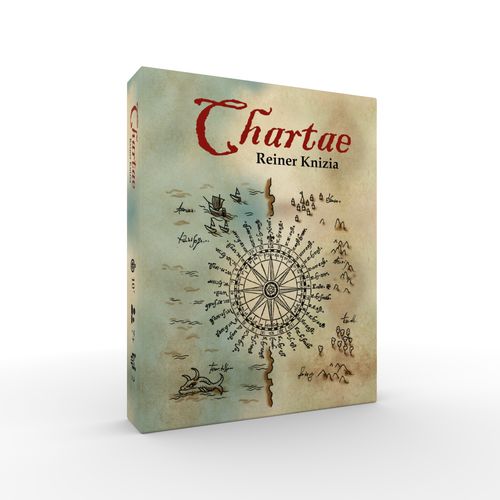
Chartae
Chartae Rulebook
Table of Contents
Table of Contents
Components
- 9 map tiles
- 1 set of rules
Each map tile shows both a land zone and a sea zone. One of the 9 tiles also bears a compass rose (wind rose).
Game Idea
You have discovered an old map, and now you debate its reconstruction. Who is entitled to which territory? The winner is the player who, at the end of the game, can claim the most map tiles for their own territory — land or sea — on a map that is 3x3 tiles in size.
Setup
- Decide which territory each of you will play (land or sea).
- Place the map tile with the compass rose in the middle between you. It may be placed in any orientation.
- Shuffle the remaining map tiles and form a face-down stack with them.
- Determine who begins the game.
- Reveal the top map tile from the stack.
Gameplay
The game is played over several rounds, until a complete map of 3x3 map tiles has been laid out. Each round, you take one turn each, in alternating order.
On your turn, you perform one of the following two actions:
1. Rotate
Rotate 1 map tile in the display 90 degrees clockwise.
- The Rotate action may not be performed more than 2 times directly in a row, regardless of which map tile it is applied to.
- If Rotate was performed on 2 consecutive turns, then Place must be performed on the next turn.
2. Place
Take the face-up map tile from the stack into your hand, immediately reveal the next tile on the stack, and add the tile from your hand to the map in the middle.
- Map tiles must be placed edge to edge within a 3x3 grid (it is not allowed to place more than 3 tiles in width or height). The compass rose does not have to lie in the middle of the map.
- Each new map tile must touch at least one edge of a tile already in play.
- The land or sea territories do not have to be connected matchingly when placing.
After you have performed 1 action, your turn is over and your opponent takes their turn.
Continue playing until the tile stack is used up and a map of 3x3 map tiles has been formed.
Placement Example
All map tiles that have been placed against the edge of another map tile lie correctly. A tile that does not touch the edge of any other tile may not be placed there.
Game End and Scoring
As soon as the map of 3x3 tiles is completely laid out, you determine, for each territory, the largest group of connected map tiles. Map tiles count as connected when they lie edge to edge without interruption and, at their shared edge, show the same territory (at least partially). Tiles that meet only at a corner do not count as connected.
The player who has the most map tiles connected together in their own largest territory wins.
In the case of a tie, the player who placed the last map tile loses.
Scoring Example
The land territory (white) has 5 map tiles connected together in its largest contiguous area; the sea territory (blue) has 6 map tiles connected together in its largest contiguous area. The sea territory wins. The two further land areas, each with 2 connected tiles, do not matter.